Week 11 · Day 3 Practice Pages
Practice page · Week 11, Day 3
Mathematics
I can divide by 6 and 7 using the matching multiplication facts.
Look: 54 ÷ 6 and 49 ÷ 7
- Ask: 6 times what is 54? 6 × 9 = 54.
- So 54 ÷ 6 = 9.
- For 49 ÷ 7, think 7 × 7 = 49, so the answer is 7.
Solve each fact. Write the multiplication check beside it.
- 1.
12 ÷ 6 = ____
- 2.
36 ÷ 6 = ____
- 3.
6 ÷ 6 = ____
- 4.
14 ÷ 7 = ____
- 5.
7 ÷ 7 = ____
- 6.
35 ÷ 7 = ____
Solve the problem. Write the division sentence.
- 7.
Ravi has 49 photos. He puts 7 photos on each page. How many pages does he fill?
Challenge: Which is greater, 42 ÷ 6 or 42 ÷ 7?
Materials: multiplication chart
Practice page · Week 11, Day 3
English Language Arts
I can write dialogue that has a job.
Look: Dialogue with a job
- Dialogue is what characters say out loud.
- Good dialogue shows a character, moves the story or shares information.
- A character may talk like a real person ('Yeah, I'm gonna try!'), but the rest of the story uses standard written English ('Yes, I am going to try.').
The Locked Shed
Malik tugged at the shed door. "It's locked, and our bikes are inside," he said. His little sister Ivy sat down on the step. "Hi," she said. "Hi," said Malik. Then Ivy jumped up. "Wait! Mom hides a key under the flowerpot!" she shouted. "You're a genius!" Malik laughed.
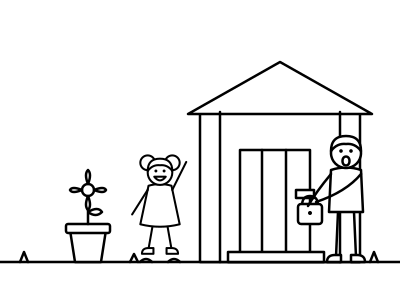
Use the story above.
- 1.
What information does Malik's first line share?
- 2.
Cross out the two lines that have no job.
- 3.
How does Ivy's shout move the story forward?
- 4.
What does "You're a genius!" show about Malik?
- 5.
Malik might say, "I'm gonna ride now." How would the narrator write it in standard written English?
Drop the e, then add the ending.
- 6.
hide + ing → ____
- 7.
share + ed → ____
- 8.
write + ing → ____
Challenge: Write a line Ivy could say next that moves the story forward.
Practice page · Week 11, Day 3
Science
I can name a body feature that helps an animal or plant survive and explain how it helps.
Beak test. Count how many pieces each tool moves in 20 seconds.
| Beak tool | Seeds | Floating food |
|---|---|---|
- 1.
Which tool was best for the seeds?
- 2.
Which tool was best for food floating in water? What real bird beak is it like?
Write how each body part helps.
- 3.
A woodpecker has a strong, pointed beak.
- 4.
An arctic hare has white fur in winter.
- 5.
A cactus has a thick, waxy stem.
- 6.
A camel's hump stores ________.
○ water○ fat○ sand
Challenge: A physical adaptation is a body part or feature. Invent one for a bird that eats nectar deep inside flowers.
Materials: tweezers, a clothespin, a spoon and chopsticks · a dish of dry rice or beans and a bowl of water with floating cereal · a timer
Practice page · Week 11, Day 3
Social Studies
I can describe the land, farming and cities of the Midwest and explain why it is called America's Breadbasket.
The Breadbasket
The Midwest sits in the north-central part of the country. Much of the land is flat or gently rolling, and the soil is deep and rich. Farmers plant miles and miles of corn, wheat and soybeans. That grain becomes bread, cereal and food for farm animals. Big cities such as Chicago and Minneapolis grew near lakes and rivers. Summers are hot, and winters are cold and snowy.
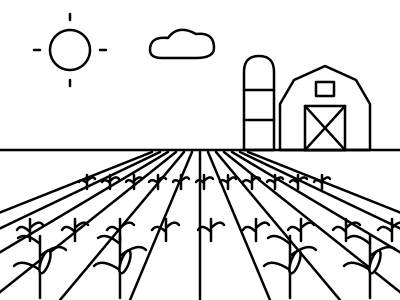
Read about the Midwest. Answer each question.
- 1.
Name two crops that grow in the Midwest.
- 2.
Why is the soil good for farming?
- 3.
Name one big Midwest city.
- 4.
Why is the Midwest called America's Breadbasket?
Label detective: read the label on a bread bag or cereal box. Fill in the chart.
| Food | Grain on the label |
|---|---|
- 5.
Which grain did you find on the label?
- 6.
Could that grain grow in the Midwest?
Challenge: Why is flat land good for big farms?
Materials: a bread bag or cereal box