Week 12 · Day 3 Practice Pages
Practice page · Week 12, Day 3
Mathematics
I can solve grouping word problems where I find how many groups there are.
Look: 40 kids make teams of 5. How many teams?
- We know the size of each group, so divide: 40 ÷ 5 = ?
- Skip count by 5 to 40: 5, 10, 15, 20, 25, 30, 35, 40.
- That is 8 jumps, so there are 8 teams.
Write an equation, skip count to check and answer in a sentence.
- 1.
Mei packs 32 eggs, 8 in each carton. How many cartons?
- 2.
Kai sets 42 chairs in rows of 7. How many rows?
- 3.
Zainab has 20 shoes. How many pairs is that?
- 4.
Omar has 54 cards and puts 9 in each pack. How many packs?
Circle sharing or grouping.
- 5.
27 bananas, 3 in each bunch. How many bunches?
○ sharing○ grouping - 6.
27 bananas shared equally by 3 monkeys. How many each?
○ sharing○ grouping
Challenge: Both banana problems above have the same answer. What is it, and why are they still different?
Materials: counters · small cups
Practice page · Week 12, Day 3
English Language Arts
I can choose an ending that solves the problem.
Look: Strong endings
- An ending can be happy, sad, surprising or open-ended.
- A strong ending solves the problem and fits the story.
- Show how the character feels or changed with a body clue or dialogue.
The Spelling Bee
Rosa practiced her spelling words every night for a month. On the day of the school spelling bee, her hands shook as she stepped up to the microphone. "Your word is 'volcano,'" said the judge. Rosa closed her eyes and pictured the word on her flash cards.
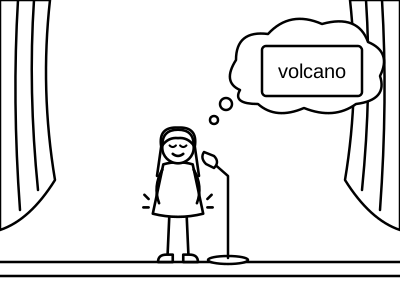
Use the story above.
- 1.
Which ending fits the story better?
○ A: Rosa went home.○ B: "V-O-L-C-A-N-O," Rosa said. The crowd cheered, and her hands finally stopped shaking. - 2.
Why is that ending better?
- 3.
What kind of ending is B?
○ happy○ sad○ open-ended - 4.
Write a surprising ending for Rosa's story.
Add -ed or -ing. Use the rules you know.
- 5.
stop + ed → ____
- 6.
hide + ing → ____
- 7.
smile + ed → ____
Challenge: Write an open-ended last line for Rosa's story.
Practice page · Week 12, Day 3
Science
I can connect several food chains into a food web.
A Pond Food Web
Pond food web arrows: algae → tadpole, algae → snail, water plants → snail, water plants → duck, tadpole → fish, tadpole → heron, snail → fish, snail → duck, snail → raccoon, fish → heron, fish → raccoon. The sun gives energy to the algae and the water plants.
Use the pond web arrows to answer.
- 1.
How many arrows point into the heron?
- 2.
Which animals eat the snail?
- 3.
Write one food chain from the web that has 4 parts, starting with the sun.
- 4.
What does the snail eat?
Draw the pond web in the box. Trace 2 chains in 2 different colors.
- 5.
My pond food web
- 6.
What is the difference between a food chain and a food web?
Challenge: Why does a food web show a pond better than one food chain?
Materials: markers in 3 colors
Practice page · Week 12, Day 3
Social Studies
I can describe how Pueblo nations and the Navajo Nation adapted to the desert Southwest.
Compare a pueblo and a hogan. Fill in the chart, then answer.
| Pueblo | Hogan | |
|---|---|---|
- 1.
What is adobe?
- 2.
Why are thick adobe walls good in the desert?
- 3.
What shape is a traditional Navajo hogan?
- 4.
How is a pueblo like an apartment building?
Circle yes or no.
- 5.
People still live at Taos Pueblo today.
○ yes○ no - 6.
The Navajo Nation has its own government today.
○ yes○ no - 7.
Pueblo farmers grow corn, beans and squash with no water at all.
○ yes○ no
Challenge: Some pueblos use ladders between levels. Why might ladders be useful?
Materials: photos of a pueblo and a hogan (optional)