Week 17 · Day 3 Practice Pages
Practice page · Week 17, Day 3
Mathematics
I can decide whether to multiply or divide and solve word problems with an unknown.
Look: groups × size = total
- If the total is unknown, multiply.
- If the groups or the size is unknown, divide.
- Write an equation with a letter first, such as 5 × s = 40.
Write an equation with a letter. Then solve and label.
| Groups | Size | Total |
|---|---|---|
- 1.
8 boats carry 6 people each. How many people?
- 2.
42 kids make 7 equal teams. How many kids are on each team?
- 3.
Bao cuts a 40-inch piece of string into 5 equal pieces. How long is each piece?
- 4.
56 beads, 8 on each bracelet. How many bracelets?
- 5.
Ayesha has 4 trays with 9 cups on each. How many cups?
- 6.
30 pears go into 5 bags equally. How many pears in each bag?
Challenge: Pick one problem where you divided. How did you know to divide?
Materials: counters
Practice page · Week 17, Day 3
English Language Arts
I can take short notes in my own words and keep events in order.
Look: Read, Cover, Write
- Read one sentence.
- Cover it with your hand.
- Write the key words you remember as a short note, then check.
How a Monarch Butterfly Grows
A monarch butterfly begins as a tiny egg stuck to a milkweed leaf. Soon a caterpillar hatches and eats and eats. It sheds, or loses, its skin several times as it grows. Next, it hangs upside down and forms a hard case called a chrysalis. Inside, its body changes completely. After one to two weeks, a butterfly crawls out, dries its wings and flies away.
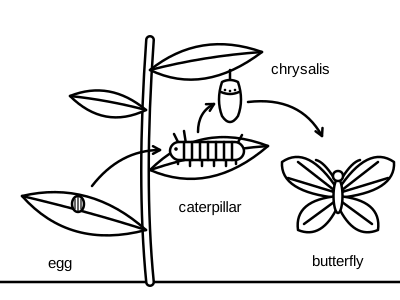
Use the passage above.
- 1.
Make a short note: 'Soon a caterpillar hatches and eats and eats.'
- 2.
Make a short note: 'Next, it hangs upside down and forms a hard case called a chrysalis.'
- 3.
What does 'sheds' mean? What clue helped?
- 4.
Number the stages in order: chrysalis, egg, butterfly, caterpillar.
- 5.
Why should notes be in your own words?
- 6.
Read the passage aloud. Did any word not make sense? Write it and tell how you fixed it.
Write the word that fits.
- 7.
Kim spoke ____ to the baby. (soft + ly)
- 8.
We could not see in the ____. (dark + ness)
Practice page · Week 17, Day 3
Science
I can show how energy moves through my model ecosystem with food chain arrows.
Write the food chains your arrows show, starting with the sun.
- 1.
Food chain 1:
- 2.
Food chain 2:
- 3.
Do any of your chains connect into a web? Where?
Show the decomposer loop.
- 4.
Finish the loop: dead leaves → ________ → soil
- 5.
Why does the loop end back at the soil?
- 6.
Terrarium only: where did you see water drops form?
Challenge: What do the arrows in a food chain show?
Materials: yarn or paper arrows and tape · sticky notes
Practice page · Week 17, Day 3
Social Studies
I can research my state's history, the Native nations whose homelands are there, and a notable person from the past.
Build a timeline for your state.
| Year | Event |
|---|---|
- 1.
A Native nation whose homeland includes my state:
- 2.
Write one present-tense fact about that nation today.
- 3.
Year my state joined the U.S.:
- 4.
A notable person from my state's history and what they did:
A local fact from home.
- 5.
In our town, ____.
- 6.
Which sentence tells about a nation today?
○ The Chickasaw Nation ran schools.○ The Chickasaw Nation runs schools.
Challenge: Why should a timeline start long before statehood?
Materials: nonfiction books or reliable websites · strip of paper for a timeline