3
    Third GradePowered by ThirdGrade.com

    Daily lesson plan

    Day 1 · Monday

    Week 18 · Building Meaning: Division, Narratives, Ecosystems & Regions

    See what your state adds or places differently

    Suggested daily schedule
    8:30–8:45 AM15 minMorning Circle / Read-Aloud / Calendar
    8:45–10:00 AM75 minEnglish Language Arts
    10:00–11:00 AM60 minMathematics
    11:00–11:15 AM15 minSnack and Movement Break
    11:15–12:00 PM30–45 minScience (every day)
    12:00–12:45 PM30–45 minSocial Studies (every day)
    12:45–1:30 PM45 minLunch and Choice Time
    1:30–2:15 PM45 minSpecials: PE / Art / Music (rotating)
    2:15–2:45 PM30 minIndependent Reading & Journaling

    Social Studies

    Objective: I can review U.S. geography and the five regions.

    Standards: D2.Geo.2.3-5, D2.Geo.10.3-5

    Builds on: Needs Week 10 (landforms and water) and Week 11 (the five regions). One-minute check: your child names the five regions. (Northeast, Southeast, Midwest, Southwest, West.)

    Materials: Blank U.S. map (or a hand-traced outline), 5 colored pencils, Region chart from Week 11, 10 index cards, Notebook, Pencil

    1. Warm-Up · 5 min

      Spaced review from Week 10. Ask: "Which mountains are older, lower and rounder: the Rockies or the Appalachians?" (The Appalachians.) Then ask the big question: "Why do places in one region look and feel alike?"

    2. Mini-Lesson · 10–15 min

      Say: "This week we review Quarter 2. Today is geography and regions." Say: "A region is a group of states that share land, climate and ways of life." Say: "Climate changes from region to region for three reasons. They are how far north a place is, how high it is, and how near the ocean it is." Show it on the blank map. Touch northern Alaska, then Florida. Say: "Far north is colder. Farther south is warmer." Now quiz with the map. Your child points and answers. "Which region has the Pacific coast, Alaska and Hawaii?" (The West.) "Which region has deep soil and huge corn and wheat farms?" (The Midwest.) "Which Great Lake lies entirely inside the U.S.?" (Lake Michigan.) "Name two states in the Northeast." (Sample: New York and Maine.) "Why is northern Alaska colder than Florida?" (It is much farther north.) If stuck, say: "Find the Mississippi River. Is the place east or west of it? Is it north or south?"

    3. Activity / Source Work · 15–20 min

      Map and clue game. 1) Your child colors and labels the five regions from memory. Then check with the Week 11 chart. 2) Your child writes two states inside each region. 3) Your child draws the Rockies as points, the Appalachians as low bumps and the Mississippi River as a blue line. 4) Write one clue on each card: Everglades, Chicago, cactus deserts, Seattle, maple syrup, Atlanta, Kansas wheat fields, Houston, Boston, Hawaii. 5) Read each card. Your child names the region and points to it. Keep a tally in the notebook: Clue | Region named | Right or not yet. Answers: Southeast, Midwest, Southwest, West, Northeast, Southeast, Midwest, Southwest, Northeast, West. Ask for evidence: "What on your map tells you that?" Expect 8 or more right. Scores vary. Look for a pattern in the misses, then replay those cards.

    4. Notebook Entry · 10 min

      Your child writes one sentence for each region: "The ___ is known for ___ and produces ___." Sample: "The Midwest is known for flat farmland and produces corn." Other samples: Northeast, big Atlantic cities, maple syrup. Southeast, warm beaches and swamps, oranges. Southwest, deserts and mesas, cattle. West, high mountains and the Pacific coast, apples.

    5. Exit Ticket · 5 min

      Put the map away. Read each exit question aloud. Praise answers that give a reason from the land or climate.

    Watch for: Confusing the Southeast with the Southwest.

    Try: Use the Week 14 rule. Say: "South plus East is the warm Atlantic side. South plus West is the dry land near Mexico." Your child traces each.

    Exit ticket:
    1. Which region touches Mexico and is mostly hot and dry?
    2. Name two states in the Midwest.
    3. Why is the climate of Maine so different from the climate of Florida?
    Show answers
    1. The Southwest.
    2. Answers vary. Look for any two, such as Illinois, Iowa, Ohio, Michigan, Kansas or Minnesota.
    3. Answers vary. Look for: Maine is much farther north, so it is colder and has snowy winters.

    Support: Give a word bank of the five region names and a map with the region borders already drawn.

    Extend: Your child adds one big city and one main product to each region from memory, then checks with the chart.

    Homework: Your child quizzes a family member with five clue cards. Look for your child explaining any missed card.

    Practice page · Week 18, Day 1

    Social Studies

    I can review U.S. geography and the five regions.

    Write the region for each clue. Use the word bank.

    Word bank: Northeast · Southeast · Midwest · Southwest · West

    1. 1.

      the Okefenokee Swamp in Georgia

    2. 2.

      the Gateway Arch in St. Louis

    3. 3.

      Mount Rainier in Washington

    4. 4.

      the Rio Grande near El Paso

    5. 5.

      maple syrup from Vermont

    Answer each question.

    1. 6.

      Which two countries border the United States?

    2. 7.

      Name two states in the Southeast.

    3. 8.

      Why are states grouped into regions?

    Challenge: On a blank map, draw the Rockies, the Appalachians and the Mississippi River. Which one runs north to south through the middle?

    Materials: blank U.S. map · colored pencils
    Mathematics

    Objective: I can use a strategy to multiply quickly with all the facts from ×2 to ×10.

    Standards: 3.OA.C.7, 3.OA.B.5

    Builds on: Review of the fact strategies from Weeks 6 to 8 and the strategy list from Week 9 Day 4. One-minute check: ask 4 × 6 and its strategy (24; double-double: 12, then 24).

    Materials: 8 index cards or paper slips, Grid paper, Notebook, Pencil

    1. Warm-Up · 5 min

      Spaced review from Week 13 Day 4. Ask 8 × 0, 1 × 9, 0 ÷ 5 and 7 ÷ 1 (0, 9, 0, 7). Then practice ×6 to ×9 facts with no clock. Ask 6 × 4, 7 × 3, 8 × 5 and 9 × 2 (24, 21, 40, 18). Your child tells the strategy for one. Any strategy that works is fine.

    2. Mini-Lesson · 10–15 min

      Say: "Speed comes from choosing a strategy, not from guessing. Let us match each hard table to its strategy." Write the list together and keep it in view. For ×6: the ×5 fact plus one more group. For ×7: 5 groups and 2 groups. For ×8: double the ×4 fact. For ×9: 10 groups minus one group. Say: "These came from Week 7 Day 3 and Week 8 Days 1 to 3." Ask: "Which strategy uses subtraction?" (The one for ×9.) Write 8 × 7. Say: "8 groups. I double the ×4 fact." Write 4 × 7 = 28, then 28 + 28 = 56. Say: "So 8 × 7 = 56." Sketch 8 rows of 7 dots with a line under row 4. Say: "8 groups is 4 groups and 4 more groups. That is why the double works." Write 9 × 6. Say: "9 groups. I use 10 groups minus one group." Write 10 × 6 = 60, then 60 − 6 = 54. Say: "So 9 × 6 = 54." Ask: "Why do I take away 6?" (10 groups is one group too many.) Ask: "Which easier tables use doubles?" (×2 and ×4. Also ×3: a double plus one more group.) Say: "For ×5 and ×10 we count by 5s or by tens. And we can always switch the factors." Now your child does more. Write 7 × 8. Ask: "Which strategy fits? Show the steps." (5 × 8 = 40; 2 × 8 = 16; 40 + 16 = 56) Ask: "Why does it match 8 × 7?" (Switching the factors keeps the product.)

    3. Guided Practice · 10–15 min

      Write each fact. Your child names the strategy first, then writes the steps and says the product in a sentence. 1) 6 × 7 (5 × 7 = 35; 35 + 7 = 42). 2) 8 × 4 (4 × 4 = 16; 16 + 16 = 32). 3) 9 × 9 (10 × 9 = 90; 90 − 9 = 81). 4) 7 × 7 (5 × 7 = 35; 2 × 7 = 14; 35 + 14 = 49). If stuck, say: "Look at the first factor. Which strategy goes with that many groups?"

    4. Independent Practice · 15–20 min

      Your child writes each fact from problems 1 to 6 on a card. The product and the strategy steps go on the back. 1) 6 × 6 (36). 2) 8 × 8 (64). 3) 9 × 4 (36). 4) 7 × 4 (28). 5) 9 × 8 (72). 6) 6 × 5 (30). 7) Your child outlines 8 rows of 6 on grid paper and draws a line under row 4. Then your child writes the double. (4 × 6 = 24; 24 + 24 = 48) 8) Solve two word problems and add a card for each. Nine teams have 7 players each. How many players are there in all? (63) Six cartons hold 9 eggs each. How many eggs are there in all? (54) Last, your child sorts the 8 cards into "know it" and "still building." Use no clock. A fact is known when the product comes without counting. Praise the strategy, not the speed. Keep the cards for Day 5.

    5. Exit Ticket · 5 min

      Cover the strategy list. Read each question aloud; your child answers on paper.

    Watch for: Guessing a nearby product instead of using a strategy, such as 48 for 7 × 7.

    Try: Slow down. Your child whispers the strategy before writing any product. For 7 × 7: "5 groups and 2 groups, 35 + 14."

    Fact fluency: ×6, ×7, ×8, ×9 facts

    Exit ticket:
    1. What is 8 × 3? Show the strategy steps.
    2. What is 9 × 3? Show the strategy steps.
    3. Which fact is still building for you? Which strategy will you use for it?
    Show answers
    1. 24; 4 × 3 = 12, and 12 + 12 = 24
    2. 27; 10 × 3 = 30, and 30 − 3 = 27
    3. Answers vary. Look for: a named fact and a strategy that fits its first factor.

    Support: Keep the strategy list in view. Work only the ×6 and ×9 cards today, and add the ×7 and ×8 cards tomorrow.

    Extend: Your child solves 8 × 8 two ways and tells which is clearer. Samples: double the ×4 fact, 32 + 32 = 64; 5 groups and 3 groups, 40 + 24 = 64.

    Homework: Your child practices the still-building cards for 5 minutes, saying the strategy first. Sample: 9 × 8; 10 × 8 = 80, and 80 − 8 = 72.

    Practice page · Week 18, Day 1

    Mathematics

    I can use a strategy to multiply quickly with all the facts from ×2 to ×10.

    Look: pick a strategy

    1. ×4 is double-double: for 4 × 6, double 6 is 12 and double 12 is 24.
    2. ×6 is double the ×3: 3 × 7 is 21, so 6 × 7 is 42.
    3. ×9 is ten groups minus one group: 10 × 8 is 80, take away 8 to get 72.

    Solve each fact. Write the strategy you used.

    1. 1.

      4 × 8 = ____

    2. 2.

      6 × 9 = ____

    3. 3.

      8 × 6 = ____

    4. 4.

      9 × 7 = ____

    5. 5.

      7 × 7 = ____

    Solve the problem.

    1. 6.

      Kofi buys 9 packs of 4 stickers. How many stickers?

    Challenge: Use double-double-double to solve 8 × 6.

    Materials: index cards

    English Language Arts

    Objective: I can review narrative writing by mapping a story I hear and writing one of my own.

    Standards: W.3.3, W.3.3.C, W.3.3.D, SL.3.2, RL.3.5

    Builds on: Needs the story arc from Week 12 Day 1 and the narrative checklist from Week 12 Day 4. One-minute check: ask, "Which part of a story is the turning point, where the problem is answered?" (The climax.)

    Materials: Notebook, Story map drawn in the notebook (characters, setting, problem, events, resolution), Pencil

    1. Warm-Up · 5 min

      Word study, 3 minutes: Unit 3 review. Write unlock, dislike, preheat, thankful, spotless, quickly. Your child sorts them into a prefix column and a suffix column. Then your child tells what each word part means. (un-: not or undo; dis-: not; pre-: before; -ful: full of; -less: without; -ly: in a certain way.) Spaced review from Week 12. Ask: "Name the five parts of a story arc." (Opening, rising action, climax, falling action, ending.)

    2. Mini-Lesson · 15 min

      Say: "This week we review Quarter 2. Today is narrative writing. A strong story has an opening, a problem that matters, rising action, a climax and an ending. The ending solves the problem. Writers add time-order words, sense details and dialogue." Read this story aloud. Your child only listens. "Nico's Window Garden" Nico planted basil seeds in an old egg carton on his windowsill. Every morning he checked them, but for a whole week nothing happened. "Maybe they're broken," he sighed. His neighbor, Mrs. Lin, leaned out of her window. "Seeds need patience, and maybe a little more water," she said. Nico watered them carefully. Three days later, he spotted tiny green loops poking through the soil. "Mrs. Lin! They're alive!" he shouted. That afternoon, he made her a thank-you card shaped like a leaf. Model the first two boxes of the story map. Say: "Characters: Nico and Mrs. Lin. Setting: Nico's windowsill, beside Mrs. Lin's window." Write them in.

    3. Guided Practice · 10 min

      1) Your child retells the story in 4 or 5 sentences from listening only. Listen for the problem and the ending. 2) Ask: "What is the problem?" (The seeds are not sprouting.) Write it on the map. 3) Ask: "What is the climax?" (Nico spots the green sprouts.) Mark it with a star. 4) Ask: "How does the story end?" (He thanks Mrs. Lin with a leaf-shaped card.) 5) Read the story once more. Your child raises a hand for each time-order phrase. (Every morning, for a whole week, three days later, that afternoon.) If stuck, say: "What did Nico want? What moment gave it to him?"

    4. Independent Practice · 20 min

      Your child writes a new short narrative of 8 to 10 sentences. Ideas: something lost and found, a plan that went wrong, or a surprise in the kitchen. 1) Plan for 3 minutes on a fresh story map. 2) Start with this frame if needed: "One ___, ___ was ___ when ___." 3) Write the story from opening to ending. 4) Tick this checklist. A clear problem and an ending that fixes it. At least 3 time-order words. At least 3 sense details. At least 2 lines of dialogue with quotation marks. Look for: one small moment, events in order, and a climax your child can point to. Save the story for tomorrow.

    5. Exit Ticket · 5 min

      Read each question aloud. Reread Nico's story first if your child asks.

    Watch for: Calling every event "rising action" and not finding the climax.

    Try: Ask, "At what moment is the problem answered?" Your child marks that sentence with a star.

    Exit ticket:
    1. What job does Mrs. Lin's line of dialogue do in the story?
    2. Name one sense detail from "Nico's Window Garden" and the sense it uses.
    3. Point to the climax of your own story. What happens there?
    Show answers
    1. It gives the advice that helps solve the problem: seeds need patience and more water.
    2. Any one: "tiny green loops poking through the soil" (sight); "he shouted" or "he sighed" (hearing).
    3. Answers vary. Look for: the moment the problem is answered, not the first or last event.

    Support: Your child draws the story map as four picture boxes first. Then your child tells the story aloud before writing one or two sentences for each box.

    Extend: Your child retells Nico's story as Mrs. Lin would tell it, using I, and adds one thought she might have.

    Homework: Read your own book for 15 to 20 minutes. Then read your narrative aloud to someone at home and ask them to name the problem. Look for: a listener who can name it.

    Practice page · Week 18, Day 1

    English Language Arts

    I can map a story and find its time-order words.

    The Runaway Goat

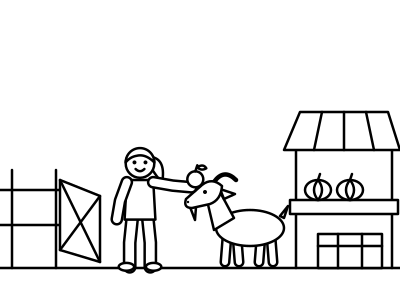
    Every Saturday, Marisol helped at her uncle's farm stand. One hot morning, a goat named Pepper slipped through the gate and trotted toward the road. "Pepper, stop!" Marisol shouted. She chased the goat past the pumpkins and around the hay bales, but Pepper was too fast. Then Marisol had an idea. She grabbed a crunchy apple and held it out. Pepper skidded to a stop, sniffed and followed her back through the gate. That evening, Uncle Rafa fixed the latch. "You were quick and clever," he said.

    Marisol holds out an apple to Pepper the goat, who has stopped to sniff it near the farm stand, the pumpkins, a hay bale and the open gate.

    Fill in the story map for the story above.

    1. 1.

      Characters

    2. 2.

      Setting

    3. 3.

      Problem

    4. 4.

      Climax

    5. 5.

      Resolution

    6. 6.

      Write two time-order words or phrases from the story.

    Write the base word and the prefix or suffix.

    1. 7.

      unlock

    2. 8.

      spotless

    Science

    Objective: I can review and explain ecosystems, habitats and adaptations with examples.

    Standards: 3-LS4-2, 3-LS4-3

    Builds on: Needs the notebook pages from Weeks 10, 11 and 14. One-minute check: ask "Is storing nuts something a squirrel HAS or something it DOES?" (Does. It is a behavioral adaptation.)

    Materials: Science notebook from Weeks 10 to 17, and pencil, 12 index cards, Bean cup and a little water

    1. Day 86 — Q2 Review: Ecosystems, Habitats and Adaptations — Wonder Warm-Up · 5 min

      Spaced review from Weeks 10 and 11. Your child gives a meaning and an example for three words, with no rush. Ecosystem (the living and nonliving things in one place and how they affect each other; a pond). Habitat (the place where a living thing gets what it needs; a desert). Adaptation (a feature or behavior that helps a living thing survive; thick fur). Check the bean cup and water it if dry. Then the wonder. Ask: "Which Quarter 2 idea could you teach to a younger child today?"

    2. Mini-Lesson · 10–15 min

      Say: "Today we check six skills." 1) Living, once living or never alive. Ask: "What is a cardboard box?" (Once living. Cardboard is made from trees.) 2) Food roles. Ask: "Name the role of a fern, a ladybug and bread mold." (Producer, consumer, decomposer.) 3) Habitat needs. Ask: "What four things does a habitat provide?" (Food, water, shelter and space.) 4) World habitats. Ask: "Which habitat is warm and very wet all year, with tall trees?" (Rainforest.) 5) HAS or DOES. Ask: "An owl has large eyes. A monarch butterfly flies south for winter. Which is physical and which is behavioral?" (Eyes are physical. Flying south is behavioral.) 6) Camouflage and variation. Ask: "Brown rabbits and white rabbits live on brown ground. Which does a hawk spot more easily?" (The white ones. Brown rabbits blend in, so more of them survive.) If stuck, say: "Find the page for that week. Read me one line from it."

    3. Investigation / Hands-On · 15–20 min

      Review Card Game. 1) Make 12 cards together, two for each skill. Write a question on the front and the answer on the back. Use these six, and your child writes six more from the notebook. "Name a decomposer." (Mushroom, mold or bacteria.) "Is a river rock living, once living or never alive?" (Never alive.) "Which habitat has frozen ground and no tall trees?" (Tundra.) "Thick fur: has or does?" (Has. It is physical.) "Name one need a nest meets for a bird." (Shelter.) "Why is a green caterpillar hard to see on a leaf?" (Camouflage. It blends in.) 2) Your child answers each card. Right answers go in a Got It pile. Missed cards go in a Practice pile. 3) Reteach each Practice card from its notebook page, then try those cards again. 4) Record the result in a table with three columns: Skill, Got It, Practice. Expect 10 or more cards in Got It by the end.

    4. Science Notebook Entry · 10 min

      Your child writes a one-page summary with a heading for each of the six skills and one example under each. They use this frame for adaptations. "The ___ lives in the ___ and has ___ that helps it ___." Sample: "The camel lives in the desert and has wide feet that help it walk on sand."

    5. Wrap-Up & Exit Ticket · 5 min

      Ask the three exit questions aloud; your child answers with no notebook. Praise examples that are different from the cards. Save the Practice pile for tomorrow's warm-up.

    Watch for: Mixing up habitat, the place where something lives, with adaptation, a feature that helps it live there.

    Try: Use the frame "The ___ lives in the ___ and has ___ that helps it ___." The second blank is always the habitat.

    Exit ticket:
    1. A pond has cattails, a turtle, mud and sunlight. Which are living, and which are nonliving?
    2. A snowshoe hare has wide furry feet. It also freezes still when a fox comes near. Which is physical, and which is behavioral?
    3. Name a habitat and one animal that survives well there. Give one reason.
    Show answers
    1. Living: cattails and turtle. Nonliving: mud and sunlight.
    2. The wide furry feet are physical. Freezing still is behavioral.
    3. Answers vary. Look for: a correct pair with a reason, such as tundra and caribou, because thick fur keeps it warm.

    Support: Use 6 cards, one for each skill. Your child may look at the notebook page before answering.

    Extend: Your child draws a food web of five living things for one world habitat. They label one adaptation for each animal.

    Homework: Practice your Practice-pile cards with a family member. Look for: each answer given without turning the card over.

    Practice page · Week 18, Day 1

    Science

    I can review and explain ecosystems, habitats and adaptations with examples.

    Review card game. Make a tally for each card in Got It or Practice.

    SkillGot ItPractice


    1. 1.

      How many cards ended in Got It?

    Practice cards. Write the answer.

    1. 2.

      Name a living part and a nonliving part of a forest.

    2. 3.

      Earthworm: producer, consumer or decomposer helper?

    3. 4.

      Which habitat has tall trees in layers and rain almost every day?

    4. 5.

      A fennec fox's big ears: physical or behavioral?

    5. 6.

      A swallow flying south for winter: physical or behavioral?

    6. 7.

      Name a habitat and one animal that survives well there. Tell one reason.

    Materials: 12 review cards · a timer

    Standards-matched clips that reinforce today's objectives.

    English Language Arts
    2:48

    Writing a Personal Narrative - Episode 1: Brainstorming a Story for Kids

    Teaching Without Frills

    Supports: I can review narrative writing by mapping a story I hear and writing one of my own.

    W.3.3
    Watch on YouTube
    Science
    8:22

    Animal Adaptations for Kids, Learn about physical, life cycle, and behavioral adaptations of animals

    Learn Bright

    Supports: I can review and explain ecosystems, habitats and adaptations with examples.

    3-LS4-2
    3-LS4-3
    Watch on YouTube
    Social Studies
    11:13

    Five Themes of Geography - How Geography Influences Civilization

    Miacademy Learning Channel

    Supports: I can review U.S. geography and the five regions.

    D2.Geo.2.3-5
    Watch on YouTube