3
    Third GradePowered by ThirdGrade.com

    Daily lesson plan

    Day 1 · Monday

    Week 20 · Reasoning: Fractions, Opinion Essays, Weather & Government

    See what your state adds or places differently

    Suggested daily schedule
    8:30–8:45 AM15 minMorning Circle / Read-Aloud / Calendar
    8:45–10:00 AM75 minEnglish Language Arts
    10:00–11:00 AM60 minMathematics
    11:00–11:15 AM15 minSnack and Movement Break
    11:15–12:00 PM30–45 minScience (every day)
    12:00–12:45 PM30–45 minSocial Studies (every day)
    12:45–1:30 PM45 minLunch and Choice Time
    1:30–2:15 PM45 minSpecials: PE / Art / Music (rotating)
    2:15–2:45 PM30 minIndependent Reading & Journaling

    Social Studies

    Objective: I can explain why the U.S. government is split into three branches and what each branch does.

    Standards: D2.Civ.5.3-5, D2.Civ.3.3-5

    Builds on: Needs Week 19 Day 1, the three levels of government, where federal means national. One-minute check: ask, "Which level of government works for the whole country?" (Federal.)

    New words:
    • Constitution – the written plan for the United States government and its highest law
    • legislative branch – the part of government that makes laws; for the country, it is Congress
    • executive branch – the part of government that carries out laws; the President leads it
    • judicial branch – the courts, which decide what laws mean
    • checks and balances – the ways each branch can limit the other two

    Materials: Notebook, Pencil, A coin, Large sheet of paper, Brown, green and blue markers, 6 index cards

    1. Warm-Up · 5 min

      Spaced review from Week 19. Ask: "Name the three levels of government from closest to farthest." (Local, state, federal.) Then play a quick coin game. Say: "I make the rules. Heads, I win. Tails, you lose. I am also the judge." Flip the coin once. Ask: "Is this game fair? Why not?" (No. One person holds all the power.) Say: "Today we see how our country avoids that."

    2. Mini-Lesson · 10–15 min

      Say: "In 1787, leaders from the states met in Philadelphia. They wrote the Constitution, the plan for our national government." Say: "They had lived under a powerful king. They did not want that again. So they split power into three branches." Say: "The legislative branch is Congress. It makes the laws." Say: "The executive branch is led by the President. It carries out the laws." Say: "The judicial branch is the Supreme Court and other federal courts. It decides what laws mean and whether they follow the Constitution." Say: "Each branch can check the others. We call this checks and balances." "The President can say no to a law that Congress wants. Courts can rule that a law breaks the Constitution." Chant: "Congress makes, the President carries out, courts decide." Ask: "Which branch is Congress?" (Legislative.) "Who leads the executive branch?" (The President.) "What can courts do when a law breaks the Constitution?" (Rule against it.) If stuck, say: "Makes, carries out, decides. Which word fits this job?"

    3. Activity / Source Work · 15–20 min

      Branch tree. 1) On the large paper, your child draws a brown trunk and labels it "U.S. Constitution." 2) Your child draws three big green branches and labels them Legislative, Executive and Judicial. 3) In blue, write each job and who does it. Legislative: makes laws, Congress. Executive: carries out laws, the President. Judicial: decides what laws mean, the Supreme Court and federal courts. 4) Write six job cards. "Votes on a new law." "Leads the armed forces." "Decides a case in court." "Writes a new law." "Meets leaders of other countries." "Rules that a law breaks the Constitution." 5) Your child places each card on a branch and says why. (Legislative, executive, judicial, legislative, executive, judicial.) 6) Draw an arrow from Executive to Legislative. Label it "can say no to a new law." Ask: "What does this arrow show?" (One branch checking another.) 7) Ask: "Use your tree as evidence. Could the President decide a court case?" (No. That job sits on the judicial branch.) Keep the tree all week.

    4. Notebook Entry · 10 min

      In the notebook, your child copies a small branch tree and writes one sentence for each branch. Then finish: "One check I learned today is ___." Sample: "Congress makes the laws. One check I learned today is that the President can say no to a new law."

    5. Exit Ticket · 5 min

      Read the three questions aloud, with the tree out of sight. Praise answers that match a branch with its job.

    Watch for: Thinking the President makes the laws.

    Try: Say the chant together. Then your child walks the "Votes on a new law" card from the legislative branch to the executive branch.

    Exit ticket:
    1. A group in Washington, D.C., votes yes on a new law about highways. Which branch is that group in?
    2. What does "checks and balances" mean?
    3. Which document is the plan for our national government, and in what year was it written?
    Show answers
    1. The legislative branch. The group is Congress.
    2. Each branch can limit the other two, so no branch grows too strong.
    3. The Constitution, written in 1787.

    Support: Add a picture cue to each branch. Use a pencil for making laws, a desk for carrying them out and a scale for judging.

    Extend: Add one more check to the tree. The President chooses federal judges, but part of Congress must approve them.

    Homework: Your child teaches a family member the three branches with the tree. Then your child asks, "Which branch decides a case in court?" Look for each branch matched to its job.

    Practice page · Week 20, Day 1

    Social Studies

    I can name the three branches of government and tell what each one does.

    A Plan for Sharing Power

    In 1787, leaders from the states met to write the U.S. Constitution. It is the plan for our national government. The leaders did not want one person to have all the power. So they made three branches. Congress makes the laws. The President carries out the laws. The courts decide what laws mean. Each branch can stop, or check, the others. This is called checks and balances.
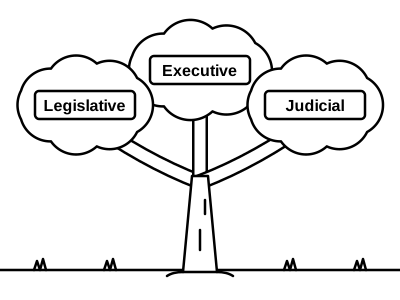
    A tree whose trunk splits into three branches labeled Legislative, Executive and Judicial.
    The Constitution is the plan for our government.

    Write the branch for each job: legislative, executive or judicial.

    Word bank: legislative · executive · judicial

    1. 1.

      A judge listens to both sides in a case.

    2. 2.

      Senators vote on a new bill.

    3. 3.

      The President meets a leader from another country.

    4. 4.

      Members of the House write a bill.

    5. 5.

      A court decides what a law means.

    6. 6.

      The President picks advisers for the Cabinet.

    Answer the question.

    1. 7.

      Why did the writers of the Constitution split power into three branches?

    Challenge: Give one example of a check one branch has on another.

    Materials: large paper for a branch tree · markers

    Mathematics

    Objective: I can show halves, thirds and fourths on a number line from 0 to 1.

    Standards: 3.NF.A.2, 3.NF.A.2.A

    Builds on: Needs number lines from Week 1 Day 4 and unit fractions from Week 19 Day 3. One-minute check: ask "How many pieces of size 1/3 fill one whole?" (3)

    Materials: Centimeter ruler, 1 paper strip, 12 cm long, Unlined paper, Pencil

    1. Warm-Up · 5 min

      Spaced review from Week 19. Ask: "How many pieces of size 1/6 build 4/6?" (4) Then practice ÷4 facts with no clock. Ask 20 ÷ 4, 28 ÷ 4, 32 ÷ 4 and 36 ÷ 4 (5, 7, 8, 9). For a slow fact, halve the total twice.

    2. Mini-Lesson · 10–15 min

      Say: "A fraction is a number, so it has a place on the number line." Draw a line 12 cm long with the ruler. Label the left end 0 and the right end 1. Say: "The whole is the distance from 0 to 1." Say: "For halves, I cut that distance into 2 equal spaces." Make a tick at 6 cm. Put a finger on 0 and slide to the tick. Say: "I moved one space of size 1/2." Label the tick 1/2. Slide one more space. Label the end 2/2 under the 1. Say: "So 1/2 is the point one space from 0." Say: "We count spaces, not ticks." Draw a new 12 cm line for thirds. Make ticks at 4 cm and 8 cm. Ask: "How many equal spaces?" (3) Label 1/3, 2/3 and 3/3. Now your child does more. Your child draws a 12 cm line and makes ticks at 3, 6 and 9 cm. Ask: "How many equal spaces?" (4) Your child labels 1/4, 2/4, 3/4 and 4/4.

    3. Guided Practice · 10–15 min

      Use the three lines. 1) Point to the halves line. Ask: "How long is each space?" (6 cm) "Are the spaces equal?" (Yes.) 2) Your child folds the 12 cm strip in half twice and opens it. Lay it under the fourths line. Ask: "Where do the folds land?" (On the ticks at 3, 6 and 9 cm.) 3) On the thirds line, ask: "Which fraction is two spaces from 0?" (2/3) 4) Draw a 12 cm line with ticks at 2 cm and 6 cm. Ask: "Are these thirds?" (No. The spaces are 2, 4 and 6 cm, so they are not equal.) If stuck, say: "Put your finger on 0. Hop one space at a time and count the hops."

    4. Independent Practice · 15–20 min

      Your child draws each line 12 cm long with the ruler, from 0 to 1. 1) Halves: a tick at 6 cm. Label the ticks (1/2, 2/2). 2) Thirds: ticks at 4 and 8 cm. Label the ticks (1/3, 2/3, 3/3). 3) Fourths: ticks at 3, 6 and 9 cm. Label the ticks (1/4, 2/4, 3/4, 4/4). 4) On the fourths line, which fraction is at the first tick after 0? (1/4) 5) How many equal spaces show halves? (2) 6) On the fourths line, which fraction is at 6 cm? (2/4) 7) An ant starts at 0 on the thirds line. It walks to the first tick. What number is the ant on? (1/3) 8) A bug starts at 0 on the fourths line. It hops 4 spaces. What number is the bug on? (4/4, which is 1)

    5. Exit Ticket · 5 min

      Your child puts the lines away and answers on paper.

    Watch for: Counting tick marks, with the 0 tick as one, so the first tick gets the label 2/4.

    Try: Your child puts a finger on 0 and hops one space at a time. Your child says "one fourth" on landing, not before the hop.

    Fact fluency: ÷4 facts

    Exit ticket:
    1. A 0 to 1 line has 3 equal spaces. What is the size of each space?
    2. On a line in fourths, what fraction is at 1?
    3. Why must the spaces on a number line be equal?
    Show answers
    1. 1/3
    2. 4/4
    3. Answers vary. Look for: fractions name equal parts, so the spaces must match.

    Support: Draw the lines and ticks first. Your child hops with a finger and labels each tick.

    Extend: Your child draws a 12 cm line with a tick every 2 cm and labels sixths. Labels: 1/6, 2/6, 3/6, 4/6, 5/6 and 6/6.

    Homework: Your child draws a 12 cm line from 0 to 1 with ticks at 3, 6 and 9 cm. Your child labels it and shows a family member 2/4. Answer: 2/4 is at the 6 cm tick.

    Practice page · Week 20, Day 1

    Mathematics

    I can show halves, thirds and fourths on a number line from 0 to 1.

    Look: thirds

    1. Draw a line. Write 0 at one end and 1 at the other end.
    2. Split the space into 3 equal spaces with 2 tick marks.
    3. Count spaces from 0: 1/3, 2/3, 3/3.

    Draw a number line from 0 to 1. Split it and label every tick.

    1. 1.

      Halves

    2. 2.

      Fourths

    3. 3.

      Thirds

    Answer each question.

    1. 4.

      A 0 to 1 line is split into 4 equal spaces. What fraction is at the first tick after 0?

    2. 5.

      A 0 to 1 line is split into 3 equal spaces. What fraction is at the second tick after 0?

    3. 6.

      What other name does 1 have on a fourths line?

    4. 7.

      Ava's path goes from the gate (0) to the pond (1). It has 4 equal parts. She stops after 3 parts. What fraction of the path did she walk?

    Challenge: On a halves line, where is 1/2? Use the words 0 and 1.

    English Language Arts

    Objective: I can tell the difference between a reason and evidence.

    Standards: W.3.1.B, L.3.6

    Builds on: Needs the body paragraphs from Week 19 Day 4, each with a reason and evidence. One-minute check: ask, "What do you ask after a reason to find evidence?" (How do you know?)

    New words:
    • personal experience – something that really happened to you

    Materials: Writer's notebook, Essay draft, Ten index cards, Two colored pencils, Pencil

    1. Warm-Up · 5 min

      Word study, Week 20: the suffixes -able and -ment. Say: "The suffix -able means can be. Washable means it can be washed. The suffix -ment turns an action into a naming word. Move becomes movement." Your child reads and sorts six words into two columns: washable, breakable, fixable, movement, payment, agreement. Spaced review from Week 19. Ask: "What does a hook do?" (It makes the reader want to keep reading.)

    2. Mini-Lesson · 10–15 min

      Say: "A reason answers WHY. Evidence answers HOW DO YOU KNOW?" Draw a T-chart with the headings Reason and Evidence. Write "A class trip helps kids learn" on the left. Write "After our trip to the pond, Ana could name four kinds of ducks" on the right. Think aloud: "The first sentence tells why a class trip is good. Anyone could say it. The second sentence tells something that happened, so it proves the reason." Say: "Evidence comes in three kinds: a fact, an example and a personal experience." Show all three for the reason "A dog keeps you active." Fact: "Our dog needs two walks every day." Example: "For example, dog owners visit the park even in winter." Personal experience: "When we got Biscuit, I started walking a mile a day." Warn: "Saying the reason again in new words is not evidence." Read: "Dogs are good buddies because they are great friends." Ask: "Does that prove anything?" (No. It repeats the reason.)

    3. Guided Practice · 10–15 min

      Write these ten sentences on ten cards, before the lesson if you can, and shuffle them. Reasons: Libraries save families money. Board games bring families together. Reusable bottles cut down on trash. Camping teaches new skills. Learning an instrument takes patience. Evidence: Last month we borrowed twelve books and paid nothing. On Friday we played checkers for a whole hour. Our bin used to fill with ten plastic bottles a week. On our last trip, I learned to tie two knots. Jo practiced for three weeks before she could play one song. 1) Your child sorts the cards into a Reason pile and an Evidence pile. (five in each) 2) Your child matches each reason to its evidence. (They match in the order listed above.) 3) Hold up the knots card. Ask: "Which of the three kinds of evidence is this card?" (a personal experience) 4) Your child picks one reason card and says a new piece of evidence for it. If stuck, say: "Read the card. Does it tell why, or does it tell something that happened or can be checked?"

    4. Independent Practice · 15–20 min

      Your child works in the essay draft. 1) Underline every reason in one color. 2) Underline every piece of evidence in the other color. 3) Put a star by any reason with no evidence beside it. 4) Add one new piece of evidence for each starred reason. With no stars, add a second kind of evidence to one paragraph. 5) Label each piece of evidence F for fact, Ex for example or PE for personal experience. Look for: every reason has evidence, and no evidence simply repeats its reason.

    5. Exit Ticket · 5 min

      Read the questions aloud. Your child answers in the notebook and uses the essay draft for question 3.

    Watch for: Repeating the reason in new words and calling it evidence.

    Try: Ask: "Could I check this, could I see it, or did it happen to you?" If not, it is not evidence yet.

    Exit ticket:
    1. One sentence is a reason and one is evidence. Which is which? "Hiking is good for your body." "On Sunday we hiked two miles to the falls."
    2. Why is this not evidence? "Reading is fun because it is enjoyable."
    3. Point to a reason in your essay that got new evidence today. What did you add?
    Show answers
    1. The first is the reason. The second is evidence, because it tells something that happened.
    2. It only says the reason again in new words. It proves nothing.
    3. Answers vary. Look for: a fact, an example or a true story that proves the reason.

    Support: Keep the T-chart in view with WHY and HOW DO YOU KNOW at the top. Sort only three pairs of cards.

    Extend: Your child writes one reason with all three kinds of evidence, each one labeled.

    Homework: Read for 15 to 20 minutes. Then find an ad or a food box at home. Name one reason it gives for buying the thing and any evidence it offers. Look for: your child can tell the reason from the proof.

    Practice page · Week 20, Day 1

    English Language Arts

    I can tell a reason from evidence.

    Look: Reason or evidence?

    1. A reason answers WHY?
    2. Evidence answers HOW DO YOU KNOW?
    3. Evidence can be a fact, an example or a personal experience.

    Opinion: Kids should help in the family garden. Circle Reason or Evidence.

    1. 1.

      Gardening teaches patience.

      ○ Reason○ Evidence
    2. 2.

      Our pea seeds took 10 days to sprout.

      ○ Reason○ Evidence
    3. 3.

      Gardens give families healthy food.

      ○ Reason○ Evidence
    4. 4.

      Last summer we picked 30 tomatoes from two plants.

      ○ Reason○ Evidence

    Answer each question.

    1. 5.

      Reason: Bikes save money. Circle the evidence that proves it.

      ○ Riding to the pool means no bus fare.○ My bike is red.
    2. 6.

      What kind of evidence is this? 'When I fell off my scooter, my helmet kept my head safe.'

      ○ fact○ example○ personal experience
    3. 7.

      -able means 'can be.' What does washable mean?

    4. 8.

      Write the -able word: can be fixed → ____

    Challenge: Write one reason and one piece of evidence for this opinion: 'Kids should have a library card.'

    Science

    Objective: I can explain the difference between weather and climate and sort statements into each.

    Standards: 3-ESS2-2

    Builds on: Needs Week 19: weather is what the air is like at one place and one time. One-minute check: your child gives today's weather in one sentence with a time (sample: at 9 a.m. it is 50°F and cloudy).

    New words:
    • climate – the usual weather of a place over many years

    Materials: 10 index cards or paper strips, World or U.S. map, Science notebook, Pencil

    1. Day 96 — What Is Climate? — Wonder Warm-Up · 5 min

      Spaced review from Week 19. Ask: "A wind comes from the north. What is it called, and where is it going?" (A north wind. It blows toward the south.) Then the wonder. Ask: "Suppose it snows here today. Does that mean it snows here all year?" Let your child explain. (No. One day does not tell about the whole year.)

    2. Mini-Lesson · 10–15 min

      Say: "Weather is what the air is like right now. Climate is the usual weather of a place over many years." Say: "Scientists use about 30 years of weather records to describe a climate." Give a memory line. "Weather is your mood today. Climate is what you are usually like." Find Phoenix, Arizona on the map. Say: "Phoenix has a hot, dry climate. It can still have a cool, rainy day." Find Seattle, Washington. Say: "Seattle has a mild climate with many cloudy, drizzly days in fall and winter. It can still have a hot, sunny day." Ask: "Did the rainy day change the climate of Phoenix?" (No. One day is weather.) Teach the clue words. Weather clues: now, today, tonight, this morning, tomorrow. Climate clues: usually, most years, every summer, all year. Ask: "Snowflakes are falling at this minute. Weather or climate?" (Weather. The clue is at this minute.) Ask: "July is usually our hottest month. Weather or climate?" (Climate. The clue is usually.) If stuck, say: "Is it about one day or about many years?"

    3. Investigation / Hands-On · 15–20 min

      Weather or Climate Sort. 1) Write one sentence on each card. Card 1: Hail is bouncing on the porch right now. Card 2: Deserts get very little rain in most years. Card 3: Tonight will be clear and chilly. Card 4: Florida is warm for most of the year. Card 5: It was 75°F at lunch today. Card 6: Antarctica is cold all year. Card 7: Frost covered the grass this morning. Card 8: The rainy season comes here every summer. Card 9: A rainbow came out after this afternoon's shower. Card 10: Our autumns are usually cool. 2) Shuffle the cards. Your child sorts them into two piles. 3) On each card they underline the clue words. 4) They record the sort in a table with two columns: Weather, Climate. Expect the odd-numbered cards under Weather and the even-numbered cards under Climate. If one is misplaced, ask: "Which words tell when?" 5) Your child writes one new sentence for each pile.

    4. Science Notebook Entry · 10 min

      Your child writes both meanings side by side in the notebook. Then they write three sentences about the climate where you live, using "usually" or "most years". Sample: "Our winters are usually cold and snowy. Most years we get thunderstorms in summer. Fall is usually dry." Help with facts about your area if needed.

    5. Wrap-Up & Exit Ticket · 5 min

      Ask the three exit questions aloud. Praise answers that point to a clue word.

    Watch for: Thinking one unusual day, such as a cold day in summer, means the climate has changed.

    Try: Ask: "Is that what usually happens here over many years, or only today?" Point to the clue words.

    Exit ticket:
    1. "Lightning flashed over the lake a minute ago." Weather or climate? Which words are the clue?
    2. "Farmers here expect dry summers in most years." Weather or climate? Which words are the clue?
    3. It rained in a desert town today. Did the town's climate change? Explain.
    Show answers
    1. Weather. The clue is "a minute ago".
    2. Climate. The clue is "in most years".
    3. No. One rainy day is weather. Climate is the usual pattern over many years, and that is still dry.

    Support: Draw a clock on one sheet and a calendar on another. Your child lays each card on the clock for now or the calendar for many years.

    Extend: Your child writes one weather sentence and one climate sentence about a place where a relative lives.

    Homework: Ask a family member to describe your area's climate in two sentences. Write the answer and underline the clue words. Look for: "usually", "most years" or "every".

    Practice page · Week 20, Day 1

    Science

    I can tell weather from climate.

    Circle weather or climate. Look for a clue word like now, today, tonight, usually or all year.

    1. 1.

      Hail is falling right now.

      ○ weather○ climate
    2. 2.

      Our winters are usually mild.

      ○ weather○ climate
    3. 3.

      Tonight will be clear and cold.

      ○ weather○ climate
    4. 4.

      Most years, this valley gets very little rain.

      ○ weather○ climate
    5. 5.

      It is 58°F at noon today.

      ○ weather○ climate
    6. 6.

      Hawaii is warm all year.

      ○ weather○ climate

    Write your answer.

    1. 7.

      What is climate?

    Challenge: Can one very cold day change a place's climate? Why or why not?

    Materials: index cards for the sort

    Standards-matched clips that reinforce today's objectives.

    English Language Arts
    7:22

    Evaluating a source’s reasoning and evidence | Reading | Khan Academy

    Khan Academy

    Supports: I can tell the difference between a reason and evidence.

    W.3.1.B
    Watch on YouTube
    Science
    4:33

    Weather vs. Climate: Crash Course Kids #28.1

    Crash Course Kids

    Supports: Define climate and contrast with weather

    3-ESS2-2
    Watch on YouTube
    Social Studies
    7:53

    Three Branches of Government | Learn about the executive, legislative, and judicial branches

    Learn Bright

    Supports: I can explain why the U.S. government is split into three branches and what each branch does.

    D2.Civ.5.3-5
    D2.Civ.3.3-5
    Watch on YouTube