Week 29 · Day 1 Practice Pages
Practice page · Week 29, Day 1
Mathematics
I can multiply side lengths to find the area of a rectangle.
Look: 3 by 6
- A rectangle is an array of squares.
- 3 rows with 6 squares in each row.
- 3 × 6 = 18, so the area is 18 square units.
Sketch each rectangle. Multiply the side lengths to find the area.
- 1.
4 by 7 rectangle
- 2.
6 by 8 rectangle
- 3.
3 by 9 rectangle
- 4.
5 by 6 rectangle
Solve. Write a multiplication sentence and the unit.
- 5.
Mia's tray holds 4 rows of 9 square tiles. What is the area of the tray?
- 6.
A rectangle has sides of 7 units and 6 units. What is its area?
- 7.
Why does multiplying the side lengths give the area?
Challenge: Is the area of a 2 by 8 rectangle the same as an 8 by 2 rectangle? Show how you know.
Materials: square tiles if you have them
Practice page · Week 29, Day 1
English Language Arts
I can take short notes and sort them by subtopic.
How Beavers Build Dams
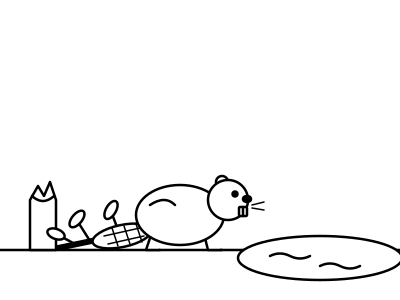
Beavers cut down small trees with their sharp front teeth. They drag the logs to a stream. Then they stack sticks, rocks and mud across the water. The dam slows the stream and makes a deep pond. In the pond, beavers build a home called a lodge. The lodge has an underwater door, so foxes and wolves cannot get in.
Write each note on the right subtopic page: A = Getting wood, B = Building the dam, C = The lodge.
- 1.
cut trees with front teeth
- 2.
stack sticks, rocks, mud
- 3.
underwater door keeps foxes out
- 4.
dam makes deep pond
- 5.
Turn this sentence into a short note: 'They drag the logs to a stream.'
Write the possessive. Is there one owner or more than one?
- 6.
the tail of one beaver = the ____ tail
- 7.
the teeth of many beavers = the ____ teeth
- 8.
the toys of the children = the ____ toys
Challenge: Why is it smart to sort notes by subtopic instead of by source?
Practice page · Week 29, Day 1
Science
I can identify inherited traits that a living thing is born with.
Write your inherited trait cards here: 3 for people, 3 for animals and 2 for plants.
| People | Animals | Plants |
|---|---|---|
- 1.
Read each card and say, 'This is passed from parents to offspring.' Did any card name something you had to learn?
Is it an inherited trait? Circle yes or no.
- 2.
an owl's large eyes
○ yes○ no - 3.
knowing how to bake bread
○ yes○ no - 4.
the orange color of a pumpkin
○ yes○ no - 5.
the sharp spines on a cactus
○ yes○ no - 6.
singing a song from school
○ yes○ no
Challenge: Why can't a baby inherit the ability to read?
Materials: index cards · marker · animal pictures
Practice page · Week 29, Day 1
Social Studies
I can read a resource map and its key.
A Resource Map of Lakeland
Lakeland is a made-up state. Its map key shows five symbols: a tree means forest and lumber, a fish means fishing, a wheat stalk means wheat, a pick means a mine, and a cow means dairy farms. Tree symbols cover the cold north. Fish symbols line the shore of Big Lake in the east. Wheat fills the flat middle. Two picks sit in the western hills. Cows dot the green south.
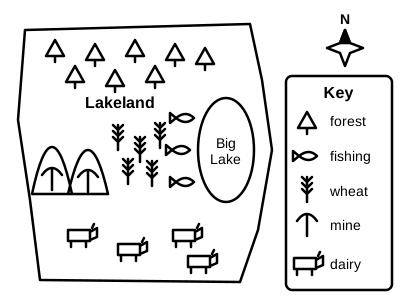
Use the Lakeland map above.
- 1.
What does a pick symbol mean?
- 2.
Where in Lakeland is fishing done?
- 3.
Which part of Lakeland grows wheat?
- 4.
Where in Lakeland would milk most likely come from?
Resource Hunt: use a real U.S. resource map. Find 3 resources and fill in the table.
| Resource | Symbol | Two states where it appears |
|---|---|---|
- 5.
Which state has the biggest fishing catch?
- 6.
My state's main resource is ____.
Challenge: Where in Lakeland would a sawmill most likely be built? Why?
Materials: U.S. natural resources map or atlas