3
    Third GradePowered by ThirdGrade.com

    Daily lesson plan

    Day 1 · Monday

    Week 34 · Synthesis: Area, Shapes, Research, Traits & Civic Action

    See what your state adds or places differently

    Suggested daily schedule
    8:30–8:45 AM15 minMorning Circle / Read-Aloud / Calendar
    8:45–10:00 AM75 minEnglish Language Arts
    10:00–11:00 AM60 minMathematics
    11:00–11:15 AM15 minSnack and Movement Break
    11:15–12:00 PM30–45 minScience (every day)
    12:00–12:45 PM30–45 minSocial Studies (every day)
    12:45–1:30 PM45 minLunch and Choice Time
    1:30–2:15 PM45 minSpecials: PE / Art / Music (rotating)
    2:15–2:45 PM30 minIndependent Reading & Journaling

    Social Studies

    Objective: I can begin my civic action safely and keep a log of what I did and what happened.

    Standards: D4.7.3-5, D2.Civ.7.3-5

    Builds on: Needs Week 33: a finished plan with a goal number, dates, helpers and a safety rule. One-minute check: ask, "What is your goal number?" (Answers vary. It should match the planner, such as 40 pairs of socks.)

    New words:
    • action log – a chart where you write what you did each day and what happened
    • civic virtue – a good habit that helps people live and work together, such as honesty or respect

    Materials: Civic Action Project planner, open to Step 5 (from the site's Civic Action Project page), or a notebook page titled Step 5, Materials box packed last week, Action log page (1 sheet of paper ruled into 4 columns: Date, What we did, Count, Note), Clipboard or a large book to write on, Notebook, Pencil, For a cleanup project only: work gloves and a trash bag

    1. Warm-Up · 5 min

      Spaced review from Week 33. Ask: "Name the six steps of the civic action cycle in order." (Identify, research, plan, act, reflect, share.) Ask: "Which step is today?" (Act.) Your child reads the plan's first step, names the helpers and says the safety rule. Then ask the big question: "What will we do if something does not go as planned?"

    2. Mini-Lesson · 10–15 min

      Say: "Today we act. Good citizens use civic virtues. Those are good habits like respect, responsibility and honesty." Say: "Respect means polite words, even when someone says no. Responsibility means doing the job we promised. Honesty means writing the real count." Say: "Real plans rarely go perfectly. Changing a plan is part of civic action." Show the action log page. Say: "Each row of an action log has four parts: the date, what we did, a count and a note." In the notebook, write a model row for a made-up sock drive: "Monday. Set the box in the hall and hung 2 flyers. 13 pairs. Note: the box was hard to see." Ask: "Which part is the count?" (13 pairs.) "What does the note tell us?" (A problem to fix. The box was hard to see.) "A neighbor says, 'No, thank you.' Which virtue do you use?" (Respect. Say thank you and move on.) If stuck, say: "Point to each column. Date, did, count, note."

    3. Activity / Source Work · 15–20 min

      Action Day 1. 1) Read the safety rule aloud. An adult stays with your child the whole time. 2) Take the materials box. Your child carries out the first step of the plan. Samples: set up a collection box and flyers, do a 15-minute cleanup, or deliver a polite letter. 3) Cleanup safety: wear gloves and use the trash bag. Never touch glass, needles or anything sharp. Your child points and the adult handles it. 4) Never put your address or full name on a flyer or online. Never go door to door alone, and never collect money online. 5) Keep the plan the same today. Just notice what works. 6) Right after, your child clips the log page to the clipboard and fills in the first row. The columns are Date | What we did | Count | Note. 7) Ask for evidence: "What in your log shows what happened today?" (The count and the note.) Look for a date, an action and a count or result. Real results vary. Look for what helped and what got in the way.

    4. Notebook Entry · 10 min

      Your child writes three sentences and draws one quick picture of the action. Frames: "Today I ___. The hardest part was ___. Tomorrow I could try ___." Sample: "Today I set out the sock box and hung two flyers. The hardest part was finding a good spot. Tomorrow I could try moving the box by the door."

    5. Exit Ticket · 5 min

      Ask the three exit questions aloud. Praise honest counts and polite words to helpers.

    Watch for: Skipping the log because the action is more fun than writing.

    Try: Keep the log on the clipboard beside the work. Fill in the row the moment the step is done.

    Exit ticket:
    1. What did you do today for your project? Point to the log row that shows it.
    2. Tara's log row says: Tuesday, picked up litter, 2 bags. Which part of the row is missing?
    3. You promised to hang three flyers but hung only one. What count do you write, and why?
    Show answers
    1. Answers vary. Look for: the first step from the plan, matching the log row.
    2. The note. It should tell one thing that happened or one problem to fix.
    3. One. An honest log shows what really happened, so the plan can be fixed.

    Support: Break today's step into two small jobs. Check off each one together. Then your child says the log row aloud while you write it.

    Extend: Your child invites one more helper, with an adult's okay, and gives that person one clear job.

    Homework: Your child tells a family member what happened today and adds any new count to the log. Look for a real number, not just "a lot."

    Practice page · Week 34, Day 1

    Social Studies

    I can begin my civic action safely and keep a log.

    A Log Row

    Tuesday: set up the hat box by the shelter's front door and taped up 2 flyers. Hats so far: 6. Note: the box was hard to see, so tomorrow we will add a bright sign.

    Use the log row above.

    1. 1.

      What did the family do on Tuesday?

    2. 2.

      What number did they record?

    3. 3.

      What will they change, and why?

    Action Day 1: fill in the first row of your log.

    DateWhat we didCountNotes


    1. 4.

      Today I ____. The hardest part was ____.

    2. 5.

      If part of the plan does not work, a good citizen ___.

      ○ changes the plan and tries again○ gives up○ blames others
    3. 6.

      My safety rule today was:

    Challenge: Draw one picture of your action today.

    Materials: action log page · materials box
    Mathematics

    Objective: I can explain why every square is a rectangle but not every rectangle is a square.

    Standards: 3.G.A.1

    Builds on: Needs Week 33 Day 4 (square, rectangle, rhombus and the square corner test). One-minute check: hold up the rectangle card and ask for its name and one reason (rectangle; 4 square corners).

    Materials: The 6 quadrilateral cards from Week 33 Day 4 (square, rectangle, rhombus, roof shape, kite, lopsided shape), 2 new cards cut from grid paper: a 5 by 5 square and a rectangle 4 long and 3 tall, Scissors (to cut out the new cards), Ruler, Index card (to test square corners), Grid paper, Notebook, Pencil

    1. Warm-Up · 5 min

      Spaced review from Week 33 Day 3. A rectangle of 12 squares is split into 4 equal parts. Ask how many squares are in each part and what fraction each is (12 ÷ 4 = 3 squares each; 1/4). Then practice ×8 facts with no clock. Ask 8 × 3, 8 × 6 and 8 × 9 (24, 48, 72).

    2. Mini-Lesson · 10–15 min

      Say: "A rectangle is a quadrilateral with 4 square corners. That is the only rule." Say: "A square has 4 square corners and 4 equal sides." Draw a big circle on paper and label it rectangles. Draw a small circle inside it and label it squares. Work the 4 by 4 square card fully. Fit the index card into each corner. Ask: "Does it pass the rectangle rule?" (Yes. It has 4 square corners.) Say: "So this square is a rectangle. Every square is a rectangle, because every square has 4 square corners." Lay it in the small circle. Ask: "Is it inside the big circle too?" (Yes) Now test the 6 by 2 rectangle card with the ruler. Ask: "Are all 4 sides equal?" (No. They are 6, 2, 6 and 2.) Say: "So this rectangle is not a square. A square is a special rectangle, one with 4 equal sides." Lay it in the big circle, outside the small one. Now your child does more. Your child tests and places the 5 by 5 card and the 4 by 3 card. (small circle; big circle only)

    3. Guided Practice · 10–15 min

      Your child tests each card, places it, and says the reason aloud. 1) The rhombus card. (Outside both circles. Its corners are not square.) 2) The roof card. (Outside both circles. Its corners are not square.) 3) Turn the 5 by 5 square onto one corner. Does it stay in the small circle? (Yes. Turning does not change corners or sides.) 4) Ask: "Can you draw a square that is not a rectangle? Try on grid paper." (No. Every square has 4 square corners.) If stuck, say: "Rectangle rule: 4 square corners. Square rule: 4 square corners and 4 equal sides. Test both."

    4. Independent Practice · 15–20 min

      For each shape, your child answers: rectangle, square, both or neither. 1) 4 square corners; sides of 4, 4, 4 and 4 units. (both) 2) 4 square corners; sides of 5, 2, 5 and 2 units. (rectangle only) 3) The kite card. (neither) 4) 4 square corners; sides of 7, 1, 7 and 1 units. (rectangle only) 5) A quadrilateral with only 2 square corners. (neither; a rectangle needs 4) 6) You draw a square standing on one corner. (both) 7) A sandbox has 4 square corners and is 6 feet on every side. Jo calls it a rectangle. Is Jo right? (Yes. A square is a special rectangle.) 8) A door has 4 square corners. It is 3 feet wide and 7 feet tall. Max calls it a square. Is Max right? (No. Its sides are not all equal.) Last, your child writes one sentence telling why a square is a special rectangle.

    5. Exit Ticket · 5 min

      Read each question aloud; your child answers on grid paper and may use the ruler and the index card.

    Watch for: Thinking a shape can belong to only one group.

    Try: Use the two circles. Your child lays the square in the small circle and sees that it sits inside the big one too.

    Fact fluency: ×8 facts

    Exit ticket:
    1. What one rule must a quadrilateral pass to be a rectangle?
    2. A shape has 4 square corners and sides of 8, 8, 8 and 8 cm. Is it a rectangle, a square or both?
    3. Draw a rectangle that is not a square. Tell why it is not a square.
    Show answers
    1. It must have 4 square corners.
    2. Both
    3. Sample: 5 units long and 2 units tall. Its sides are not all equal.

    Support: Use only the 4 by 4 square card and the 6 by 2 rectangle card. Your child tests every corner and side, then places each card.

    Extend: Your child draws every rectangle with a perimeter of 16 units and whole-number sides, then circles the square. (1 by 7, 2 by 6, 3 by 5 and 4 by 4; the square is 4 by 4)

    Homework: Your child finds three squares and three rectangles that are not squares at home and lists them. Sample: a sticky note is a square; a door is a rectangle that is not a square.

    Practice page · Week 34, Day 1

    Mathematics

    I can explain why every square is a rectangle but not every rectangle is a square.

    Look: rectangle or square?

    1. A rectangle has 4 square corners.
    2. A square has 4 square corners and 4 equal sides.
    3. So a square has everything a rectangle needs.

    Circle the best answer for each shape.

    1. 1.

      A 3 cm by 3 cm shape with 4 square corners

      ○ square only○ rectangle only○ both a square and a rectangle○ neither
    2. 2.

      A 7 cm by 2 cm shape with 4 square corners

      ○ square only○ rectangle only○ both a square and a rectangle○ neither
    3. 3.

      A shape with 4 equal sides and no square corners

      ○ rectangle○ square○ neither
    4. 4.

      A quadrilateral with only 2 square corners

      ○ rectangle○ square○ neither

    Answer each question.

    1. 5.

      Is every square a rectangle?

      ○ yes○ no
    2. 6.

      Is every rectangle a square?

      ○ yes○ no
    3. 7.

      Write why a square is a special rectangle.

    Challenge: Draw a tilted square. Is it still a square?

    Materials: ruler · index card

    English Language Arts

    Objective: I can read a script aloud as reader's theater and use the parts of a play to read it well.

    Standards: RL.3.5, RL.3.10, RF.3.4.A, RF.3.4.B, L.3.2.F

    Builds on: Needs story parts from Week 1 (characters, setting, beginning, middle and end) and the word scene from Week 1 Day 3. One-minute check: ask, "In a play, what do we call each part?" (a scene)

    New words:
    • script – a story written as a play, with a line for each speaker
    • cast – the list of characters in a play
    • stage directions – words in parentheses that tell how to speak a line or what to do
    • reader's theater – reading a play aloud using only your voice, with no costumes or stage

    Materials: The script in this lesson, copied by hand or printed, one copy per reader, Highlighters or colored pencils in different colors, Reader's notebook, Pencil, One or two family members to read parts (you may read two parts yourself)

    1. Warm-Up · 5 min

      Word study, about 3 minutes. Say: "This week's words have soft c and soft g. C usually says /s/ and g usually says /j/ before e, i or y." Write pencil, center, mice, giant, page and magic. Your child circles the letter that follows each soft c or g, reads the word and sorts it. (Soft c: pencil, center, mice. Soft g: giant, page, magic.) Spaced review from Week 1. Ask: "What two things does a setting tell?" (where and when)

    2. Mini-Lesson · 10–15 min

      Say: "A script is a story written as a play. In reader's theater we read it aloud with only our voices." Point to each part of the script as you name it. Say: "The cast is the list of characters. A name in capital letters tells who speaks. The words after the colon are the line. Words in parentheses are stage directions. They tell how to speak a line or what to do. We never read them aloud. A new scene starts when the time or place changes." Read the script together: "The Squeaky Wagon": CAST: NARRATOR, DESI, AUNT FLO, MR. PARK, a neighbor. SCENE 1. NARRATOR: It is the morning of the pet parade. Desi pulls a wagon with her rabbit, Clover, inside. DESI (groaning): Squeak, squeak, squeak! This wheel is so loud! AUNT FLO (peeking into the wagon): Poor Clover is shaking. She hates that noise. DESI (sighing): We can't be in the parade like this. MR. PARK (calling from his porch): I have an oil can... somewhere in my shed! SCENE 2. NARRATOR: Ten minutes later, Mr. Park kneels beside the wagon. MR. PARK (squeezing the can): One drop here. Now give it a pull. DESI (whispering): Listen... nothing! AUNT FLO (smiling): Clover has stopped shaking. DESI (cheering): Thank you, Mr. Park! Come and march with us! NARRATOR: And the quietest wagon in the parade rolled down Main Street. Think aloud on Desi's first line. Say: "The stage direction says groaning. So I make my voice low and tired." Read it that way. Ask: "Who speaks next?" (Aunt Flo) "What does her stage direction tell her to do?" (peek into the wagon) Say: "As we read, listen for the problem."

    3. Guided Practice · 10–15 min

      1) Each reader highlights their own character name and lines in one color. Your child also circles every set of parentheses in pencil. Ask: "How many stage directions did you find?" (8) 2) Read the script once, slowly. Ask: "What is the problem in Scene 1?" (The squeaky wheel scares Clover, so they cannot join the parade.) 3) Point to the three dots in Desi's whispered line. Say: "Dots mean pause." Your child rereads that line with a whisper and a pause. 4) Ask: "What happens in Scene 2 because of Scene 1?" (Mr. Park offers the oil can in Scene 1. In Scene 2 he uses it, and the squeak stops.) If stuck, say: "Find the parentheses. What word is inside? Make your voice match that word."

    4. Independent Practice · 15–20 min

      1) Read the script three times. Switch parts each time so your child reads the Narrator, Desi and Mr. Park. 2) After each read, your child names one line that sounded better. 3) In the notebook, your child writes three sentences: the problem, how it is solved, and the stage direction that helped most. Sample: "The squeaky wagon scared Clover. Mr. Park oiled the wheel. The word whispering helped me read softly." Look for: the problem and its solution, a stage direction copied correctly, and a voice change you can hear.

    5. Exit Ticket · 5 min

      Ask the three questions aloud. Your child keeps the script open and points to the line that proves each answer.

    Watch for: Reading the stage directions aloud as if they were part of the line.

    Try: Your child circles each set of parentheses before reading. Say: "Circled words are for your eyes only. They change your voice."

    Exit ticket:
    1. Why does a new scene begin after Mr. Park's first line?
    2. Find Aunt Flo's line in Scene 2. How should she sound, and how do you know?
    3. Read Desi's last line aloud. What did you do with your voice, and why?
    Show answers
    1. The time changes. The narrator says it is ten minutes later.
    2. Happy or relieved. The stage direction says smiling, and Clover has stopped shaking.
    3. Answers vary. Look for: a louder, excited voice, because the stage direction says cheering and the sentences end with exclamation points.

    Support: Your child reads only Aunt Flo's two short lines on the first read. Add Desi's part on the second read.

    Extend: Your child writes a four-line Scene 3 set at the parade. Each line needs a speaker name and a stage direction.

    Homework: Perform "The Squeaky Wagon" for your family for about 10 minutes. You may read two parts. Look for a different voice on at least three stage directions.

    Practice page · Week 34, Day 1

    English Language Arts

    I can read a script and use its parts to read it well.

    The Lost Lunchbox

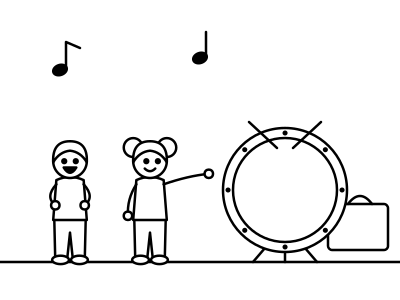
    NARRATOR: It is lunchtime, but Leo's lunchbox is gone. LEO (upset): My lunch was right here in my cubby! AMARA (thinking): Did you take it to music class? LEO (slowly): Maybe... I put it down by the drums. NARRATOR: They hurry down the hall. AMARA (pointing): There it is, behind the big drum! LEO (laughing): My sandwich got to hear the whole concert! NARRATOR: From then on, Leo kept his lunch in his cubby.

    Amara points to Leo's lunchbox peeking out from behind a big drum while Leo laughs.

    Use the script above.

    1. 1.

      Draw a box around each character name.

    2. 2.

      Circle every stage direction.

    3. 3.

      What do stage directions tell a reader?

    4. 4.

      How should Leo sound when he says, 'My lunch was right here in my cubby!'?

      ○ sleepy○ upset and worried○ silly
    5. 5.

      What is the problem, and how is it solved?

    Circle the letter after each c or g. Then write soft c or soft g.

    1. 6.

      city

    2. 7.

      gentle

    3. 8.

      dance

    Challenge: Read the script three times with a partner, switching parts. Which line sounded better each time?

    Science

    Objective: I can plan a survey to collect data about one inherited trait.

    Standards: 3-LS3-1

    Builds on: Needs Week 28 (traits are inherited and vary) and the tally marks used in Week 16. One-minute check: ask, "Which is an inherited trait: a dog's fur color or a dog's name?" (Fur color.)

    New words:
    • survey – checking the same thing about many people or living things, then counting what you find

    Materials: Science notebook, Ruler for drawing the chart, Pencil

    1. Day 166 — Plan a Trait Survey — Wonder Warm-Up · 5 min

      Spaced review from Week 28. Ask: "What is variation?" (Differences among living things of the same kind, like puppies in one litter.) Then the wonder. Ask: "If we looked at 10 dogs, would they all have the same fur? Which fur would we see most?" Your child writes a guess in pencil in the notebook.

    2. Mini-Lesson · 10–15 min

      Say: "A survey checks the same thing about many people or living things. Then we count to find a pattern." Say: "A good survey trait is inherited, easy to see, and has 2 to 4 clear choices." Read this menu aloud. Dogs: fur length (short, medium, long). One kind of garden plant: flower color. People: eye color (brown, blue, green, other) or natural hair (straight, wavy, curly). Give three rules. Check at least 10. Ask permission first. Use kind words, because no trait is better than another. Say: "A small group can fool you. Ten or more gives a truer pattern." Now model a tally chart. Draw three rows: short, medium, long. Say: "I saw seven dogs. Short, short, long, medium, short, long, short." Your child makes one mark for each dog as you read. Ask: "How many had short fur?" (4) "How many marks did you make in all?" (7) "Is a favorite food a good survey trait?" (No. It is a choice, not an inherited trait.) If stuck, say: "Were they born with it? Can you see it? Can you name every choice?"

    3. Investigation / Hands-On · 15–20 min

      Survey Plan. 1) Your child picks one trait from the menu and writes its choices. 2) They list at least 10 to check. For people, use family, neighbors, friends or family photos. For dogs, plan a walk with an adult. For plants, pick 10 plants of one kind. 3) With the ruler, they draw a tally chart with three columns: Choice, Tally, Total. Make one row for each choice. 4) They write the survey question. 5) They predict the most common choice and give a reason. Nothing is counted today. Keep one thing the same in the plan: look at or ask each one the same way. Check the plan together. The trait can be seen. The choices do not overlap. The chart has room for 10 or more marks. Safety: look at dogs you do not know from a distance, with an adult.

    4. Science Notebook Entry · 10 min

      Your child titles a page "Trait Survey Plan" and fills in these frames. "My question: What ___ do ___ have? Choices: ___. I will check ___. I predict ___ will be most common because ___." Sample: "What fur length do dogs near my home have? Choices: short, medium, long. I will check 12 dogs on our walk. I predict short, because I see many short-haired dogs."

    5. Wrap-Up & Exit Ticket · 5 min

      Read the three exit questions aloud; your child answers on paper. Praise choices that are clear and do not overlap.

    Watch for: Choosing something that is not inherited, such as a favorite color, or a trait that is hard to see.

    Try: Ask two questions: "Were they born with it? Can I see it clearly?" If either answer is no, switch to a trait from the menu.

    Exit ticket:
    1. Mia wants to survey "favorite ice cream." Is that an inherited trait? Explain.
    2. Plan a survey of the rose bushes in a park. Name the trait and three choices.
    3. A fur color chart has rows for "brown," "dark" and "light brown." What is the problem?
    Show answers
    1. No. A favorite is a choice. It is not passed from parents to offspring.
    2. Answers vary. Look for: a trait you can see, such as flower color, with choices such as red, pink and white.
    3. The choices overlap. One dog could fit two rows, so the counts would be wrong.

    Support: Pick a trait with only two choices, such as dog fur that is one color or more than one color. The chart then has two rows.

    Extend: Your child plans to record two traits for each individual, in two charts. They predict the most common choice in each chart.

    Homework: Start the survey with 2 family members, 2 dogs or 2 plants. Add their tally marks. Look for: one mark for each, in the correct row.

    Practice page · Week 34, Day 1

    Science

    I can plan a survey about one inherited trait.

    Survey Plan. Pick a trait you can see that has 2 to 4 choices, such as eye color, hair texture, dimples or freckles.

    1. 1.

      My trait: ____

    2. 2.

      Its choices: ____

    3. 3.

      10 people I will ask (with permission):

    4. 4.

      My prediction: the most common choice will be ____.

    Make your blank tally chart.

    ChoiceTallyTotal


    1. 5.

      What is a survey?

    Challenge: Why should the choices not overlap?

    Materials: ruler

    Standards-matched clips that reinforce today's objectives.

    Mathematics

    Types of Quadrilaterals | Trapezoids, Parallelograms, Squares & More

    Math with Mr. J

    Supports: I can explain why every square is a rectangle but not every rectangle is a square.

    3.G.A.1
    Watch on YouTube