Week 7 · Day 4 Practice Pages
Practice page · Week 7, Day 4
Mathematics
I can choose a strategy to solve mixed ×3, ×4 and ×6 facts.
Look: pick a strategy
- ×3: double plus one group. 7 × 3 is 14 and 7, 21.
- ×4: double-double. 7 × 4 is 14, then 28.
- ×6: the ×5 fact plus one group. 7 × 6 is 35 and 7, 42.
Multiply.
- 1.
4 × 8 = ____
- 2.
3 × 7 = ____
- 3.
6 × 5 = ____
- 4.
9 × 4 = ____
- 5.
3 × 3 = ____
- 6.
8 × 6 = ____
Solve.
- 7.
Tomas sets up 6 rows of 4 chairs. How many chairs?
- 8.
Nia buys 3 bags of 9 limes. How many limes?
Challenge: 6 × 4 can be solved as a ×4 fact or a ×6 fact. Show both ways.
Materials: Multiplication chart (optional)
Practice page · Week 7, Day 4
English Language Arts
I can explain how a detail supports the main idea and find causes, effects and sentence types.
Look: sentence types
- Simple (S): one complete thought. Trees grow.
- Compound (C): two thoughts joined with and, but or so. It rained, so we stayed in.
- Complex (X): a part with because, when or if plus a complete thought. When it rains, we stay in.
Why Leaves Change Color
In fall, many trees get ready for winter. The days get shorter, so trees make less of the green coloring in their leaves. When the green fades, yellow and orange colors that were hiding in the leaves show through. Because frozen ground holds little water, trees drop their leaves to save water for winter. Squirrels bury acorns in the fall too.
Answer about the paragraph.
- 1.
Which sentence does NOT support the main idea?
- 2.
Cause: the days get shorter. Effect: ____
- 3.
Finish: "Trees drop their leaves" supports the main idea because ____.
- 4.
S, C or X? The days get shorter, so trees make less green.
○ S○ C○ X - 5.
S, C or X? When the green fades, yellow colors show.
○ S○ C○ X - 6.
S, C or X? Trees drop their leaves.
○ S○ C○ X
Split each word after the open syllable.
- 7.
spider
- 8.
student
Challenge: Rewrite with because: It snowed, so school closed.
Practice page · Week 7, Day 4
Science
I can run fair tests on my latch, find where it fails and make it better.
Run each test on Version 1, make one change, then test Version 2.
| Test | Version 1 | Version 2 |
|---|---|---|
- 1.
Shake test: did it stay shut after 5 gentle shakes?
- 2.
Open test: could you open it with one finger?
- 3.
Strength test: how many paper clips did it hold before it dropped open?
Answer the questions.
- 4.
What is a failure point?
- 5.
My improvement was ____. I know it helped because ____.
Challenge: Version 1 held 7 clips. Version 2 held 12 clips. How many more did Version 2 hold?
Materials: the prototype shoebox cabinet · about 20 paper clips · a timer
Practice page · Week 7, Day 4
Social Studies
I can explain what a treaty is and give more than one view of Indian Removal.
Removal from the Southeast
In 1830 a U.S. law called the Indian Removal Act pushed Native nations in the Southeast to move west of the Mississippi River. The Cherokee, Muscogee (Creek), Choctaw, Chickasaw and Seminole nations were all forced to leave homelands. Many had signed treaties that promised them their land. Many U.S. leaders wanted the land for farms. Other Americans said the treaties should be kept. Thousands of Native people died on the long journeys.
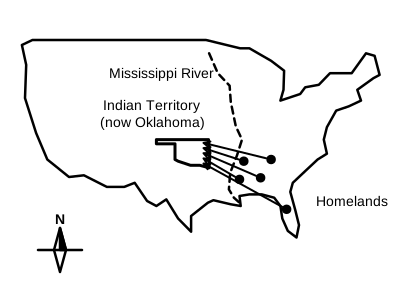
Write what each group might say about the question "Who should live on this land?"
| Group | Their view |
|---|---|
- 1.
U.S. leaders who wanted removal:
- 2.
A Native nation:
- 3.
Americans who spoke against removal:
Answer each question.
- 4.
What is a treaty?
- 5.
The Cherokee call their forced walk west the ____.
- 6.
Where is the Cherokee Nation's capital today?
Challenge: Name one nation besides the Cherokee that was forced to move west.
Materials: U.S. map · yarn