Day 1 · Monday
Mathematics
I can tell the value of each digit in a 3-digit number.
Builds on: Review of Grade 2 place value, needed for rounding and adding this year. One-minute check: ask how many ones make 1 ten (10) and how many tens make 1 hundred (10).
- digit – one of the symbols 0 to 9 that we use to write numbers
- place value – what a digit is worth because of where it sits
- expanded form – a number written as its hundreds plus its tens plus its ones
Materials: Place-value chart drawn on paper (3 columns: hundreds, tens, ones), 30 counters (dried beans, coins or buttons), Notebook, Pencil
5 min · Warm-Up
Grade 2 review, since this is the first week. Ask: "What is 10 more than 45?" (55) Then count by 10s from 230 to 290 together. Count by 100s from 150 to 950. Ask: "Which digit changed when we counted by 10s?" (The tens digit.) "Which changed when we counted by 100s?" (The hundreds digit.)
10–15 min · Mini-Lesson
Lay 10 beans in a row. Say: "Ten ones make 1 ten. I draw a ten as a stick." Draw one stick. Say: "Ten tens make 1 hundred. I draw a hundred as a square." Draw one square. Write 348 in the chart, one digit in each column. Draw 3 squares, 4 sticks and 8 dots. Say: "A digit's value depends on its place." Point to the 3. Ask: "How many hundreds? What are they worth?" (3 hundreds; 300) Ask: "What is the 4 worth?" (4 tens; 40) "What is the 8 worth?" (8 ones; 8) Write 348 = 300 + 40 + 8. Say: "This is expanded form. It shows what each digit is worth." Next write 507. Ask: "How many tens?" (0) Say: "The 0 holds the tens place. Without it, the number would read 57." Write 507 = 500 + 7. Now your child does more. Write 256. Your child draws it, tells each digit's value and writes the expanded form. (2 squares, 5 sticks, 6 dots; 256 = 200 + 50 + 6)
10–15 min · Guided Practice
Your child draws each number, then writes its expanded form. 1) 431 (4 squares, 3 sticks, 1 dot; 431 = 400 + 30 + 1). 2) 620 (6 squares, 2 sticks, no dots; 620 = 600 + 20). 3) You draw 2 squares, no sticks and 9 dots. Ask: "What number is this?" (209) 4) Ask: "What is the 5 worth in 705? In 518? In 153?" (5, 500, 50) If stuck, say: "Point to the digit. Which column is it in? How many squares, sticks or dots is that?"
15–20 min · Independent Practice
Your child writes the value of each digit and the expanded form. 1) 124 (100, 20, 4; 124 = 100 + 20 + 4). 2) 380 (300, 80, 0; 380 = 300 + 80). 3) 615 (615 = 600 + 10 + 5). 4) 999 (999 = 900 + 90 + 9). 5) Ask: "In 999, are all three 9s worth the same?" (No. They are worth 900, 90 and 9.) 6) You draw 5 squares, 3 sticks and 8 dots. Your child writes the number (538). 7) A jar holds 3 bags of 100 buttons, 6 strips of 10 and 5 loose buttons. How many buttons? (365) 8) Maya has 208 stickers. She says the 2 is worth 20. Is she right? (No. The 2 is in the hundreds place, so it is worth 200.) Your child checks each line by reading the expanded form back as one number.
5 min · Exit Ticket
Put the drawings away and read each question aloud; your child writes the answers, then you check them together.
Watch for: Naming the digit instead of its value, such as calling the 4 in 348 just 4.
Try: Ask "4 of what?" Your child points to the 4 sticks and counts them by tens: 10, 20, 30, 40.
Exit ticket (3 questions)
- What is the value of the 7 in 374?
- Write 562 in expanded form.
- What digit is in the hundreds place in 408, and what is it worth?
Show answers
- 70
- 500 + 60 + 2
- 4; it is worth 400
Support: Use 2-digit numbers first, such as 23 and 30. Your child lays beans in rows of 10, then draws sticks and dots.
Extend: Ask for the largest and smallest 3-digit numbers made from the digits 4, 0 and 7 (740 and 407). Ask why 047 does not count. (It is really 47, a 2-digit number.)
Homework: Find three 3-digit numbers at home, such as on a box or a book page. Write each one in expanded form. Sample: 425 = 400 + 20 + 5.
English Language Arts
I can set up my reader's notebook and name the parts of a book.
Builds on: Needs Grade 2 work with book covers, titles and authors. One-minute check: hand your child any book and ask for the title and the author. (Your child points to both on the cover.)
- title page – the first inside page that gives the title, the author and the illustrator
- table of contents – the list near the front that shows each chapter and its starting page
- glossary – a small dictionary at the back of some books
Materials: Spiral notebook for the reader's notebook, Pencil, Two or three chapter books, Sticky notes
5 min · Warm-Up
Word study, Week 1: closed and silent-e syllables. Say: "A closed syllable ends in a consonant, so its vowel is short. A silent e at the end makes the vowel say its name." Write cap, cape, hop, hope, slid, slide. Your child reads each word, then sorts the words into short vowel and long vowel. (Short: cap, hop, slid. Long: cape, hope, slide.) Spaced review from Grade 2. Ask: "What does every sentence need at its start and at its end?" (A capital letter and an end mark.)
10–15 min · Mini-Lesson
Say: "Readers keep a reader's notebook. It helps us remember what we read and what we thought." Your child writes Reader's Notebook on the cover and numbers the first 20 pages. On page 1, draw two columns. Label them What I Read and What I Thought. Now open a chapter book. Say: "Books have parts, and each part has a job." Point to each part and say its job. Cover: shows the title and who made the book. Title page: gives the title, author and illustrator again. Table of contents: lists the chapters and their starting pages. Chapters: the parts of the story. Glossary: a small dictionary at the back of some books. Say: "The author writes the words. The illustrator makes the pictures." Your child writes the five parts on page 2. Ask: "Where would you look to find where Chapter 3 starts?" (The table of contents.)
10–15 min · Guided Practice
Show your child this table of contents from a made-up book called "The Kite on Cedar Hill." Chapter 1: A Gift from Uncle Ray, page 1. Chapter 2: Wind on Cedar Hill, page 9. Chapter 3: The Broken String, page 17. Chapter 4: Up in the Old Oak, page 26. Glossary, page 35. 1) Ask: "You want to reread the part where the string breaks. Which page do you turn to?" (Page 17.) 2) Ask: "What trouble do you think the kite gets into? Which chapter titles tell you?" (Its string breaks and it lands in a tree. Chapters 3 and 4.) 3) Say: "In a title, capitalize the first word, the last word and every important word. Small words like a, the, of, and, in and on stay lowercase in the middle." Ask: "Which word in the book's title is lowercase? Why?" (Only on. It is a small word in the middle.) 4) Write: the Dog and The bone. Ask: "Can you fix my title?" (The Dog and the Bone) If stuck, say: "Is it the first word, the last word or an important word? If yes, use a capital."
15–20 min · Independent Practice
Your child chooses a book and reads for 15 minutes, then marks the stopping place with a sticky note. Then your child writes on page 1 of the notebook. 1) The title and author, with correct capitals. 2) One full sentence under What I Read. 3) One full sentence under What I Thought. Sample: What I Read: In Chapter 1, Tam moves to a new town. What I Thought: I think she will miss her old friends. Look for: correct title capitals; a capital and an end mark on each sentence; a thought, not a second event.
5 min · Exit Ticket
Ask the three questions aloud. Your child may hold a book and point while answering. Write the title in question 3 so your child can see it.
Watch for: Mixing up the author and the illustrator.
Try: Open to the title page. Your child points to each name and says its job: "The author writes the words. The illustrator makes the pictures."
Exit ticket (3 questions)
- Which part of a book is like a small dictionary, and where do you find it?
- You want to know how many chapters a book has. Which part do you check?
- Look at this title: A Day at the Lake. Why are "at" and "the" lowercase?
Show answers
- The glossary. It is at the back of the book.
- The table of contents.
- They are small words in the middle of the title. Only the first, last and important words get capitals.
Support: Write the five book parts on sticky notes. Your child sticks each note on that part of a real book and says its job.
Extend: On page 3, your child writes a reading goal for the year and two steps to reach it. Sample: I will read 20 chapter books. I will read every night and try one new kind of book each month.
Homework: Read your chosen book for 15 to 20 minutes. Add one What I Read and What I Thought line to page 1. Look for a full sentence in each column.
Science
I can explain what a force is and give examples.
Builds on: Needs only everyday experience of moving things by hand. One-minute check: your child moves a book across the table two different ways. (Sample: slide it away, then drag it back.)
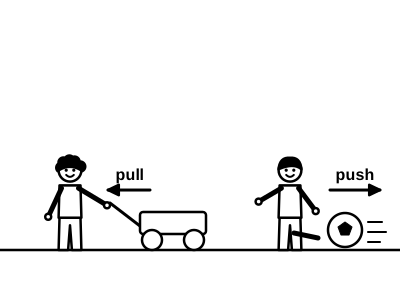
- force – a push or a pull
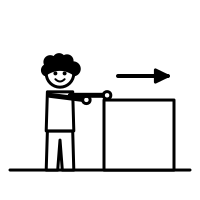
- push – a force that moves a thing away from the pusher
- pull – a force that moves a thing toward the puller
- motion – how a thing moves from place to place
Materials: Toy car, Small ball, 2 pieces of string, about 2 feet each, Tape, A door, a drawer, a chair and a hardcover book, Science notebook, Pencil and 2 crayons of different colors
5 min · Day 1 — What Is a Force? — Wonder Warm-Up
This is the first week, so review from everyday life. Ask: "What makes a playground swing start moving?" (Someone pushes it.) Tape one string to the front of the toy car. Set the car on the table. Wonder question: "How many ways can you make this car move?" Your child tries a finger, a breath and the string. Ask: "What did you do each time?" (pushed or pulled)
10–15 min · Mini-Lesson
Say: "A force is a push or a pull. A push moves a thing away from the pusher. A pull moves a thing toward the puller." Stand at a door. Push it shut. Pull it open. Ask: "Which one was the push?" (Shutting it. The door moved away from you.) Say: "We cannot see a force. We can see the motion it causes." Lifting can be either one. Lift the book on a flat palm. Say: "My hand is under the book. It pushes the book up." Tie the second string around the book and lift by the string. Say: "Now I am above the book. The string pulls it up." Check: "I slide a plate away from me. Push or pull?" (push) "You tug a blanket up to your chin. Push or pull?" (pull) If stuck, say: "Watch the thing. Did it move toward the one doing the work, or away?"
15–20 min · Investigation / Hands-On
1) Your child draws a chart with two columns, PUSH and PULL. 2) Do six actions, one at a time. Open a drawer. Close the drawer. Slide the book away across the table. Roll the ball across the floor. Drag a chair toward you. Lift the book on a flat palm. 3) Before each action, your child guesses push or pull. 4) After each action, your child writes it in a column. Look for one thing each time: did the object move toward the person or away? Expect pulls for opening the drawer and dragging the chair. Expect pushes for the other four. If an answer differs, repeat the action slowly and watch which way the object moves.
10 min · Science Notebook Entry
Title a page "Forces and Motion" and add the date. Your child writes: "A force is a push or a pull." Then your child draws three of the actions, each with an arrow pointing the way the force went. Use one crayon for push arrows and the other for pull arrows. Sentence frame: "When I ___, I used a ___ because the ___ moved ___ me." Sample: "When I opened the drawer, I used a pull because the drawer moved toward me."
5 min · Wrap-Up & Exit Ticket
Your child answers the three exit questions aloud or in writing. Praise answers that name the object and which way it moved.
Watch for: Calling every lift a pull, or choosing push or pull by how hard the action felt.
Try: Lift the book from below on a flat palm, then from above by the string. Ask each time: "Is the hand pushing it away or pulling it closer?"
Exit ticket (3 questions)
- You cannot see a force. How can you tell that a force acted on a toy car?
- You press a doorbell button. Is that a push or a pull? How do you know?
- Name one pull you made today. Which way did the thing move?
Show answers
- The car moved, or its motion changed. Accept: it started rolling, stopped or turned.
- A push. The button moved away from my finger.
- Answers vary. Look for: a real pull where the object moved toward your child, such as pulling a drawer open.
Support: Act out each action first and say "away, push" or "toward, pull" as you do it. Your child copies you, then sorts only four actions.
Extend: Your child finds one object that can be moved with a push and with a pull, such as a door. They draw both, with an arrow for each force.
Homework: At dinner, your child notices 5 forces, writes each one and labels it push or pull. Look for labels that match the motion. Sample: passing a plate away is a push; pulling out a chair is a pull.