3
    Third GradePowered by ThirdGrade.com

    Standards this week

    Social Studies

    • D2.Geo.1 Construct maps and other graphic representations of familiar and unfamiliar places.Day 1
    • D2.Geo.2 Use maps, satellite images, and other models to explain relationships between places.Day 1, 2, 3, 4, 5
    • D2.Geo.5.3-5 Explain how the cultural and environmental characteristics of places change over time.Day 2, 5
    • D2.Geo.8.3-5 Day 3
    • D2.Geo.10.3-5 Day 4

    Mathematics

    • 3.OA.A.2 Interpret whole-number quotients as equal sharing or grouping.Day 1, 2, 3, 5
    • 3.OA.B.6 Understand division as an unknown-factor problem.Day 4, 5
    • 3.OA.C.7 Fluently multiply and divide within 100; know products of two one-digit numbers.Day 4

    English Language Arts

    • W.3.3 Write narratives with established situation, characters, and event sequences.Day 1, 5
    • SL.3.1 Engage effectively in a range of collaborative discussions, building on others' ideas.Day 1
    • W.3.3.A Establish a situation and introduce a narrator and/or characters; organize an event sequence.Day 2, 3, 5
    • SL.3.1.C Day 2
    • SL.3.3 Ask and answer questions about information from a speaker, offering appropriate elaboration and detail.Day 2
    • RL.3.7 Explain how illustrations contribute to what is conveyed by the words in a story.Day 3
    • W.3.3.C Use temporal words and phrases to signal event order.Day 4, 5
    • RI.3.3 Describe relationships between events, ideas, or steps using sequence and cause/effect.Day 4
    • L.3.1.D Day 4
    • L.3.1.E Day 4
    • L.3.2.E Day 4

    Science

    • 3-LS4-3 Construct an argument with evidence that in a particular habitat some organisms can survive well, some survive less well, and some cannot survive at all.Day 1, 2, 3, 4, 5
    • 3-LS1-1 Develop models to describe that organisms have unique and diverse life cycles.Day 2, 5

    See what your state adds or places differently

    Suggested daily schedule
    8:30–8:45 AM15 minMorning Circle / Read-Aloud / Calendar
    8:45–10:00 AM75 minEnglish Language Arts
    10:00–11:00 AM60 minMathematics
    11:00–11:15 AM15 minSnack and Movement Break
    11:15–12:00 PM30–45 minScience (every day)
    12:00–12:45 PM30–45 minSocial Studies (every day)
    12:45–1:30 PM45 minLunch and Choice Time
    1:30–2:15 PM45 minSpecials: PE / Art / Music (rotating)
    2:15–2:45 PM30 minIndependent Reading & Journaling

    Mark Week 10 complete

    0 / 4 done

    Saved in this browser

    Day 1 · Monday

    Social Studies

    I can find the United States on a globe and name its neighbors and oceans.

    D2.Geo.1.3-5D2.Geo.2.3-5

    Builds on: Needs Week 3: globes, maps and the compass rose. One-minute check: ask which direction is opposite north (south) and which is opposite east (west).

    New words:
    • border – the line where one country or state ends and the next one begins

    Materials: Globe, Flat map of North America or the United States, 7 sticky notes, Notebook, Pencil and colored pencils

    5 min · Warm-Up

    Spaced review from Week 3. Ask: "How are a globe and a map different?" (A globe is round like Earth. A map is flat and easy to carry.) Then spin the globe. Say: "Our country is somewhere on this ball. How could you tell a visitor exactly where it is?" Take guesses.

    10–15 min · Mini-Lesson

    Find North America on the globe. Say: "The United States is a country on the continent of North America." Trace its edge with a finger. Say: "A border is the line where one country ends and the next begins." Point and name each neighbor. Canada is north. Mexico is south. The Atlantic Ocean is east. The Pacific Ocean is west. Say: "Our country has 50 states. Forty-eight of them touch each other." Show Alaska. Say: "Alaska is far to the northwest. Canada lies between Alaska and the other states." Show Hawaii. Say: "Hawaii is a chain of islands far out in the Pacific." Ask: "Which country is south of us?" (Mexico) "Which ocean is east of us?" (Atlantic) "Which state is made of islands?" (Hawaii) If stuck, say: "Put your finger on the United States. Slide it up. That is north. What do you touch?"

    15–20 min · Activity / Source Work

    Globe hunt. 1) Label the seven sticky notes: United States, Canada, Mexico, Atlantic Ocean, Pacific Ocean, Alaska, Hawaii. 2) Your child sticks each note in the right place on the globe. 3) For each note ask: "Which direction is it from the 48 states?" (Canada north, Mexico south, Atlantic east, Pacific west, Alaska northwest, Hawaii southwest.) 4) Open the flat map. Many maps print Alaska and Hawaii in small corner boxes. Ask: "Which shows where they really are, the globe or the boxes? What is your evidence?" (The globe. On it, Alaska touches Canada and Hawaii sits far out in the ocean.) 5) Your child moves the notes to the map. If a note lands wrong, go back to the globe and slide a finger from the 48 states.

    10 min · Notebook Entry

    Your child sketches a rough outline of North America and shades the United States. Labels: Canada, Mexico, Atlantic Ocean, Pacific Ocean, Alaska, Hawaii. Add a compass rose with N, S, E and W. Then finish the frame: "The United States is on the continent of ___. ___ is to the north and ___ is to the south." (North America; Canada; Mexico.) Look for Canada above the shaded part and Mexico below it.

    5 min · Exit Ticket

    Read each question aloud. Your child answers in the notebook, then proves each answer on the globe. Praise every direction word used correctly.

    Watch for: Thinking Alaska and Hawaii sit just below the other states, because flat maps print them in corner boxes.

    Try: Show both on the globe first. Then point to the map boxes and say: "These boxes move them so they fit on the page."

    Exit ticket (3 questions)
    1. What is a border?
    2. Which direction would you travel from the 48 touching states to reach Alaska?
    3. A family drives from the United States into Mexico. Which direction are they heading?
    Show answers
    1. The line where one country or state ends and the next one begins.
    2. Northwest. Also accept north and west.
    3. South.

    Support: Keep the labeled flat map beside the globe so your child can match names to shapes. Place the two neighbor countries first, then the oceans.

    Extend: Your child finds your own state and gives two direction clues. Sample: "south of Canada and west of the Atlantic Ocean."

    Homework: Your child shows a family member the United States on a globe or map. They name its two neighbors and two oceans. Look for the right direction word with each one.

    Mathematics

    I can share a total into equal groups to show what division means.

    3.OA.A.2

    Builds on: Needs equal groups from Week 4: some groups with the same number in each. One-minute check: your child builds 3 groups of 5 with beans and tells the total (15).

    New words:
    • divide – to split a total into equal groups
    • share equally – to give every group the same number, with none left over
    • divided by (÷) – the sign and words we use when we divide

    Materials: 30 counters (dried beans, coins or buttons), 6 paper plates or cups, Notebook, Pencil

    5 min · Warm-Up

    Spaced review from Week 4. Say: "Build 4 groups of 5." Your child builds it with beans and writes the multiplication sentence (4 × 5 = 20). Then practice ×2, ×5 and ×10 facts with no clock. Ask 7 × 2, 8 × 5 and 6 × 10 (14, 40, 60). Your child tells how one answer was found.

    10–15 min · Mini-Lesson

    Say: "Today we divide. To divide is to split a total into equal groups." Count out 12 beans and set out 4 plates. Say: "Four friends share 12 cookies. They share equally, so each friend gets the same number. Each plate is one friend." Deal one bean to each plate, round and round. Say "one for you, one for you" until the beans are gone. Ask: "Does every plate have the same number?" (Yes.) "How many are on each plate?" (3) "Are any left over?" (No.) Write 12 ÷ 4 = 3. Point to each part and read: "Twelve divided by 4 equals 3." Say: "12 is the total. 4 is the number of groups. 3 is how many in each group." Say: "So 12 ÷ 4 = 3. Each friend gets 3 cookies." Now your child does more. Say: "Share 20 beans equally onto 5 plates." Your child deals, counts one plate and writes the division. (20 ÷ 5 = 4) Ask: "What does the 4 tell us?" (There are 4 beans on each plate.)

    10–15 min · Guided Practice

    Your child deals beans onto plates, then draws circles with dots and writes the division. 1) Share 15 beans onto 3 plates (15 ÷ 3 = 5). 2) Share 18 beans onto 6 plates (18 ÷ 6 = 3). 3) Share 14 beans onto 2 plates (14 ÷ 2 = 7). 4) Put 5, 4 and 3 beans on three plates. Ask: "Is this a fair share of 12?" (No. Move one bean so each plate has 4.) If stuck, say: "Set out the plates first. How many groups? Now deal one bean at a time until none are left."

    15–20 min · Independent Practice

    Your child draws a circle for each group, deals dots one at a time and writes the division. Beans are fine for any problem. 1) 16 ÷ 4 (4). 2) 10 ÷ 5 (2). 3) 18 ÷ 3 (6). 4) 24 ÷ 6 (4). 5) 30 ÷ 5 (6). 6) You draw 3 circles with 7 dots in each. Ask: "What division does this show?" (21 ÷ 3 = 7) 7) Maya shares 16 grapes equally onto 2 plates. How many grapes are on each plate? (16 ÷ 2 = 8) 8) Five children share 25 stickers equally. How many stickers does each child get? (25 ÷ 5 = 5) Check each drawing. All circles must match, with no dots left over.

    5 min · Exit Ticket

    Put the beans and plates away. Read each question aloud; your child answers on paper and may draw.

    Watch for: Uneven dealing: some plates get more beans, or your child stops before all the beans are used.

    Try: Your child deals one bean at a time, in order around the plates. Then your child counts every plate. All must match.

    Fact fluency: ×2, ×5, ×10 facts
    Exit ticket (3 questions)
    1. What does 18 ÷ 2 mean when you share?
    2. Draw 28 dots shared equally into 4 circles. Write the division.
    3. Three children share 9 crackers equally. How many crackers does each child get?
    Show answers
    1. 18 things are shared equally into 2 groups. There are 9 in each group.
    2. 28 ÷ 4 = 7 (drawing shows 4 circles with 7 dots in each)
    3. 3 crackers (9 ÷ 3 = 3)

    Support: Use 6, 8 or 10 beans and only 2 plates. Your child deals, then says "__ shared onto 2 plates is __ each."

    Extend: Your child writes a sharing story for 30 ÷ 6, then solves it with a drawing. Answer: 5 in each group. Ask what each number means in the story.

    Homework: Your child shares 20 small objects equally into 2 cups, draws it and writes the division. Answer: 20 ÷ 2 = 10, so 10 in each cup.

    English Language Arts

    I can tell what a narrative is and name its five parts.

    W.3.3SL.3.1

    Builds on: Needs the Week 1 story parts: characters, setting, and beginning, middle and end. One-minute check: ask, "What does the setting of a story tell?" (when and where it happens)

    New words:
    • narrative – a story, real or made up, that tells what happened
    • narrator – the voice that tells the story
    • personal narrative – a true story about yourself, told with the word I

    Materials: Writer's notebook (start a "Narrative Writing" section), A recipe or how-to card from the kitchen, Pencil, Highlighter

    5 min · Warm-Up

    Word study, about 3 minutes. Say: "This week's rule is doubling. A short word that ends in one short vowel and one consonant doubles its last letter before -ed or -ing." Write hop, then hopped. Circle the pp. Your child reads stopped, hugged, hopped, running, swimming and shopping, then sorts them under -ed and -ing. Ask: "Which letter doubled in swimming?" (m) Spaced review from Week 8. Ask: "What are the four parts of an opinion paragraph?" (opinion, reasons, linking words, conclusion)

    10–15 min · Mini-Lesson

    Read one step from the recipe card. Then tell a 30-second true story, such as the morning the smoke alarm rang over burnt toast. Ask: "Which one told a story?" (the toast one) Say: "A story is called a narrative. It tells what happened, real or made up. Its job is to entertain or share an experience." Write the five parts in the notebook. Narrator: who tells it. Characters: who is in it. Setting: when and where. Events in order. Ending. Say: "When a writer tells a true story about herself and says I, it is a personal narrative." Think aloud with your toast story: "I told it, so I am the narrator. The characters were you and me. The setting was our kitchen at breakfast. The events were burnt toast, a loud alarm and a waving towel. The ending was cereal." Ask: "Why is the recipe not a narrative? Start with I think." (It only gives steps. Nobody does anything in it.) Add on: "I agree, and also it has no ending."

    10–15 min · Guided Practice

    Read aloud "The Lost Mitten": On the first snowy Saturday of winter, my little brother Teo and I built a snow fort behind our building. The snow squeaked under our boots, and our cheeks stung from the cold. When we went inside for cocoa, Teo started to cry. His red mitten was gone! We pulled our boots back on and searched the whole yard. Finally, I spotted a tiny red thumb poking out of the fort wall. We had built the mitten right into our fort! Teo laughed so hard he snorted cocoa. Your child highlights each part on the notebook list as you find it. 1) Ask: "Who is the narrator? Which word tells you?" (Teo's older brother or sister; the word I) 2) Ask: "Name every character." (Teo and the narrator) 3) Ask: "What is the setting?" (a snowy Saturday, behind their building) 4) Ask: "Tell three events in order. How does it end?" (They build a fort. The mitten is lost. They find it in the wall. Teo laughs.) If stuck, say: "Listen again for the words that tell when and where."

    15–20 min · Independent Practice

    Your child titles a page "Stories I Could Tell" and lists five moments from real life, one line each. 1) A first time. 2) A surprise. 3) A mistake. 4) A proud moment. 5) A funny moment. Sample line: the day the hamster escaped into the couch. 6) Your child circles the one remembered best and adds who was there and where it happened. Look for: one line each, and one short happening rather than a whole trip. The circled idea has a who and a where beside it.

    5 min · Exit Ticket

    Ask the three questions aloud while your child answers in the notebook. If question 2 is missed, reread the notebook list of five parts together.

    Watch for: Mixing up narrator and character, or thinking the narrator cannot be in the story.

    Try: Reread a sentence with I in it. Say: "The narrator is the person saying I. Here the narrator is also a character."

    Exit ticket (3 questions)
    1. What is a narrative?
    2. A true story begins, "I dropped my ice cream." Who is telling it, and what kind of narrative is it?
    3. Look at the idea you circled. Who are the characters, and what is the setting?
    Show answers
    1. A story, real or made up, that tells what happened.
    2. The writer is the narrator, shown by the word I. It is a personal narrative.
    3. Answers vary. Look for: at least one named person, plus a time and a place.

    Support: Take one part at a time. Reread the story and stop when your child hears the setting. Then listen again for the characters.

    Extend: Your child retells "The Lost Mitten" in three sentences with Teo as the narrator, using I.

    Homework: Read your own book for 15 minutes. Then tell a family member who the narrator is. Look for: your child says whether the narrator uses I or stands outside the story.

    Science

    I can explain that an ecosystem is all the living and nonliving things in one place and how they affect each other.

    3-LS4-3

    Builds on: Needs everyday knowledge of plants, animals, sun and water from time spent outside. One-minute check: ask, "Is a tree alive? Is a rock alive?" (Yes. No.)

    New words:
    • ecosystem – all the living and nonliving things in one place, and the ways they affect each other
    • nonliving – not alive, like water, air, rocks and sunlight

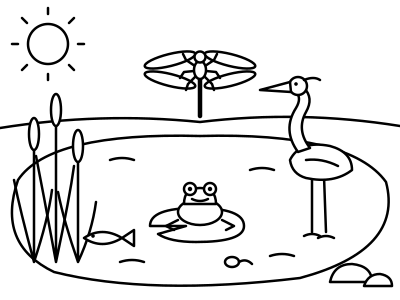
    Materials: Science notebook, Pencil, Green and blue colored pencils, Clipboard or hardcover book to write on, Picture of a pond or forest (library book, calendar or photo)

    5 min · Day 46 — What Is an Ecosystem? — Wonder Warm-Up

    Spaced review from Week 4. Ask: "Name a force that can pull without touching." (Magnetism, static electricity or gravity.) Show the picture. Your child names 5 things in it. Write them in two piles with no labels: living things in one pile, nonliving things in the other. Ask: "How did I sort these?" (Alive and not alive.) Say: "Today's wonder: how do the things in one place need each other?"

    10–15 min · Mini-Lesson

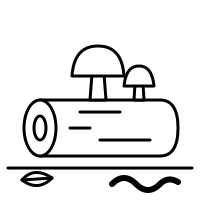
    Say: "An ecosystem is all the living and nonliving things in one place. It is also the ways they affect each other." Point to the picture. Say: "Living parts are plants, animals and mushrooms. Nonliving parts are sunlight, water, air, soil and rocks." Trace one link with your finger, such as: "This plant needs sunlight and water. This animal eats the plant." Ask: "What might happen to pond fish if the pond dried up?" (They could not live there.) Ask: "Is sunlight living or nonliving?" (Nonliving.) Ask: "Can an ecosystem be small?" (Yes. A rotting log or a patch of lawn is one.) If stuck, say: "Point to one thing. Does it grow and need food or water? Then it is living. Now find something it needs."

    15–20 min · Investigation / Hands-On

    Ecosystem Walk. Safety: an adult stays close, and nothing gets picked or tasted. 1) Go outside, or sit at a window, for 10 minutes. Bring the notebook on the clipboard. 2) Your child lists 10 things they notice. 3) They circle living things in green and underline nonliving things in blue. 4) They draw a line between two things that affect each other and say the link. Sample: "The tree shades the grass." 5) Make a two-column tally, Living and Nonliving, and count each. Expect at least 3 in each column. If every item is living, say: "Look up and look down. What here is not alive?" (Sun, air, soil, a path.) Real results vary. Look for the pattern: every place has both kinds.

    10 min · Science Notebook Entry

    Start a section titled "Ecosystems" and write the date. Give these frames: "An ecosystem is ___." "In my ecosystem, the ___ needs the ___ because ___." Look for something like: "An ecosystem is the living and nonliving things in a place and how they affect each other. In my ecosystem, the robin needs the soil because worms live there."

    5 min · Wrap-Up & Exit Ticket

    Ask the three questions aloud, or let your child write the answers. Praise any answer that tells how two parts affect each other.

    Watch for: Thinking an ecosystem is only the animals, or only a wild place far away such as a jungle.

    Try: Point to a sidewalk crack. Ask: "Is there sun, water, soil and something living here?" An ecosystem can be right outside the door.

    Exit ticket (3 questions)
    1. A garden has bees, sunlight, tomato plants and rain. Which two are nonliving?
    2. Tell one way a living thing on your walk needed a nonliving thing.
    3. A puddle has mud, water and tiny bugs. Is it an ecosystem? Tell why.
    Show answers
    1. Sunlight and rain.
    2. Answers vary. Look for: a real link, such as "the grass needs sunlight to grow" or "the bird drinks from a puddle."
    3. Yes. It has living and nonliving things in one place, and they affect each other.

    Support: Your child draws and labels each item in two boxes marked Living and Nonliving. Writing can wait.

    Extend: Study a tiny ecosystem under one rock or log. List 5 living and 5 nonliving parts. Look without touching, then set the rock back gently.

    Homework: Spend 10 minutes at a window or in the yard. Write 3 sentences about one ecosystem. Look for one living thing, one nonliving thing and how they affect each other.
    Day 2 · Tuesday

    Social Studies

    I can find the Rocky Mountains and the Appalachian Mountains and explain how they are different.

    D2.Geo.2.3-5D2.Geo.5.3-5

    Builds on: Needs Week 4: landforms and reading a physical map. One-minute check: ask how a mountain is different from a hill (a mountain is taller and steeper).

    New words:
    • mountain range – a long line of mountains

    Materials: Physical map of the United States, 2 sheets of scrap paper, Brown and green crayons, Notebook, Pencil

    5 min · Warm-Up

    Spaced review from Week 4. Ask: "What is a plain?" (Wide, flat land.) Then open the physical map. Say: "The West looks brown and bumpy. The East looks greener and smoother. Why might that be?" Take guesses.

    10–15 min · Mini-Lesson

    Say: "A mountain range is a long line of mountains. Our country has two big ones." Trace the Rockies with a finger. Say: "The Rocky Mountains are in the West. They run from Canada down to New Mexico. They are tall and jagged. Many peaks rise above 14,000 feet." Trace the Appalachians. Say: "The Appalachian Mountains are in the East. In our country they run from Maine to Alabama. Their highest peak is under 7,000 feet." Say: "The Appalachians are far older. Wind, rain and ice have worn them lower and rounder over millions of years." In the notebook, draw a sharp zigzag line and a low wavy line. Ask: "Which line is the Rockies?" (The zigzag.) "Which range is older?" (The Appalachians.) "Why are older mountains lower?" (Wind, rain and ice wore them down.) If stuck, say: "Think of a sand castle in the rain. Does it grow taller or wear down?"

    15–20 min · Activity / Source Work

    Trace and model. 1) Your child traces each range on the map with a finger and names two states it crosses. (Rockies: Montana, Wyoming, Colorado or New Mexico. Appalachians: Pennsylvania, West Virginia or North Carolina, among others.) 2) Crumple both sheets of paper into sharp peaks. Leave one alone. That is the Rockies. 3) Press the other sheet gently with a flat hand. Keep the paper the same; change only the pressing. That is the Appalachians after long weathering. 4) Your child compares the two models: taller or lower, sharp or rounded. 5) Ask: "Which range would be harder to cross in a wagon? Use your model as evidence." (The Rockies. The peaks are taller and steeper.) 6) Ask: "Why did early roads follow low gaps and valleys?" (Travel and building were easier there.)

    10 min · Notebook Entry

    Your child draws a chart with two columns: Rocky Mountains and Appalachian Mountains. Four rows: where, height, shape, age. Look for: West and East; taller and lower; jagged and rounded; younger and older. Add a brown sketch of the Rockies and a green sketch of the Appalachians. Then finish the frame: "The ___ are lower because ___." (The Appalachians are lower because wind, rain and ice wore them down.)

    5 min · Exit Ticket

    Read each question aloud. Your child writes the answers, then points to each range on the map. Praise answers that give a reason.

    Watch for: Thinking older mountains must be taller because they had more time to grow.

    Try: Press the crumpled paper a little flatter each time. Say: "Each press is a million years of rain. Older means more worn, so lower."

    Exit ticket (3 questions)
    1. A hiker stands among tall, jagged peaks in Colorado. Which mountain range is she in?
    2. What wore the Appalachian Mountains lower and rounder?
    3. What is a mountain range?
    Show answers
    1. The Rocky Mountains.
    2. Wind, rain and ice, over millions of years.
    3. A long line of mountains.

    Support: Sketch a simple United States outline and mark both ranges with dotted lines. Your child traces them in brown and green before using the map.

    Extend: Your child finds Denali in Alaska. It is the tallest mountain in North America, about 20,300 feet high. Add it under the chart and note that it is in neither range.

    Homework: Your child finds a picture of a mountain in a book or calendar. They tell a family member which range it looks more like. Look for a reason about shape.

    Mathematics

    I can make equal groups of a given size to solve a division problem.

    3.OA.A.2

    Builds on: Needs sharing from Day 1 and skip-counting from Week 4. One-minute check: your child shares 10 beans into 2 cups and writes the division (10 ÷ 2 = 5).

    New words:
    • grouping – making groups of the same size to find how many groups there are

    Materials: 30 counters (dried beans, coins or buttons), 6 cups or small bags, Notebook, Pencil

    5 min · Warm-Up

    Spaced review from Week 2. Your child solves 348 + 276 in columns (624). Then practice ×3 and ×4 facts with no clock. Ask 3 × 6, 4 × 7 and 3 × 9 (18, 28, 27). Your child tells how one answer was found.

    10–15 min · Mini-Lesson

    Say: "Yesterday we knew how many groups. Today we know how many go in each group." Count out 12 beans. Say: "I have 12 cookies. I put 3 in each bag. How many bags can I fill?" Put 3 beans in a cup. Fill more cups with 3 beans until none are left. Ask: "How many are in each cup?" (3) "How many cups did I fill?" (4) Write 12 ÷ 3 = 4. Say: "12 is the total. 3 is how many in each group. 4 is the number of groups." Count the cups by 3s to check: 3, 6, 9, 12. Say: "This is grouping. So 12 ÷ 3 = 4. I can fill 4 bags." Now your child does more. Say: "You have 20 pencils. Put 5 in each cup. How many cups?" Your child fills cups and writes the division. (20 ÷ 5 = 4) Ask: "What does the 4 tell us?" (There are 4 cups.) Ask: "Yesterday you shared 20 beans into 5 groups. What did the 4 mean then?" (4 beans in each group.) Say: "Sharing finds how many in each group. Grouping finds how many groups."

    10–15 min · Guided Practice

    Your child fills cups, then draws the beans and rings each group. 1) 18 beans, 6 in each cup. How many cups? (18 ÷ 6 = 3) 2) 15 beans, 3 in each cup. (15 ÷ 3 = 5) Count the cups by 3s to check: 3, 6, 9, 12, 15. 3) 24 beans, 4 in each cup. (24 ÷ 4 = 6) 4) Say: "Deal 12 crackers to 4 children. Then put 12 crackers in bags of 4." Ask: "Which is sharing? Which is grouping?" (The first is sharing. The second is grouping.) If stuck, say: "How many go in one group? Make one group. Keep making groups until nothing is left."

    15–20 min · Independent Practice

    Your child reads each ÷ sign as "in groups of." Problem 1 is "10 in groups of 2." Your child draws dots for the total, rings equal groups and writes the division. 1) 10 ÷ 2 (5). 2) 20 ÷ 4 (5). 3) 21 ÷ 3 (7). 4) 30 ÷ 6 (5). 5) 18 ÷ 2 (9). 6) You draw 28 dots with rings around groups of 7. Ask: "What division does this show?" (28 ÷ 7 = 4) 7) Hamid has 24 stickers. He puts 3 on each page. How many pages does he fill? (24 ÷ 3 = 8) 8) A baker has 30 rolls. She puts 5 in each bag. How many bags does she fill? (30 ÷ 5 = 6) Your child skip-counts by the group size to check each one.

    5 min · Exit Ticket

    Put the beans and cups away. Read each question aloud; your child answers on paper and may draw.

    Watch for: Mixing up the numbers: making 3 groups when the problem says groups of 3.

    Try: Put 3 beans in one cup as a model. Say: "Each cup holds 3." Your child then fills the other cups the same way.

    Fact fluency: ×3, ×4 facts
    Exit ticket (3 questions)
    1. In a grouping problem, what do you already know and what do you find?
    2. Ana has 14 socks. She makes groups of 2. How many groups does she make? Write the division.
    3. Is this sharing or grouping? "Deal 15 cards equally to 5 players."
    Show answers
    1. You know how many are in each group. You find the number of groups.
    2. 7 groups (14 ÷ 2 = 7)
    3. Sharing. You know the number of groups (5) and find how many each player gets.

    Support: Use 6, 8 or 10 beans and groups of 2. Your child says "a group of 2" for each pile, then counts the piles.

    Extend: Your child draws 16 ÷ 8 two ways and tells how the drawings differ. Look for: sharing shows 8 circles of 2; grouping shows 2 rings of 8.

    Homework: Your child puts 18 small objects into piles of 3, draws the piles and writes the division. Answer: 18 ÷ 3 = 6, so 6 piles.

    English Language Arts

    I can choose one small moment that makes a strong, focused story.

    W.3.3.ASL.3.1.CSL.3.3

    Builds on: Needs yesterday's list of five moments and the five narrative parts. One-minute check: ask, "Name three of the five parts of a narrative." (Any three: narrator, characters, setting, events in order, ending.)

    New words:
    • small moment – one short happening, only a few minutes long, with a clear start and end

    Materials: Writer's notebook with yesterday's list of five moments, Pencil, Three index cards

    5 min · Warm-Up

    Word study, about 3 minutes. Write drop + ed. Say: "One short vowel, one consonant, so double it." Write dropped. Your child builds grab + ed, clap + ed, get + ing and swim + ing, then underlines the doubled letters. (grabbed, clapped, getting, swimming) Ask: "Why does jump not double in jumped?" (It ends in two consonants.) Spaced review from Week 7. Ask: "Every paragraph has a main idea. What does that mean?" (It is what the paragraph is mostly about.)

    10–15 min · Mini-Lesson

    Say: "Today you pick one small moment. A small moment is one short happening." Read two pieces aloud. "My Trip to the Beach": We drove to the beach. We swam. We ate lunch. We built a castle. Then we went home. "The Wave That Stole My Shovel": I was digging a moat with my red shovel when a wave rushed up the sand. Cold water slapped my knees. When the wave slid back, my shovel was sailing away. I splashed after it and caught the handle just in time. Ask: "Which one could you picture?" (the shovel one) Say: "The first is a list of a whole day. The second stays inside one minute, so there is room for details." Write the three tests on index cards. Test 1: It happened, or it could have. Test 2: It has a clear start and end. Test 3: I remember details I can see, hear or feel. Think aloud: "I test the wave story. Could it happen? Yes. It starts when the wave comes. It ends when I catch the shovel. I remember the red shovel and the cold water. It passes all three."

    10–15 min · Guided Practice

    1) Your child holds the first idea from yesterday's list against the cards and says if it passes, and why. You add on: "I agree, and also..." or "My idea is different because..." 2) Take turns going first on the other ideas. Cross out any idea that fails a test. 3) Test the topic "Winter" together. (It fails. It has no clear start or end.) 4) Ask: "What one minute of winter do you remember best?" (Sample: the morning my sled hit the snowman.) If stuck, say: "Picture a one-minute movie. What are the first and last scenes?"

    15–20 min · Independent Practice

    1) Your child picks the strongest idea left. 2) Your child writes a title that names the moment. 3) Your child writes one summary sentence telling who, where and what happened. Model: The Day My Bike Chain Snapped: My chain broke halfway up Hill Street, and I walked my bike home in the rain. 4) Your child tells the moment aloud. You ask two detail questions, such as "What did the rain sound like?" Your child answers and writes each answer as a note. 5) Swap. You tell a one-minute moment, and your child asks you one question about a detail. Look for: a title naming one short event, a summary with who, where and what, and two detail notes.

    5 min · Exit Ticket

    Ask the three questions. For question 3, check that the first and last things happen only minutes apart.

    Watch for: Picking a topic that is really a list of events, such as "our vacation," with no clear start and end.

    Try: Ask: "If this were a one-minute movie, what would the first and last scenes be?" Keep only that slice.

    Exit ticket (3 questions)
    1. Which is a small moment: "All About My Dog" or "The Time My Dog Ate My Sandwich"?
    2. Name two of the three tests for a small moment.
    3. Read your title. What are the first thing and the last thing that happen in your moment?
    Show answers
    1. "The Time My Dog Ate My Sandwich."
    2. Any two: it happened or could have; it has a clear start and end; I remember details I can see, hear or feel.
    3. Answers vary. Look for: a clear first and last event that are close together in time.

    Support: If choosing is hard, name one place, such as the kitchen. Ask: "Tell me one thing that happened right here." Your child picks from those.

    Extend: Your child writes one title that is too big, then shrinks it into three small-moment titles.

    Homework: Read your own book for 15 minutes. Then find one small moment in it. Tell a family member where that moment starts and ends. Look for: a scene that lasts only a few minutes.

    Science

    I can use a checklist to decide if something is living, was once living, or was never alive.

    3-LS1-13-LS4-3

    Builds on: Needs Day 1: an ecosystem has living and nonliving parts. One-minute check: your child names one living and one nonliving thing from yesterday's walk (sample: grass, sunlight).

    New words:
    • reproduce – to make more living things of the same kind
    • once living – not alive now, but it was part of a living thing before

    Materials: 10 things to sort: 1 dry bean, a houseplant, a rock, a cup of water, a metal spoon, a coin, a dry fallen leaf, a wooden spoon, a feather or seashell, and your child, 2 more dry beans, a damp paper towel and a zip-top bag (seed test), Three index cards labeled Living, Once Living, Never Alive, Sheet of paper for the checklist, Science notebook, Pencil

    5 min · Day 47 — Living vs. Nonliving — Wonder Warm-Up

    Spaced review from Week 3. Ask: "What does friction do to a box sliding across the floor?" (It slows the box until it stops.) Then pose a puzzle: "A car moves and uses fuel. Is it alive?" Let your child argue for a minute. Say: "Scientists do not decide from one clue. They use a checklist. Let's build one."

    10–15 min · Mini-Lesson

    Write the Living Checklist on paper as you say it. Say: "Living things need food. They need water and air. They grow. They respond to what is around them. Their kind can reproduce, which means make more of itself." Test the car aloud. Say: "It moves and uses fuel. It does not grow, and cars cannot make baby cars. It was never alive." Hold up the wooden spoon. Say: "This wood was part of a tree. It is once living." Hold up the bean. Say: "A dry seed is resting. With water and warmth it can sprout, so it is living." Ask: "A river moves. Is it alive?" (No. It does not eat or reproduce.) Ask: "A houseplant stays still. Is it alive?" (Yes. It grows and needs water.) If stuck, say: "Ask two things. Does it grow? Can its kind make more of itself?"

    15–20 min · Investigation / Hands-On

    Sorting Investigation. Safety: do not eat the test beans. 1) Lay out the three cards and the things to sort. Your child counts as one item. 2) Your child predicts a group for each and places it. 3) For each, run the checklist aloud and move anything that fails. 4) Check the three groups. Living: bean, houseplant, your child. Once living: leaf, wooden spoon, feather or shell. Never alive: rock, water, metal spoon, coin. 5) Start a seed test. Fold 2 beans into the damp towel and seal it in the bag. Keep it warm and look each day. Many beans show a root in 3 to 5 days. Some never sprout, and those may no longer be alive. Real results vary. Look for the pattern.

    10 min · Science Notebook Entry

    Draw a three-column chart: Living, Once Living, Never Alive. Your child writes all 10 items in the right columns. Then give the frame: "A seed is living because ___." Look for: "it can sprout and grow when it gets water and warmth." Add a box labeled "Seed Test" with today's date and a drawing of the beans.

    5 min · Wrap-Up & Exit Ticket

    Ask the three questions aloud. Praise answers that give a reason from the checklist, not just yes or no.

    Watch for: Deciding that anything that moves is alive, such as cars and rivers. Also deciding that still things, such as seeds, are not alive.

    Try: For every moving or still item ask: "Does it grow? Can its kind make more of itself?" Use the sprouting beans as proof.

    Exit ticket (3 questions)
    1. A cloud moves and gets bigger. Is it alive? Use the checklist.
    2. Is a cotton T-shirt living, once living or never alive? Why?
    3. Name two things on the Living Checklist.
    Show answers
    1. No. It does not need food, and clouds cannot reproduce. It only gathers more water.
    2. Once living. Cotton came from a cotton plant.
    3. Any 2: needs food, needs water and air, grows, responds to what is around it, its kind can reproduce.

    Support: Start with clear cases: your child and the rock. Ask one checklist question at a time before trying the tricky items.

    Extend: Place three tricky items with the checklist: a pine cone, a wool sock, and an icicle that grows longer. (Once living, once living, never alive.)

    Homework: Sort 5 things at home into living, once living or never alive. Look for one checklist reason for each. Check the bean bag and draw any change.

    Day 3 · Wednesday

    Social Studies

    I can find four major U.S. rivers on a map and explain why rivers matter to people.

    D2.Geo.2.3-5D2.Geo.8.3-5

    Builds on: Needs Week 4: rivers are fresh water that flows. One-minute check: ask which keeps moving, a lake or a river (a river). Ask whether river water is salty or fresh (fresh).

    New words:
    • tributary – a smaller river that flows into a bigger river

    Materials: U.S. map that shows rivers, laid flat, Blue yarn or string, about 3 feet, Scissors, 4 index cards, Glass of water, Dinner plate, Notebook, Pencil

    5 min · Warm-Up

    Spaced review from Week 4. Ask: "Name one landform that a river can carve." (A canyon or a valley.) Then hold up the glass of water. Ask: "Where does our faucet water come from?" (Many towns use rivers, lakes or wells.) Say: "Today we find out why big cities sit beside rivers."

    10–15 min · Mini-Lesson

    Tip the plate over a sink and pour a little water at the high edge. Say: "Water always runs downhill, from higher land to lower land. Rivers do the same." Trace the Mississippi on the map. Say: "The Mississippi River starts at Lake Itasca in Minnesota. It flows south about 2,300 miles to the Gulf of Mexico." Say: "A tributary is a smaller river that flows into a bigger one." Trace two. "The Missouri River starts in the Rocky Mountains and joins the Mississippi near St. Louis. The Ohio River starts at Pittsburgh and joins it at the southern tip of Illinois." Trace the Colorado. "In the West, the Colorado River carved the Grand Canyon over millions of years." Say: "Rivers give people water, a road for boats, and rich soil for farms." Ask: "Which way does the Mississippi flow?" (South.) "Name its two big tributaries." (Missouri and Ohio.) If stuck, say: "Put your finger where the river starts. Slide toward the sea."

    15–20 min · Activity / Source Work

    Yarn rivers and a river town. 1) With scissors, cut one long piece of yarn and three short pieces. 2) Your child lays the long piece along the Mississippi, from Minnesota to the Gulf. 3) Add the Missouri and the Ohio so each joins the Mississippi. Add the Colorado in the Southwest. 4) Label four index cards, each with a river and a place beside it. Mississippi: New Orleans. Missouri: Kansas City. Ohio: Cincinnati. Colorado: Grand Canyon. Your child sets each card by its river. 5) Read this source aloud: "St. Louis began as a trading post near the place where the Missouri meets the Mississippi. Boats could reach it from the north, the south and the west. Traders brought furs and farmers brought grain to its docks. Riverboats carried those goods down to New Orleans. By 1850 it was one of the ten largest cities in the country." 6) Ask: "Find two pieces of evidence that rivers helped St. Louis grow." (Boats reached it from three directions. Steamboats carried goods to New Orleans.)

    10 min · Notebook Entry

    Your child sketches the four rivers on a rough United States outline. An arrow on each shows which way it flows. Then finish two frames. "Rivers help people by ___, ___ and ___." (Giving water, carrying boats and goods, leaving rich soil.) "The Missouri is a tributary because ___." (It flows into a bigger river, the Mississippi.)

    5 min · Exit Ticket

    Read each question aloud. Your child answers in the notebook and shows each river on the map. Praise answers that use the word tributary.

    Watch for: Thinking every river flows south, or "down the page" on a map.

    Try: Trace the Ohio flowing southwest and the Missouri flowing southeast. Say: "Rivers follow the slope of the land, not the top of the map."

    Exit ticket (3 questions)
    1. What is a tributary?
    2. Which river begins at Pittsburgh and flows into the Mississippi?
    3. Why does the water in a river keep moving?
    Show answers
    1. A smaller river that flows into a bigger river.
    2. The Ohio River.
    3. Water runs downhill, from higher land to lower land.

    Support: Write each river's name on a small paper scrap and set it on the map first. Your child then only lays the yarn where each river flows.

    Extend: Your child finds the river closest to home on a map and writes where it starts and ends.

    Homework: Your child asks a family member where your home's drinking water comes from and writes one sentence. Look for a named river, lake, reservoir or well.

    Mathematics

    I can read and write division sentences and name the dividend, divisor and quotient.

    3.OA.A.2

    Builds on: Needs sharing and grouping from Days 1 and 2, and the words factor and product from Week 4. One-minute check: write 3 × 7 = 21. Your child points to the factors and the product (3 and 7; 21).

    New words:
    • division sentence – an equation with the ÷ sign, such as 15 ÷ 3 = 5
    • dividend – the total that gets divided; it comes first
    • divisor – the number we divide by
    • quotient – the answer when we divide

    Materials: 3 index cards or paper slips marked dividend, divisor and quotient, 30 counters (dried beans, coins or buttons), Notebook, Pencil

    5 min · Warm-Up

    Spaced review from Week 1. Your child rounds 583 to the nearest 10 and the nearest 100 (580, 600). Then practice ×6 facts with no clock. Ask 6 × 3, 6 × 6 and 6 × 8 (18, 36, 48). Your child tells how one answer was found.

    10–15 min · Mini-Lesson

    Say: "A multiplication sentence has factors and a product. A division sentence has names too." Write 15 ÷ 3 = 5 and read it aloud. Lay the dividend card under 15. Say: "The dividend is the total we divide. It comes first." Lay the divisor card under 3. Say: "The divisor is the number we divide by. It can be the number of groups or the size of each group." Lay the quotient card under 5. Say: "The quotient is the answer." Your child builds it both ways with 15 beans. Ask: "Shared into 3 piles, how many are in each pile?" (5) "In piles of 3, how many piles?" (5) Say: "So 15 ÷ 3 = 5 both ways." Next, turn a story into a sentence. Say: "18 crayons go equally into 3 boxes." Ask: "What is the total? What do we divide by?" (18; 3) Write 18 ÷ 3 = 6. Say: "So 18 ÷ 3 = 6. Each box gets 6 crayons." Now your child does more. Say: "30 beads, with 5 on each string." Your child writes the division sentence and lays the three cards. (30 ÷ 5 = 6; dividend 30, divisor 5, quotient 6)

    10–15 min · Guided Practice

    1) Write 24 ÷ 4 = 6. Your child reads it aloud and lays the three cards. (Dividend 24, divisor 4, quotient 6.) 2) Say: "Twenty divided by 2 equals 10." Your child writes the sentence and names the quotient. (20 ÷ 2 = 10; quotient 10) 3) Say: "12 eggs sit in 2 equal rows." Your child writes the sentence. (12 ÷ 2 = 6) Ask: "Which number is the divisor?" (2) 4) Say: "Tom shared 18 beans among 3 friends. He wrote 3 ÷ 18." Ask: "What should he fix?" (The total comes first: 18 ÷ 3 = 6.) If stuck, say: "What is the total being split? Write that number first. Then write what you divide by."

    15–20 min · Independent Practice

    Your child writes each division sentence and solves it with beans or a drawing. 1) 20 ÷ 4 (5). 2) 14 ÷ 2 (7). 3) 18 split into 6 equal groups (18 ÷ 6 = 3). 4) 28 with 4 in each group (28 ÷ 4 = 7). 5) "Twenty-seven divided by 3" (27 ÷ 3 = 9). 6) You draw 2 circles with 9 dots in each. Your child writes the sentence. (18 ÷ 2 = 9) 7) A teacher shares 24 pencils equally among 8 tables. How many pencils go to each table? (24 ÷ 8 = 3) 8) Rosa has 30 photos. She puts 6 on each page. How many pages does she fill? (30 ÷ 6 = 5) Last, your child circles every quotient and underlines every dividend.

    5 min · Exit Ticket

    Turn the three word cards face down. Read each question aloud; your child answers on paper.

    Watch for: Writing the numbers in the wrong order, such as 3 ÷ 18 for 18 split into 3 groups.

    Try: Ask: "What is the total being split?" Your child writes that number first, then the ÷ sign, then the divisor.

    Fact fluency: ×6 facts
    Exit ticket (3 questions)
    1. Name the dividend, divisor and quotient in 21 ÷ 7 = 3.
    2. Write "forty divided by 5 equals 8" as a division sentence.
    3. 10 muffins go equally into 2 boxes. Write the division sentence and circle the quotient.
    Show answers
    1. Dividend 21, divisor 7, quotient 3.
    2. 40 ÷ 5 = 8
    3. 10 ÷ 2 = 5, with the 5 circled

    Support: Use 12 ÷ 2, 12 ÷ 3 and 12 ÷ 4 only (6, 4, 3). Your child builds each with beans. Then your child draws an arrow from each number to its card.

    Extend: Your child writes a story for 40 ÷ 8 = 5 and tells whether it is sharing or grouping. Ask what the dividend and the divisor mean in the story.

    Homework: Your child writes 3 division sentences about things at home and labels the parts in one. Sample: 12 socks in pairs, 12 ÷ 2 = 6; dividend 12, divisor 2, quotient 6.

    English Language Arts

    I can write an opening that shows the setting and introduces the characters.

    W.3.3.ARL.3.7

    Builds on: Needs yesterday's small moment, with its title and summary sentence. One-minute check: your child says the summary aloud and names who was there. (Answers vary. Look for: a person and a place.)

    New words:
    • opening – the first few sentences of a story
    • sense detail – words that tell what you see, hear, smell, taste or feel

    Materials: Writer's notebook, One of your child's own picture books (any), Colored pencils, Pencil

    5 min · Warm-Up

    Word study, about 3 minutes. Dictate: "Dad dropped the bag when we stopped shopping." Your child writes it. Check it together: the capital, the period, and the double p in dropped, stopped and shopping. Ask: "Why does shop double its p?" (one short vowel, then one consonant) Spaced review from Week 6. Ask: "What does a caption tell you?" (It tells about the picture.)

    10–15 min · Mini-Lesson

    Open the picture book to a page that shows a place. Ask: "What do you learn about this place from the picture alone?" (Sample: the weather, the time of day, how crowded it is.) Ask: "What mood does the picture give: cozy, busy or spooky?" (Answers vary.) Say: "Pictures add to the words. In your story, your words must paint the picture." Write the opening pattern in the notebook: time, place, sense detail, character. Read the model, "At the Pool": On a windy Tuesday afternoon, I stood at the edge of the community pool. The water smelled like bleach and sunscreen. My cousin Amara was already splashing in the deep end, waving at me with both arms. Think aloud, one finger for each part: "Time: a windy Tuesday afternoon. Place: the edge of the community pool. Sense detail: the smell of bleach and sunscreen. Character: my cousin Amara, splashing and waving. All four are here."

    10–15 min · Guided Practice

    Read this weak opening: One day I went somewhere with my grandma. It was fun. 1) Ask: "Which of the four parts can you find?" (a character, Grandma) 2) Ask: "What is missing or fuzzy?" (the exact time, the place, a sense detail) 3) Fix it aloud together. (Sample: On the last night of June, Grandma and I stepped into the bus station. The benches felt cold, and a loudspeaker crackled.) 4) Draft one opening for your child's own moment together. Count the four parts on your fingers and fix what is missing. If stuck, say: "Close your eyes. You are there. What do you smell or hear first?"

    15–20 min · Independent Practice

    1) Your child writes two different openings for the same moment, each 3 or 4 sentences long. Frame: "On ___ (time), I was at ___ (place). I could ___ (sense). ___ (character) was ___." 2) The second opening may start with a sound instead. 3) Your child draws a small colored-pencil sketch beside each opening. 4) Your child adds an arrow note naming one thing only the sketch shows. 5) Your child stars the stronger opening and says why. Checklist: a time, a place, a sense detail, and a character doing something.

    5 min · Exit Ticket

    Ask the three questions. Your child answers from the starred opening and its sketch.

    Watch for: Naming a character but skipping the setting, so the reader cannot tell where or when the story happens.

    Try: Your child holds up four fingers and says "time, place, sense, character" while rereading, folding one finger for each part found.

    Exit ticket (3 questions)
    1. What four things belong in a strong opening?
    2. Read your starred opening aloud. Which words are your sense detail, and which sense is it?
    3. What does your sketch tell a reader about the setting that your sentences leave out?
    Show answers
    1. A time, a place, a sense detail and a character.
    2. Answers vary. Look for: words about a sight, sound, smell, taste or touch, with the sense named correctly.
    3. Answers vary. Look for: a color, the weather, the time of day, or how big or crowded the place is.

    Support: Your child says the whole opening aloud first. You write the first sentence, and your child writes the rest.

    Extend: Your child writes an opening with no I in the first sentence, starting with a sound.

    Homework: Read your own book for 15 minutes. Then study one picture page. Write one sentence about what the picture adds to the words. Look for: a detail about the setting, a character or the mood.

    Science

    I can sort living things into producers, consumers and decomposers by how they get their food.

    3-LS4-3

    Builds on: Needs Day 2: living things need food. One-minute check: ask, "Is a mushroom living? How do you know?" (Yes. It grows and its kind can make more mushrooms.)

    New words:
    • producer – a living thing that makes its own food, like a plant
    • consumer – a living thing that eats plants or animals to get its food
    • decomposer – a living thing that breaks down dead plants and animals
    • herbivore – an animal that eats only plants
    • carnivore – an animal that eats only other animals
    • omnivore – an animal that eats both plants and animals

    Materials: 12 index cards, Three paper plates labeled Producer, Consumer, Decomposer, Green, red and brown crayons, A leaf or a houseplant, Science notebook, Pencil

    5 min · Day 48 — Producers, Consumers, Decomposers — Wonder Warm-Up

    Spaced review from Week 2. Ask: "Two people pull a rope equally hard in opposite directions. Does the rope move?" (No. The forces are balanced.) Then ask: "Where does a plant get its food? Where do you get yours?" Write both answers down to check later.

    10–15 min · Mini-Lesson

    Say: "Living things get food in three ways." Hold up the leaf. Say: "Producers make their own food. A plant uses sunlight, air and water to make sugar in its leaves." Say: "Soil gives a plant water and minerals. Soil is not its food." Next say: "Consumers eat other living things. An herbivore eats plants, like a rabbit. A carnivore eats animals, like a hawk. An omnivore eats both, like a raccoon." Then say: "Decomposers break down dead plants and animals. Mushrooms, mold and tiny bacteria do this. They return nutrients to the soil." Ask: "A cow eats only grass. What kind of consumer is it?" (Herbivore.) Ask: "Mold grows on old bread. What is its role?" (Decomposer.) Ask: "You eat chicken and carrots. What are you?" (Omnivore.) If stuck, say: "Does it make food, eat food, or break down dead things?"

    15–20 min · Investigation / Hands-On

    Card Sort. 1) Write one name on each card: oak tree, grass, sunflower, algae, rabbit, deer, hawk, raccoon, honeybee, mushroom, bread mold, earthworm. 2) Your child puts each card on a plate and says a reason. Sample: "The deer is a consumer because it eats plants." 3) On each consumer card they write H, C or O. 4) Count the cards on each plate and check. Producers (4): oak tree, grass, sunflower, algae. Consumers (6): rabbit H, deer H, hawk C, raccoon O, honeybee H, earthworm (no letter). Decomposers (2): mushroom and bread mold. The earthworm is an animal that eats dead leaves, so it is a consumer. Its chewing helps the decomposers. Many books call it a decomposer, so accept that plate with this reason. 5) Reread the warm-up answer about plant food and fix it together if needed.

    10 min · Science Notebook Entry

    Draw a three-column chart with a green heading for Producers, red for Consumers and brown for Decomposers. Your child writes the 12 names. Then give two frames: "Plants make their food from ___, ___ and ___." (sunlight, air and water) "A ___ is a ___ because ___." Look for: "A hawk is a consumer because it eats other animals."

    5 min · Wrap-Up & Exit Ticket

    Ask the three questions aloud. Praise answers that tell how the living thing gets its food, not just its name.

    Watch for: Believing that plants get their food from the soil, as if they eat dirt.

    Try: Point to a leaf and call it the plant's kitchen. Food is made there from sunlight, air and water. Soil gives water and minerals.

    Exit ticket (3 questions)
    1. Is a pine tree a producer, a consumer or a decomposer? How does it get food?
    2. Which is the carnivore: a horse that eats hay or a snake that eats mice?
    3. What would a forest floor look like if there were no decomposers?
    Show answers
    1. A producer. It makes its own food from sunlight, air and water.
    2. The snake. It eats other animals.
    3. Dead leaves and logs would pile up, and their nutrients would not go back into the soil.

    Support: Color a dot on each card first: green for plants, red for animals, brown for decomposers. Your child then only has to say each reason.

    Extend: Tell your child that a Venus flytrap makes food from sunlight but also traps insects for nutrients. Ask where it fits. (Producer. It makes its own food.)

    Homework: In a yard, park or kitchen, find one producer, one consumer and one decomposer. Moldy food counts; look, but do not touch or sniff. Look for a labeled drawing of each.

    Day 4 · Thursday

    Social Studies

    I can name the five Great Lakes and describe how climate is different in different parts of the U.S.

    D2.Geo.2.3-5D2.Geo.10.3-5

    Builds on: Needs Week 4: weather is today's air, and climate is the usual weather over many years. One-minute check: ask "Is a snowy Tuesday weather or climate?" (weather).

    Materials: U.S. map, 10 sticky notes, Notebook, Pencil and colored pencils

    5 min · Warm-Up

    Spaced review from Week 4. Ask: "Is the water in most lakes salty or fresh?" (Fresh.) Then say: "Some lakes are so wide that you cannot see across them. How many Great Lakes can you name?" Write down any your child knows.

    10–15 min · Mini-Lesson

    Point to the Great Lakes. Say: "The Great Lakes are five huge freshwater lakes on our northern border." Teach the memory word HOMES: Huron, Ontario, Michigan, Erie, Superior. Say: "Lake Superior is the largest and deepest. Four lakes are shared with Canada. Only Lake Michigan lies entirely inside the United States." Say: "Together they hold about one fifth of the fresh water on Earth's surface." Now teach climate. Say: "Places far to the north are usually colder. Places beside an ocean are often milder. Deserts get very little rain." Ask: "What does the S in HOMES stand for?" (Superior.) "Why is northern Alaska colder than Florida?" (It is much farther north.) "Is a rainy afternoon weather or climate?" (Weather.) If stuck, say: "Say HOMES slowly. Each letter starts a lake's name."

    15–20 min · Activity / Source Work

    Lakes and climates. 1) Write H, O, M, E and S on five sticky notes. Your child puts each on its lake and says the full name. From west to east they are Superior, Michigan, Huron, Erie, Ontario. 2) Read this data table aloud. Usual January afternoon temperature: Miami, Florida, 76 degrees. Phoenix, Arizona, 68. San Diego, California, 66. Portland, Maine, 32. Utqiagvik, in northern Alaska, below 0. Rain in a year: Phoenix about 7 inches, Miami more than 60 inches. 3) Your child copies the table, then writes each city on a sticky note and places it on the map. 4) Ask: "Which place is coldest? What do you notice about where it is?" (Utqiagvik. It is farthest north.) 5) Ask: "Phoenix and Miami are both warm in January. What evidence shows their climates differ?" (Phoenix gets about 7 inches of rain. Miami gets more than 60.) 6) Your child says two climate words for each place, such as hot and dry.

    10 min · Notebook Entry

    Your child sketches the five lakes and labels them. Then write three sentences with this frame: "___ is ___ and ___ because ___." Sample answers: "Northern Alaska is very cold and snowy because it is far north." "Phoenix is hot and dry because it is in a desert." Look for a reason in every sentence.

    5 min · Exit Ticket

    Read each question aloud. Your child answers in the notebook. Praise answers that explain with the word because.

    Watch for: Mixing up weather (today) and climate (the usual pattern over many years).

    Try: Say six short facts, such as "It is windy now" and "Arizona summers are hot." Your child calls out weather or climate for each.

    Exit ticket (3 questions)
    1. Which Great Lake lies entirely inside the United States?
    2. Name the two Great Lakes that begin with the letters M and E.
    3. Portland, Maine, has long, snowy winters year after year. Is that a fact about weather or climate? How do you know?
    Show answers
    1. Lake Michigan.
    2. Lake Michigan and Lake Erie.
    3. Climate. It tells the usual pattern over many years, not one day.

    Support: Sketch the lakes large and print the first letter inside each one. Your child finishes each name, then moves to the map.

    Extend: Your child compares your town's climate with one city from the table and writes two differences, each with a reason.

    Homework: Your child teaches HOMES to a family member and points to each lake from west to east. Look for all five names.

    Mathematics

    I can use a multiplication fact to find a division fact in the same fact family.

    3.OA.B.63.OA.C.7

    Builds on: Needs arrays from Week 4 and the two equations for one array from Week 9. One-minute check: your child draws 3 rows of 5 and writes two multiplication equations. (3 × 5 = 15 and 5 × 3 = 15)

    New words:
    • fact family – the multiplication and division facts made from the same three numbers
    • inverse operations – two kinds of math that undo each other, like multiplying and dividing

    Materials: 30 counters (dried beans, coins or buttons), 8 paper triangles (cut from scrap paper or index cards), Notebook, Pencil

    5 min · Warm-Up

    Spaced review from Week 3. Your child solves 700 − 348 (352). Then practice ×7 facts with no clock. Ask 7 × 3, 7 × 6 and 7 × 8 (21, 42, 56). Your child tells how one answer was found.

    10–15 min · Mini-Lesson

    Say: "Today we see how multiplication and division fit together." Build an array of 4 rows of 6 beans. Ask: "How many rows? How many in each row? How many in all?" (4; 6; 24) Write 4 × 6 = 24 and 6 × 4 = 24. Say: "Now start with all 24 beans. They sit in 4 equal rows." Ask: "How many are in each row?" (6) Write 24 ÷ 4 = 6. Say: "Or put 6 in each row." Ask: "How many rows?" (4) Write 24 ÷ 6 = 4. Say: "Four facts from three numbers. This is a fact family." On a paper triangle, write 24 at the top corner. Write 4 and 6 at the bottom corners. Say: "Multiplying joins equal groups. Dividing splits them apart again. They undo each other, so we call them inverse operations." Next, use it to divide. Write 36 ÷ 9 = ?. Say: "I ask: 9 times what is 36?" Write 9 × ? = 36. Ask: "Which fact fits?" (9 × 4 = 36) Say: "So 36 ÷ 9 = 4." Now your child does more. Write 35 ÷ 5 = ?. Ask: "5 times what is 35?" (7) Your child writes 5 × 7 = 35, then 35 ÷ 5 = 7.

    10–15 min · Guided Practice

    1) Your child makes a triangle for 7, 8 and 56 and writes all four facts. (7 × 8 = 56, 8 × 7 = 56, 56 ÷ 7 = 8, 56 ÷ 8 = 7) 2) Cover one bottom corner with a finger. Ask: "What number is hiding? Which fact finds it?" (Sample: 8, because 56 ÷ 7 = 8.) 3) Write 27 ÷ 3 = ?. Your child writes the multiplication question and solves. (3 × ? = 27; 9) 4) Write 6 × 6 = 36. Ask: "How many facts are in this family?" (Two: 6 × 6 = 36 and 36 ÷ 6 = 6.) If stuck, say: "Point to the total. It is the product. It also comes first when you divide."

    15–20 min · Independent Practice

    For problems 1 to 4, your child makes a triangle and writes all four facts. 1) 5, 6 and 30. (5 × 6 = 30, 6 × 5 = 30, 30 ÷ 5 = 6, 30 ÷ 6 = 5) 2) 4, 7 and 28. (4 × 7 = 28, 7 × 4 = 28, 28 ÷ 4 = 7, 28 ÷ 7 = 4) 3) 4, 8 and 32. (4 × 8 = 32, 8 × 4 = 32, 32 ÷ 4 = 8, 32 ÷ 8 = 4) 4) 2, 9 and 18. (2 × 9 = 18, 9 × 2 = 18, 18 ÷ 2 = 9, 18 ÷ 9 = 2.) For problems 5 and 6, your child writes the multiplication question, then solves. 5) 40 ÷ 8 = ? (8 × ? = 40; 5) 6) 81 ÷ 9 = ? (9 × ? = 81; 9) 7) 48 muffins sit in rows of 6. How many rows are there? (48 ÷ 6 = 8, because 8 × 6 = 48) 8) Nine friends share 54 marbles equally. How many marbles does each friend get? (54 ÷ 9 = 6, because 9 × 6 = 54) Last, your child reads one family aloud. Ask: "Which two facts undo each other?" (Sample: 4 × 7 = 28 and 28 ÷ 7 = 4.)

    5 min · Exit Ticket

    Turn the triangles face down. Read each question aloud; your child answers on paper.

    Watch for: Writing a division fact backward, such as 6 ÷ 24 in place of 24 ÷ 6.

    Try: Touch the top corner of the triangle. Say: "Division starts with the total." Your child writes the top number first.

    Fact fluency: ×7 facts
    Exit ticket (3 questions)
    1. Write the fact family for 3, 7 and 21.
    2. Solve 72 ÷ 8. Write the multiplication fact that helps.
    3. Why can a multiplication fact help you divide?
    Show answers
    1. 3 × 7 = 21, 7 × 3 = 21, 21 ÷ 3 = 7, 21 ÷ 7 = 3
    2. 9, because 8 × 9 = 72
    3. Answers vary. Look for: dividing undoes multiplying, and both use the same three numbers.

    Support: Build 2 rows of 5 beans. Your child writes 2 × 5 = 10, then splits the rows apart and writes 10 ÷ 2 = 5. Repeat with 3 rows of 4.

    Extend: Your child finds another family with only two facts and explains why. Sample: 7, 7 and 49. Both factors match, so turning the array changes nothing.

    Homework: Your child makes two more triangles and writes all four facts for each. Use 3, 6 and 18, then 2, 7 and 14. Answers: 3 × 6 = 18, 6 × 3 = 18, 18 ÷ 3 = 6, 18 ÷ 6 = 3. Then 2 × 7 = 14, 7 × 2 = 14, 14 ÷ 2 = 7, 14 ÷ 7 = 2.

    English Language Arts

    I can use time-order words to show the order of events.

    W.3.3.CRI.3.3L.3.1.DL.3.1.EL.3.2.E

    Builds on: Needs the Week 1 sequence words first, next and finally, plus yesterday's starred opening. One-minute check: your child tells three things from this morning in order. (Sample: First, I got dressed. Next, I ate. Finally, I fed the cat.)

    New words:
    • time-order words – words that tell when things happen, like first, next and finally
    • irregular verb – a verb that changes its spelling in the past instead of adding -ed, like run and ran

    Materials: Writer's notebook with yesterday's opening, Nine index cards, Pencil

    5 min · Warm-Up

    Word study, about 3 minutes. Give a clue. Your child says and spells the word. "Took hold of fast." (grabbed) "Moving through water." (swimming) "Resting on a chair." (sitting) "Put both arms around." (hugged) Spaced review from Week 8. Ask: "Name two linking words for an opinion paragraph." (Any two: because, also, for example, another reason.)

    10–15 min · Mini-Lesson

    Say: "Time-order words tell when things happen. In Week 1 you called some of them sequence words." List them in the notebook: first, next, then, after that, later, soon, before, while, suddenly, finally. Read aloud "How to Make Juice Pops": First, pour fruit juice into small paper cups. Leave a little space at the top because juice takes up more room when it freezes. Next, cover each cup with foil. After that, poke a craft stick through the foil so the stick stands up straight. Then set the cups in the freezer for about five hours. Finally, peel away the paper cup and enjoy your juice pop. Ask: "Which words tell the order?" (First, Next, After that, Then, Finally) Ask: "Why do you leave space at the top?" (Juice takes up more room when it freezes.) Ask: "Which word signals that reason?" (because) Say: "A story that already happened uses the past tense." Write: I walk (present). I walked (past). I will walk (future). Say: "Most verbs add -ed. Some double first, like stop and stopped. Irregular verbs change instead." Write: run, ran; go, went; see, saw; take, took; find, found. Your child reads each pair, then says one sentence three ways. (Sample: I see a hawk. I saw a hawk. I will see a hawk.)

    10–15 min · Guided Practice

    1) Write the five juice-pop steps on index cards with no time-order words. Shuffle them. Your child puts them in order and names one clue. (pour, cover, poke, freeze, peel; foil must be on before the stick goes in) 2) Your child retells the steps in the past tense with time-order words. (First, I poured. Next, I covered. After that, I poked. Then I set. Finally, I peeled.) Point out that set stays set. 3) Write four events from your child's small moment on new cards. Add a time-order word to each together. 4) Your child says each verb on those cards in the past tense. If stuck, say: "Start with yesterday. Yesterday I ___."

    15–20 min · Independent Practice

    Your child keeps drafting after the starred opening. 1) Write the middle events in order, 5 to 7 sentences. 2) Use at least four different time-order words and underline each one. 3) Keep every verb in the past tense. 4) Read only the underlined words aloud. They should tell the order. Model: First, I climbed onto the bike seat. Then Dad let go. Suddenly, the front wheel wobbled. Checklist: events in order, four different time-order words, past-tense verbs, and -ed words checked with the doubling rule.

    5 min · Exit Ticket

    Ask the three questions. Your child uses the draft for question 2.

    Watch for: Starting every sentence with then, so the order is clear but the writing sounds the same.

    Try: Your child circles every then. At least two get swapped for other words from the list, such as soon.

    Exit ticket (3 questions)
    1. Put these in order: "Then I rinsed." "Finally, I smiled in the mirror." "First, I squeezed the toothpaste."
    2. Read one sentence from your draft. Name the verb, then say it in the present and in the future.
    3. Which time-order word shows a surprise: later, suddenly or first?
    Show answers
    1. First, I squeezed the toothpaste. Then I rinsed. Finally, I smiled in the mirror.
    2. Answers vary. Look for: the right verb, then its present and future forms, such as dropped, drop, will drop.
    3. Suddenly.

    Support: Copy the time-order list onto a notebook page beside the draft. Your child picks from it and thinks only about the order.

    Extend: Your child writes one sentence with while to show two things at once, and one with suddenly for a surprise.

    Homework: Read your own book for 15 minutes. Then write the steps for making a snack, using four different time-order words. Look for: steps in an order that works.

    Science

    I can explain how plants, animals and decomposers depend on each other in an ecosystem.

    3-LS4-3

    Builds on: Needs Day 3: producers, consumers and decomposers. One-minute check: say grass, hawk, mushroom. Your child names each role (producer, consumer, decomposer).

    New words:
    • depend – to need something in order to live
    • pollen – the yellow dust in flowers that must be moved for a plant to make seeds

    Materials: Ball of yarn or string, 8 index cards: Sun, Grass, Clover, Grasshopper, Rabbit, Frog, Fox, Mushroom, Tape, Sheet of paper, Science notebook, Pencil

    5 min · Day 49 — Depending on Each Other — Wonder Warm-Up

    Spaced review from Week 6. Ask: "A ball bounces lower each time. What do you predict for the next bounce?" (Lower again. The pattern continues.) Then ask: "If all the bees left a garden, what might happen to the squash and apples?" (Less pollen gets carried, so fewer fruits and seeds grow.)

    10–15 min · Mini-Lesson

    Say: "Living things depend on each other for food, shelter and help." Say: "Plants give animals food and shelter. Some animals help plants by carrying pollen or spreading seeds. Decomposers put nutrients back in the soil for plants." Draw a loop on paper as you talk: oak tree, acorns, squirrel, buried acorns, new oak trees. Say: "The oak feeds the squirrel. The squirrel buries acorns and forgets some. Those grow into new oaks." Ask: "How does the oak help the squirrel?" (It gives food and a home.) Ask: "How does the squirrel help the oak?" (It plants its seeds.) Ask: "Name another way an animal helps a plant." (It carries pollen.) If stuck, say: "Pick one animal. What does it eat? Where does it hide? It depends on those things."

    15–20 min · Investigation / Hands-On

    Web of Life Yarn Game. 1) Tape the 8 cards in a circle on a table. 2) Tape the yarn end to Sun. Run it to Grass and say: "Grass needs the sun to make food." Tape it down there. 3) Keep going. Your child says a "needs" sentence at each stop. Go from Grass to Grasshopper, then Frog, then Mushroom, then Clover. Go on to Rabbit, then Fox, then Mushroom again, then back to Grass. For the Mushroom stops say: "Mushrooms break down dead things. Nutrients go back to the plants." 4) Lift the Grasshopper card. Ask: "Which yarn moves? Who is affected first?" (The frog. It eats grasshoppers.) Ask: "Who else?" (The grass may get eaten less.) Look for at least two living things named. Any answer with a real link counts.

    10 min · Science Notebook Entry

    Your child sketches 2 "depends on" chains from the game, with arrows. Under each they finish the frame: "If the ___ disappeared, then the ___ would ___ because ___." Look for: "If the clover disappeared, then the rabbit would have less food because it eats clover."

    5 min · Wrap-Up & Exit Ticket

    Ask the three questions aloud. Praise answers that use "because" and name a real link.

    Watch for: Thinking that taking away a hunter is always good: no more foxes means happy rabbits forever.

    Try: Ask: "With many more rabbits, what happens to the clover?" Too many plant-eaters can eat plants faster than they regrow. Later the rabbits go hungry too.

    Exit ticket (3 questions)
    1. Name one way a bird depends on a tree and one way a tree depends on a bird.
    2. In the yarn game, what might happen to the fox if the rabbits were gone? Why?
    3. Dead leaves pile up under a tree. How do decomposers turn them into help for the tree?
    Show answers
    1. Answers vary. Look for: the bird gets food or a nest place; the tree gets its seeds spread.
    2. It would have less food, because it eats rabbits. It might hunt something else or move away.
    3. They break the leaves down, and the nutrients go back into the soil for the tree's roots.

    Support: Use only 5 cards: Sun, Grass, Grasshopper, Frog, Mushroom. Say each "needs" sentence together before your child repeats it.

    Extend: Add Hawk, Snake and Robin cards. Your child links each one, then lifts one card and explains the chain of effects on 3 others.

    Homework: Pick one creature near home, such as a squirrel, pigeon or ant. Write 3 things it depends on. Look for at least one nonliving thing, such as water.

    Day 5 · Friday

    Social Studies

    I can show what I know about U.S. landforms, rivers, lakes and oceans.

    D2.Geo.2.3-5D2.Geo.5.3-5

    Builds on: Needs Days 1 to 4 of this week. One-minute check: ask your child to point to the Rocky Mountains and the Mississippi River on the map.

    Materials: U.S. map, Blank U.S. outline (printed, or traced from your map onto plain paper), Pencil and colored pencils, Notebook, Week 10 Social Studies Check (8 items) with answer key

    5 min · Warm-Up

    Spaced review from Week 3. Ask: "Which map tool shows north, south, east and west?" (The compass rose.) Then say: "Today you are the mapmaker. Can you find a place from one clue?"

    10–15 min · Mini-Lesson

    Play Clue and Point with the map open. Say a clue. Your child points and names the place. Clues: "The mountain range that runs from Canada to New Mexico." (Rocky Mountains) "The mountain range that runs from Maine to Alabama." (Appalachian Mountains) "A tributary that starts at Pittsburgh." (Ohio River) "The ocean east of us." (Atlantic Ocean) "The river that carved the Grand Canyon." (Colorado River) "The Great Lake farthest east." (Lake Ontario) Then model a strong answer. Say: "A strong answer uses a place name and a direction word." Ask: "Where is Alaska?" Model: "Alaska is northwest of the 48 states, next to Canada." Now your child gives you three clues. Ask after each: "Which direction word could you add?" If stuck, say: "Find it on the map first. Then tell what is beside it."

    15–20 min · Activity / Source Work

    Memory map. 1) Close the map. Give your child the blank outline. 2) From memory, your child draws and labels eight things. Two mountain ranges. The Mississippi River with its two tributaries. The Great Lakes. Both oceans. Canada and Mexico. 3) Open the map. Your child checks each feature and fixes mistakes in a different color. 4) Make a small chart with three columns: Feature, Drawn from memory, In the right place. Your child fills one row for each feature with yes or no. 5) Ask: "Which feature was hardest to place? What clue will help next time?" Expect the lakes and tributaries to be hardest. That is normal.

    10 min · Notebook Entry

    Your child finishes these frames: "The easiest part of this week was ___. The hardest part was ___. My favorite landform or river is ___ because ___." Sample: "My favorite is the Colorado River because it carved the Grand Canyon." Look for a real fact in the last sentence.

    5 min · Exit Ticket

    Ask the three exit questions aloud. Then give the stored Week 10 check: 8 items, about 15 minutes. Score it with the answer key. With 6 or more right, move on to Week 11. With 4 or 5 right, revisit Day 4, the Great Lakes and climate. With 3 or fewer right, reteach Day 2 with the paper models, then any other day missed. Praise clear direction words. The check adds about 15 minutes. To fit it, skip the notebook entry today, or give the check later today.

    Watch for: Swapping the Atlantic and the Pacific on a map.

    Try: Say: "Atlantic starts with A, the first letter. The sun rises first over the Atlantic, in the east." Your child labels east first.

    Exit ticket (3 questions)
    1. Name one mountain range and tell whether it is in the East or the West.
    2. Give a clue for the Mississippi River without saying its name.
    3. Which is farther north: the Great Lakes or the Gulf of Mexico?
    Show answers
    1. Rocky Mountains, West; or Appalachian Mountains, East.
    2. Answers vary. Look for: it starts in Minnesota, flows south, or has the Missouri and Ohio as tributaries.
    3. The Great Lakes.

    Support: Leave the map open during the memory map and read each check item aloud. Your child may point before writing.

    Extend: Your child adds the Colorado River, Lake Itasca and Denali to the memory map without looking.

    Homework: Your child writes three place clues for a family member to solve on a map. Look for a direction word in each clue.

    Mathematics

    I can show what I know about division models, division sentences and fact families on the Week 10 check.

    3.OA.A.23.OA.B.6

    Builds on: Needs everything from Days 1 to 4. One-minute check: write 16 ÷ 2 = 8. Your child names the dividend, divisor and quotient (16, 2, 8). Then your child tells one multiplication fact in the family (2 × 8 = 16).

    Materials: Stored Week 10 check and its answer key, 8 paper slips marked 12 ÷ 2, 15 ÷ 3, 20 ÷ 4, 18 ÷ 6, 21 ÷ 3, 30 ÷ 5, 14 ÷ 7 and 16 ÷ 8, 1 coin, 30 counters (dried beans, coins or buttons), Paper triangles from Day 4 (for reteaching), Notebook, Pencil

    5 min · Warm-Up

    Spaced review from Week 2. Your child solves 465 + 278 in columns (743). Then practice ×8 facts with no clock. Ask 8 × 3, 8 × 6 and 8 × 7 (24, 48, 56). Your child tells how one answer was found.

    10–15 min · Mini-Lesson

    Play Flip a Story for 10 minutes. Place the 8 slips face down. Say: "Draw a slip and flip the coin. Heads means sharing. Tails means grouping." Model one turn. Draw 20 ÷ 4 and flip tails. Say: "Tails is grouping. The divisor is the size of each group. I make piles of 4." Build piles of 4 with 20 beans. Ask: "How many piles?" (5) Say: "So 20 ÷ 4 = 5. The quotient is 5. A multiplication fact in this family is 5 × 4 = 20." Ask: "What would heads look like?" (4 piles with 5 beans in each.) Now your child takes every turn. Your child draws a slip, flips the coin and builds the piles. Then your child says the division sentence, names the quotient and tells a multiplication fact in the family. Ask each turn: "Is the divisor the number of groups or the size of each group?" A correct turn wins the slip. There is no clock. Play about 6 turns.

    10–15 min · Guided Practice

    Do three check-style problems together. 1) Your child draws 28 ÷ 4 as sharing. (4 circles with 7 dots in each; 28 ÷ 4 = 7) 2) Your child draws 28 ÷ 4 as grouping. (7 rings of 4 dots.) Ask: "What stayed the same?" (The total, the divisor and the quotient.) 3) Your child writes the fact family for 4, 9 and 36. (4 × 9 = 36, 9 × 4 = 36, 36 ÷ 4 = 9, 36 ÷ 9 = 4.) If stuck, say: "Is the divisor the number of groups or the size of a group? Draw that part first."

    15–20 min · Independent Practice

    Give the stored Week 10 check now. Find it with the Week 10 lessons. Your child works alone for about 15 minutes, then you score it with the answer key. Beans are fine for sharing and grouping items. Choose a route by the result. 6 or more right: move on to Week 11. 4 or 5 right: find the kind of item missed. For sharing, redo Day 1 Guided Practice. For grouping, redo Day 2 Guided Practice. For dividend, divisor and quotient, redo Day 3 Guided Practice. For fact families, redo Day 4 Guided Practice with the paper triangles. 3 or fewer right: reteach the Day 1 and Day 2 Mini-Lessons with beans, one each day. Then give the check again.

    5 min · Exit Ticket

    After the check, your child answers these three questions; then go over any missed check items together.

    Watch for: Thinking that sharing and grouping give different answers for the same division sentence.

    Try: Your child builds 12 ÷ 3 both ways with beans, side by side. Ask: "What is the same?" (12 beans, the divisor 3 and the quotient 4.)

    Fact fluency: ×8 facts
    Exit ticket (3 questions)
    1. Which number is the divisor in 40 ÷ 5 = 8?
    2. Share 14 crayons equally between 2 children. How many crayons does each child get?
    3. Write the two division facts in the family for 3, 6 and 18.
    Show answers
    1. 5
    2. 7 crayons (14 ÷ 2 = 7)
    3. 18 ÷ 3 = 6 and 18 ÷ 6 = 3

    Support: Read each check item aloud. Let your child build with beans before drawing or writing.

    Extend: Your child writes one sharing story and one grouping story for 32 ÷ 8, then solves both. Answer: 4 each time.

    Homework: Play 8 turns of Flip a Story with a family member. Say the division sentence each turn. Sample: 18 ÷ 6 with heads is sharing, so 6 piles of 3 and 18 ÷ 6 = 3.

    English Language Arts

    I can show what I know about narrative parts, small moments and time-order words.

    W.3.3W.3.3.AW.3.3.C

    Builds on: Needs Days 1 to 4: narrative parts, small moments, openings, time-order words and past tense. One-minute check: ask, "What four things go in a strong opening?" (time, place, sense detail, character)

    Materials: Stored Week 10 check and its answer key, Pencil, Writer's notebook, Narrative draft

    5 min · Warm-Up

    Word study, about 3 minutes. Give an untimed spelling check: clapped, hugged, sitting, getting, dropped, running. Challenge word: forgetting. Correct it together. Your child circles each doubled letter. Ask: "Why does forgetting double its t?" (The last part, get, is said the strongest, and it ends in one vowel and one consonant.) Spaced review from Week 9. Ask: "Write the plurals of box and berry." (boxes, berries)

    10–15 min · Review

    Review the week with a new story. Read aloud "The Hiccups": Right after lunch on Wednesday, our class sat reading on the library rug. The room was so quiet I could hear pages turn. Suddenly, a hiccup popped out of me. Then came another, even louder. My friend Dario started to giggle. Next, Ms. Okafor handed me a paper cup of water. I sipped slowly and held my breath. Finally, the hiccups stopped, and Dario gave me a thumbs-up. 1) Your child names all five narrative parts. (Narrator: a student who says I. Characters: the narrator, Dario and Ms. Okafor. Setting: Wednesday after lunch, the library rug. Events: hiccups, giggles, water. Ending: the hiccups stop.) 2) Ask: "Is this a small moment? Which test proves it?" (Yes. It has a clear start and end, minutes apart.) 3) Ask: "Which four words tell the order?" (Suddenly, Then, Next, Finally) 4) Ask: "Find three verbs that doubled a letter before -ed." (popped, sipped, stopped) Ask: "Which verbs are irregular?" (Any of: was, sat, came, held, gave.)

    10 min · Guided Practice

    Your child checks the draft with you. 1) Your child reads the draft aloud. 2) Your child labels the five parts in the margin. 3) Your child counts the time-order words. Are there four different ones? 4) Your child checks three -ed words for spelling. Then say: "Next is the weekly check. It has a short story and 8 items. You read the story on your own." If stuck on a part, say: "Point to the words that tell when and where."

    15 min · Weekly Check

    Give the stored Week 10 English Language Arts Check. It has 8 items. Your child works alone with the notebook closed. You may read the directions aloud, but not the story. Score it with its answer key. 7 or more right: your child is ready for Week 11. 5 or 6 right: revisit Day 4, then redo the Day 4 practice page. 4 or fewer right: reteach Day 1 before moving on. Tell a short story and point to its five parts.

    5 min · Exit Ticket

    Go over the check together first. Then ask the three questions, which your child answers from the draft.

    Watch for: Sliding between tenses in the draft, such as "Then I run to the door and opened it."

    Try: Your child rereads each sentence aloud with the word yesterday in front. Any verb that sounds wrong gets fixed.

    Exit ticket (3 questions)
    1. Read your first two sentences. What time and place do they name?
    2. Read one time-order word from your draft. What happens right after it?
    3. Say one past-tense verb from your draft. Did it add -ed, or did it change?
    Show answers
    1. Answers vary. Look for: a real time and a real place from the opening.
    2. Answers vary. Look for: a time-order word and the event that follows it.
    3. Answers vary. Look for: a past-tense verb sorted correctly, such as dropped (added -ed) or ran (changed).

    Support: Read every direction on the check aloud. For the longest answer, your child may say it while you write the exact words.

    Extend: Your child retells "The Hiccups" in four sentences with Dario as the narrator.

    Homework: Read your draft aloud to a family member and ask them to name the setting. Then read your own book for 15 minutes. Look for: the listener can name both a time and a place.

    Science

    I can show what I know about ecosystems, ecosystem roles and living vs. nonliving things.

    3-LS4-33-LS1-1

    Builds on: Needs Days 1 to 4. One-minute check: your child says what an ecosystem is (living and nonliving things in one place that affect each other).

    Materials: Week 10 Science Check (7 items) and its answer key, Pencil, Blank paper and crayons, Bean bag from Day 2, Science notebook

    5 min · Day 50 — Week 10 Check: Ecosystems — Wonder Warm-Up

    Spaced review from Week 8. Ask: "In a fair test, how many things do you change?" (One. Everything else stays the same.) Then look at the bean bag from Day 2. Ask: "Has a root appeared? What does that tell us?" (A sprouting seed is living.) Say: "Today you show what you know about ecosystems."

    10–15 min · Mini-Lesson

    Review the week's three big ideas, with no rush. First, the Living Checklist. Hold up the bean bag. Ask: "Which checklist lines is this bean showing?" (It took in water and it is growing.) Second, food roles. Say: "A dandelion, a ladybug that eats tiny insects, and mold on a peach." Ask: "Which role does each one have?" (Producer, consumer, decomposer.) Ask: "Is the ladybug an herbivore or a carnivore?" (Carnivore.) Third, links. Ask: "In a garden, how do rain and plants affect each other?" (Rain gives plants the water they need to grow.) If stuck on a role, say: "Does it make food, eat food, or break down dead things?"

    15–20 min · Investigation / Hands-On

    Mini-Ecosystem Design. Keep this to 15 minutes. 1) On blank paper your child draws a small pond or garden ecosystem. 2) It must follow the 2-2-1-3 rule: 2 producers, 2 consumers, 1 decomposer and 3 nonliving parts. 3) They label each living thing P, C or D. 4) They draw one arrow from a food to the animal that eats it. 5) Check together with a tally: P, C, D and Nonliving. Expect counts of 2, 2, 1 and 3 or more. If the sun or water is marked P, ask: "Is it alive by our checklist?" Drawings will differ. Look for a real example in every group.

    10 min · Science Notebook Entry

    Give two frames: "The idea I know best is ___." "One thing I want to remember is ___." Look for a science idea from this week. Sample: "One thing I want to remember is that a seed is living."

    5 min · Wrap-Up & Exit Ticket

    Ask the three questions about the drawing. Then give the Week 10 Science Check, which has 7 items and takes about 10 minutes. If time is short, give it later today. Your child works alone; then score it with the key. With 6 or more right, move on. With 4 or 5, redo the Day 3 card sort, then sort 10 kitchen or yard items as on Day 2. With 3 or fewer, reteach Day 2 by testing 6 real objects with the checklist.

    Watch for: Labeling the sun or water as a producer because it makes things grow.

    Try: Ask: "Is the sun alive by our checklist?" The sun gives energy. The plant is the producer because it is alive and makes food.

    Exit ticket (3 questions)
    1. Name one producer and one consumer in your drawing.
    2. Why is the sun not a producer?
    3. Pick one nonliving part of your drawing. Which living thing needs it, and why?
    Show answers
    1. Answers vary. Look for: a plant or algae as the producer and an animal as the consumer.
    2. The sun is not alive. It gives energy, and the plant is the living thing that makes food.
    3. Answers vary. Look for: a real link, such as "the fish needs the water to live in."

    Support: Read each check item aloud. Your child answers out loud while you write.

    Extend: Add a "depends on" chain to the drawing with the caption "If ___ disappeared, then ___."

    Homework: Teach a family member the three roles: producer, consumer and decomposer. Look for one true example of each from the kitchen or yard.

    Friday Checks & Answer Keys

    Mathematics · Week 10 Mathematics Check

    3.OA.A.23.OA.B.63.OA.C.7

    Goals

    • I can solve division problems by sharing and by making equal groups.
    • I can name the parts of a division sentence.
    • I can use a fact family to divide.

    Answer each question. Show your thinking in the box when there is one.

    1. Bao shares 24 crackers equally among 3 friends. How many crackers does each friend get?
    2. Imani has 35 beads. She puts 7 beads on each string. How many strings does she fill?
    3. Is Imani's problem sharing or grouping?
      ○ sharing○ grouping
    4. In 28 ÷ 7 = 4, which number is the divisor?
    5. In 28 ÷ 7 = 4, which number is the quotient?
    6. Write the fact family for 6, 7 and 42.
    7. Use a multiplication fact to solve 45 ÷ 5.
    Show answer key
    1. 8 crackers
    2. 5 strings
    3. grouping
    4. 7
    5. 4
    6. 6 × 7 = 42, 7 × 6 = 42, 42 ÷ 6 = 7, 42 ÷ 7 = 6
    7. 9, because 5 × 9 = 45

    What to do next

    Most right
    If 6 or more are right: write three sharing stories and three grouping stories for a family member to solve.
    Some right
    If 4–5 are right: redo the Day 2 page, then sort 30 counters into groups of 5 and groups of 6.
    Few right
    If 3 or fewer are right: reteach Day 1 (sharing) and Day 2 (grouping), one each day. Deal counters onto paper plates, then write each division sentence together.

    English Language Arts · Week 10 English Language Arts Check

    W.3.3SL.3.1W.3.3.ASL.3.1.CSL.3.3RL.3.7W.3.3.CRI.3.3

    Goals

    • I can name the parts of a narrative and choose a focused topic.
    • I can use time-order words and past-tense verbs.
    • I can double the last letter before -ed and -ing.

    The Muddy Shoe

    On a rainy Thursday after school, my friend Kiri and I raced across the soccer field. The grass squished under our sneakers. Suddenly, Kiri's shoe stuck in a deep puddle, and her foot popped right out! She hopped on one leg while I tugged and tugged. Finally, the shoe came loose with a loud slurp. Kiri wore it home, full of mud, laughing the whole way.

    Answer each question. Show your thinking in the box when there is one.

    1. Who is the narrator of 'The Muddy Shoe'?
    2. What is the setting?
    3. Write the three main events in order.
    4. Write two time-order words from the story.
    5. Which title is a small moment?
      ○ My Week at Grandma's○ The Morning the Rooster Woke Me Up
    6. Future tense: Tomorrow we ____ to the park. (run)
    7. Past tense: tug → ____
    8. Add -ing: dig → ____
    Show answer key
    1. Kiri's friend, the 'I' who tells the story.
    2. A rainy Thursday after school on the soccer field.
    3. They raced across the field; Kiri's shoe got stuck in a puddle; the shoe came loose.
    4. Suddenly and Finally (after school is also OK).
    5. The Morning the Rooster Woke Me Up
    6. will run
    7. tugged
    8. digging

    What to do next

    Most right
    If 7 or more are right: write a new small-moment story opening about a time you laughed hard, using a time, a place and two sense details.
    Some right
    If 5-6 are right: redo the Day 4 page, then act out brushing your teeth while saying first, next, then and finally.
    Few right
    If 4 or fewer are right: reteach the Day 1 lesson on the five parts; tell a short story with toys and point to the narrator, characters, setting, events and ending.

    Science · Week 10 Science Check

    3-LS4-33-LS1-1

    Goals

    • I can explain what an ecosystem is.
    • I can use a checklist to decide if something is alive.
    • I can name the role each living thing plays in getting food.

    Answer each question. Show your thinking in the box when there is one.

    1. Circle the nonliving part of this meadow.
      ○ wind○ clover○ beetle
    2. A paper bag came from a tree. Is it living, once living or never alive?
      ○ living○ once living○ never alive
    3. A sunflower seed from a seed packet sits in a jar. Is it living? Tell how you know.
    4. A moss plant makes its own food from sunlight. What is its role?
      ○ Producer○ Consumer○ Decomposer
    5. A fox eats mice and berries. Is it an herbivore, carnivore or omnivore?
      ○ herbivore○ carnivore○ omnivore
    6. A log is covered in mushrooms. What are the mushrooms doing to the log?
    7. Write one way two parts of a pond affect each other.
    Show answer key
    1. wind
    2. once living
    3. Yes. With water and warmth it can sprout and grow.
    4. producer
    5. omnivore
    6. Breaking it down and returning nutrients to the soil.
    7. Answers vary. Look for: a real link, such as 'frogs eat the insects' or 'sunlight helps the water plants grow.'

    What to do next

    Most right
    If 6 or more are right: draw a mini ecosystem in a shoebox lid and label every part with L or N and P, C or D.
    Some right
    If 4–5 are right: redo the Day 3 page, then sort 10 kitchen or yard items into living, once living and never alive.
    Few right
    If 3 or fewer are right: reteach Day 2 (the Living Checklist) by testing 6 real objects aloud, one step at a time.

    Social Studies · Week 10 Social Studies Check

    D2.Geo.1.3-5D2.Geo.2.3-5D2.Geo.5.3-5D2.Geo.8.3-5D2.Geo.10.3-5

    Goals

    • I can find the United States, its neighbors and oceans on a map.
    • I can name major U.S. mountains, rivers and lakes.
    • I can describe the climate of different places.

    Answer each question. Show your thinking in the box when there is one.

    1. Which country shares the long border on the north side of the U.S.?
    2. A ship sails straight west from California. Which ocean is it on?
    3. Which mountain range is taller and younger?
      ○ Rocky Mountains○ Appalachian Mountains
    4. A boat floats all the way down the Mississippi River. Where does it end up?
      ○ Gulf of Mexico○ Lake Superior○ Pacific Ocean
    5. Which Great Lake is the biggest?
    6. Hawaii is a chain of ____ in the Pacific Ocean.
    7. A place has hot days and very little rain, year after year. Describe its climate.
    8. Give one reason people build towns near rivers.
    Show answer key
    1. Canada
    2. Pacific Ocean
    3. Rocky Mountains
    4. Gulf of Mexico
    5. Lake Superior
    6. islands
    7. hot and dry
    8. Answers vary. Look for: drinking water, moving boats and goods, or rich soil for farms.

    What to do next

    Most right
    If 6 or more are right: Draw a treasure map of the U.S. with five clues that use landforms and the words north, south, east and west.
    Some right
    If 4–5 are right: Redo the Day 4 page (Great Lakes and climate), then quiz each other with the HOMES trick.
    Few right
    If 3 or fewer are right: Reteach Day 2 (mountain ranges): crumple paper into tall peaks and fold soft hills, then match each model to its range on the map.

    Week 10

    Home Connection

    Big ideas

    • Division means sharing or grouping into equal parts.
    • A good story focuses on one small moment.
    • Ecosystems are living and nonliving things working together.
    • The U.S. has mountains, rivers, lakes and oceans.

    Mathematics

    Try it (10 min): Share 24 crackers or beans equally on 4 plates, then put 24 into groups of 6. Write both division sentences: 24 ÷ 4 = 6 and 24 ÷ 6 = 4.

    Talk about it: How is sharing different from making groups?

    English Language Arts

    Try it (10 min): Talk about one small moment from this week, like a funny dinner or a walk. Your child tells it in order using first, next, then and finally, starting with where it happened.

    Talk about it: What made that small moment worth telling?

    Science

    Try it (10 min): Step outside or look out a window and list five living things, like grass, birds and insects, and five nonliving things, like rocks, water and air.

    Talk about it: How does one living thing you saw depend on something else?

    Social Studies

    Try it (10 min): On a U.S. map or globe, find the Atlantic and Pacific Oceans, Canada, Mexico, the Rocky and Appalachian Mountains, and the Mississippi River.

    Talk about it: Why do you think many cities were built next to rivers?

    This week’s words

    divide · quotient · narrative · ecosystem · nonliving · Great Lakes

    Celebrate

    Name three things to celebrate: a sharing problem you solved, a small moment you told, and an ecosystem you explored.

    This week's read-aloud

    Who Eats What? Food Chains and Food Webs by Patricia Lauber

    Your child begins ecosystems this week, sorting producers, consumers and decomposers, and this book shows how living things depend on each other for food.

    See the five daily prompts →

    Math catch-up · 3.OA.A.2

    Share It Out, Group It Up

    Division has two meanings: sharing into a set number of groups, or making groups of a set size. Acting out both shows that 24 ÷ 4 can answer either question.

    Builds on: 3.OA.A.1

    Materials: 24 counters (crackers or beans) · 6 small plates · 6 sandwich bags · paper and pencil

    1. Sharing: deal 24 counters onto 4 plates, one at a time, until they are gone. Each plate has 6. Write 24 ÷ 4 = 6.
    2. Grouping: put 24 counters into bags of 6. Count the bags: 4. Write 24 ÷ 6 = 4.
    3. Ask, "What did the answer tell us each time?" (How many on each plate; how many bags.) Connect each to multiplication: 4 × 6 = 24.
    4. Each day, you tell one sharing story and one grouping story. Your child acts them out and writes the division sentence.

    Try again

    1. 18 stickers are shared equally by 3 friends. How many does each friend get?
    2. 20 apples are put in bags of 5. How many bags?
    3. Write a division sentence for 30 beads put into 6 equal groups.

    Reading About Our World · Week 10 · Science

    A Pond Is an Ecosystem

    Ecosystems · This week's Science lessons

    A pond ecosystem with cattails, a frog on a lily pad, a dragonfly, a heron wading, a fish, a tadpole, rocks and the sun.

    Read it aloud first while your child follows along. Then read it together, and let your child read the parts they can. Talk about the words in the word box.

    Life at the Pond

    Sit quietly beside a pond. You might see cattails swaying, a frog on a lily pad and a dragonfly zipping by. You might feel the warm sun and see mud along the edge. All of these things, living and nonliving, make up an ecosystem.

    Living and Nonliving

    An ecosystem is all the living and nonliving things in one place and the ways they affect each other. The living parts of a pond include plants, fish, frogs, insects, birds and tiny living things too small to see. The nonliving parts include water, sunlight, air, mud, rocks and temperature. Some ecosystems are huge, like an ocean. Others are as small as a rotting log.

    Producers

    Plants are producers. They make their own food using sunlight, air and water. At a pond, cattails, lily pads and tiny green algae are producers. Almost every other living thing in the pond depends on them for food, either directly or indirectly.

    Consumers

    Animals are consumers, because they eat other living things. A tadpole eats algae. A dragonfly catches insects in the air. A heron wades in the shallow water and spears fish with its sharp beak. Some animals eat only plants, some eat only animals, and some eat both. A raccoon eats both plants and animals.

    Decomposers

    When plants and animals die, decomposers break them down. Bacteria, molds and other tiny living things in the mud do this job. As they break down dead leaves and animals, they return nutrients to the water and soil. Plants then use those nutrients to grow. Earthworms and pill bugs help, too, by eating dead leaves.

    Everything Is Connected

    The parts of an ecosystem depend on each other. If the pond dries up in a long dry spell, fish cannot survive. If the water gets too dirty, plants may not grow, and the animals that eat them go hungry. A change to one part can affect every other part. Healthy ecosystems need all their parts working together.

    Word box

    • ecosystem: all the living and nonliving things in one place and how they affect each other
    • producer: a living thing that makes its own food, like a plant
    • consumer: a living thing that eats other living things
    • Mushrooms grow on a rotting log while an earthworm and a dead leaf lie on the soil below.decomposer: a living thing that breaks down dead plants and animals
    • nutrients: materials living things need to grow and stay healthy

    Questions

    1. Name three nonliving parts of a pond ecosystem.
    2. What do decomposers do?
    3. What might happen to the herons if most of the fish in a pond died? Explain.
    4. The passage has sections called Producers, Consumers and Decomposers. How does this help you understand an ecosystem?

    Week 10 spelling words →