3
    Third GradePowered by ThirdGrade.com

    Daily lesson plan

    Day 1 · Monday

    Week 16 · Building Meaning: Division, Narratives, Ecosystems & Regions

    See what your state adds or places differently

    Suggested daily schedule
    8:30–8:45 AM15 minMorning Circle / Read-Aloud / Calendar
    8:45–10:00 AM75 minEnglish Language Arts
    10:00–11:00 AM60 minMathematics
    11:00–11:15 AM15 minSnack and Movement Break
    11:15–12:00 PM30–45 minScience (every day)
    12:00–12:45 PM30–45 minSocial Studies (every day)
    12:45–1:30 PM45 minLunch and Choice Time
    1:30–2:15 PM45 minSpecials: PE / Art / Music (rotating)
    2:15–2:45 PM30 minIndependent Reading & Journaling

    Social Studies

    Objective: I can explain what immigration means and name reasons people move to a new country.

    Standards: D2.Geo.7.3-5, D2.His.14.3-5

    Builds on: Needs Week 13 Day 1, where your child learned that pushes and pulls make people move. One-minute check: "A mom gets a new job in another city, so the family moves. Push or pull?" (A pull.)

    New words:
    • immigration – moving to a new country to live there
    • immigrant – a person who moves to a new country to live there
    • refugee – a person who had to leave their home country because it was not safe to stay
    • ancestor – a family member who lived long ago, before your grandparents

    Materials: World map or globe, 5 index cards, 4 pieces of yarn or string, each about as long as your arm, Tape, Notebook, Pencil

    1. Warm-Up · 5 min

      Spaced review from Week 13. Ask: "What is a push? What is a pull?" (A push makes it hard to stay. A pull draws people to a new place.) Then ask the big question: "Why might a family leave one country to live in another?" Accept every idea.

    2. Mini-Lesson · 10–15 min

      Say: "Immigration means moving to a new country to live there. A person who does this is an immigrant." Show it on the map. Slide a finger from Ohio to Colorado. Say: "This is moving. No country border is crossed." Slide a finger from Mexico to the U.S. Say: "This crosses a border to live. This is immigration." Say: "People immigrate for four main reasons: a job, school, family or safety. A refugee is a person who had to leave their home country because it was not safe." Say: "Not every family story begins with immigration. Native nations have lived here for thousands of years. They were here first. Many African Americans have ancestors who were brought here by force and enslaved. They did not choose to come. Every family's story is its own." Ask: "A family moves from Kenya to Texas to live. Is that immigration?" (Yes. They crossed a border to live.) "A family moves from Maine to Florida?" (No. It is the same country.) "Which reason fits a refugee?" (Safety.) If stuck, say: "Did they cross a country border? Did they come to stay?"

    3. Activity / Source Work · 15–20 min

      Story cards. These stories are made up. 1) Write one story on each of 4 cards. "Arjun's dad came from India to work as an engineer." "Grace's grandparents came from Ireland to join their cousins in Boston." "Ana came from Brazil to study at a university." "The Haddad family came from Syria because their city was not safe." 2) Your child reads each card and writes the reason on it. 3) Your child finds each home country on the map. Tape yarn from it to the U.S. 4) Your child fills a chart in the notebook: Person | From | Reason | Push or pull. Ask for evidence: "Which words on the card tell you the reason?" Expect: Arjun's dad, India, job, pull. Grace's grandparents, Ireland, family, pull. Ana, Brazil, school, pull. The Haddad family, Syria, safety, push.

    4. Notebook Entry · 10 min

      Your child writes: "Immigration means ___. People immigrate for ___, ___, ___ and ___. One example is ___." Sample: "Immigration means moving to a new country to live there. People immigrate for jobs, school, family and safety. One example is Ana, who came from Brazil to study."

    5. Exit Ticket · 5 min

      Read each exit question aloud. Your child answers in the notebook. Praise answers that give a reason, not just one word.

    Watch for: Calling every move immigration, such as a move from one state to another.

    Try: Use the yarn test. Ask: "Does the yarn cross a country border? Did they come to stay?" Two yes answers mean immigration.

    Exit ticket:
    1. True or false: A family that visits another country for a one-week vacation has immigrated. Tell why.
    2. Kofi's aunt moved from Ghana to the U.S. to go to nursing school. Which of the four reasons is that?
    3. Why is it wrong to say that every family's ancestors chose to come to America?
    Show answers
    1. False. They did not move there to live.
    2. School.
    3. Answers vary. Look for: Native nations were already here, and enslaved Africans were brought by force.

    Support: Write the four reason words on the fifth card as a word bank. Your child points to one for each story.

    Extend: Your child writes a new story card about a made-up family. The story must show both a push and a pull.

    Homework: If your family would like to, talk about where your ancestors lived long ago. Your child draws it or writes one sentence. If not, your child tells a family member the four reasons. Look for all four: job, school, family, safety.

    Practice page · Week 16, Day 1

    Social Studies

    I can explain what immigration means and name reasons people move to a new country.

    Read each made-up story. Write the reason. Use the word bank.

    Word bank: job · family · school · safety

    1. 1.

      Dev's mom came from Kenya to work as a nurse.

    2. 2.

      Luca's grandparents came from Italy to join their cousins in Chicago.

    3. 3.

      Sun-hee came from South Korea to study at a college.

    4. 4.

      The Abadi family came as refugees because their city was not safe.

    Answer each question.

    1. 5.

      What does immigration mean?

    2. 6.

      What is a refugee?

    3. 7.

      Who lived in North America for thousands of years before anyone immigrated here?

    Challenge: Many African Americans are descended from people who were brought here by force and enslaved. How is that different from choosing to move?

    Materials: world map · yarn
    Mathematics

    Objective: I can find and explain patterns on the multiplication chart and in skip counting.

    Standards: 3.OA.D.9

    Builds on: Needs skip-counting, even numbers from Week 6 and switching factors from Week 13 Day 1. One-minute check: ask 6 × 3 and 3 × 6, and why they match (18; switching the factors keeps the product).

    Materials: Multiplication chart to 10 × 10 (a paper copy to color), Addition table for 0 to 5, drawn before the lesson (6 rows and 6 columns of sums), Crayons (three colors), Notebook, Pencil

    1. Warm-Up · 5 min

      Spaced review from Week 15. Your child solves 4 + 3 × 6 (22). Then try ×9 facts with no clock. Ask 9 × 3, 9 × 6 and 9 × 8 (27, 54, 72). Listen for: 10 groups minus one group.

    2. Mini-Lesson · 10–15 min

      Lay out the multiplication chart. Say: "A pattern is something that repeats in a way we can explain." Your child colors the ×4 row and reads it aloud: 4, 8, 12, 16, 20, 24, 28, 32, 36, 40. Ask: "What do you notice?" (Every product is even.) Say: "Let us explain why." Write 4 × 7. Say: "4 groups of 7 is 2 groups of 7 and 2 more groups of 7." Write 14 + 14 = 28. Say: "So 4 × 7 = 28. Two equal parts always make an even number, so 4 times any number is even." Next, find 3 × 8 and 8 × 3 on the chart. Ask: "Why do they match?" (Switching the factors keeps the product. That is the commutative property.) Now your child does more. Your child colors the ×5 row. Ask: "What pattern do the ones digits make? Why?" (5, 0, 5, 0. Every two 5s make a 10.)

    3. Guided Practice · 10–15 min

      Your child finds each pattern on the chart and explains it. 1) Color the ×10 row. What digit ends every product? (0. Each product is a number of tens with no ones.) 2) Read the ×9 row from 18 to 90. Add the two digits of each product. (Each sum is 9. Adding 9 is adding 10 and taking away 1.) 3) Compare the ×2 row and the ×4 row. (Each ×4 product is double the ×2 product.) 4) Look at the addition table. Each box holds the sum of its row number and column number. Find every 5. What do you notice? (One addend goes up 1 as the other goes down 1.) If stuck, say: "Read the row aloud. What happens from each number to the next?"

    4. Independent Practice · 15–20 min

      Your child uses the chart and writes a short sentence for each. 1) Skip-count by 6 to 60. Is every product even? (Yes.) 2) What is the 7th number when you count by 6? Which fact is that? (42; 7 × 6 = 42) 3) Find the products where both factors match, such as 3 × 3. List them up to 5 × 5 (1, 4, 9, 16, 25). 4) Compare the ×3 row and the ×6 row (each ×6 product is double the ×3 product). 5) Read the ×3 row. Tell its even and odd pattern (odd, even, odd, even). 6) In the addition table, what happens along any row? (Each sum is 1 more.) 7) Zoe says 5 × 7 is 34. How does the ×5 pattern show a mistake? (×5 products end in 0 or 5; it is 35.) 8) Tariq counts by 10s and lands on 75. Can that be right? (No. Every ×10 product ends in 0.)

    5. Exit Ticket · 5 min

      Your child may look at the chart for question 3 only. Read each question aloud.

    Watch for: Naming a pattern after checking only one or two products.

    Try: Your child tests the pattern on three more facts in the row before writing the sentence.

    Fact fluency: ×9 facts

    Exit ticket:
    1. What digits can a ×5 product end in?
    2. Is 4 × 9 even or odd? Explain without multiplying.
    3. When you count by 6, what is the 5th number? Which fact is that?
    Show answers
    1. 0 or 5
    2. Even. 4 groups of 9 is 2 groups of 9 and 2 more groups of 9, which is two equal parts.
    3. 30; 5 × 6 = 30

    Support: Color only the ×2, ×5 and ×10 rows. Your child reads each row aloud and tells the ending digits.

    Extend: Your child finds a new pattern and explains it. Sample: each ×8 product is double the ×4 product, because 8 groups is 4 groups twice.

    Homework: Show a family member one chart pattern and test it on 3 facts. Sample: ×5 products end in 0 or 5. Test: 5 × 3 = 15, 5 × 4 = 20, 5 × 9 = 45.

    Practice page · Week 16, Day 1

    Mathematics

    I can find and explain patterns on the multiplication chart and in skip counting.

    Look: chart patterns

    1. Times-5 products end in 0 or 5.
    2. Times-9 products up to 90 have digits that add to 9: 9 × 4 = 36, and 3 + 6 is 9.
    3. The square numbers sit on the diagonal: 1, 4, 9, 16, 25 and more.

    Color the times-5 row and the times-9 row on your chart. Then answer.

    1. 1.

      Skip count by 4 to 40.

    2. 2.

      On an addition table, 2 + 8, 3 + 7, 4 + 6 and 5 + 5 all make the same sum. What is it, and why?

    3. 3.

      Is 45 on the times-5 row? How do you know?

    Use patterns to answer.

    1. 4.

      Skip count by 8. What is the 6th number? What fact does it show?

    2. 5.

      9 × 7 is 63. What do the digits of 63 add to?

    3. 6.

      What square number comes after 25 on the diagonal?

    Challenge: Skip count by 7s to 70. Which of those numbers are even?

    Materials: multiplication chart to color · colored pencils

    English Language Arts

    Objective: I can compare the characters, plots and lessons of two fables.

    Standards: RL.3.9, RL.3.2, SL.3.1

    Builds on: Needs Week 3 Day 4, where your child compared two fables, and the word "moral" from Week 4. One-minute check: ask, "What is the moral of a fable?" (The lesson it teaches.)

    New words:
    • suffix – a word part added to the end of a base word that changes its meaning
    • theme – the big lesson or idea of a story; another name for the central message

    Materials: Paper with the two Fern fables copied or printed (text in the lesson), Large Venn diagram drawn on paper, Two colored pencils, Notebook

    1. Warm-Up · 5 min

      Word study, 3 minutes: suffixes -ful and -less. Say: "A suffix is a word part added to the end of a base word. The suffix -ful means 'full of.' The suffix -less means 'without.'" Write helpful, careless, hopeful, spotless, colorful, endless. Your child reads each word, circles the suffix and tells the meaning (helpful: full of help; careless: without care). Point out that -ful has only one l. Spaced review from Week 15. Ask: "Lines 1 and 2 of a poem rhyme. Lines 3 and 4 rhyme. What is the rhyme scheme?" (AABB)

    2. Mini-Lesson · 10–15 min

      Say: "When we compare, we find what is the same. When we contrast, we find what is different." Say: "These two fables come from one storyteller and have the same characters. We will look at three things: the setting, the plot and the theme. The theme is the lesson." Read Fable 1 aloud while your child follows. "Fern and the Hidden Acorns" One fall morning, Fern the squirrel dashed through the oak woods, burying acorns as fast as she could. Old Moss the toad sat on his stump. "Slow down and mark each spot," he croaked. "No time!" Fern called. When snow came, Fern dug and dug but found only six acorns. Moss had watched all fall. He hopped to every hiding place and showed her. "Thank you," Fern said softly. "Next time I will take my time." Think aloud: "The setting is the oak woods in fall and winter. The plot: Fern rushes, loses her acorns, and Moss helps her." Write Setting and Plot in the notebook with those notes. Ask: "What does Fern learn?" (Taking your time works better than rushing.) Write it beside Theme.

    3. Guided Practice · 10–15 min

      Read Fable 2 aloud. "Fern and the Spring Flood" One spring evening, rain filled the creek until it roared. The stump where Moss lived was now a tiny island, and the water kept rising. "Jump!" cried a blue jay. But Fern did not rush. She studied the bank and found a long, dead branch. Slowly she pushed it until one end reached the stump. Moss crept across to dry ground. "You took your time," he said. Fern smiled. "A wise old toad taught me." Label the circles with the two titles. Use one color for the middle and one for the outer parts. 1) Ask: "Where and when does Fable 2 happen?" (At the creek on a rainy spring evening.) Write each setting in its own circle. 2) Ask: "Who needs help in each fable?" (Fern in Fable 1; Moss in Fable 2.) 3) Ask: "What goes in the middle?" (Fern and Moss; a problem; one friend helps the other.) 4) Talk it over. Take turns. Use the starters "I agree because..." and "I noticed something different..." If stuck, say: "Point to Fern in each fable. Is she fast or careful here?"

    4. Independent Practice · 15–20 min

      Your child works alone. 1) Finish the Venn diagram with at least 6 entries, 2 in each part. 2) Write 3 sentences with these frames: "Both fables teach that ___. In the first fable, ___. In the second fable, ___." Sample: "Both fables teach that taking your time works better than rushing. In the first fable, Fern rushes and loses her acorns. In the second fable, she thinks first and saves Moss." Look for: the theme written as a full sentence and one detail from each fable. Check that each diagram entry sits in the right part.

    5. Exit Ticket · 5 min

      Read each question aloud. Your child may look back at both fables and answers in the notebook.

    Watch for: Listing only surface details, such as "both have animals," and missing the shared lesson.

    Try: Ask, "What did Fern learn the first time? Does she use it the second time?" Write the answer in the middle of the diagram.

    Exit ticket:
    1. In Fable 2, the blue jay cries "Jump!" Does that advice fit the lesson of both fables? Explain.
    2. Name one way the plots of the two fables are different.
    3. Which words in Fable 2 show that Fern learned the lesson from Fable 1?
    Show answers
    1. No. Jumping at once is rushing. Both fables teach that taking your time and thinking works better.
    2. Answers vary. Look for: Fern loses her acorns in Fable 1 but saves Moss in Fable 2. Or: first Moss helps Fern, then Fern helps Moss.
    3. Any one: "But Fern did not rush"; "Slowly she pushed it"; "A wise old toad taught me."

    Support: Write six notes on scraps of notebook paper. Use fall woods, spring creek, Fern rushes, Fern takes her time, Moss helps, Fern helps. Your child places each scrap on the diagram before writing.

    Extend: Your child plans a third Fern and Moss fable with the same theme. It needs a new setting, such as a summer meadow, and a new problem.

    Homework: Read your own book for 15 to 20 minutes. Then tell a family member both fables and ask which lesson they share. Look for: both plots told in order.

    Practice page · Week 16, Day 1

    English Language Arts

    I can compare the characters, plots and lessons of two fables.

    Look: Compare and contrast

    1. Compare: find what is the same. Contrast: find what is different.
    2. Look at the characters, the problem, how it is solved and the lesson.
    3. Put shared things in the middle of the Venn diagram and the rest in each fable's own circle.

    Two Fables

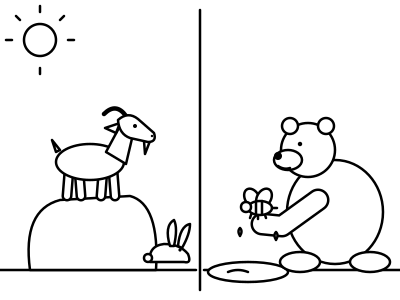
    The Goat and the Rabbit: On a hot day, a goat shared her shady rock with a tired rabbit. Later, a fox crept toward the sleeping goat. The rabbit thumped the ground hard, and the goat woke up and ran to safety. Lesson: A good deed comes back to you. The Bear and the Bee: A bear lifted a drowning bee out of a puddle. Weeks later, a wolf snuck up on the bear. The bee buzzed into the wolf's ear until it ran away. Lesson: Even a small friend can be a big help.

    Two fable scenes: on the left a goat stands on a shady rock beside a resting rabbit, and on the right a bear lifts a small bee out of a puddle with its paw.

    Fill in the Venn diagram, then answer.

    Only Goat and RabbitBothOnly Bear and Bee


    1. 1.

      Write one way the two fables are alike.

    2. 2.

      Write one way they are different.

    3. 3.

      Write the lesson both fables share in a full sentence.

    4. 4.

      Do you agree with the lesson? Answer with 'I agree because...' or 'I see it differently because...'

    Add -ful or -less to fit the sentence.

    1. 5.

      The bee was ____ to the bear. (full of help)

    2. 6.

      The rabbit was ____ when it thumped. (without fear)

    3. 7.

      Sneaking up on the bear was ____ for the wolf. (without use)

    Challenge: Write a title for a new fable that could teach the same lesson.

    Science

    Objective: I can choose a local study site and plan how to observe it safely like a field scientist.

    Standards: 3-LS4-3

    Builds on: Needs Week 10: an ecosystem is the living and nonliving things in one place and how they affect each other. One-minute check: your child names two living and two nonliving things seen from a window (sample: grass, sparrow; soil, sunlight).

    New words:
    • field scientist – a scientist who works outdoors, where plants and animals really live
    • study square – a small marked spot that you look at closely and visit again
    • landmark – something big that stays put and helps you find a place again

    Materials: 4 sticks or craft sticks, About 5 yards of string, Clipboard or hardcover book, Magnifying glass, Science notebook and pencil, Bean cup from Week 15 and a little water

    1. Day 76 — Choose Your Local Ecosystem — Wonder Warm-Up · 5 min

      Spaced review from Week 15. Ask: "A puppy grows into a dog and has puppies. Which shared life cycle part is having puppies?" (Reproduction.) Check the bean cup together. Water it if the soil feels dry. Then the wonder. Ask: "What ecosystem could we study near home?" (A backyard, garden bed, park edge or schoolyard corner.)

    2. Mini-Lesson · 10–15 min

      Say: "This week you are a field scientist. You will study one small piece of a real ecosystem." Lay two sticks on the floor, one big step apart. Say: "Each side of your study square will be this long." Ask: "Why not study a whole park?" (It is too big to look at closely.) If stuck, say: "Could you count every ant in a whole park?" Ask: "We will visit twice. Why must we find the same spot again?" (So we can compare the two visits fairly.) Now teach six safety rules. 1) An adult stays with you. 2) Look at mushrooms and unknown plants, but do not touch or taste. 3) Keep hands out of places you cannot see into. 4) Do not chase or pick up wild animals. 5) Stay back from water edges. 6) Wash hands when you come inside. Say: "Leaves of three, let it be. That helps you avoid poison ivy." In cold weather, plan shorter visits and look for buds, seeds, tracks and birds.

    3. Investigation / Hands-On · 15–20 min

      Pick and Mark the Site. Safety: an adult goes along and checks each spot for poison ivy and sharp litter first. 1) Walk to two or three possible spots. 2) At each one ask: "Can you see at least three kinds of living things here?" Your child checks the ground with the magnifying glass. 3) Choose one spot with some plants and some bare ground that you can reach again easily. 4) Push in the 4 sticks to make a square, one big step on each side. Wrap the string around them. 5) On the clipboard, your child maps the square and one landmark, such as a tree or fence post. 6) Plan two visits and write the days and times. Say: "We keep the spot and the time of day the same. Then the changes we see come from nature, not from us." Expect a map with the square, one landmark and two visit times. In a public place, take the sticks home.

    4. Science Notebook Entry · 10 min

      In the science notebook, title a page "My Local Ecosystem Field Journal." Your child writes the place and date, then copies the map and visit plan. They finish two frames. "I chose this spot because ___." "I will stay safe by ___, ___ and ___." Sample: "I chose this spot because it has grass, clover and an ant hill."

    5. Wrap-Up & Exit Ticket · 5 min

      Ask the three exit questions aloud; your child answers aloud or in writing. Praise a clear reason for the spot and a careful map.

    Watch for: Choosing a spot with almost nothing living in it, or a spot too large to study closely.

    Try: Ask the three-kinds question again before marking. Shrink the square to one big step on each side.

    Exit ticket:
    1. Where is your study square, and what landmark will help you find it again?
    2. Why do field scientists study a small square and not a whole park?
    3. Why should both visits happen at the same time of day?
    Show answers
    1. Answers vary. Look for: a specific place and a landmark that stays put, such as the back fence corner by the maple tree.
    2. A small square can be looked at very closely, and it is easy to find and check again.
    3. So the comparison is fair. Light, warmth and animal activity change during the day.

    Support: Choose the closest spot yourself and draw the square on the map page. Your child adds the landmark and labels.

    Extend: Mark a second square in shade if the first is sunny. Your child predicts one difference to check.

    Homework: Tell your family the field plan. Then list 5 things you expect to find in your square. Look for: a mix of living and nonliving things.

    Practice page · Week 16, Day 1

    Science

    I can choose a local study site and plan how to observe it safely like a field scientist.

    Draw a map of your study square. Add a north arrow if you know it and one landmark.

    1. 1.

      My study square map

    2. 2.

      Where is your study square?

    3. 3.

      Visit 1 day and time:

    4. 4.

      Visit 2 day and time:

    Answer like a field scientist.

    1. 5.

      Why is it helpful to use a small study square?

    2. 6.

      Why should both visits be at about the same time of day?

    3. 7.

      Write one safety rule for your field visits.

    Materials: 4 sticks and string · a clipboard or hard book · a magnifying glass

    Standards-matched clips that reinforce today's objectives.

    Mathematics
    1:36

    Finding patterns in a multiplication table | Khan Academy

    Khan Academy

    Supports: Identify patterns on the multiplication chart

    3.OA.D.9
    Watch on YouTube
    English Language Arts
    9:47

    Compare and Contrast Stories | Helping kids learn useful compare and contrasting skills

    Learn Bright

    Supports: I can compare the characters, plots and lessons of two fables.

    RL.3.9
    Watch on YouTube
    Science

    How Do Scientists Study Nature? - Observing and Asking Questions

    Miacademy Learning Channel

    Supports: I can choose a local study site and plan how to observe it safely like a field scientist.

    3-LS4-3
    Watch on YouTube