Week 16 · Day 1 Practice Pages
Practice page · Week 16, Day 1
Mathematics
I can find and explain patterns on the multiplication chart and in skip counting.
Look: chart patterns
- Times-5 products end in 0 or 5.
- Times-9 products up to 90 have digits that add to 9: 9 × 4 = 36, and 3 + 6 is 9.
- The square numbers sit on the diagonal: 1, 4, 9, 16, 25 and more.
Color the times-5 row and the times-9 row on your chart. Then answer.
- 1.
Skip count by 4 to 40.
- 2.
On an addition table, 2 + 8, 3 + 7, 4 + 6 and 5 + 5 all make the same sum. What is it, and why?
- 3.
Is 45 on the times-5 row? How do you know?
Use patterns to answer.
- 4.
Skip count by 8. What is the 6th number? What fact does it show?
- 5.
9 × 7 is 63. What do the digits of 63 add to?
- 6.
What square number comes after 25 on the diagonal?
Challenge: Skip count by 7s to 70. Which of those numbers are even?
Materials: multiplication chart to color · colored pencils
Practice page · Week 16, Day 1
English Language Arts
I can compare the characters, plots and lessons of two fables.
Look: Compare and contrast
- Compare: find what is the same. Contrast: find what is different.
- Look at the characters, the problem, how it is solved and the lesson.
- Put shared things in the middle of the Venn diagram and the rest in each fable's own circle.
Two Fables
The Goat and the Rabbit: On a hot day, a goat shared her shady rock with a tired rabbit. Later, a fox crept toward the sleeping goat. The rabbit thumped the ground hard, and the goat woke up and ran to safety. Lesson: A good deed comes back to you. The Bear and the Bee: A bear lifted a drowning bee out of a puddle. Weeks later, a wolf snuck up on the bear. The bee buzzed into the wolf's ear until it ran away. Lesson: Even a small friend can be a big help.
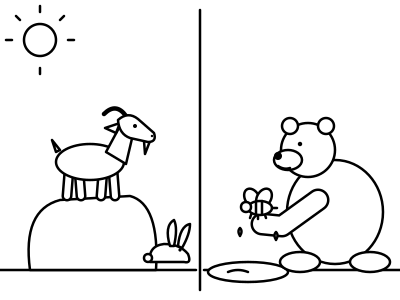
Fill in the Venn diagram, then answer.
| Only Goat and Rabbit | Both | Only Bear and Bee |
|---|---|---|
- 1.
Write one way the two fables are alike.
- 2.
Write one way they are different.
- 3.
Write the lesson both fables share in a full sentence.
- 4.
Do you agree with the lesson? Answer with 'I agree because...' or 'I see it differently because...'
Add -ful or -less to fit the sentence.
- 5.
The bee was ____ to the bear. (full of help)
- 6.
The rabbit was ____ when it thumped. (without fear)
- 7.
Sneaking up on the bear was ____ for the wolf. (without use)
Challenge: Write a title for a new fable that could teach the same lesson.
Practice page · Week 16, Day 1
Science
I can choose a local study site and plan how to observe it safely like a field scientist.
Draw a map of your study square. Add a north arrow if you know it and one landmark.
- 1.
My study square map
- 2.
Where is your study square?
- 3.
Visit 1 day and time:
- 4.
Visit 2 day and time:
Answer like a field scientist.
- 5.
Why is it helpful to use a small study square?
- 6.
Why should both visits be at about the same time of day?
- 7.
Write one safety rule for your field visits.
Materials: 4 sticks and string · a clipboard or hard book · a magnifying glass
Practice page · Week 16, Day 1
Social Studies
I can explain what immigration means and name reasons people move to a new country.
Read each made-up story. Write the reason. Use the word bank.
Word bank: job · family · school · safety
- 1.
Dev's mom came from Kenya to work as a nurse.
- 2.
Luca's grandparents came from Italy to join their cousins in Chicago.
- 3.
Sun-hee came from South Korea to study at a college.
- 4.
The Abadi family came as refugees because their city was not safe.
Answer each question.
- 5.
What does immigration mean?
- 6.
What is a refugee?
- 7.
Who lived in North America for thousands of years before anyone immigrated here?
Challenge: Many African Americans are descended from people who were brought here by force and enslaved. How is that different from choosing to move?
Materials: world map · yarn