Day 1 · Monday
Mathematics
I can explain that a fraction names equal parts of one whole.
Builds on: Needs Grade 2 halves, thirds and fourths, and equal sharing from Week 10. One-minute check: your child folds paper into 2 equal parts and names one part (one half).
- fraction – a number for equal parts of a whole
- denominator – the bottom number: how many equal parts make the whole
- numerator – the top number: how many parts we count
Materials: 2 paper squares, the same size (plus 2 more for the extension), 1 paper circle, cut out ahead, Grid paper, Crayons, Pencil
5 min · Warm-Up
Spaced review from Week 10. Read: "20 crackers are shared equally by 4 children. How many does each get?" (20 ÷ 4 = 5) Then practice ÷2 and ÷4 facts with no clock. Ask 16 ÷ 2, 18 ÷ 2, 24 ÷ 4 and 36 ÷ 4 (8, 9, 6, 9).
10–15 min · Mini-Lesson
Fold one paper square in half twice. Open it. Ask: "How many parts?" (4) "Are they equal?" (Yes. They match when folded.) On the second square, draw 3 lines that make 4 unequal parts. Ask: "Is this a fair way to share?" (No. The parts are not equal.) Say: "A fraction is a number that names equal parts of one whole." Shade 1 part of the folded square with a crayon. Write 1/4. Say: "The bottom number, the denominator, tells how many equal parts make the whole. The top number, the numerator, tells how many parts we count." Say: "So 1 of 4 equal parts is shaded. Each part is 1/4 of the whole square." Shade one more part. Write 2/4. Now your child does more. Your child folds the circle in half three times and opens it. Ask: "How many equal parts?" (8) Your child shades 7 parts and writes the fraction (7/8).
10–15 min · Guided Practice
Use grid paper. 1) Draw a rectangle 6 squares long and 1 square tall, with a line after every 2 squares. Ask: "How many equal parts?" (3) Your child shades 1 part and writes the fraction (1/3). 2) Draw the same rectangle with a line after every square. Your child shades 2 parts and writes the fraction (2/6). 3) Draw a rectangle 8 squares long with one line after 3 squares. Ask: "Is each part 1/2?" (No. The parts have 3 and 5 squares.) If stuck, say: "Count all the equal parts first. That is the bottom number."
15–20 min · Independent Practice
Your child draws each rectangle 1 square tall and writes the fraction. 1) 8 squares long, with a line after 4 squares. Shade 1 part (1/2). 2) 8 squares long, with a line after every 2 squares. Shade 1 part (1/4). 3) 8 squares long, with a line after every square. Shade 6 parts (6/8). 4) 6 squares long, with a line after every square. Shade 3 parts (3/6). 5) You draw a circle with 4 unequal parts. "Are these fourths?" (No. The parts are not equal.) 6) Ask: "In 2/3, what does the 3 tell?" (The whole has 3 equal parts.) 7) A cornbread has 6 equal pieces. Dad eats 1 piece. What fraction does he eat? (1/6) 8) A garden has 8 equal parts. Beans grow in 5 parts. What fraction grows beans? (5/8)
5 min · Exit Ticket
Your child answers aloud and draws on grid paper for question 3.
Watch for: Calling any 4 pieces fourths, even when their sizes differ.
Try: Your child folds the parts on top of each other. Parts that do not match are not fourths.
Exit ticket (3 questions)
- In 3/4, which number is the denominator? What does it tell?
- A pizza is cut into 6 unequal pieces. Is one piece 1/6 of it? Why?
- Draw a rectangle 6 squares long with 6 equal parts. Shade 4. What fraction is shaded?
Show answers
- 4. The whole has 4 equal parts.
- No. The pieces are not equal.
- 4/6 (4 of the 6 squares are shaded)
Support: Use only halves and fourths. Your child folds real paper to check each part.
Extend: Your child folds two more squares into fourths in different ways: 4 strips, and 2 rows of 2 squares. Ask: "Are both fourths?" (Yes. Each square has 4 equal parts.)
Homework: Your child draws 3 foods cut into equal parts and writes the fraction for one part. Sample: a pizza in 8 equal slices, 1/8.
English Language Arts
I can tell how an opinion essay is different from an opinion paragraph and name its parts.
Builds on: Needs the opinion paragraph from Week 8: an opinion, reasons, linking words and a conclusion. One-minute check: ask, "What is an opinion?" (What someone thinks or believes. Other people may disagree.)
- essay – a piece of writing with several paragraphs about one topic
- body paragraph – a middle paragraph of an essay that tells one reason
Materials: Writer's notebook, Five sticky notes or index cards, Pencil
5 min · Warm-Up
Word study, Week 19: the endings -er and -est. Say: "The ending -er compares two things. The ending -est compares three or more." Write taller, faster, colder, smallest, strongest, longest. Your child reads each word and underlines its ending. Ask: "Which words compare just two things?" (taller, faster, colder) Spaced review from Week 17. Ask: "When you take notes, do you copy whole sentences?" (No. Write short notes in your own words.)
10–15 min · Mini-Lesson
Say: "In Week 8 all your reasons shared one paragraph. An essay is several paragraphs about one topic. In an essay, each reason gets a paragraph of its own." Draw five stacked boxes titled Opinion Essay. Label the top box Introduction (catchy start + opinion). Label the middle boxes Body 1, Body 2 and Body 3, with one reason each. Label the last box Conclusion (opinion again + strong ending). Say: "The three middle boxes are body paragraphs." Read the model essay aloud slowly. "Every Kid Should Learn to Swim." (Introduction) Have you ever watched kids splash in a pool while one child sits alone on the edge? Swimming is a skill that keeps kids safe and happy. I think every kid should learn to swim. (Body 1) First, swimming keeps you safe near water. Swimmers learn how to float and how to get back to the edge. (Body 2) Another reason is that swimming is great exercise. After twenty minutes of laps, my cousin's heart is pumping fast. (Body 3) Most importantly, swimmers get to join the fun. Last summer, my friend could finally jump off the dock with everyone at the lake. (Conclusion) Swimming makes kids safer, stronger and part of the fun. Ask a grown-up about swimming lessons this summer! Think aloud: "The opinion sits at the end of the first paragraph. Each middle paragraph gives one reason."
10–15 min · Guided Practice
Your child writes Intro, Body 1, Body 2, Body 3 and Conclusion on five sticky notes. Reread the essay. Your child holds up the matching note for each part. Then ask. 1) "Which sentence tells the opinion?" (I think every kid should learn to swim.) 2) "What is the reason in Body 2?" (Swimming is great exercise.) 3) "Which words start the three body paragraphs?" (First, Another reason, Most importantly) 4) "How does the conclusion give the opinion again?" (In new words: swimming makes kids safer, stronger and part of the fun.) If stuck, say: "Point to that box on our chart. What job does that box do?"
15–20 min · Independent Practice
1) Your child lists five topics they have a real opinion about. Ideas: the best season, bedtimes, the best pet. 2) Talk for three minutes. Your child tells you the top two topics. Ask: "Which one has more reasons?" Start with "I agree because ..." when you agree. Start with "I see it differently because ..." when you do not. 3) Your child circles one topic and writes one opinion sentence. Sample: "I think fall is the best season." 4) Comparing words. Say: "Opinions often compare. Use -er or more for two things. Use -est or most for three or more." Show: "Fall is cooler than summer." "Fall is the coolest season for hiking." "Leaves drop more quickly in October than in September." Say: "Cooler tells about a noun, so it is an adjective. More quickly tells how something happens, so it is an adverb." Your child writes one sentence with -er or more and one with -est or most. Look for: an opinion someone could disagree with, and no doubled forms such as "more cooler."
5 min · Exit Ticket
Ask the three questions aloud. Your child answers in the notebook.
Watch for: Writing a topic ("pets") instead of an opinion ("Cats are the best pet for an apartment").
Try: Ask: "Could someone disagree with your sentence?" If not, add "I think" and a judging word such as best or should.
Exit ticket (3 questions)
- In an essay, where does each reason go?
- In the swimming essay, what is the reason in Body 1?
- Finish the sentence and tell why: "Of the three kids, Mia swam the ___ (fast)."
Show answers
- In its own body paragraph.
- Swimming keeps you safe near water.
- fastest. Three kids are compared, so the word needs -est.
Support: Reread one part at a time. Your child touches the matching box on the chart before holding up a note.
Extend: Your child writes a different catchy first sentence for the swimming essay.
Homework: Read for 15 to 20 minutes. Then tell a family member your opinion sentence and ask if they agree. Write one reason they give as a short note. Look for: a reason, not just "yes" or "no."
Science
I can explain what weather is and describe today's weather using its five parts.
Builds on: Needs the everyday experience of choosing clothes for the day. One-minute check: ask what your child would wear in rain, and why (sample: a raincoat keeps the water off).
- weather – what the air is like at one place and one time
- temperature – how hot or cold something is
- precipitation – water that falls from the sky, such as rain, snow, sleet or hail
- humidity – how much water is in the air as a gas you cannot see
Materials: A glass of ice water, A window or outdoor spot, A light jacket for going outside, Science notebook and pencil, Crayons
5 min · Day 91 — What Is Weather? — Wonder Warm-Up
Spaced review from Week 12. Ask: "In a food web, which way do the arrows point?" (From the food to the eater.) Set the glass of ice water on the table for later. Then the wonder. Open a window or step to the door. Ask: "What three words tell about the air outside right now?" (Sample: chilly, cloudy, breezy.) Say: "Those words all tell about weather."
10–15 min · Mini-Lesson
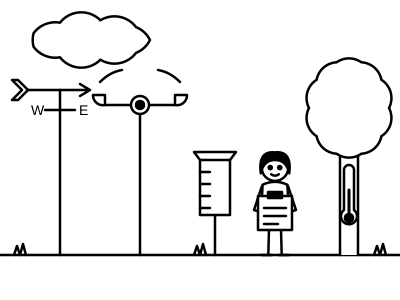
Say: "Weather is what the air is like at one place and one time." Write the five parts of weather in a column and say each one. "Temperature is how hot or cold the air is. Precipitation is water falling from the sky, like rain, snow, sleet or hail. Wind is moving air. Clouds tell how much of the sky is covered. Humidity is how much water is in the air as a gas you cannot see." Now look at the glass. Ask: "Where did the drops on the outside come from?" (From water in the air.) Say: "The cold glass turned unseen water in the air into drops. Damp air makes more drops." In very dry air, few drops form. Ask: "Which part is moving air?" (Wind.) Ask: "Weather changes hour by hour. What should a scientist always write down?" (The time and the place.) If stuck, say: "Point to the list. Read each part until one fits."
15–20 min · Investigation / Hands-On
Weather Detective. Safety: watch from a window if there is lightning, strong wind or bitter cold. 1) Go outside for 5 minutes with the notebook. Wear the jacket if it is cool. 2) Your child stands still and uses eyes, ears and skin. 3) They fill in a table with two columns: Part, What I observed. It has five rows, one for each part. 4) Offer word choices. Temperature: hot, warm, cool, cold. Precipitation: none, drizzle, rain, snow. Wind: calm, breezy, gusty. Clouds: clear, partly cloudy, all gray. Humidity: dry, comfortable, sticky. 5) They write the time and place above the table. 6) Ask: "What is your evidence for the wind word?" (Sample: the leaves are moving.) Expect all five rows filled from today's observing, not from memory.
10 min · Science Notebook Entry
Your child makes a title page called "Weather and Climate" and decorates it with crayons. On the next page they finish two frames. "Weather is ___." "Today at ___ the weather is ___." The second sentence should use all five parts. Sample: "Weather is what the air is like in one place at one time. Today at 10 a.m. the weather is cool and dry, with a light breeze, a few clouds and no rain." Then rule a Weather Log to use all week. Its columns are Day, Time, Temperature, Precipitation, Wind, Clouds. Write today's words in the first row.
5 min · Wrap-Up & Exit Ticket
Ask the three exit questions aloud. Praise answers that name a part of weather and give evidence your child observed.
Watch for: Saying the weather is "nice" or "bad" instead of describing its parts.
Try: Ask: "Nice how?" Point to each part on the list. Your child gives one word for each.
Exit ticket (3 questions)
- Which five things do we observe to describe the air outside?
- A friend says, "It is nice out." What two questions could you ask to get a better description?
- "It snowed at our house at 7 a.m." Is this sentence about weather? How do you know?
Show answers
- Temperature, precipitation, wind, clouds and humidity.
- Answers vary. Look for: questions about two parts, such as "How warm is it?" and "Is it windy or cloudy?"
- Yes. It tells what the air and sky were doing at one place and one time.
Support: Draw five boxes with a small picture in each: thermometer, raindrop, flag, cloud, water drop. Your child writes one word in each box.
Extend: Your child observes again later today. They write which parts changed and which stayed the same.
Homework: Listen to or read one weather report with a family member. Tick the parts it mentions on your list of five. Look for: at least three parts ticked.