Week 28 · Day 1 Practice Pages
Practice page · Week 28, Day 1
Mathematics
I can explain that area is the flat space inside a shape.
Look: What is area?
- Area is the flat space inside a shape.
- Cover the shape with same-size squares. Leave no gaps and no overlaps.
- Count the squares. Write the answer in square units.
Find the area. Each shape is covered by squares with no gaps and no overlaps.
- 1.
A shape is covered by 18 unit squares. What is its area?
- 2.
Lena covers a card with 2 rows of 7 squares. Count them. What is the area?
- 3.
Which tiles can measure area with no gaps?
○ circles○ squares○ coins - 4.
Jamal lays 20 squares on a mat, but one square sits right on top of another. What is the real area?
- 5.
Why do we use squares, not circles, to measure area?
Cover three flat things with paper squares and record the area of each.
| Thing I covered | Number of squares | Area |
|---|---|---|
- 6.
Which thing had the biggest area?
Challenge: Draw two different shapes that each have an area of 6 square units.
Materials: paper squares (1 inch)
Practice page · Week 28, Day 1
English Language Arts
I can choose a research topic that is small enough to study.
Look: the three topic tests
- Test 1: I really want to learn about it.
- Test 2: It is narrow enough for four weeks.
- Test 3: I can find books or kid-safe websites about it.
Circle the topic that is narrow enough for a four-week project.
- 1.
Which topic is narrower?
○ Animals○ How bats find food in the dark - 2.
Which topic is narrower?
○ How volcanoes erupt○ Earth - 3.
Which topic is narrower?
○ Jobs○ How firefighters train - 4.
Finish the ladder: Sports → Ball games → Soccer → ____
- 5.
Talk with a partner about one topic. Finish the sentence to build on their idea: 'I agree, and ____.'
Write the contraction for the two words.
- 6.
do not = ____
- 7.
we are = ____
- 8.
she will = ____
Challenge: Write your own topic. Does it pass all three tests? Tell why in one sentence.
Practice page · Week 28, Day 1
Science
I can tell what a trait is and record some of my own traits.
My Trait Inventory. Use a mirror and a ruler to fill in each line.
- 1.
My eye color: ____
- 2.
My natural hair texture:
○ straight○ wavy○ curly - 3.
Do I have freckles or dimples? ____
- 4.
My hand from wrist to fingertip: ____ cm
Is it a trait of the body? Circle yes or no.
- 5.
a cat's long whiskers
○ yes○ no - 6.
wearing a blue hat
○ yes○ no - 7.
liking to play soccer
○ yes○ no - 8.
the pointed leaves of a maple tree
○ yes○ no
Challenge: Look at a plant or pet. Write 3 of its traits.
Materials: hand mirror · ruler · a plant or pet to observe
Practice page · Week 28, Day 1
Social Studies
I can trace an everyday item back to the people who helped make it.
The Story of a Wool Hat
Your warm hat began on a farm. A farmer raised sheep, and in spring a shearer clipped their thick wool. At a mill, workers washed the wool and spun it into yarn. A knitter turned the yarn into a hat. A truck driver carried boxes of hats to a store, and a store worker put them on the shelf. Then your family bought one. Many people helped, and the hat needed every one of their steps. When people depend on each other for goods and services, we call it interdependence.
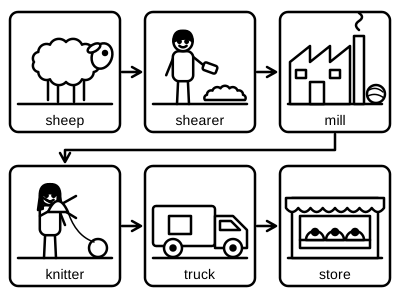
Use the story above.
- 1.
What natural resource does the hat chain start with?
- 2.
Put these in order: truck driver, shearer, knitter, store worker.
- 3.
Could the store sell hats if the mill closed? Why or why not?
- 4.
Interdependence means people ___.
○ depend on each other for goods and services○ make everything by themselves○ never trade
Trace It Back: choose one item at home. Fill in one row for each step, starting with nature.
| Step | Person or place | What they do |
|---|---|---|
- 5.
My item:
- 6.
My chain starts with this natural resource:
- 7.
Finish: I depend on ____ for ____.
Challenge: Why would it be very hard for one person to make a pair of sneakers all alone?
Materials: one item from home, such as a sock or a jar of jam