3
    Third GradePowered by ThirdGrade.com

    Daily lesson plan

    Day 2 · Tuesday

    Week 3 · Foundations: Place Value, Stories, Forces & Communities

    See what your state adds or places differently

    Suggested daily schedule
    8:30–8:45 AM15 minMorning Circle / Read-Aloud / Calendar
    8:45–10:00 AM75 minEnglish Language Arts
    10:00–11:00 AM60 minMathematics
    11:00–11:15 AM15 minSnack and Movement Break
    11:15–12:00 PM30–45 minScience (every day)
    12:00–12:45 PM30–45 minSocial Studies (every day)
    12:45–1:30 PM45 minLunch and Choice Time
    1:30–2:15 PM45 minSpecials: PE / Art / Music (rotating)
    2:15–2:45 PM30 minIndependent Reading & Journaling

    Social Studies

    Objective: I can use a map key to find out what the symbols on a map mean.

    Standards: D2.Geo.1.3-5, D2.Geo.2.3-5

    Builds on: Needs Day 1: a map is a flat drawing of a place. One-minute check: ask "Which is flat, a map or a globe?" (A map.)

    New words:
    • symbol – a small picture or color that stands for a real thing
    • map key – the box on a map that tells what each symbol means; also called a legend

    Materials: 2 sheets of plain paper, Colored pencils, including blue and green, Notebook, Pencil

    1. Day 12 — Map Symbols and Keys — Big Question Warm-Up · 5 min

      Spaced review from Week 2. Ask: "What do we call the daily trip to work and back?" (A commute.) Then ask the big question: "Why do many maps have a small box of pictures in the corner?"

    2. Mini-Lesson · 10–15 min

      Say: "Maps use symbols. A symbol is a small picture or color that stands for a real thing." Say: "The map key, or legend, tells what each symbol means." In the notebook, draw a star, a blue wavy line and a small book. Beside them draw a key box: star = capital city, blue line = river, book = library. Say: "Here is the rule. Read the key first, then read the map." Ask: "What tells you what the star means?" (The key.) Ask: "On this key, what does the book mean?" (A library.) Say: "Blue often shows water and green often shows parks or forests. But symbols can change from map to map." Ask: "Could a star mean something else on another map?" (Yes. Check that map's key.) If stuck, say: "Put your finger on the key. Now find the same picture on the map."

    3. Activity / Source Work · 15–20 min

      1) Draw the Fern Park map on plain paper while your child watches. Draw a box for the park. Draw a blue lake in the middle. Draw 3 small squares above the lake. Draw 2 picnic tables left of the lake. Write a P in the bottom left corner. Draw a dashed line from the P to the lake. Draw 5 green trees on the right side. 2) In the top left corner draw the key box. Square = cabin, table = picnic area and P = parking. Dashed line = trail, tree = forest and blue = water. 3) Your child reads the key aloud first. 4) Ask: "How many cabins are there?" (3) "How many picnic areas?" (2) "What does the dashed line mean?" (A trail.) "What is on the right side of the park?" (Forest.) "Where does the trail start and end?" (From parking to the lake.) 5) After each answer ask: "Show me in the key how you know." Save this map for Days 3 and 5.

    4. Notebook Entry · 10 min

      On the second sheet, your child draws a pencil map of a bedroom. The key needs four symbols: bed, door, window and shelf. Look for: every symbol in the key is on the map, and every symbol on the map is in the key.

    5. Wrap-Up & Exit Ticket · 5 min

      Ask the three exit questions aloud. Praise your child for checking the key before answering.

    Watch for: Guessing what a symbol means instead of checking the key, such as thinking every star is a city.

    Try: Cover the map. Your child reads the key aloud first. Then uncover the map.

    Exit ticket:
    1. Some maps label the key box with a different word. What is that word?
    2. A key shows a small airplane beside the word "airport." You see two airplanes on the map. What does that tell you?
    3. Two maps use a red line. On one it means a highway. On the other it means a hiking trail. How can you tell which is which?
    Show answers
    1. A legend.
    2. The map shows two airports.
    3. Read the key on each map.

    Support: Cover the trees, tables and trail in the key. Start with only the cabins, the lake and the P.

    Extend: Your child draws a map of your street or yard with a key of six symbols they invent.

    Homework: Find a map at home, such as a game board, a store flyer map or a bus map. Look for: your child names three symbols and their meanings. If you find no map, add two symbols to the bedroom map.

    Practice page · Week 3, Day 2

    Social Studies

    I can use a map key to find places on a map.

    Map of Cedar Lake Park

    Map key: a tent means campsite. A fork and spoon means snack stand. A boat means boat dock. A blue patch means water. A green triangle means trees. The park has 3 tents, 1 snack stand and 2 boat docks. Both docks sit on the edge of the blue lake.
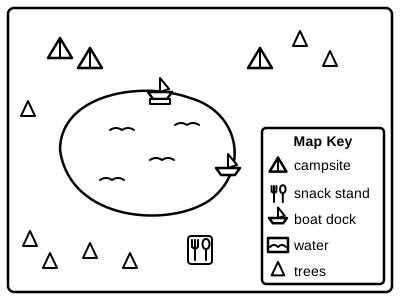
    A map of Cedar Lake Park shows a lake with two boat docks, three tents, one snack stand and trees, with a map key in the corner.

    Use the key to answer each question.

    1. 1.

      What does the boat symbol mean?

    2. 2.

      How many campsites are in the park?

    3. 3.

      What does the blue patch show?

    4. 4.

      Where are the boat docks?

    5. 5.

      What should you read first?

      ○ the key○ the title only○ nothing

    Draw a map of your kitchen with a key of 4 symbols.

    1. 6.

      My kitchen map and key

    Challenge: What is another name for a map key?

    Materials: a ruler

    Mathematics

    Objective: I can subtract 3-digit numbers in columns when no regrouping is needed.

    Standards: 3.NBT.A.2

    Builds on: Needs Week 2 Day 2: lining up the places to add in columns. One-minute check: your child stacks and adds 324 + 152 (476).

    New words:
    • subtract in columns – stack the numbers so the places line up, then subtract one place at a time

    Materials: Grid paper, Notebook, Pencil

    1. Warm-Up · 5 min

      Spaced review from Week 2. Your child solves 425 + 343 in columns (768). Then subtract hundreds aloud. Ask: 700 − 300 (400), 850 − 200 (650), 936 − 500 (436), 610 − 400 (210).

    2. Mini-Lesson · 10–15 min

      Say: "Today we subtract in columns. The top number is what we start with." On grid paper, write 798 with 425 under it, one digit in each square. Beside it, draw 798 as 7 squares, 9 sticks and 8 dots. Say: "Squares are hundreds. Sticks are tens. Dots are ones." Say: "Start with the ones." Cross out 5 dots. Ask: "How many ones are left?" (3) Write 3 in the ones column. Cross out 2 sticks. Ask: "How many tens are left?" (7) Write 7 in the tens column. Cross out 4 squares. Ask: "How many hundreds are left?" (3) Write 3. Say: "The difference is 373." Say: "We can check subtraction by adding." Write 373 + 425 = 798. Ask: "Did we get back to the start?" (Yes.) Now your child does more. Your child stacks 586 − 243, draws it, and crosses out each place (343). Then your child checks: 343 + 243 = 586.

    3. Guided Practice · 10–15 min

      Your child stacks each problem on grid paper and says each step aloud. 1) 467 − 125 (342). Check together: 342 + 125 = 467. 2) 859 − 316 (543). 3) 675 − 40 (635). Ask: "Where do the 4 and the 0 go?" (The 4 goes under the 7. The 0 goes under the 5.) 4) 398 − 205 (193). Ask: "What is 9 tens take away 0 tens?" (9 tens) If stuck, say: "Read it as start with, take away. Cover every column except the ones. Now subtract."

    4. Independent Practice · 15–20 min

      Your child solves in columns and checks each by adding. 1) 567 − 234 (333). 2) 689 − 357 (332). 3) 879 − 425 (454). 4) 768 − 312 (456). 5) 945 − 623 (322). 6) Draw squares, sticks and dots for 356 − 142, then cross out (214). 7) A farm has 487 hens. The farmer sells 135. How many hens are left? (352) 8) Ana's puzzle has 750 pieces. She has placed 420. How many pieces are left to place? (330)

    5. Exit Ticket · 5 min

      Your child answers on grid paper with no drawings, then checks question 2 by adding.

    Watch for: Lining up digits from the left, so in 675 − 40 the 4 sits under the 6.

    Try: Use grid paper with one digit in each square. Your child names each digit's place aloud before writing it.

    Fact fluency: Subtracting hundreds mentally

    Exit ticket:
    1. Which place do you subtract first?
    2. Solve 576 − 314.
    3. How can you check a subtraction answer?
    Show answers
    1. The ones place
    2. 262
    3. Add the answer to the number you took away. You should get the starting number (262 + 314 = 576).

    Support: Use 2-digit numbers first, such as 68 − 25 (43). Your child draws sticks and dots and crosses out.

    Extend: Your child writes three subtraction problems that each have a difference of 222. Samples: 555 − 333 = 222, 987 − 765 = 222, 422 − 200 = 222.

    Homework: Solve 4 problems in columns and check each by adding. 857 − 432 (425), 694 − 271 (423), 978 − 506 (472), 739 − 118 (621).

    Practice page · Week 3, Day 2

    Mathematics

    I can subtract 3-digit numbers in columns when no regrouping is needed.

    Look: 687 − 254

    1. Put the starting amount on top. Line up the places.
    2. Ones: 7 − 4 = 3. Tens: 8 − 5 = 3. Hundreds: 6 − 2 = 4.
    3. The difference is 433. Check by adding: 433 + 254 = 687.

    Subtract in columns.

    1. 1.

      596 − 243 = ____

    2. 2.

      798 − 365 = ____

    3. 3.

      469 − 127 = ____

    4. 4.

      857 − 504 = ____

    5. 5.

      975 − 642 = ____

    Solve and check.

    1. 6.

      A garden has 548 flowers. Theo picks 214 of them. How many flowers are still in the garden?

    2. 7.

      Check your answer to 798 − 365 by adding. Write the addition.

    Challenge: Find the missing number: ____ − 231 = 425

    Materials: Graph paper (optional)

    English Language Arts

    Objective: I can answer a question using exact words from the text as evidence.

    Standards: RL.3.1

    Builds on: Needs Day 1's story about the note, the oak and the key. One-minute check: ask what Marcus and Ana dug up under the oak. (A tin box with a key inside.)

    New words:
    • text evidence – the exact words in a text that prove an answer

    Materials: Reader's notebook, Pencil

    1. Warm-Up · 5 min

      Word study: mark the r team. Write shark, card, storm, short, hurt, bird. Your child underlines the vowel and r together in each word, then reads it. (ar, ar, or, or, ur, ir) Ask: "Hurt and bird use different letters. Do they share a vowel sound?" (Yes. The letters ur and ir sound the same.) Spaced review from Week 2. Ask: "What does an adverb do?" (It tells how an action happens.)

    2. Mini-Lesson · 10–15 min

      Ask: "How could you prove you ate breakfast?" (Show the empty bowl.) Say: "That is evidence. When we answer a question about a text, we point to the exact words that prove it. Those words are text evidence." Write the stem: I know because the text says, "___." Model with a sentence from yesterday's story. Write: The paper was yellow and soft, as if it were very old. Say: "My question is how we know the note was old. Step 1, I look back. Step 2, I put my finger on the proof. Step 3, I answer with the stem." Write: The note was old. I know because the text says, "The paper was yellow and soft." Say: "Now the mystery goes on." Read Part 2 aloud. Marcus and Ana carried the key to the library. Mrs. Bell, the librarian, turned it over in her hand. "This cabinet has been locked for thirty years," she said. She led them to a small wooden cabinet behind her desk. The key fit the tiny brass lock. Inside lay a class photo and a notebook. On the first page, someone had written, "We were the first readers here. Finder, add your name." Ana picked up a pen and signed below twelve faded names.

    3. Guided Practice · 10–15 min

      Your child puts a finger on the proof before answering. 1) Ask: "Where did the children take the key?" (To the library. The text says, "Marcus and Ana carried the key to the library.") 2) Ask: "Who is Mrs. Bell?" (The librarian. The text says, "Mrs. Bell, the librarian.") 3) Ask: "How long had the cabinet been locked?" (Thirty years. The text says, "This cabinet has been locked for thirty years.") 4) Ask: "Do the words you chose really prove each answer?" Your child rereads each copied sentence to check. If stuck, say: "Do not answer from memory. Look back, and touch the sentence that tells you."

    4. Independent Practice · 15–20 min

      Your child answers in the notebook, using the stem and copying the proof exactly. 1) Where was the cabinet? 2) What was inside the cabinet? 3) How do you know other children signed long ago? Good answers: 1) Behind Mrs. Bell's desk. I know because the text says, "a small wooden cabinet behind her desk." 2) A class photo and a notebook. I know because the text says, "Inside lay a class photo and a notebook." 3) The names were faded. I know because the text says, "twelve faded names." Look for: the stem; quotation marks around copied words; a quote that truly proves the answer.

    5. Exit Ticket · 5 min

      Ask the three questions aloud. Your child may look back at Part 2 and gives the evidence for questions 2 and 3.

    Watch for: Answering from memory or opinion without going back to the text.

    Try: Make look back a rule. Your child puts a finger on the words before writing any answer.

    Exit ticket:
    1. Which one is text evidence: "I think the cabinet was old" or "locked for thirty years"? Why?
    2. What did the first page of the notebook ask the finder to do? Give the evidence.
    3. How do you know the key was the right one for the cabinet? Give the evidence.
    Show answers
    1. The second one. It is exact words from the text. The first is only what a reader thinks.
    2. To add their name. The text says, "Finder, add your name."
    3. It opened the lock. The text says, "The key fit the tiny brass lock."

    Support: Offer two answer choices for each question. Your child points to the line in the story that proves the right one.

    Extend: Your child writes four sentences on why the first readers might have hidden the note, with two pieces of evidence.

    Homework: Read for 15 to 20 minutes. Answer one question about your book with the stem: I know because the text says, "___."

    Practice page · Week 3, Day 2

    English Language Arts

    I can answer a question with exact words from the text as evidence.

    Look: the evidence stem

    1. Read the question.
    2. Find and underline the words that prove the answer.
    3. Write: I know because the text says, "____."

    The Lemonade Stand

    Tess and her brother Omar set up a lemonade stand on the hottest day of July. They set their table in the shady backyard. By noon, they had sold only two cups. "Maybe nobody can see us," said Omar. Tess carried the table to the busy corner by the park. Within an hour, a line of thirsty soccer players stretched down the sidewalk. By three o'clock, the pitcher was empty.

    Answer each question with the evidence stem.

    1. 1.

      When did Tess and Omar sell lemonade?

    2. 2.

      Why did they sell so few cups at first?

    3. 3.

      Where did Tess move the table?

    4. 4.

      How do you know the new spot worked?

    Find words in the story with r-controlled vowels.

    1. 5.

      Write a word with or.

    2. 6.

      Write a word with ar.

    3. 7.

      Write a word with ir.

    Challenge: Underline the sentence that shows the stand sold all the lemonade.

    Science

    Objective: I can measure friction by how far a rubber band stretches when I pull an object.

    Standards: 3-PS2-1

    Builds on: Needs Day 1 (friction pushes against sliding) and Week 1 Day 3 (a harder pull stretches a rubber band more). One-minute check: ask, "Which usually makes more friction, a rough surface or a smooth one?" (a rough one)

    New words:
    • pull-meter – a homemade tool that shows how strong a pull is

    Materials: Small hardcover book, A second book (to add weight if needed, and for the extension), Thin rubber band, String, about 3 feet, Ruler marked in inches, 4 surfaces: table, bath towel, aluminum foil, and sandpaper or a doormat, Masking tape, Strip of paper (for the support option), Science notebook, Pencil

    1. Day 12 — Measuring Friction with a Pull-Meter — Wonder Warm-Up · 5 min

      Spaced review from Week 1. Ask: "You pulled a toy with a rubber band. When did the band stretch more?" (when the pull was stronger) Wonder question: "People slip on ice but not on a rug. Why? Could we measure friction with a number?"

    2. Mini-Lesson · 10–15 min

      Say: "Ice is very smooth, and it has a very thin watery layer on top. So ice makes very little friction. A rug is rough, so it makes more." Now build the pull-meter. Tie the string around the book like ribbon on a gift. Loop the rubber band onto the string. Say: "This is a pull-meter. A longer band means a stronger pull." Pull the band slowly until the book slides across the table. Ask: "What happened to the band?" (It stretched.) Say: "Friction holds the book back. More friction needs a stronger pull to keep the book sliding." Point out the start. Say: "Starting takes a bigger pull. We read the ruler only while the book slides." Check: "The band is longer on surface A than on surface B. Which has more friction?" (surface A) "When do we read the ruler?" (while the book slides slowly and steadily) If stuck, say: "Longer band, stronger pull, more friction."

    3. Investigation / Hands-On · 15–20 min

      Safety: stretch the band gently and keep it away from faces. Measure in inches, to the nearest half inch. A mark halfway between two numbers is a half inch. 1) Tape the foil and the towel flat on the table. 2) Your child predicts the order from least to most friction. 3) Your child pulls the band so the book slides at a slow, steady speed. 4) You hold the ruler beside the band and read its length to the nearest half inch. 5) Run 2 trials on each surface. Change only the surface. Keep the same book, band and speed. Record in a chart with columns Surface, Trial 1 and Trial 2, in inches. Expect the longest band on the sandpaper or doormat. If two surfaces read the same, add the second book for every surface and retest. Results depend on your materials. Real results vary. Look for the pattern.

    4. Science Notebook Entry · 10 min

      Your child ranks the four surfaces from least to most friction below the chart. Frame: "The band was ___ inches on the ___ and ___ inches on the ___. So the ___ had more friction." Sample: "The band was 3 inches on the table and 5 inches on the doormat. So the doormat had more friction."

    5. Wrap-Up & Exit Ticket · 5 min

      Ask the three exit questions. Praise your child for reading the band only while the book was sliding.

    Watch for: Reading the band before the book moves, or at the jerk when it first starts.

    Try: Your child says "sliding" once the book moves smoothly. Read the ruler only after you hear that word.

    Exit ticket:
    1. Why do we wait until the book is sliding before we read the ruler?
    2. Your band measured 4 inches on a towel and 3 inches on a table. On which surface did friction hold the book back more?
    3. Which of your four surfaces had the least friction? Give a number from your chart as proof.
    Show answers
    1. Starting takes a bigger pull. We want the pull that keeps the book sliding.
    2. The towel. The longer band shows a stronger pull was needed.
    3. Answers vary. Look for: the surface with the shortest band length, with that length named.

    Support: Hold the paper strip beside the band. Your child marks the band's length with a pencil line for each surface, then compares the lines.

    Extend: Your child sets the second book on top and predicts the change. Then they measure on one surface. A heavier load usually needs a stronger pull.

    Homework: Your child runs the pull test on 2 surfaces at home and reports which needed the stronger pull. Look for "the longer band means more friction."

    Practice page · Week 3, Day 2

    Science

    I can measure friction by how far a rubber band stretches when I pull an object.

    Use your rubber-band pull-meter. Pull slowly and steadily, then measure the band.

    SurfaceBand length while sliding (inches)Rank (1 = least friction)


    1. 1.

      Which surface needed the longest stretch?

    2. 2.

      Which surface needed the shortest stretch?

    Think about the pull-meter.

    1. 3.

      A longer stretch means ____ friction.

      ○ more○ less
    2. 4.

      Why is it easy to slide on ice?

    3. 5.

      Why must you use the same book and the same speed each time?

    Challenge: Chloe's band stretched 5 inches on carpet and 3 inches on wood. Which had more friction?

    Materials: a small book · a rubber band and string · a ruler · four surfaces such as a table, a towel, foil and sandpaper

    Standards-matched clips that reinforce today's objectives.

    Social Studies
    9:11

    Maps for Kids | Learn how to read a map and other skills in this fun introduction to maps

    Learn Bright

    Supports: I can use a map key to find out what the symbols on a map mean.

    D2.Geo.1.3-5
    D2.Geo.2.3-5
    Watch on YouTube