Day 1 · Monday
Mathematics
I can subtract 3-digit numbers in my head using place value, counting up and friendly numbers.
Builds on: Needs the Grade 2 skill of taking 10 or 100 from a number in your head, and friendly numbers from Week 2 Day 1. One-minute check: your child says 460 − 100 (360), then 460 − 10 (450).
- difference – the answer when we subtract; how far apart two numbers are
- count up – start at the smaller number and hop up to the bigger number
Materials: Scrap paper for drawing number lines, Notebook, Pencil
5 min · Warm-Up
Spaced review from Week 1. Your child rounds 645 to the nearest 10 (650) and the nearest 100 (600). Then subtract tens aloud. Ask: 90 − 40 (50), 170 − 30 (140), 520 − 20 (500), 380 − 50 (330).
10–15 min · Mini-Lesson
Say: "Today we subtract in our heads. There are three ways." Write 425 − 213. Say: "Way 1: take away one place at a time." Ask: "What is 213 in hundreds, tens and ones?" (200, 10 and 3) Write 425 − 200 = 225, then 225 − 10 = 215, then 215 − 3 = 212. Say: "The difference is 212." Write 800 − 197. Say: "Way 2: count up. The difference is how far apart the numbers are." Draw a line. Mark 197 at the left end and 800 at the right end. Draw a hop to 200. Ask: "How big is the hop?" (3) Draw a hop to 800. (600) Write 3 + 600 = 603. Say: "So 800 − 197 = 603." Write 500 − 199. Say: "Way 3: use a friendly number. 199 is close to 200." Write 500 − 200 = 300. Ask: "Did I take away too many or too few?" (1 too many) Say: "So I put 1 back." Write 300 + 1 = 301. Say: "So 500 − 199 = 301." Now your child does more. Write 700 − 298. Your child picks a way and tells each step. (Sample: 298 to 300 is 2; 300 to 700 is 400; 402)
10–15 min · Guided Practice
Your child solves each aloud, the way named. 1) 563 − 240 by places (563 − 200 = 363; 363 − 40 = 323). 2) 900 − 496 by counting up (496 to 500 is 4; 500 to 900 is 400; 404). 3) 400 − 99 with a friendly number (400 − 100 = 300; 300 + 1 = 301). 4) 654 − 302. Ask: "Which way is easiest here? Why?" (By places: 654 − 300 = 354; 354 − 2 = 352.) If stuck, say: "Is the second number close to a hundred? Then count up or use a friendly number."
15–20 min · Independent Practice
Your child solves in the head and writes only the answer. 1) 280 − 130 (150). 2) 643 − 200 (443). 3) 540 − 320 (220). 4) 500 − 250 (250). 5) 700 − 195 (505). 6) Draw the hops for 600 − 397 (397 to 400 is 3; 400 to 600 is 200; 203). 7) A book has 300 pages. Dana has read 98. How many pages are left? (202) 8) A jar holds 475 beans. Omar takes out 150. How many beans are left? (325) Your child explains one answer aloud, then checks it by counting up.
5 min · Exit Ticket
Read each question aloud; your child solves in the head and may draw hops for question 2.
Watch for: With a friendly number, fixing the wrong way, such as answering 299 for 500 − 199.
Try: Tell it as a story: "You had 500 beans. You gave away 200, but you only owed 199." Ask: "Do you get 1 back?" (Yes.)
Exit ticket (3 questions)
- Solve 612 − 200 in your head.
- Solve 600 − 198 in your head.
- Which way did you use for 600 − 198? Tell the steps.
Show answers
- 412
- 402
- Answers vary. Look for: counting up (198 to 200 is 2; 200 to 600 is 400). Or 600 − 200 = 400, then put 2 back.
Support: Use numbers that end in zero first, such as 500 − 200 (300) and 340 − 120 (220). Your child draws the hops for every count-up problem.
Extend: Your child solves 603 − 298 by counting up, then with a friendly number (305). Ask: "Which way was quicker? Why?"
Homework: Solve each in your head. Tell a family member how you did it. 370 − 150 (220), 800 − 398 (402), 600 − 99 (501), 745 − 300 (445).
English Language Arts
I can ask questions before, during and after reading, and ask a speaker questions to learn more.
Builds on: Needs Week 2's habit of looking for clues in what characters say and do. One-minute check: ask for a trait and its proof from any story. (Sample: Jada is generous. She gave Ben her turn.)
Materials: Reader's notebook, Five sticky notes, Pencil, Your child's own book
5 min · Warm-Up
Word study, Week 3: r-controlled vowels. Say: "When r comes right after a vowel, it changes the vowel's sound. The letters ar say the sound in farm. The letters or say the sound in corn. The letters er, ir and ur all say the sound in fern." Write farm, start, corn, fern, bird, turn. Your child reads each word and sorts it by sound. (ar: farm, start. or: corn. er sound: fern, bird, turn.) Spaced review from Week 2. Ask: "Is excited about a party a trait or a feeling?" (A feeling. It does not last.)
10–15 min · Mini-Lesson
Say: "Strong readers wonder. They ask questions before, during and after reading. Asking keeps your mind awake." Write three headings: Before, During, After. Read only the title, "The Note in the Library Book." Think aloud. Say: "Before I read, I wonder who put a note in a book." Write that question under Before. Read the first part aloud. When Marcus opened his library book, a folded note slid onto the floor. It said, "If you find this, look under the big oak by the pond." Marcus showed his sister, Ana. "Who wrote it?" she asked. Stop there. Say: "During reading, I wonder why someone would hide a note in a book." Write that question under During. Say: "Strong questions start with who, what, where, when, why or how."
10–15 min · Guided Practice
Read the rest of the story aloud. The paper was yellow and soft, as if it were very old. The next morning, the two of them walked to the pond with a small shovel. Under the oak, they dug up a tin box. Inside was a key, but there was no lock. 1) Ask: "What do you wonder now?" Your child writes an After question on a sticky note. (Sample: Where is the lock for this key?) 2) Ask: "Did the story answer my During question?" (No. We still do not know why the note was hidden.) 3) Ask: "Ana asked who wrote the note. Where might a reader find that answer?" (Later in the story, if it goes on.) 4) Now switch to listening. Tell a one-minute true story from your own childhood. Your child asks you two questions about it. (Samples: How old were you? Why did you do that?) Answer each with a new detail. If stuck, say: "Start with why or how. Which part made you curious?"
15–20 min · Independent Practice
Your child reads their own book for 15 minutes with three sticky notes. 1) Before reading, write a question from the title or chapter title. 2) During reading, stop once and write a question. 3) After reading, write a question the pages did not answer. 4) Copy the best question into the notebook, and write where the answer might be found. Sample: Why did Tam hide the letter? I might find out in the next chapter. Look for: questions that start with who, what, where, when, why or how; no yes-or-no questions.
5 min · Exit Ticket
Ask the three questions aloud. Question 3 is about the true story you told.
Watch for: Asking yes-or-no questions that do not help understanding.
Try: For today, your child starts every question with why or how.
Exit ticket (3 questions)
- Which word starts a stronger question about a story: "Did" or "Why"? Explain.
- Marcus and Ana took a shovel to the pond. Ask a how or why question about that part.
- You asked me two questions about my story. What did you learn from my answers?
Show answers
- Why. A question that starts with did gets only a yes or a no.
- Answers vary. Look for: a how or why question about the shovel, such as "How did they know they would need to dig?"
- Answers vary. Look for: one detail your child learned only by asking.
Support: Write three starters on a sticky note: Why did ___? What will ___? How did ___? Your child picks one for each question.
Extend: Your child writes a short paragraph that predicts what the key opens, with one reason from the story.
Homework: Read for 15 to 20 minutes. Bring one question about your book to share at breakfast. Look for a question word at the start.
Science
I can explain what friction is and how it affects moving things.
Builds on: Needs Week 2 Day 3, where rubbing held the penny car back. One-minute check: ask, "Why did one extra penny not move the car?" (Rubbing at the table edge and wheels held it back.)
- friction – a force between two touching surfaces that pushes against sliding
- surface – the outside or top of a thing
- trial – one run of a test
Materials: Small hardcover book or wooden block, Ruler, Tape measure, Smooth bare floor, Bath towel, Rug or doormat, A fourth surface, such as a large cutting board (for the extension), Masking tape, Science notebook, Pencil
5 min · Day 11 — What Is Friction? — Wonder Warm-Up
Spaced review from Week 2. Ask: "A book sits still on a table. Are the forces balanced or unbalanced?" (balanced) Then slide the book across the bare floor and across the rug. Wonder question: "I tried to push the same way both times. What is slowing the book?"
10–15 min · Mini-Lesson
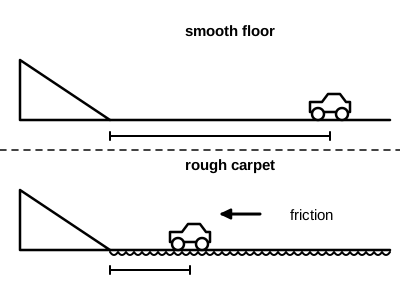
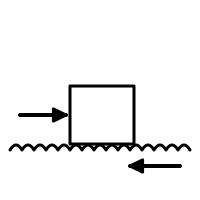
Say: "A surface is the outside or top of a thing. Friction is a force between two surfaces that touch. It pushes against sliding. So friction slows moving things." Your child rubs both palms together fast for ten seconds. Ask: "What do you feel?" (warmth) Say: "Rubbing made that warmth. That is friction at work." Your child slides one fingertip along the floor, then along the towel. Ask: "Which one grips your finger more?" (the towel, usually) Say: "Rough or bumpy surfaces usually make more friction. Smooth surfaces usually make less. Friction also makes it harder to start a thing sliding." Check: "The book slid and then stopped. What force slowed it?" (friction) "The book slides to the right. Which way does friction push on it?" (to the left, against the motion) If stuck, say: "Which two surfaces are touching? Are they rubbing?"
15–20 min · Investigation / Hands-On
Question: on which surface does the book slide the shortest distance? 1) Tape a start line on the floor, the towel and the rug. Tape the towel's edges flat. 2) Your child predicts the order from farthest to shortest. 3) Set the book just behind the line. Give it one quick shove with the ruler, and stop the ruler at the line. Practice the shove three times first. 4) Measure from the line to the book's front edge, to the nearest inch. 5) Run 3 trials on each surface. Change only the surface. Keep the same book, shove and start line. Record in a chart with columns Surface, Trial 1, Trial 2 and Trial 3. Expect the longest slides on the bare floor. Your shove will not be exactly the same each time. That is why you run three trials. Real results vary. Look for the pattern.
10 min · Science Notebook Entry
Your child copies the chart, then finishes this frame. "Friction was greatest on the ___ because the book slid only about ___ inches there." Sample: "Friction was greatest on the rug because the book slid only about 4 inches there." Check that the sentence uses numbers from the chart.
5 min · Wrap-Up & Exit Ticket
Ask the three exit questions. Praise answers that use a measured distance as evidence.
Watch for: Shoving harder on some surfaces, which makes the test unfair.
Try: Your child says "same shove" before every trial. Redo any trial that felt stronger or weaker than the others.
Exit ticket (3 questions)
- You slide a coin across a desk and it stops. Which two surfaces rubbed together?
- With the same shove, a puck slid 3 inches on a doormat and 20 inches on a kitchen floor. Which one made less friction? How do you know?
- Why did we use the same book and the same shove on every surface?
Show answers
- The coin and the desk.
- The kitchen floor. The puck slid much farther there, so less friction slowed it.
- To keep the test fair. Only the surface changed.
Support: Use only two very different surfaces, the bare floor and the rug. Compare tape marks instead of measuring.
Extend: Your child adds a fourth surface. They predict where it fits in the order, then run 3 trials to check.
Homework: Your child slides the same spoon with the same gentle push on 3 surfaces at home. They rank the surfaces from least to most friction. Look for: the shortest slide means the most friction.