3
    Third GradePowered by ThirdGrade.com

    Standards this week

    Social Studies

    • D2.Geo.5.3-5 Explain how the cultural and environmental characteristics of places change over time.Day 1, 2, 3, 5
    • D2.Geo.2 Use maps, satellite images, and other models to explain relationships between places.Day 1, 2
    • D2.Geo.10.3-5 Day 3
    • D2.Eco.3.3-5 Identify examples of the variety of resources (human, natural, capital) used to produce goods and services.Day 4, 5
    • D2.Geo.4 Explain how culture influences how people modify and adapt to their environments.Day 4, 5
    • D2.Geo.8.3-5 Day 4

    Mathematics

    • 3.OA.A.1 Interpret products of whole numbers as equal groups.Day 1, 2, 3, 4, 5
    • 3.OA.A.3 Use multiplication and division within 100 to solve word problems.Day 3, 4, 5
    • 3.OA.B.5 Apply the commutative, associative, and distributive properties.Day 3

    English Language Arts

    • RL.3.2 Recount stories and determine the central message, lesson, or moral.Day 1, 2, 3, 4, 5
    • RL.3.7 Explain how illustrations contribute to what is conveyed by the words in a story.Day 1
    • SL.3.2 Determine the main ideas and supporting details of a text read aloud or information presented in diverse media.Day 2
    • SL.3.1 Engage effectively in a range of collaborative discussions, building on others' ideas.Day 4
    • SL.3.1.A Day 4
    • SL.3.1.B Day 4
    • SL.3.1.C Day 4
    • SL.3.1.D Day 4

    Science

    • 3-PS2-3 Ask questions about cause-and-effect relationships of electric or magnetic interactions.Day 1, 2, 3, 4, 5

    See what your state adds or places differently

    Suggested daily schedule
    8:30–8:45 AM15 minMorning Circle / Read-Aloud / Calendar
    8:45–10:00 AM75 minEnglish Language Arts
    10:00–11:00 AM60 minMathematics
    11:00–11:15 AM15 minSnack and Movement Break
    11:15–12:00 PM30–45 minScience (every day)
    12:00–12:45 PM30–45 minSocial Studies (every day)
    12:45–1:30 PM45 minLunch and Choice Time
    1:30–2:15 PM45 minSpecials: PE / Art / Music (rotating)
    2:15–2:45 PM30 minIndependent Reading & Journaling

    Mark Week 4 complete

    0 / 4 done

    Saved in this browser

    Day 1 · Monday

    Social Studies

    I can name and describe common landforms and find them near where I live.

    D2.Geo.5.3-5D2.Geo.2.3-5

    Builds on: Needs Week 3 map reading and your child's own memory of land seen on walks or drives. One-minute check: ask, "On most maps, which direction is at the top?" (North.)

    New words:
    • landform – a natural shape of the land
    • mountain – very tall land with steep sides
    • hill – raised land that is lower and gentler than a mountain
    • plain – wide, flat land
    • valley – low land between hills or mountains
    • plateau – high land with a flat top
    • canyon – a deep, narrow valley with steep sides
    • physical map – a map that shows the shape of the land and the water

    Materials: Notebook, Pencil, Play dough or clay (about 1 cup), 1 paper plate, 6 sticky notes, 1 bath towel, 4 thick books, A physical map of the United States (atlas or library book)

    5 min · Day 16 — Landforms — Big Question Warm-Up

    Spaced review from Week 3. Say: "A map scale says 1 inch = 10 miles. Two farms are 3 inches apart. How far is that?" (30 miles.) Then ask the day's wonder: "Is the land near our home flat, bumpy or steep? Why is land not the same shape everywhere?" Take every idea.

    10–15 min · Mini-Lesson

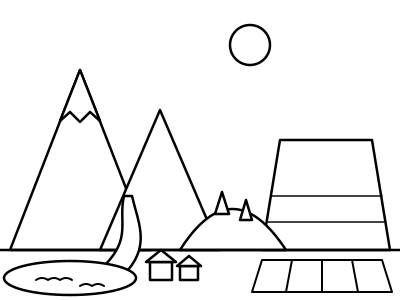
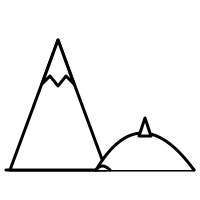
    Say: "A landform is a natural shape of the land. Today we learn six." Lay the towel flat on a table. Say: "Wide, flat land is a plain." Push the towel up into one tall, pointed peak. Say: "Very tall land with steep sides is a mountain." Make a small, rounded bump. Say: "A hill is raised land too, but lower and gentler." Make two peaks and point between them. Say: "Low land between hills or mountains is a valley." Now set two stacks of two books a finger-width apart. Say: "Each flat top is like a plateau. A plateau is high land with a flat top." Point into the gap. Say: "This deep, narrow gap with steep sides is like a canyon. A river often carves a canyon, very slowly, over a very long time." Ask: "Which landforms rise up?" (Mountain, hill and plateau.) "Which are low places between higher land?" (Valley and canyon.) "Which one has a flat top?" (The plateau.) If your child is stuck, say: "Does it go up, go down, or stay flat?"

    15–20 min · Activity / Source Work

    Build and find. 1) Your child shapes all six landforms from play dough on the paper plate. 2) Your child writes each name on a sticky note and labels each model. 3) Read these clues. Your child points to the right model. "I am the tallest landform, and my sides are steep." (Mountain.) "I am low land with higher land on both sides." (Valley.) "You could run across me for miles and never climb." (Plain.) "I am high, but my top is flat." (Plateau.) "My walls are steep rock, and I am deep and narrow." (Canyon.) "I am a gentle bump you can walk up easily." (Hill.) 4) Open the physical map. Together find the Rocky Mountains, the Great Plains, the Colorado Plateau and the Grand Canyon. Ask: "What on this map shows that the Rocky Mountains are high land?" (Brown color or shading, as the key explains.) Models differ. Look for the right shape.

    10 min · Notebook Entry

    In the notebook, your child sketches and labels all six landforms in pencil. Then your child finishes two frames. "Near my home there is a ____. I know because ____." Sample: "Near my home there is a hill. I know because our street slopes up to the park." If your land is flat, "plain" is a fine answer.

    5 min · Wrap-Up & Exit Ticket

    Read the three exit questions aloud. Your child answers without looking at the models. Praise answers that describe the shape of the land, not only its name.

    Watch for: Calling any steep land a canyon, which mixes up raised land and low land.

    Try: Your child traces each model with a finger. Mountains go up from the land. Valleys and canyons go down between land.

    Exit ticket (3 questions)
    1. Put these in order from lowest to highest: mountain, plain, hill.
    2. A plateau and a plain both have flat land. How are they different?
    3. You stand at the bottom of a deep, narrow place with steep rock walls. A river runs beside you. Which landform are you in?
    Show answers
    1. Plain, hill, mountain.
    2. A plateau is high land that stands above the land around it. A plain is not raised.
    3. A canyon.

    Support: Teach only mountain, hill and plain today. Your child touches each model and says its name three times.

    Extend: On the physical map, your child finds three landforms in your state and writes their names. Ask which one is nearest your home.

    Homework: On a walk or drive, your child spots one landform and draws it. Look for a correct name and one detail, such as "a hill with gentle sides."

    Mathematics

    I can show equal groups and find how many in all.

    3.OA.A.1

    Builds on: Needs Grade 2 skip-counting and adding the same number again. One-minute check: your child counts by 5s to 30, then adds 2 + 2 + 2 (6).

    New words:
    • equal groups – groups that all have the same number of things
    • in all – the total when you count every group

    Materials: 30 counters (dried beans, coins or buttons), 7 paper plates or cups, Notebook, Pencil

    5 min · Warm-Up

    Spaced review from Week 3. Write 600 − 125. Your child solves it (475). Then count by 2s to 20 together. Ask: "What comes after 14?" (16)

    10–15 min · Mini-Lesson

    Say: "Today we make equal groups. Equal groups all have the same number." Set out 4 plates. Put 3 beans on each plate, counting aloud. Ask: "How many groups?" (4) "How many in each group?" (3) Say: "We have 4 groups of 3." Touch each plate and count by 3s: 3, 6, 9, 12. Say: "4 groups of 3 is 12 in all." Next, put 2, 5 and 3 beans on three plates. Ask: "Are these equal groups?" (No. The plates hold different numbers.) Now your child does more. Say: "Make 2 groups of 5." Ask: "How many groups? How many in each? How many in all?" (2, 5, 10)

    10–15 min · Guided Practice

    Your child builds each one with plates, then draws circles with dots inside. 1) 5 groups of 2 (10). Count together: 2, 4, 6, 8, 10. 2) 3 groups of 5 (15). 3) 2 groups of 4 (8). 4) Set out plates holding 4, 4 and 3 beans. Ask: "Equal groups?" (No. Add 1 bean to the last plate.) If stuck, say: "Set out the plates first. How many plates? Now put the same number on each."

    15–20 min · Independent Practice

    Your child draws circles and dots, then writes "__ groups of __ is __." 1) 3 groups of 4 (12). 2) 5 groups of 3 (15). 3) 6 groups of 2 (12). 4) 4 groups of 5 (20). 5) 7 groups of 2 (14). 6) You draw 2 circles with 6 dots in each. Ask: "How many groups of how many?" (2 groups of 6 is 12.) 7) Four cars have 4 wheels each. How many wheels in all? (16) 8) 5 bags hold 5 apples each. How many apples in all? (25) Check each total by skip-counting.

    5 min · Exit Ticket

    Read each question aloud; your child answers on paper with no plates and draws for question 3.

    Watch for: Swapping the two numbers, such as drawing 4 groups of 3 when asked for 3 groups of 4.

    Try: Ask "How many groups?" first. Your child draws the circles before any dots, then fills each circle.

    Fact fluency: Skip-counting by 2s
    Exit ticket (3 questions)
    1. What makes groups equal groups?
    2. How many are in 3 groups of 3?
    3. Draw 6 groups of 3. How many in all?
    Show answers
    1. Answers vary. Look for: every group has the same number.
    2. 9
    3. 18 (drawing shows 6 circles with 3 dots in each)

    Support: Use only 2 or 3 plates with 2 beans on each. Your child counts every bean one by one, then counts by 2s.

    Extend: Give your child 12 beans. Ask for every way to make equal groups. Answers: 1 of 12, 2 of 6, 3 of 4, 4 of 3, 6 of 2, 12 of 1.

    Homework: Find 3 sets of equal groups at home, such as socks in pairs. Draw one and write how many in all. Sample: 4 pairs of socks, 4 groups of 2 is 8.

    English Language Arts

    I can name the features of a folktale and use the pictures to understand it.

    RL.3.2RL.3.7

    Builds on: Needs Week 1 Day 4, finding a story's central message, and Week 1 Day 2, learning from pictures. One-minute check: ask, "What is a central message?" (The big lesson a story teaches.)

    New words:
    • folktale – a story people told aloud for many years before anyone wrote it down
    • mood – the feeling a story or a picture gives you
    • open syllable – a word part that ends in a vowel; that vowel usually says its name

    Materials: Reader's notebook, Pencil, Crayons, Your child's own book

    5 min · Warm-Up

    Word study, consonant-le. Write table, maple, title, apple, little, puzzle. Say: "Each word ends with a consonant plus le. Those three letters make the last syllable. Count back three letters and split." Your child draws the lines. (ta|ble, ma|ple, ti|tle, ap|ple, lit|tle, puz|zle) Ask: "Which first syllables end in a vowel?" (ta, ma, ti) Say: "A syllable that ends in a vowel is open, and its vowel says its name. The others end in a consonant. They are closed, so the vowel is short." Read all six. Spaced review, Week 3. Ask: "What is text evidence?" (The exact words in a text that prove an answer.)

    10–15 min · Mini-Lesson

    Say: "A folktale is a story people told aloud for many years. Folktales often have a clever character, things that happen in threes, and a lesson." Write those three features as a checklist. Read aloud "Stone Soup," a folktale told in many countries of Europe: [A hungry traveler came to a village. Every door was shut, and everyone hid their food. The traveler filled a pot with water, set it over a fire, and dropped in a smooth stone. "Stone soup," he said loudly. "It would taste even better with one carrot." A woman crept out with a carrot. "An onion would make it perfect," he said. A man brought an onion. "Beans would make it fit for a king." A boy ran up with beans. Soon the pot was full, and the whole village ate together. "All that from one stone?" asked the boy. The traveler only smiled.] Think aloud: "The traveler never begs. He makes people curious instead. That is clever, so I check the first box."

    10–15 min · Guided Practice

    1) Ask: "What happens three times?" (He asks for one more food. A carrot, an onion and beans come.) 2) Ask: "What lesson does the village learn?" (When everyone shares a little, there is enough for all.) 3) Say: "Pictures add to the words. They can show a mood, the feeling of a scene." Say: "Imagine the first picture in a book of this tale: shut doors, crossed arms, a face behind a curtain." Ask: "What mood is that?" (Unfriendly or worried.) 4) Say: "Now imagine the last picture: one long table, full bowls, people laughing." Ask: "What changed, and which words in the story match?" (The mood is happy. "The whole village ate together.") If stuck, say: "Point to the three foods. Now tell me who brought each one."

    15–20 min · Independent Practice

    Your child works in the reader's notebook. 1) Draw the village with crayons at the beginning and at the end. Show the mood in the faces and doors. 2) List the three folktale features with a story example for each. 3) Write the lesson in one sentence. 4) Finish: "My picture shows ___, which the words do not say." Look for: two pictures that clearly differ; an example for each feature; a lesson about sharing, not a retelling. Sample: "Clever character: the traveler. Pattern of three: carrot, onion, beans. Lesson: A little sharing feeds everyone."

    5 min · Exit Ticket

    Read each question aloud. Your child answers in full sentences, aloud or in the notebook. Circle any missed idea to revisit tomorrow.

    Watch for: Giving an event as the lesson, such as "They made soup."

    Try: Ask, "What should people learn from this?" The answer must fit people who were never in the story.

    Exit ticket (3 questions)
    1. Name two features that make "Stone Soup" a folktale. Give a story example for one of them.
    2. The boy asks, "All that from one stone?" What really filled the pot?
    3. A picture shows the villagers laughing at one long table. What does it add to the story's ending?
    Show answers
    1. Any two: a clever character (the traveler), a pattern of three (carrot, onion, beans), a lesson, told aloud for many years.
    2. The food the villagers shared, a little from each person.
    3. Answers vary. Look for: a happy, friendly mood that shows how the village has changed.

    Support: Your child retells the tale with three quick sketches of the foods. Then they name each feature while pointing to a sketch.

    Extend: Your child invents a fourth villager and food. Then they explain why storytellers so often stop at three.

    Homework: Read your own book for 15–20 minutes. Then ask a family member for a story they heard as a child. Listen for one folktale feature and name it: a clever character, a pattern of three or a lesson.

    Science

    I can show that magnet poles attract or repel each other without touching.

    3-PS2-3

    Builds on: Needs Week 1 Day 3, where a magnet pulled a paper clip without touching it. One-minute check: ask, "Did the magnet touch the clip before the clip moved?" (No.)

    New words:
    • pole – one of two places on a magnet where its force is strongest, called north and south
    • attract – to pull together
    • repel – to push apart

    Materials: 2 bar magnets or 2 disc magnets (not flat fridge-sheet magnets), 1 steel paper clip, Masking tape and a marker, 2 round pencils (rollers), Toy car (only if you use disc magnets), Red and blue crayons, Science notebook and a pencil for writing

    5 min · Day 16 — Magnets: Attract and Repel — Wonder Warm-Up

    Spaced review from Week 3. Ask: "What force slows a book sliding on a rug? Do the surfaces have to touch?" (Friction. Yes.) Then hold a magnet just above the paper clip until it jumps. Ask: "Did anything touch the clip before it moved?" (No.) Say: "Today we find out how magnets push and pull across a gap."

    10–15 min · Mini-Lesson

    Safety: never put magnets in a mouth, and keep them away from phones and bank cards. Say: "A magnet's force is strongest at its poles. Every magnet has a north pole and a south pole." Point to them: the two ends of a bar magnet, or the two flat faces of a disc magnet. If the poles are not marked, find two ends that push each other away. Tape N on both and S on the other two. The labels only need to match. Say: "Attract means pull together. Repel means push apart." Bring N toward S and let them snap. Ask: "Attract or repel?" (Attract.) Turn one magnet around. Your child pushes N toward N and feels the push. Ask: "Attract or repel?" (Repel.) "Did the magnets touch before you felt it?" (No.) Say: "Opposite poles attract. Like poles repel." If stuck, say: "Same letters push away. Different letters pull together."

    15–20 min · Investigation / Hands-On

    1) Lay the two pencils side by side, a finger apart. Rest one bar magnet across them so it can roll. For disc magnets, tape one on its edge to the front of the toy car instead. 2) Draw a chart with three columns: Poles facing, Prediction, What happened. Make four rows: N to N, S to S, N to S, S to N. 3) Your child predicts attract or repel for one row. 4) Your child slowly brings the second magnet toward the first and stops a finger-width away. Look for the first magnet rolling toward or away. 5) Record it, then do the next row. Change only which poles face each other. Keep the same magnets and slow speed. Expect repel for the two like pairs and attract for the two opposite pairs. If the roller spins around and snaps on, say: "Real results vary. It turned so opposite poles could meet. Try again, more slowly." Ask: "What made the magnet roll away?" (Like poles faced each other.)

    10 min · Science Notebook Entry

    Your child draws the four pairings as two small magnets each, with the facing letters. Add arrows: pointing apart for repel, pointing together for attract. Then write the rule: "Opposite poles ___. Like poles ___." Sample: arrows apart on N to N and S to S; "Opposite poles attract. Like poles repel."

    5 min · Wrap-Up & Exit Ticket

    Ask the three exit questions; your child answers aloud or in writing. Praise the words attract, repel and pole used correctly.

    Watch for: Thinking magnets only pull, because fridge magnets always stick.

    Try: Your child holds like poles close and feels the push. Have your child say, "That push is repel."

    Exit ticket (3 questions)
    1. A magnet on a toy car rolls away when you bring another magnet near. What do you know about the two poles facing each other?
    2. What could you do to make that car roll toward your magnet instead?
    3. Tell what attract and repel mean.
    Show answers
    1. They are like poles (both north or both south), so they repel.
    2. Turn one magnet around so opposite poles face each other. Then they attract.
    3. Attract means pull together. Repel means push apart.

    Support: Color a red dot on every N and a blue dot on every S. Practice saying: "Same colors push. Different colors pull."

    Extend: Your child pushes a magnet across the table using only repelling, never touching it. Ask what makes it hard. (The loose magnet tries to turn so opposite poles meet.)

    Homework: Find two magnets at home. Try to make them attract. Then turn one around and try to make them repel. Draw what happened, with arrows. Flat fridge magnets may only slide, because their poles are in tiny stripes.
    Day 2 · Tuesday

    Social Studies

    I can name bodies of water and tell how they are different.

    D2.Geo.5.3-5D2.Geo.2.3-5

    Builds on: Needs Day 1 landforms and Week 3 map keys. One-minute check: ask, "Which landform is low land between mountains?" (A valley.)

    New words:
    • ocean – a huge body of salt water
    • sea – salt water that is smaller than an ocean and partly surrounded by land
    • river – fresh water that flows across the land in a long path
    • stream – a small river
    • lake – a large body of water with land all around it
    • pond – a small, shallow lake
    • fresh water – water that is not salty
    • evidence – words, numbers or a place on a map that you can point to, to show an answer is true

    Materials: Notebook, Pencil, Blue crayon, A U.S. or world map, 1 baking tray, 1 thick book, 2 clear cups with half a cup of drinking water in each, Half a teaspoon of salt, 1 spoon

    5 min · Day 17 — Bodies of Water — Big Question Warm-Up

    Spaced review from Week 3. Ask: "On a map key, what does the color blue usually stand for?" (Water.) Then ask the day's wonder: "Where does the water in a river come from, and where is it going?" Take every idea.

    10–15 min · Mini-Lesson

    Say: "Water on Earth has different names. The name depends on size, on salt, and on whether the water flows." Rest one end of the tray on the book. Slowly pour the water from one cup onto the high end. Say: "Watch. This water flows downhill in a path. Flowing fresh water is a river. A small river is a stream." Point to the pool at the low end. Say: "This water stays in one place with land around it. That is a lake. A small, shallow lake is a pond." Stir the salt into the second cup with the spoon. Your child may taste one drop on a fingertip. Say: "An ocean is a huge body of salt water. Earth has five oceans. They are the Pacific, Atlantic, Indian, Arctic and Southern. A sea is salt water too. It is smaller than an ocean and partly surrounded by land." Ask: "Which flows, a river or a lake?" (A river.) "Which is bigger, a stream or a river?" (A river.) "Why can we not drink ocean water?" (It is too salty.) If stuck, say: "Ask two things. Is it salty or fresh? Does it flow or stay?"

    15–20 min · Activity / Source Work

    Map and chart work. 1) On the map, your child finds the Pacific Ocean, the Atlantic Ocean, the Great Lakes and the Mississippi River. 2) Your child traces the Mississippi with a finger from north to south. Say: "Evidence is what you can point to that shows your answer is true." Ask: "Where does this river end? What is your evidence?" (It ends at the salt water south of Louisiana. The blue line stops there.) Say: "Rivers flow from higher land down to a lake or an ocean." 3) In the notebook, draw a chart with three columns. Head them Water, Salt or fresh, and Flows in a path. List the six water words down the side. Your child fills in each row in pencil. Expect these answers. Ocean: salt, no. Sea: salt, no. River: fresh, yes. Stream: fresh, yes. Lake: mostly fresh, no. Pond: fresh, no. 4) Find the water nearest your home on the map and name its kind.

    10 min · Notebook Entry

    Your child draws and labels the six bodies of water with the blue crayon. Then your child finishes this frame. "A ____ is different from a ____ because ____." Sample: "A river is different from a lake because a river flows and a lake stays."

    5 min · Wrap-Up & Exit Ticket

    Read the three exit questions aloud. Your child may look at the chart for question 2 only. Praise answers that use the words salt, fresh or flows.

    Watch for: Thinking any very large water is an ocean.

    Try: Ask, "Is it salty? Is there land all around it?" Lake Michigan is huge, but it is fresh and has land around it.

    Exit ticket (3 questions)
    1. Which is bigger, a pond or a lake?
    2. Name the two kinds of water that flow in a path across the land.
    3. Lake Superior is so wide that you cannot see across it. Why is it still a lake and not an ocean?
    Show answers
    1. A lake.
    2. A river and a stream.
    3. It has land all around it and its water is fresh. An ocean is salt water.

    Support: Sort only three words today: ocean, river and lake. Your child says salty or fresh, then flows or stays, for each.

    Extend: Your child finds the longest river or largest lake in your state on a map. Then your child names one town beside it.

    Homework: Your child finds one river or lake on a map of your state and tells a family member its name. Look for the right word, river or lake.

    Mathematics

    I can connect equal groups to repeated addition and multiplication.

    3.OA.A.1

    Builds on: Needs Day 1 equal groups. One-minute check: put 2 beans on each of 3 plates. Ask how many groups, how many in each, how many in all (3, 2, 6).

    New words:
    • repeated addition – adding the same number again and again
    • multiplication – a short way to write equal groups
    • multiplication sentence – a number sentence with ×, like 5 × 2 = 10

    Materials: 30 counters (dried beans, coins or buttons), 6 paper plates or cups, Notebook, Pencil

    5 min · Warm-Up

    Spaced review. Ask: "How many are in 4 groups of 5?" (20) Then write 372 − 148 for Week 3 practice (224). Count by 5s to 50 together.

    10–15 min · Mini-Lesson

    Build 5 groups of 2 on plates. Say: "I can add the groups." Write 2 + 2 + 2 + 2 + 2 = 10. Say: "Adding the same number again and again is repeated addition." Ask: "How many 2s did I write?" (5) Write 5 × 2 = 10 underneath. Say: "This sign means groups of. We read it: 5 groups of 2 is 10. Many people also say 5 times 2." Point to each number. Say: "The 5 tells how many groups. The 2 tells how many in each group." Now your child does more. Build 3 groups of 4. Your child writes the addition (4 + 4 + 4 = 12). Ask: "How many 4s?" (3) Your child writes 3 × 4 = 12 and reads it aloud.

    10–15 min · Guided Practice

    Your child builds, writes the addition, then writes the multiplication sentence. 1) 2 groups of 6 (6 + 6 = 12; 2 × 6 = 12). 2) 4 groups of 5 (5 + 5 + 5 + 5 = 20; 4 × 5 = 20). 3) Write 6 + 6 + 6. Ask: "How many 6s?" (3, so 3 × 6 = 18) 4) Go backward. Write 3 × 2. Ask: "What does this tell you to build?" (3 groups of 2, which is 6.) If stuck, say: "Count the plates. Write that number first. Then write how many are on one plate."

    15–20 min · Independent Practice

    Your child writes the repeated addition and the multiplication sentence. 1) 3 groups of 5 (5 + 5 + 5 = 15; 3 × 5 = 15). 2) 4 groups of 2 (2 + 2 + 2 + 2 = 8; 4 × 2 = 8). 3) 6 groups of 3 (6 × 3 = 18). 4) 2 groups of 7 (2 × 7 = 14). 5) You draw 5 circles with 4 dots in each (5 × 4 = 20). 6) Write 4 × 4. Your child draws it and solves (4 groups of 4; 16). 7) 3 vases hold 3 flowers each. How many flowers? (3 × 3 = 9) 8) 5 friends get 5 stickers each. How many stickers? (5 × 5 = 25)

    5 min · Exit Ticket

    Put the plates away and read each question aloud; your child writes the answers.

    Watch for: Writing the group size first, such as 4 × 3 for 4 + 4 + 4.

    Try: Count the addends aloud: "I see three 4s." Your child writes the 3 first, then reads "3 groups of 4."

    Fact fluency: Skip-counting by 5s
    Exit ticket (3 questions)
    1. Write 4 groups of 6 as repeated addition. What is the total?
    2. 3 + 3 + 3 + 3 + 3 makes what total? Write it as multiplication.
    3. What does 2 × 4 tell you to build? How many in all?
    Show answers
    1. 6 + 6 + 6 + 6 = 24
    2. 15; 5 × 3 = 15
    3. 2 groups of 4; 8

    Support: Use only 2 or 3 plates. Your child touches each plate while saying the addition, then counts the plates.

    Extend: Write 4 + 4 + 5. Ask: "Can this be one multiplication sentence?" (No. The groups are not equal.) Then your child writes a story for 4 × 6 and solves it (24).

    Homework: Draw 2 equal-group pictures of things at home. Write each as addition and as multiplication. Sample: 3 chairs with 4 legs each, 4 + 4 + 4 = 12, 3 × 4 = 12.

    English Language Arts

    I can listen to a fable, retell it, and state its moral.

    RL.3.2SL.3.2

    Builds on: Needs Week 1 Day 4, when your child heard a fable and told its central message. One-minute check: ask, "What lesson did the village learn in 'Stone Soup'?" (Sharing a little helps everyone.)

    New words:
    • moral – the lesson a fable teaches, often said in one sentence at the end

    Materials: Reader's notebook, Pencil, Your child's own book

    5 min · Warm-Up

    Word study, consonant-le. Write cable, bugle, stable, candle, simple, middle. Your child counts back three letters, draws the line and reads each word. (ca|ble, bu|gle, sta|ble, can|dle, sim|ple, mid|dle) Ask: "Why is the a in stable long?" (The first syllable ends in a vowel.) Spaced review, Week 3. Ask: "How is a quote different from a paraphrase?" (A quote copies exact words inside quotation marks. A paraphrase uses your own words.)

    10–15 min · Mini-Lesson

    Say: "A fable is a very short story, often with talking animals. It teaches a lesson called a moral. Listen without looking." Read aloud "The Boy Who Cried Wolf," a fable from Aesop of ancient Greece: [A shepherd boy sat on a hill, bored with watching sheep. "Wolf! Wolf!" he shouted. The villagers dropped their work and ran up the hill. There was no wolf. The boy laughed at their red faces. The next day he played the same trick, and again they came running. On the third day, a real wolf crept out of the woods. "Wolf! Wolf!" cried the boy. This time nobody came, and the wolf scattered the whole flock.] Think aloud: "To retell, I say the key events in order. First, the boy tricks the villagers. Next, he tricks them again. Finally, a real wolf comes, and nobody helps." Write the three sentences, and your child reads them back. Say: "The moral is not an event. It is what people should learn. Moral: People stop believing a liar, even when he tells the truth."

    10–15 min · Guided Practice

    Read aloud "The Ant and the Grasshopper," another fable from Aesop, while your child listens: [All summer, Grasshopper sang in the sunny field. Ant marched past, dragging a seed to her nest. "Why work so hard?" laughed Grasshopper. "Come and sing!" Ant shook her head. "Winter is coming," she said. When snow covered the field, Grasshopper shivered with an empty belly. Ant sat snug in her nest with food to last until spring.] 1) Ask: "What did each character do in summer?" (Grasshopper sang. Ant stored food.) 2) Ask: "What happened in winter?" (Grasshopper was cold and hungry. Ant had plenty.) 3) Your child retells the fable in three sentences with first, next and finally. 4) Ask: "What is the moral?" (Get ready today for what you will need later.) If stuck, say: "Who had food in winter? Why did she have it?"

    15–20 min · Independent Practice

    Your child works in the reader's notebook. 1) Write both morals in their own words. 2) Under each moral, write one key detail that shows it. 3) Draw a small picture for each fable. 4) Write one sentence about a real time when one moral would help. Look for: morals that are lessons for people, not events; details that come from the fable. Sample: "Moral: Plan ahead. Detail: Ant had food in winter because she worked all summer. This helps when I pack my bag the night before."

    5 min · Exit Ticket

    Read each question aloud. Your child answers aloud in full sentences without looking back. Listen for events told in order.

    Watch for: Retelling the fable when asked for the moral.

    Try: Ask, "What should a person learn from this?" The answer must work for real people, not only the characters.

    Exit ticket (3 questions)
    1. Why did nobody come the third time the shepherd boy shouted?
    2. Retell "The Ant and the Grasshopper" in two sentences.
    3. A child puts off a book report until the last night. Which fable's moral fits, and why?
    Show answers
    1. He had lied twice, so the villagers no longer believed him.
    2. Answers vary. Look for: Grasshopper sings all summer while Ant stores food; in winter Grasshopper is hungry and Ant has plenty.
    3. "The Ant and the Grasshopper." Its moral is to get ready ahead of time.

    Support: Say three morals aloud. Your child matches one to each fable and tells which event shows it.

    Extend: Your child rewrites one moral as a saying of six words or fewer, such as "Nobody believes a liar."

    Homework: Read your own book for 15–20 minutes. Then tell a family member one of today's fables from memory. Ask them to guess the moral. Look for events in order and a moral that is a lesson.

    Science

    I can test objects and sort them into magnetic and not magnetic.

    3-PS2-3

    Builds on: Needs Day 1: magnets attract and repel each other without touching. One-minute check: ask, "What do two like poles do?" (They repel, or push apart.)

    New words:
    • magnetic – pulled by a magnet
    • iron – a strong gray metal; steel is made mostly of iron

    Materials: 1 bar or disc magnet, 10 test objects: steel paper clip, aluminum foil, coin, metal spoon, plastic spoon, house key, rubber band, wooden pencil, steel bottle cap or jar lid, sheet of paper, 2 bowls with paper labels: Yes and No, Science notebook and a pencil for writing

    5 min · Day 17 — Which Things Are Magnetic? — Wonder Warm-Up

    Spaced review from Week 2. Ask: "A lamp sits still on a table. Are the forces on it balanced or unbalanced?" (Balanced.) Then hold up the paper clip and the foil. Ask: "Both are metal. Will a magnet pick up both?" Take a guess, but do not test yet.

    10–15 min · Mini-Lesson

    Say: "A magnet attracts things that have iron in them. Steel is mostly iron, so most steel things are magnetic." Touch the magnet to the paper clip and lift. Ask: "What is the clip probably made of?" (Steel, which has iron.) Say: "Many other metals are not magnetic. Aluminum and copper are two of them." Hold the magnet to the foil. Ask: "Is foil a metal? Did the magnet attract it?" (Yes, it is aluminum. No.) Say: "Plastic, wood, paper, rubber and glass are not magnetic either." Ask: "So does metal always mean magnetic?" (No. It needs iron, or one of a few other metals.) Say: "Spoons, keys and coins can surprise us. So scientists test. They do not guess." If stuck, say: "Ask two questions. Is it metal? Does that metal have iron in it?"

    15–20 min · Investigation / Hands-On

    Safety: a bottle cap can have a sharp edge, so hold it by the top. 1) In the notebook, draw a chart with three columns: Object, Prediction, Result. List the 10 objects. 2) Your child writes Yes or No for every prediction before testing anything. 3) Test one object at a time. Change only the object. Keep the same magnet and touch it the same way. Look for a pull you can feel, or a lift. 4) Write Yes or No in the Result column, then drop the object in its bowl. 5) Circle each surprise. Expect Yes for the paper clip and the steel cap. Expect No for the foil, plastic spoon, rubber band, pencil wood and paper. The metal spoon, key and coin depend on their metal; many will not stick. If your results differ, say: "Real results vary. The magnet shows us what is inside." Ask: "Which objects in the No bowl are metal?" (The foil, and maybe the key, coin or spoon.)

    10 min · Science Notebook Entry

    Your child finishes two sentence frames under the chart. "A magnet attracted ___ and ___." "Not all metals are magnetic. For example, ___ is metal but was not attracted." Sample: "A magnet attracted the paper clip and the bottle cap. The foil is metal but was not attracted."

    5 min · Wrap-Up & Exit Ticket

    Ask the three exit questions aloud. Praise any answer that points back to a test result instead of a guess.

    Watch for: Believing that all metals are magnetic.

    Try: Your child predicts the foil and the coin, then tests them. Let the surprise teach. Then say, "Metal is not enough. It needs iron."

    Exit ticket (3 questions)
    1. A brass doorknob is metal, but a magnet will not stick to it. What does that tell you about brass?
    2. A magnet sticks to the side of a soup can. What can you say about the can?
    3. Why should you test an object instead of guessing from how it looks?
    Show answers
    1. Brass is not magnetic. Not all metals are magnetic.
    2. It is magnetic, so it probably has iron in it (it is steel).
    3. Answers vary. Look for: looks can fool you; many metals look alike, and only a test shows whether a magnet attracts one.

    Support: Start with 5 clear objects: paper clip, foil, plastic spoon, paper and bottle cap. Add the tricky ones afterward.

    Extend: Your child tests 10 more metal objects around the home, sorts them, and tells which ones probably contain iron.

    Homework: Test 5 more objects at home with a magnet and add them to the chart. Look for a prediction written before each result. Keep magnets away from phones and computers.

    Day 3 · Wednesday

    Social Studies

    I can describe my region's climate and explain how it affects the way people live.

    D2.Geo.5.3-5D2.Geo.10.3-5

    Builds on: Needs your child's own memory of summer and winter where you live, and Week 3 globe work. One-minute check: ask, "Which is round, a globe or a map?" (A globe.)

    New words:
    • weather – what the air outside is like right now or today
    • climate – the usual weather in a place over many years
    • equator – the make-believe line around the middle of Earth

    Materials: Notebook, Pencil, Crayons, A globe or world map

    5 min · Day 18 — Climate of Our Region — Big Question Warm-Up

    Spaced review from Week 2. Ask: "Name the three types of communities." (Urban, suburban and rural.) Then ask the day's wonder: "Why do some children need snow boots every winter and other children never see snow?" Take every idea.

    10–15 min · Mini-Lesson

    Look out a window together. Ask: "What is the air like right now?" Say: "That is weather. Weather is what the air is like today. It can change by lunch." Ask: "What are our summers usually like?" Say: "That is climate. Climate is the usual weather in a place over many years." Now your child sorts three sentences. "It is windy right now." (Weather.) "Our winters are usually cold and snowy." (Climate.) "A storm is coming tonight." (Weather.) Show the globe. Run a finger around the equator. Say: "This line is the equator. Places near it get the most direct sunlight, so they are usually warm all year. Places far to the north or south get slanted sunlight, so they are colder." Ask: "Is our home near the equator or far from it?" (Answers vary. Check on the globe.) If stuck, say: "Ask yourself, is it like this most years, or only today?"

    15–20 min · Activity / Source Work

    Source work. Read these two climate cards aloud. "Phoenix, Arizona, is in a desert. A usual January afternoon is about 67 degrees. A usual July afternoon is about 106 degrees. Only about 7 inches of rain fall in a year. Minneapolis, Minnesota, is far to the north. A usual January afternoon is about 24 degrees, and snow often covers the ground. A usual July afternoon is about 83 degrees. About 31 inches of rain and melted snow fall in a year." 1) In the notebook, draw a chart with four columns: Place, January, July, Rain in a year. Your child fills in both cities from the cards in pencil. 2) Ask: "Which city needs snow shovels? Give a number as evidence." (Minneapolis. January is about 24 degrees.) "Where would a cactus grow well? Give your evidence." (Phoenix. It gets only about 7 inches of rain.) 3) Find both cities on the globe. Ask: "Which is farther from the equator?" (Minneapolis.) 4) Add a third row for your town. Use what you know. A good estimate is fine.

    10 min · Notebook Entry

    Your child finishes these frames. "Our climate is ____. Because of our climate, people ____, ____ and ____." Sample: "Our climate is hot and dry. Because of our climate, people wear sun hats, use air conditioning and water their gardens." Then your child draws clothes for your coldest and hottest months with crayons.

    5 min · Wrap-Up & Exit Ticket

    Read the three exit questions aloud. Praise answers that tell what is usual over many years, not what happened today.

    Watch for: Describing today's weather as the climate, such as "Our climate is rainy" because it rained today.

    Try: Ask, "Is it like this most of the year, year after year?" If not, it is weather.

    Exit ticket (3 questions)
    1. It hailed for ten minutes this afternoon. Is that weather or climate?
    2. Which is usually warmer all year: a place near the equator or a place near the North Pole?
    3. A town is hot and rainy for most of the year, year after year. Name one way that climate shapes homes, clothes or jobs there.
    Show answers
    1. Weather.
    2. A place near the equator.
    3. Answers vary. Look for a real link, such as light clothes, fans, roofs that shed rain or rain-loving crops.

    Support: Skip the globe step. Your child draws a sun, snowflake or raindrop for each season where you live, then says the climate sentence.

    Extend: Your child compares your climate with Phoenix or Minneapolis. Your child writes two ways daily life would be different there.

    Homework: Your child asks a family member how your climate affects their clothes, home or job, then writes the answer. Look for one clear link to usual weather.

    Mathematics

    I can use an array of rows and columns to show multiplication.

    3.OA.A.13.OA.A.33.OA.B.5

    Builds on: Needs Grade 2 arrays: adding the rows of a small array. One-minute check: draw 2 rows of 3 dots. Your child writes 3 + 3 = 6.

    New words:
    • array – things lined up in equal rows
    • row – a line that goes across
    • column – a line that goes up and down

    Materials: 30 counters (dried beans, coins or buttons), Empty 12-egg carton, Grid paper, Plain sheet of paper, Crayons, Notebook, Pencil

    5 min · Warm-Up

    Spaced review. Write 4 + 4 + 4 + 4. Your child writes it as multiplication (4 × 4 = 16). Then count by 3s to 30 together.

    10–15 min · Mini-Lesson

    Show the egg carton. Say: "An array is things lined up in equal rows. Rows go across." Slide a finger along each row. Ask: "How many rows?" (2) "How many in each row?" (6) Write 2 × 6 = 12. Say: "2 rows of 6 is 12." Next, build 3 rows of 4 beans on the plain paper. Run a finger down one column. Say: "Columns go up and down." Write 3 × 4 = 12. Turn the paper a quarter turn. Ask: "How many rows now?" (4) "How many in each row?" (3) Write 4 × 3 = 12. Ask: "Did I add or take away any beans?" (No.) Say: "Turning an array never changes the total." Now your child does more. Your child builds 2 rows of 5 and writes 2 × 5 = 10. Then your child turns the paper and writes 5 × 2 = 10.

    10–15 min · Guided Practice

    Your child writes one sentence, turns the array, and writes the other. 1) Build 4 rows of 5 (4 × 5 = 20; turned, 5 × 4 = 20). Check by rows: 5, 10, 15, 20. 2) Color 3 rows of 6 squares on grid paper (3 × 6 = 18; turned, 6 × 3 = 18). 3) A muffin pan has 2 rows of 3 cups. How many cups? (2 × 3 = 6) 4) Ask: "5 × 3 = 15. What is 3 × 5?" (15. It is the same array turned.) If stuck, say: "Slide your finger across one row. How many? How many rows like that?"

    15–20 min · Independent Practice

    On grid paper, your child colors each array and writes its sentence. 1) 2 rows of 4 (2 × 4 = 8). 2) 3 rows of 5 (3 × 5 = 15). 3) 4 rows of 4 (4 × 4 = 16). 4) 5 rows of 3 (5 × 3 = 15). 5) 6 rows of 2 (6 × 2 = 12). 6) Which two arrays have the same total? Why? (Arrays 2 and 4. One is the other turned.) 7) A garden has 4 rows of 6 plants. How many plants? (4 × 6 = 24) 8) Chairs stand in 5 rows of 5. How many chairs? (5 × 5 = 25)

    5 min · Exit Ticket

    Your child answers on grid paper with the beans put away.

    Watch for: Mixing up rows and columns, so 3 rows of 4 is written as 4 × 3.

    Try: Lay a pencil across one row. Say: "Rows go across, like lines of words on a page." Count the rows first.

    Fact fluency: Skip-counting by 3s
    Exit ticket (3 questions)
    1. Which way do rows go? Which way do columns go?
    2. Draw an array with 3 rows of 3. Write the multiplication sentence.
    3. 6 × 5 = 30. What is 5 × 6? How do you know?
    Show answers
    1. Rows go across; columns go up and down.
    2. 3 × 3 = 9
    3. 30. Look for: it is the same array turned, so the total stays the same.

    Support: Use the egg carton. Put beans in 2 rows of 3 cups, then 2 rows of 4. Count each row aloud.

    Extend: Give your child 18 beans. Ask for every array and its sentence. Answers: 1 × 18, 2 × 9, 3 × 6, 6 × 3, 9 × 2, 18 × 1.

    Homework: Find 2 arrays at home, such as window panes or floor tiles. Draw each and write its multiplication sentence. Sample: a window with 2 rows of 3 panes, 2 × 3 = 6.

    English Language Arts

    I can explain what a myth tells about the natural world.

    RL.3.2

    Builds on: Needs yesterday's skill of retelling a short tale and saying its lesson. One-minute check: ask, "What kind of story ends with a moral?" (A fable.)

    New words:
    • myth – a very old story that explains something in nature, often with gods or magical beings

    Materials: Reader's notebook, Pencil, Crayons, Your child's own book

    5 min · Warm-Up

    Word study, consonant-le. Dictate: "The little candle sat in the middle of the table." Your child writes it, then checks each word against yours. Look at the le endings and the double letters in little and middle. Spaced review, Week 1. Ask: "What two things does a setting tell?" (Where and when a story happens.)

    10–15 min · Mini-Lesson

    Ask: "Why do we have winter?" Say: "Scientists explain the seasons with the tilt of Earth as it travels around the sun. Long ago, people told myths instead. A myth is a very old story that explains something in nature. Myths often have gods, goddesses or magical beings." Read aloud "Demeter and Persephone," a myth from ancient Greece: [Demeter was the goddess of the harvest. Wherever she walked, wheat ripened and fruit grew sweet. Her daughter, Persephone, was her greatest joy. One day Hades, king of the underworld, carried Persephone down to his dark kingdom. Demeter searched the whole world, weeping. In her sadness she let nothing grow, and the earth turned cold and bare. At last the gods made an agreement. Persephone would live part of each year below with Hades and part above with her mother. When she returns, Demeter rejoices, and flowers bloom. When she leaves, winter comes again.] Think aloud: "I ask a myth two questions. Who are the magical beings? What in nature does it explain? Here the beings are gods. The story explains why winter comes and goes."

    10–15 min · Guided Practice

    1) Ask: "Who are the characters, and how are they different from ordinary people?" (Demeter, Persephone and Hades. They are gods and goddesses.) 2) Ask: "What happens to the earth when Demeter is sad?" (Nothing grows. It turns cold and bare.) 3) Ask: "Which season does Persephone's return explain?" (Spring, when plants grow again.) 4) Draw two columns: The Myth Says and Science Says. Fill in one row about winter together. (Myth: Demeter grieves while Persephone is away. Science: our part of Earth tilts away from the sun and gets less direct light.) If stuck, say: "Find the sentence where the earth changes. What was Demeter feeling then?"

    15–20 min · Independent Practice

    Your child works in the reader's notebook. 1) Draw a three-panel comic with crayons: Persephone is taken, the earth turns cold, she returns and flowers bloom. 2) Write one sentence under each panel. 3) Finish: "This myth explains ___." 4) Write one sentence telling how you know it is a myth and not a fable. Look for: panels in story order; a sentence that names winter or the seasons; a reason about gods or explaining nature. Sample: "This myth explains why winter comes each year. I know it is a myth because goddesses cause something in nature."

    5 min · Exit Ticket

    Read each question aloud. Your child answers in full sentences, aloud or in the notebook. The story may stay open.

    Watch for: Thinking the myth is a true science explanation.

    Try: Point to the two-column chart. Say, "Both answer the same question. Only the science answer has been tested with evidence."

    Exit ticket (3 questions)
    1. What two clues tell you that "Demeter and Persephone" is a myth?
    2. According to the myth, why do flowers bloom in spring?
    3. How is the myth's reason for winter different from the science reason?
    Show answers
    1. It has gods and goddesses, and it explains something in nature (the seasons).
    2. Persephone returns to her mother, and Demeter is so glad that she lets plants grow.
    3. The myth says Demeter is sad. Science says Earth is tilted, so our part gets less direct sunlight for part of the year.

    Support: Your child retells the myth with three quick sketches first. Then reread the text, pausing at the part each sketch shows.

    Extend: Ask: "How would the world change if Persephone stayed below all year?" Your child writes three sentences that fit the myth.

    Homework: Read your own book for 15–20 minutes. Then make up a short myth, four or five sentences, that explains why the wind blows. Tell it to a family member. Look for a magical being and a clear explanation.

    Science

    I can observe that charged objects attract or repel without touching.

    3-PS2-3

    Builds on: Needs Days 1 and 2: magnets attract or repel without touching, and only some materials are magnetic. One-minute check: ask, "Will a magnet attract a sheet of paper?" (No. Paper has no iron.)

    New words:
    • static electricity – an electric charge that builds up on something, often from rubbing
    • charge – a kind of electricity an object can pick up when it is rubbed

    Materials: 2 balloons (or a plastic comb if anyone has a latex allergy), Wool sock or sweater, About 20 tiny bits of tissue paper, 2 pieces of string, each about 2 feet long, 1 magnet and 1 steel paper clip, Science notebook and pencil

    5 min · Day 18 — Static Electricity — Wonder Warm-Up

    Spaced review from Day 2. Ask: "Name one thing a magnet attracts and one metal thing it does not." (Sample: a paper clip; aluminum foil.) Then rub a balloon on the wool sock and hold it just above your child's hair. Ask: "What is happening to your hair? Is the balloon a magnet now?" Say: "Let's find out."

    10–15 min · Mini-Lesson

    Safety: an adult blows up the balloons and throws away any popped pieces at once. Say: "Everything is made of bits too tiny to see. Some of those bits carry electric charge. Rubbing moves some of them from the wool onto the balloon." Rub the balloon on the wool 10 times. Say: "Now the balloon has extra charge. We call that static electricity." Hold the balloon just above three tissue bits. Ask: "What did the tissue do? Did the balloon touch it first?" (It jumped up. No.) Say: "A charged object can pull light things without touching." Now hold the magnet over the paper clip, then over the tissue. Ask: "Does the magnet pull the tissue?" (No.) "Is static electricity the same force as magnetism?" (No. They are two different forces.) If stuck, say: "A magnet needs iron. A balloon needs rubbing to get its charge."

    15–20 min · Investigation / Hands-On

    Work on a dry day if you can, because damp air weakens static. 1) Draw a chart with three columns: Test, Prediction, Attract or repel. Your child predicts before each test. 2) Tissue test: rub the balloon on the wool 10 times. Hold it a finger-width above the tissue bits. 3) Wall test: rub 10 times again. Press the rubbed side gently on a wall and let go. 4) Two-balloon test: tie a string to each balloon and rub both on the wool. Hold both strings in one hand so the balloons hang side by side. Keep the wool and the 10 rubs the same. Change only what the balloon is near. Expect the tissue to jump up and the balloon to cling to the wall for a while. Expect the two balloons to swing apart. Ask: "Both balloons got the same kind of charge. What do same charges do?" (They repel.) If a test fails, say: "Real results vary. Rub longer and try again."

    10 min · Science Notebook Entry

    Your child sketches the three tests and labels each one attract or repel. Then finish two frames. "Rubbing gave the balloon a ___." "The balloon moved the tissue without ___." Sample: "Rubbing gave the balloon a charge. The balloon moved the tissue without touching it."

    5 min · Wrap-Up & Exit Ticket

    Ask the three exit questions aloud. Praise answers that keep static electricity and magnetism apart.

    Watch for: Thinking the rubbed balloon has turned into a magnet.

    Try: Hold the rubbed balloon over the tissue, then the magnet over the tissue. Ask, "Which one moved it? So are they the same force?"

    Exit ticket (3 questions)
    1. You rub a plastic spoon on your sleeve, and then it lifts tiny bits of paper. What did rubbing give the spoon?
    2. Socks cling to a shirt when they tumble together in a clothes dryer. Is that magnetism or static electricity? How do you know?
    3. A friend says a rubbed balloon has become a magnet. Give one reason your friend is wrong.
    Show answers
    1. An electric charge (static electricity).
    2. Static electricity. Cloth has no iron, and the tumbling rubs the clothes together.
    3. Sample: the balloon pulled paper and hair, not iron or steel, and only after rubbing. That is static electricity, a different force.

    Support: Do only the tissue test, three times. Your child says "attract without touching" each time.

    Extend: Your child asks a cause-and-effect question and tests it. Sample: does the balloon lift more tissue bits after 20 rubs than after 5? Count the bits each time.

    Homework: Show a family member the balloon and tissue test, and explain it using the word charge. Listen for: "Rubbing gave the balloon a charge, and it pulled the tissue without touching."

    Day 4 · Thursday

    Social Studies

    I can name natural resources in my region and explain how people use them.

    D2.Eco.3.3-5D2.Geo.4.3-5D2.Geo.8.3-5

    Builds on: Needs Days 1 to 3, because land, water and climate decide which resources a place has. One-minute check: ask, "Which describes many years, weather or climate?" (Climate.)

    New words:
    • natural resource – something useful that comes from nature, such as trees, water or soil
    • mineral – a useful material found in rock or in the ground, such as iron

    Materials: Notebook, Pencil, 1 wooden spoon, 1 glass jar, 1 cotton shirt, 1 metal can, 1 sheet of paper, A map of your state

    5 min · Day 19 — Natural Resources — Big Question Warm-Up

    Spaced review from Week 1. Ask: "Name one community need and a helper who meets it." (Sample: safety, a firefighter.) Then hold up the wooden spoon. Ask the day's wonder: "What was this before it was a spoon? Where does our stuff really come from?"

    10–15 min · Mini-Lesson

    Say: "A natural resource is something useful that comes from nature. People did not make it." Tap the spoon. Say: "This spoon began as a tree. Trees are a natural resource. People cut the wood and shaped it." Name more resources and count them on your fingers. Say: "Water. Soil for growing food. Plants and animals, which give us food, cotton and leather. Minerals like iron and copper, found in rock. Oil and natural gas from deep underground. Sunlight and wind, which can make electricity." Say: "Some resources come back. A new tree can grow in a person's lifetime. Rain refills rivers. Other resources took millions of years to form. Oil and iron are like that, so we must not waste them." Say: "People often settle near resources. Forests in the Pacific Northwest led to towns with lumber mills." Ask: "Is soil a natural resource?" (Yes. It comes from nature and helps us grow food.) "Is a plastic toy a natural resource?" (No. People made it.) "Which comes back sooner, a forest or oil?" (A forest.) If stuck, say: "Did people make it, or did it come from nature first?"

    15–20 min · Activity / Source Work

    Play Trace It Back. 1) Set out the five items. 2) In the notebook, draw a chart with two columns: Item and Natural resource. 3) For each item your child asks, "What was it before people made it?" Your child writes the answer in pencil. Expect these answers. Wooden spoon: trees. Paper: trees. Cotton shirt: cotton plants, which need soil, water and sun. Glass jar: sand, melted with great heat. Metal can: metal from rock dug out of the ground. 4) Open your state map. Talk about what you see when you travel in your region. Look for farmland, forests, rivers, lakes, coast, mines, quarries, sunshine and wind. 5) Your child lists five natural resources of your region. Ask: "What is your evidence that we have that resource here?" (Sample: "I see cornfields on the way to Grandma's house.") Lists differ from place to place. Look for real resources, not things people made.

    10 min · Notebook Entry

    Your child makes a chart with two columns: Resource in our region, and How people use it. Your child fills five rows, then circles each resource that can grow back or refill. Sample row: "Soil. Farmers grow wheat in it." Sample circles: trees, crops, water.

    5 min · Wrap-Up & Exit Ticket

    Read the three exit questions aloud. Praise answers that trace a thing back to nature in one or two steps.

    Watch for: Calling anything useful a natural resource, even things people made, like a car.

    Try: Ask, "Did people make it, or did it come from nature first?" Trace it back one step at a time.

    Exit ticket (3 questions)
    1. Is a bicycle a natural resource? Tell why or why not.
    2. A house has wooden walls and glass windows. Name the natural resource behind each.
    3. Name one resource that can grow back and one that cannot be replaced quickly.
    Show answers
    1. No. People made it. Its metal came from a natural resource in the ground.
    2. Trees for the wood and sand for the glass.
    3. Answers vary. Look for: trees or crops grow back; oil, natural gas, iron or copper cannot be replaced quickly.

    Support: Use only the spoon, the paper and the shirt. Your child points to a tree or plant picture for each one.

    Extend: Your child picks one local resource and draws four steps from nature to a product. Sample: tree, mill, factory, store.

    Homework: Your child finds one thing at home made from a resource of your region and tells a family member. Look for the item, the resource and the link between them.

    Mathematics

    I can read and write multiplication sentences and name the factors and product.

    3.OA.A.13.OA.A.3

    Builds on: Needs Days 2 and 3: writing a multiplication sentence for groups and arrays. One-minute check: build 2 rows of 4 beans. Your child writes 2 × 4 = 8.

    New words:
    • factor – a number we multiply
    • product – the answer when we multiply

    Materials: 30 counters (dried beans, coins or buttons), 3 index cards, Notebook, Pencil

    5 min · Warm-Up

    Spaced review. Your child draws 2 rows of 5 dots and writes the sentence (2 × 5 = 10). Then write 500 − 247 for Week 3 practice (253). Count by 4s to 40 together.

    10–15 min · Mini-Lesson

    Write 6 × 4 = 24. Say: "The numbers we multiply are factors. The answer is the product." Point and label: 6 is a factor, 4 is a factor, 24 is the product. Say: "One sentence can match three pictures." Draw 6 circles with 4 dots in each. Write 4 + 4 + 4 + 4 + 4 + 4 = 24. Draw 6 rows of 4 dots. Ask each time: "Where is the 6? Where is the 4?" (6 groups or rows; 4 in each.) Next, write 3 × 5 = ?. Say: "The question mark stands for the number we do not know yet." Now your child does more. Your child draws groups or an array for 3 × 5 and solves (15). Ask: "Which numbers are the factors? Which is the product?" (3 and 5; 15)

    10–15 min · Guided Practice

    Make three cards. Card 1: a drawing of 3 groups of 6. Card 2: the addition 6 + 6 + 6. Card 3: an array with 3 rows of 6. 1) Ask: "Which one sentence matches all three cards?" (3 × 6 = 18) 2) Ask: "Name the factors and the product." (3 and 6; 18) 3) 4 bags hold 2 oranges each. Your child writes a sentence with ? for the total, then solves (4 × 2 = ?; 8). 4) Ask: "Tell a story for 5 × 2." (Sample: 5 bikes with 2 wheels each is 10 wheels.) If stuck, say: "How many groups? How many in each? Write the groups number first."

    15–20 min · Independent Practice

    Your child writes the sentence, solves, and circles the product. 1) 3 groups of 4 (3 × 4 = 12). 2) 4 + 4 + 4 + 4 + 4 (5 × 4 = 20). 3) 6 rows of 2 (6 × 2 = 12). 4) 5 × 5 = ? (25) 5) 6 × 3 = ? Draw it. (18) 6) In 2 × 6 = 12, name the factors and the product. (2 and 6; 12) 7) A tray has 5 rows of 6 cookies. How many cookies? (5 × 6 = 30) 8) 4 dogs have 4 legs each. How many legs? (4 × 4 = 16) Check by drawing or skip-counting.

    5 min · Exit Ticket

    Read each question aloud; your child writes the answers without the cards.

    Watch for: Calling the product a factor, or pointing to the wrong number.

    Try: Say "factors make the product." Your child touches each factor, then the product, on every sentence.

    Fact fluency: Skip-counting by 4s
    Exit ticket (3 questions)
    1. In 7 × 3 = 21, which numbers are the factors?
    2. In 7 × 3 = 21, what is the product?
    3. Write a multiplication sentence for 4 groups of 3. Use ? for the total, then solve.
    Show answers
    1. 7 and 3
    2. 21
    3. 4 × 3 = ?; 12

    Support: Keep a card on the table that reads factor × factor = product. Build each problem with beans in 2 or 3 small groups first.

    Extend: Your child writes a story for 4 × 7, draws it, and solves it (28).

    Homework: Write 3 multiplication sentences for things at home. Label the factors and the product. Sample: 2 hands with 5 fingers each, 2 × 5 = 10; factors 2 and 5, product 10.

    English Language Arts

    I can compare folktales, fables and myths and discuss how they are alike and different.

    RL.3.2SL.3.1SL.3.1.ASL.3.1.BSL.3.1.CSL.3.1.D

    Builds on: Needs this week's four tales and the discussion rules from Week 2 Day 4. One-minute check: ask, "What does the Demeter myth explain?" (Why winter comes and goes.)

    Materials: Reader's notebook, Pencil, Five index cards or paper slips, Your child's own book

    5 min · Warm-Up

    Word study, consonant-le. Ask: "Which word names a horn like a small trumpet?" (bugle) "Which word names a thick, strong wire?" (cable) "Which word means easy or plain?" (simple) Your child uses title in a sentence. (Sample: The title of the myth is "Demeter and Persephone.") Spaced review, Week 2. Ask: "What do compare and contrast mean?" (To compare, tell how things are alike. To contrast, tell how they differ.)

    10–15 min · Mini-Lesson

    Say: "Today we compare three kinds of old stories." Draw a chart with columns Folktale, Fable, Myth and rows Length, Characters, Purpose. Think aloud for the first row: "'Stone Soup' took about a minute to tell. The fables were even shorter. Myths can be short or very long. I write: short; very short; short or long." Say: "Good talkers come prepared. Open your reader's notebook to this week's pages. You will use one note as evidence." Agree on three talk rules and write them. One: one speaker at a time. Two: ask a question when you are unsure or disagree, such as "Why do you think that?" Three: add on with "I agree because" or "I want to add."

    10–15 min · Guided Practice

    Fill in the chart by talking. 1) Ask: "Who are the characters in each kind?" (Folktale: ordinary or clever people. Fable: often talking animals. Myth: gods and magical beings.) 2) Ask: "What is each kind for?" (Folktale: pass on a people's wisdom. Fable: teach a moral. Myth: explain nature.) Your child points to a notebook note as evidence. 3) Read three story cards. Your child names the kind and the clue. [Card A, from the Māori people of New Zealand: The hero Māui catches the sun with ropes and makes it cross the sky slowly. That is why days are long enough for work. Card B, from Ghana in West Africa: Anansi the spider is small but clever. He tricks a python, a leopard and a swarm of hornets, one after another. Card C, a fable from Aesop: A thirsty crow drops pebbles into a pitcher until the water rises. Little by little does the job.] (A: myth, it explains nature. B: folktale, a clever character and a pattern of three. C: fable, very short with a moral.) 4) Your child finishes: "I used to think ___, but after our talk I think ___ because ___." If stuck, say: "Does it explain nature, end with a moral, or show a clever character?"

    15–20 min · Independent Practice

    1) Your child adds one title from this week under each column. ("Stone Soup"; either fable; "Demeter and Persephone") 2) They write five sorting cards on index cards for a family game. Each card describes a story in one or two sentences without naming its kind. 3) On the back, they write the kind and the clue. Look for: a clue on each card that fits only one kind; at least one card for each kind. Sample card: "A turtle teaches a boastful rabbit to be humble. Slow and steady wins." Back: "Fable. It ends with a moral."

    5 min · Exit Ticket

    Read each question aloud. Your child answers in full sentences and may look at the chart.

    Watch for: Mixing up folktales and fables because both can teach a lesson.

    Try: Ask, "Is it very short, with a moral stated at the end?" If yes, it is a fable.

    Exit ticket (3 questions)
    1. A story tells how a giant's footsteps made the lakes. Which kind of story is it, and what is your clue?
    2. How are a fable and a folktale alike? How are they different?
    3. What is one thing you did in our talk to follow the rules?
    Show answers
    1. A myth. It explains something in nature with a magical being.
    2. Answers vary. Alike: both teach a lesson. Different: a fable is very short and states its moral. A folktale often has clever people and a pattern of three.
    3. Answers vary. Look for: waited for a turn, asked a question, or added on to an idea.

    Support: Fill in one box in each column before the talk. Complete the rest together aloud, one row at a time.

    Extend: Your child writes a paragraph: "My favorite kind of old story is ___ because ___," with one example from this week.

    Homework: Read your own book for 15–20 minutes. Then play the sorting game with a family member using the five cards. Your child explains the clue for each answer.

    Science

    I can sort forces into contact and non-contact forces and show that distance changes a magnet's pull.

    3-PS2-3

    Builds on: Needs Days 1 to 3 and Week 3 friction. One-minute check: ask, "Did the balloon touch the tissue before the tissue jumped?" (No.)

    New words:
    • contact force – a push or pull that works only when things touch
    • non-contact force – a push or pull that works across a gap, without touching

    Materials: 1 bar or disc magnet (plus a second one for the extension), 1 steel paper clip, Ruler with centimeters, Masking tape, A book, Science notebook and pencil

    5 min · Day 19 — Forces at a Distance — Wonder Warm-Up

    Spaced review from Week 3. Ask: "Which makes more friction, a rough rug or a smooth floor?" (The rough rug.) Then set the paper clip on the table and hold the magnet a hand away. Ask: "Why isn't the clip moving yet? What will happen as I come closer?" Take ideas.

    10–15 min · Mini-Lesson

    Say: "Some forces need touching. We call them contact forces." Your child pushes the book across the table. Ask: "Did your hand touch it?" (Yes.) "What force slowed it?" (Friction, where the book rubbed the table.) Say: "A hand push and friction are contact forces." Say: "Other forces work across a gap. We call them non-contact forces." Lift the book slightly and let go. Ask: "What pulled it down? Did anything have to touch it?" (Gravity. No.) Say: "Gravity, magnetism and static electricity are non-contact forces." Ask: "Kicking a ball: contact or non-contact?" (Contact.) "A magnet pulling a clip across a gap?" (Non-contact.) Say: "Here is today's question. Does distance change a magnet's pull?" If stuck, say: "Ask yourself: must the two things touch for this force to work?"

    15–20 min · Investigation / Hands-On

    Use centimeters today. They are smaller than inches, so short distances show. 1) Tape the ruler flat on the table. Put the paper clip at 0. 2) Draw a chart with two columns: Trial, Distance when the clip first moved (centimeters). Your child writes a prediction above it. 3) Hold the magnet at the 15 centimeter mark. Slide it very slowly toward the clip. 4) Stop the moment the clip moves. Read the mark at the magnet's front edge and record it. 5) Do 3 trials. Circle the middle number. Change only the distance. Keep the same magnet, clip, facing pole and slow speed. Expect the clip to stay still when the magnet is far, then jump when it is close. Many home magnets work from 1 to 3 centimeters, and strong ones reach farther. If your trials differ, say: "Real results vary. Look for the pattern." Ask: "Where is the pull stronger, near or far?" (Near. It gets weaker with distance.)

    10 min · Science Notebook Entry

    Make a T-chart: Contact forces, Non-contact forces. Your child sorts hand push, friction, kick, gravity, magnetism and static electricity. (The first three are contact forces.) Then write: "The magnet moved the clip from ___ centimeters away." Last, write one cause-and-effect question to test, starting "Does ___ change ___?" Sample: "Does using two magnets change how far away the clip moves?"

    5 min · Wrap-Up & Exit Ticket

    Ask the three exit questions aloud. Praise answers that say the pull is weaker farther away.

    Watch for: Listing friction as a non-contact force because it cannot be seen.

    Try: Your child slides the book on the table, then moves it just above the table. Ask, "Can friction slow the book when the surfaces do not touch?" (No.)

    Exit ticket (3 questions)
    1. A broom sweeps crumbs across the floor. Is the broom's push a contact force or a non-contact force?
    2. An apple falls from a tree. What force pulls it down, and is that force contact or non-contact?
    3. Is a magnet's pull on a paper clip stronger from 1 centimeter away or from 4 centimeters away?
    Show answers
    1. A contact force. The broom touches the crumbs.
    2. Gravity. It is a non-contact force.
    3. From 1 centimeter away. The pull is stronger when the magnet is closer.

    Support: Skip reading the ruler. Your child marks each jump spot with a bit of tape and compares the three marks.

    Extend: Your child tests the sample question. Stack two magnets, repeat the 3 trials and compare the middle numbers.

    Homework: List 5 forces from your day and label each one contact or non-contact. Look for at least one of each. Sample: zipping a coat is contact; a dropped spoon falling is non-contact.

    Day 5 · Friday

    Social Studies

    I can show what I know about landforms, bodies of water, climate, and resources.

    D2.Geo.5.3-5D2.Geo.4.3-5D2.Eco.3.3-5

    Builds on: Needs everything from Days 1 to 4. One-minute check: ask, "Is a valley a landform, a body of water or a natural resource?" (A landform.)

    Materials: Week 4 check (7 items), Pencil, Notebook, 1 sheet of plain paper, A map of your state, Colored pencils

    5 min · Day 20 — Week 4 Check: Geography of Our Region — Big Question Warm-Up

    Spaced review from Week 3. Ask: "North is at the top of a map. Where is west?" (On the left.) Then play Sort Race. Say each word. Your child calls out landform, water or resource. Canyon (landform). Lake (water). Iron (resource). Plateau (landform). Stream (water). Soil (resource). Sea (water). Hill (landform). Today's big question: "What makes our region different from every other place?"

    10–15 min · Mini-Lesson

    Review the week's four ideas with one new question each. Say: "Landforms are shapes of the land." Ask: "Ravi's town sits on high land that is flat on top. Name the landform." (A plateau.) Say: "Bodies of water differ by salt and by flow." Ask: "A small, shallow body of fresh water sits in a park. What is it?" (A pond.) Say: "Climate is the usual weather over many years." Ask: "'Summers here are hot and sticky.' Is that weather or climate?" (Climate.) Say: "Natural resources come from nature." Ask: "Which is a natural resource, a forest or a bookshelf?" (A forest.) If your child misses one, say: "Let us look at that day's notebook page together." Reread the page, then ask again with a new example.

    15–20 min · Activity / Source Work

    Make a map of your state. 1) Your child looks at the state map and draws the state's outline on plain paper in pencil. A rough shape is fine. 2) Your child marks your town with a dot and writes its name. 3) Your child draws and labels one landform, such as a mountain range or a plain. 4) Your child draws and labels one body of water with a blue colored pencil. 5) Your child adds one natural resource with a small picture, such as a tree for forests. 6) Your child adds a compass rose and a key for every symbol. Ask: "What is your evidence that the river belongs there?" (It is in the same place on the state map.) Ask: "Which direction is the landform from our town?" (Answers vary. Check with the compass rose.) Maps will differ. Look for features placed in about the right part of the state.

    10 min · Notebook Entry

    Keep this entry to about 5 minutes so the check fits. In the notebook, your child finishes three frames. "This week the easiest idea was ____. The hardest idea was ____. My favorite landform is ____ because ____." Sample: "My favorite landform is a canyon because a river carved it."

    5 min · Wrap-Up & Exit Ticket

    Read the three exit questions aloud. Then give the stored Week 4 check, 7 items, about 15 minutes. A short break first is fine, or give it later the same day. Score it together. With 6 or more right, move on. With 4 or 5 right, redo the Day 1 notebook page and rebuild any missed landforms. With 3 or fewer right, reteach the Day 2 Mini-Lesson with the tray and cups. Praise careful thinking, not speed.

    Watch for: Mixing up the landform and the water when a canyon has a river in it.

    Try: Ask, "Is it the shape of the land or the water?" The canyon is the landform. The river is the water.

    Exit ticket (3 questions)
    1. Canyon, pond, soil: which one is a landform?
    2. Sort these into salt water and fresh water: sea, pond, stream.
    3. Tell one way the land, water or climate of our region changes how people live here.
    Show answers
    1. Canyon.
    2. Salt water: sea. Fresh water: pond and stream.
    3. Answers vary. Look for a real link, such as flat land for farms, a river for boats or cold winters for warm homes.

    Support: Read each check item aloud. Your child may draw answers to the landform items.

    Extend: Your child adds two more landforms, one more body of water and a scale to the state map.

    Homework: Your child tells a family member three geography facts about your region, using the state map. Look for one landform, one body of water and one resource.

    Mathematics

    I can show what I know about equal groups, repeated addition and arrays (Week 4 check).

    3.OA.A.13.OA.A.3

    Builds on: Needs everything from Days 1 to 4. One-minute check: say "3 groups of 2." Your child builds it and tells the total (6).

    Materials: Stored Week 4 check and its answer key, 30 counters (dried beans, coins or buttons), Playing cards, aces through 5s, Paper plates or cups and grid paper (for reteaching), Notebook, Pencil

    5 min · Warm-Up

    Spaced review from Week 1. Your child rounds 467 to the nearest 10 (470) and the nearest 100 (500). Then count by 10s to 100 together.

    10–15 min · Mini-Lesson

    Play Flip and Build for 10 minutes. Use the cards ace through 5; an ace is 1. Say: "The first card is the number of groups. The second card is how many in each." Model one turn. Flip a 4, then a 3. Say: "4 groups of 3." Build 4 rows of 3 beans. Write 3 + 3 + 3 + 3 = 12, then 4 × 3 = 12. Say: "The factors are 4 and 3. The product is 12." Now your child takes every turn: flip, build, write both sentences, name the factors and product. Ask each turn: "How many groups? How many in each?" A correct turn wins the two cards. Play about 6 turns.

    10–15 min · Guided Practice

    Do three check-style problems together. 1) Your child draws 2 groups of 6 and writes the sentence (2 × 6 = 12). 2) Write 5 + 5 + 5. Your child writes it as multiplication (3 × 5 = 15). 3) A shelf has 4 rows of 5 books. How many books? (4 × 5 = 20) If stuck, say: "Which number is the groups? Which number is how many in each?"

    15–20 min · Independent Practice

    Give the stored Week 4 check now. It has 7 items and no clock. Your child works alone for about 15 minutes, then you score it with the answer key. Choose a route by the result. 6 or more right: move on, and play Flip and Build again for fun. Your child can also hunt for arrays at home, such as egg cartons, windows and tiles. Write a multiplication sentence for each one. 4 or 5 right: find the kind of item missed. For drawings of groups, redo Day 1 Guided Practice. For addition and multiplication sentences, redo Day 2 Guided Practice. For arrays or word problems, redo Day 3 Guided Practice on grid paper. Then build three arrays with counters and turn each one. 3 or fewer right: reteach the Day 1 and Day 2 Mini-Lessons with plates before starting Week 5. Your child puts counters on the plates and names the groups aloud. Sample: 3 groups of 4 is 12. Teach one each day, then give the check again.

    5 min · Exit Ticket

    After the check, your child answers these three questions; then go over any missed check items together.

    Watch for: Drawing groups of different sizes, then counting them as equal groups.

    Try: Before writing a total, your child points to each group and says its number aloud.

    Fact fluency: Skip-counting by 10s
    Exit ticket (3 questions)
    1. Draw an array for 2 × 7. How many in all?
    2. Write 6 + 6 + 6 as a multiplication sentence.
    3. Which way of showing multiplication do you like best, and why?
    Show answers
    1. 14 (drawing shows 2 rows of 7)
    2. 3 × 6 = 18
    3. Answers vary. Look for: a named model (groups, repeated addition or array) and a reason.

    Support: Read each check item aloud. Let your child build with beans before drawing.

    Extend: Your child writes a word problem for 4 × 6, gives it to you to solve, and checks your answer (24).

    Homework: Play 10 rounds of Flip and Build with a family member, cards ace through 5. Say each turn as "__ groups of __ is __." Sample: a 5 then a 2 is 5 groups of 2, which is 10.

    English Language Arts

    I can show what I know about folktales, fables, myths and their lessons.

    RL.3.2

    Builds on: Needs Day 4's chart of folktales, fables and myths. One-minute check: ask, "Which kind of old story explains nature?" (A myth.)

    Materials: Week 4 English Language Arts Check (find it with the Week 4 lessons), Day 4's chart of folktales, fables and myths, Reader's notebook, Pencil, Your child's own book

    5 min · Warm-Up

    Word study check, not timed. Say each word, use it in a sentence, and your child writes it: table, apple, puzzle, maple, candle, simple. Challenge word: tremble. Correct together. Your child rewrites any missed word and splits it before the le syllable. Spaced review, Week 1. Ask: "Name three words that show the order of events." (Any three: first, next, then, after that, finally.)

    10–15 min · Mini-Lesson

    Your child explains folktale, fable and myth in one sentence each without notes. Check against Day 4's chart. Then read aloud a new tale, "The Young Mule and the Marsh": [A young mule was in a hurry to reach the barn. "Do not cross the marsh," said the old ox. "The mud is deep. Take the road." The mule snorted. "The marsh is shorter," he said, and he trotted straight in. Soon the mud gripped his legs like glue. He stood stuck until sunset, when the farmer pulled him out with a rope. The ox was already asleep in the warm barn.] Think aloud: "Step 1, the kind. It is very short, the animals talk, and it teaches a lesson. It is a fable. Step 2, the lesson. I do not say what happened. I say what people should learn: Listen to good advice."

    10–15 min · Guided Practice

    1) Ask: "Which advice did the mule ignore?" (The ox said, "Do not cross the marsh.") 2) Say: "Give me one event from the fable. Now give me the moral. How are they different?" (Event: the mule got stuck. Moral: listen to good advice. An event happens in the story. A moral is for everyone.) 3) Ask: "What would this story need to become a myth?" (Gods or magical beings, and it would explain something in nature.) 4) Ask: "Which two features make 'Stone Soup' a folktale?" (Any two: clever character, pattern of three, a lesson, told aloud for many years.) If stuck, say: "Look at the chart. Which column fits a clever person and a pattern of three?"

    15–20 min · Independent Practice

    Your child takes the Week 4 English Language Arts Check alone. It has 8 items and takes about 15 minutes. Read the directions aloud, but give no hints. Score it with the answer key. 6 or more right: your child is ready for Week 5. 4 or 5 right: redo the Day 4 practice page and make three new sorting cards. 3 or fewer right: reteach Day 4, then reread the Day 2 fables and state each moral. Afterward, your child reads their own book and writes its lesson in the reader's notebook.

    5 min · Exit Ticket

    Read each question aloud after the check is scored. Your child answers aloud in full sentences.

    Watch for: Naming the kind from the characters alone, such as "animals, so it is a fable."

    Try: Check the purpose too. Does the story teach a moral, explain nature, or pass on a people's wisdom?

    Exit ticket (3 questions)
    1. What makes a fable different from a myth?
    2. What did the young mule do that caused his problem?
    3. Which kind of old story do you like best? Give one reason that names a feature of that kind.
    Show answers
    1. A fable is very short and teaches a moral. A myth explains something in nature and often has gods or magical beings.
    2. He ignored the ox's warning and walked into the marsh.
    3. Answers vary. Look for: a real feature, such as talking animals, a pattern of three, or an explanation of nature.

    Support: Read the check's questions aloud. Your child reads the story alone, then chooses and writes every answer.

    Extend: Your child writes a paragraph that answers, "Why are these old stories still told today?"

    Homework: Read your own book for 15–20 minutes. Tell a family member the lesson of what you read. Say whether it reminds you of a folktale, a fable or a myth.

    Science

    I can show what I know about magnets, static electricity and non-contact forces.

    3-PS2-3

    Builds on: Needs Days 1 to 4. One-minute check: ask, "Name two forces that work without touching." (Any two: magnetism, static electricity, gravity.)

    Materials: Stored Week 4 science check (7 items) and its answer key, 2 magnets, 2 steel paper clips, 1 balloon and a wool sock, Tiny bits of tissue paper, 6 paper plates (1 for the maze, 5 for the extension), Marker, Science notebook and pencil

    5 min · Day 20 — Week 4 Check: Magnets and Static — Wonder Warm-Up

    Spaced review from Week 1. Ask: "Name three things a force can do to an object's motion." (Any three: start it, stop it, speed it up, slow it down, turn it.) Then say: "Today you are the magnet expert. Can a magnet steer a paper clip through a maze without touching it?"

    10–15 min · Mini-Lesson

    Keep this review to 10 minutes and the maze to 15, so the check fits. Do three quick demos. Your child does each one and names what happens. 1) Say: "Make two magnets repel." Ask: "Which poles are facing?" (Like poles.) 2) Say: "Lift a paper clip with a magnet." Ask: "Why does the clip stick, when foil would not?" (The clip is steel, which has iron.) 3) An adult blows up the balloon. Your child rubs it on the wool and lifts tissue bits. Ask: "Is this magnetism?" (No. It is static electricity, from rubbing.) Then ask: "What is the same about all three?" (The force worked without touching.) Say: "Those are non-contact forces." If stuck on a demo, say: "Tell me what you see first. Then name the force." Reteach that one idea for a minute before moving on.

    15–20 min · Investigation / Hands-On

    1) Your child draws a simple maze on a paper plate with the marker. Mark Start and Finish. Make the paths two fingers wide. 2) Set a paper clip on Start. Hold a magnet under the plate, touching the bottom. 3) Your child steers the clip to Finish by moving only the magnet. 4) Now test a question: does a bigger gap weaken the pull? Lower the magnet one finger-width below the plate and try again. Then try two finger-widths. Change only the gap. Keep the same magnet, clip and plate. 5) Record in a chart with two columns: Gap, Did the clip follow? Expect the clip to follow well when the magnet touches the plate. Expect it to stop following as the gap grows. If your magnet still works at two fingers, say: "Real results vary. Keep going until it stops." Ask: "How can the magnet move the clip through the plate?" (Its force works without touching, even through thin things.)

    10 min · Science Notebook Entry

    Your child draws the maze test, then finishes three frames. "The magnet moved the clip without ___." "The pull got ___ when the gap got bigger." "One thing I still wonder is ___." Sample: "The magnet moved the clip without touching it. The pull got weaker when the gap got bigger."

    5 min · Wrap-Up & Exit Ticket

    Ask the three exit questions aloud. Then give the stored Week 4 science check: 7 items, about 10 minutes, working alone. Score it with the key. 6 or more right: move on to Week 5. 4 or 5 right: redo the Day 2 sorting test with 6 new objects. Redo Day 4 if distance was missed. 3 or fewer right: reteach Day 1 with the pencil rollers, then Day 2. Praise careful explaining, not speed.

    Watch for: Saying a magnet picks up anything made of metal.

    Try: Ask your child to name the metal first. Say, "Iron and steel, yes. Aluminum and copper, no."

    Exit ticket (3 questions)
    1. In the maze, did the magnet touch the paper clip? What kind of force is that?
    2. Would your maze still work if the paper clip were a plastic bead? Why or why not?
    3. Which test this week surprised you most, and what did it show?
    Show answers
    1. No. It is a non-contact force (magnetism).
    2. No. Plastic is not magnetic, so the magnet would not pull the bead.
    3. Answers vary. Look for: a named test and what it showed. Sample: "The foil did not stick, so not all metals are magnetic."

    Support: Read each check item aloud and write down your child's spoken answers. Do not hint or explain.

    Extend: Stack 2, then 4, then 6 paper plates over the magnet. Your child records when the clip stops following, and explains why.

    Homework: Explain contact and non-contact forces to a family member, with one example of each. Listen for: contact needs touching, like a push; non-contact works across a gap, like a magnet.

    Friday Checks & Answer Keys

    Mathematics · Week 4 Mathematics Check

    3.OA.A.13.OA.A.33.OA.B.5

    Goals

    • I can show multiplication with equal groups, repeated addition and arrays.
    • I can name factors and products.

    Answer each question. Show your thinking in the box when there is one.

    1. How many in all? 4 groups of 6
    2. Write 9 + 9 + 9 as a multiplication sentence.
    3. Draw an array with 3 rows of 7. How many in all?
    4. Turn a 2 × 5 array. Write the new sentence.
    5. In 7 × 4 = 28, what are the factors?
    6. Are these equal groups? 5, 5, 6
      ○ Yes○ No
    7. Jonah has 6 boxes with 2 cars in each. How many cars?
    Show answer key
    1. 24
    2. 3 × 9 = 27
    3. 21
    4. 5 × 2 = 10
    5. 7 and 4
    6. No
    7. 12

    What to do next

    Most right
    If 6 or more are right: hunt for arrays at home (egg cartons, windows, tiles) and write a multiplication sentence for each.
    Some right
    If 4–5 are right: redo the Day 3 page, then build three arrays with counters and turn each one.
    Few right
    If 3 or fewer are right: reteach Day 1 and Day 2 (equal groups), one each day. Put counters on paper plates and say "__ groups of __ is __."

    English Language Arts · Week 4 English Language Arts Check

    RL.3.2RL.3.7SL.3.2SL.3.1SL.3.1.ASL.3.1.BSL.3.1.CSL.3.1.D

    Goals

    • I can tell kinds of traditional stories apart.
    • I can state the lesson of a story.
    • I can split words that end in a consonant plus le.

    The Goat and the Gate

    A young goat wanted the grass on the other side of the gate. He pushed and pushed until the gate swung open. He ran into the new field and ate and ate. But the new grass was dry and bitter, and the wind blew the gate shut behind him. He spent the night alone in the cold field, looking back at his soft green home.

    Answer each question. Show your thinking in the box when there is one.

    1. What kind of story is "The Goat and the Gate"?
      ○ folktale○ fable○ myth
    2. Write a moral for the goat story.
    3. A story about a sky god who makes thunder by beating a giant drum is most likely a ____.
      ○ fable○ myth○ folktale
    4. A story told for many years in one culture, where the youngest of three sisters outsmarts a troll, is a ____.
      ○ fable○ myth○ folktale
    5. What do myths often have as characters?
    6. Is "The goat pushed the gate open" an event or a moral?
      ○ an event○ a moral
    7. Split these words: bugle, puzzle
    8. Is the first syllable in "cable" open or closed?
      ○ open○ closed
    Show answer key
    1. fable
    2. Answers vary. Look for: be happy with what you have, or the grass is not always greener.
    3. myth
    4. folktale
    5. gods, goddesses or magical beings
    6. an event
    7. bu|gle, puz|zle
    8. open

    What to do next

    Most right
    If 6 or more are right: write your own short myth that explains why it rains, and draw a picture for it.
    Some right
    If 4–5 are right: redo the Day 4 page, then make three new sorting cards and quiz a family member.
    Few right
    If 3 or fewer are right: reteach Day 4 (comparing story types). Sort the week's stories into three labeled boxes and say the clue for each.

    Science · Week 4 Science Check

    3-PS2-3

    Goals

    • I can describe how magnet poles act on each other.
    • I can sort materials and forces by how they work.

    Answer each question. Show your thinking in the box when there is one.

    1. What happens when a north pole faces a south pole?
    2. What happens when a south pole faces a south pole?
    3. Will a magnet pick up a steel key ring?
      ○ yes○ no
    4. Will a magnet pick up an aluminum pie pan?
      ○ yes○ no
    5. What is static electricity?
    6. Write a question you could test about what changes a magnet's pull. Start with "What happens to the pull if ...?"
    7. A magnet is moved farther from a paper clip. What happens to its pull?
    Show answer key
    1. They attract (pull together).
    2. They repel (push apart).
    3. yes
    4. no
    5. An electric charge built up on an object, often by rubbing.
    6. Answers vary. Look for: one thing to change and one effect, such as "What happens to the pull if the magnet is farther from the clip?" or "...if I use two magnets?"
    7. It gets weaker.

    What to do next

    Most right
    If 6 or more are right: Test which household objects a magnet can hold through a paper towel, then through a book cover.
    Some right
    If 4–5 are right: Redo the Day 2 page, then test 6 new objects with a magnet before predicting.
    Few right
    If 3 or fewer are right: Reteach Day 1 (Magnet Poles) by rolling a magnet on pencils and trying all four pole pairings.

    Social Studies · Week 4 Social Studies Check

    D2.Geo.5.3-5D2.Geo.2.3-5D2.Geo.10.3-5D2.Eco.3.3-5D2.Geo.4.3-5D2.Geo.8.3-5

    Goals

    • I can name and describe landforms and bodies of water.
    • I can explain weather, climate and natural resources.

    Answer each question. Show your thinking in the box when there is one.

    1. Which landform is wide, flat land?
      ○ plain○ mountain○ canyon
    2. How is a mountain different from a hill?
    3. Which body of water flows in a long channel?
      ○ river○ pond○ lake
    4. Is ocean water salty or fresh?
      ○ salty○ fresh
    5. What is the difference between weather and climate?
    6. What natural resource is a wooden chair made from?
    7. Name one natural resource in our region and how people use it.
    Show answer key
    1. plain
    2. A mountain is taller with steeper sides; a hill is lower and gentler.
    3. river
    4. salty
    5. Weather is what the air is like today; climate is the usual weather over many years.
    6. trees
    7. Answers vary by family. Look for: a real local resource with a correct use.

    What to do next

    Most right
    If 6 or more are right: pick a U.S. national park and make a fact card on its landforms, water and climate.
    Some right
    If 4–5 are right: redo the Day 1 page, then build two landforms you missed out of play dough.
    Few right
    If 3 or fewer are right: reteach Day 2 (Bodies of Water) with salt water and fresh water cups and photo matching.

    Week 4

    Home Connection

    Big ideas

    • Multiplication joins equal groups to find the total.
    • Folktales, fables and myths teach lessons in different ways.
    • Magnets and static electricity push or pull without touching.
    • Landforms, water and resources shape how people live.

    Mathematics

    Try it (10 min): Use buttons, dry pasta or coins to make equal groups, like 4 groups of 3. Then line them up in an array with rows and columns and write the multiplication sentence 4 × 3 = 12.

    Talk about it: Where do you see arrays at home, like egg cartons or muffin pans?

    English Language Arts

    Try it (10 min): Tell or read a fable, a folktale or a myth from any culture. Your child names the type of story and tells its moral or the part of nature it explains.

    Talk about it: How is a myth different from a fable?

    Science

    Try it (10 min): Use a fridge magnet to test 10 household objects and sort them into magnetic and not magnetic. Then rub a balloon on a sweater and see if it lifts tiny paper bits. Keep magnets away from phones and screens.

    Talk about it: How can a magnet or a balloon pull something without touching it?

    Social Studies

    Try it (10 min): Look at a map or photos of your state and find a hill, mountain, river, lake or other landform or body of water. Then name one natural resource from your area, like trees, soil or water.

    Talk about it: How do people near you use the land and water?

    This week’s words

    equal groups · array · product · moral · magnet · landform

    Celebrate

    Name three things to celebrate: an array you built, a story lesson you found, and a magnet test you tried.

    This week's read-aloud

    Lon Po Po: A Red-Riding Hood Story from China by Ed Young

    Your child is comparing folktales, fables and myths this week, and this Chinese folktale pairs well with the Aesop fables in the lessons.

    See the five daily prompts →

    Math catch-up · 3.OA.A.1

    Groups and Rows

    Children often mix up the number of groups and the number in each group. Building groups and rows by hand makes both numbers easy to point to.

    Builds on: 2.OA.C.4, 2.OA.C.3

    Materials: 30 counters (beans, buttons or cereal) · 6 small cups or plates · paper and pencil

    1. Put 4 counters in each of 3 cups. Say, "3 groups of 4." Count by 4s: 4, 8, 12. Write 4 + 4 + 4 = 12 and 3 × 4 = 12.
    2. Now make 4 groups of 3. Point and ask, "How many groups? How many in each group?" Write 4 × 3 = 12.
    3. Line the counters up in an array: 3 rows of 5. Each row is a group. Write 5 + 5 + 5 = 15 and 3 × 5 = 15.
    4. Each day, you say a multiplication sentence and your child builds it, then says what each number means.

    Try again

    1. There are 4 groups of 6. Write a multiplication sentence and find the total.
    2. An array has 3 rows with 7 in each row. Write it as an addition and a multiplication sentence.
    3. Write 5 + 5 + 5 + 5 as a multiplication sentence.

    Reading About Our World · Week 4 · Social Studies

    Land, Water and Gifts from Nature

    Landforms, water & resources · This week's Social Studies lessons

    A landscape shows two mountains with a valley between them, a gentle hill and a flat-topped plateau, with a river flowing from the valley past a small town into a lake and a farm field on the flat plain.

    Read it aloud first while your child follows along. Then read it together, and let your child read the parts they can. Talk about the words in the word box.

    Shapes of the Land

    Earth's land is not flat everywhere. It has many shapes, called landforms. A mountain is very tall land with steep sides. A hill is raised land that is lower and gentler than a mountain. A plain is wide, flat land. A valley is low land between hills or mountains. A plateau is high land with a flat top. A canyon is a deep, narrow valley with steep sides, often carved by a river.

    Salty Water

    Most of the water on Earth is in the ocean, and ocean water is salty. Earth has five named oceans: the Pacific, Atlantic, Indian, Arctic and Southern oceans. The Pacific is the largest. People cannot drink salt water without first removing the salt.

    Fresh Water

    Most rivers and lakes hold fresh water. A river is a long stream of water that flows across the land, often to a lake or the ocean. A lake is a body of water with land all around it. People use fresh water for drinking, cooking, washing and growing crops. A pond is like a small, shallow lake.

    Natural Resources

    A natural resource is something useful that comes from nature. Trees give wood and paper. Soil helps farmers grow food. Rocks and minerals, such as iron and copper, are used to make tools, wires and buildings. Water, sunlight and wind are natural resources too.

    Land Shapes Lives

    Landforms and resources affect how people live. Farmers often settle on flat plains with rich soil. Towns grow beside rivers, where people can get water and travel by boat. People in mountain towns may work in forests or mines, or at ski areas. Near the coast, many people fish or work at ports where ships load and unload goods.

    Your Region

    What landforms are near your home? Is there a river, a lake or an ocean nearby? What resources do people in your area use? Your answers help describe your region. Take a walk and look closely.

    Word box

    • A tall mountain stands beside a rounded hill, two natural shapes of the land.landform: a natural shape of the land, like a hill or a valley
    • plain: wide, flat land
    • plateau: high land with a flat top
    • natural resource: something useful that comes from nature
    • fresh water: water that is not salty

    Questions

    1. How is a hill different from a mountain?
    2. Name three natural resources from the passage.
    3. Why do you think many towns were built beside rivers?
    4. Read the section Salty Water. What is the main idea of that section?

    Week 4 spelling words →