Week 30 · Day 2 Practice Pages
Practice page · Week 30, Day 2
Mathematics
I can find perimeter by counting unit lengths on grid paper.
Look: a 2 by 4 rectangle
- Put a dot on a starting corner.
- Count edges: 4 across, 2 down, 4 back, 2 up.
- 4 + 2 + 4 + 2 makes 12 units.
Draw each rectangle on grid paper. Count every outside edge to find the perimeter.
- 1.
2 by 6
- 2.
5 by 5
- 3.
3 by 7
- 4.
1 by 9
Solve.
- 5.
An L-shape has sides of 6, 2, 3, 3, 3 and 5 units. What is its perimeter?
- 6.
Do you count the edges inside the shape?
○ yes○ no, only the outside - 7.
Zoe draws a 4 by 4 square on grid paper. What is its perimeter? What is its area?
Challenge: Draw a different rectangle on grid paper with a perimeter of 20 units.
Practice page · Week 30, Day 2
English Language Arts
I can write an introduction with a hook, my topic and my research question.
An Introduction
What animal can swim across an ocean and still find its way back to the beach where it hatched? A sea turtle can! Sea turtles are reptiles that live in warm oceans all over the world. This report will explain how sea turtles find their way across the ocean.
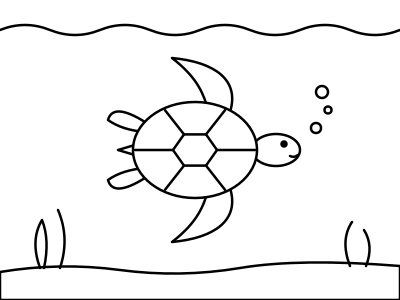
Use the introduction above.
- 1.
Underline the hook.
- 2.
What kind of hook is it?
○ a question○ a surprising fact○ a tiny scene - 3.
Circle the sentence that tells what the report will explain.
- 4.
Write a surprising-fact hook for a report about bees.
- 5.
Change the weak word to a strong one: 'A whale is a big animal.'
Circle the right homophone.
- 6.
The turtles laid ____ eggs on the beach.
○ their○ there○ they're - 7.
I want to see a turtle ____.
○ to○ too○ two - 8.
Please ____ your name on the line.
○ write○ right
Challenge: Write the first sentence of your own introduction. Which kind of hook did you use?
Practice page · Week 30, Day 2
Science
I can compare traits that vary among dogs of one species.
One Species, Many Looks
A tiny dog and a giant dog are both dogs. They belong to one species, so they can have puppies together. Long ago, people chose dogs with the traits they wanted, like a strong nose or thick fur. They let those dogs be parents. The puppies inherited those traits. Over many years, this made many breeds.
Breed Compare. Fill in the chart for 4 dog breeds.
| Breed | Size | Fur | Ears | Face shape |
|---|---|---|---|---|
- 1.
List 3 traits all 4 breeds share.
Read and answer.
- 2.
Are a dachshund and a husky the same species?
○ yes○ no - 3.
How did people create so many dog breeds?
- 4.
Pick one breed. What job might people have chosen its traits for?
Challenge: Name one trait that varies a lot among dog breeds.
Materials: pictures of 4 dog breeds · index cards
Practice page · Week 30, Day 2
Social Studies
I can track deposits and withdrawals in a savings account.
Look: a bank register
- A deposit puts money in, so add it to the balance.
- A withdrawal takes money out, so subtract it.
- The balance is how much is in the account now.
Fill in the register. Start with $0.
| Move | Deposit | Withdrawal | Balance |
|---|---|---|---|
- 1.
Deposit $15. Balance:
- 2.
Deposit $6. Balance:
- 3.
Withdraw $9 for a book. Balance:
- 4.
Deposit $4. Balance:
Answer each question.
- 5.
Eli has $22 in savings. He withdraws $7 and then deposits $5. What is his balance?
- 6.
Why does a bank pay savers interest?
Challenge: Jo keeps $30 in a piggy bank for a year. Max keeps $30 in a savings account that pays $1 of interest for the year. How much does each have after the year?
Materials: play money · handmade deposit and withdrawal slips