Week 6 · Day 1 Practice Pages
Practice page · Week 6, Day 1
Mathematics
I can use doubles to know my ×2 facts.
Look: 6 × 2
- Multiplying by 2 is the same as doubling.
- 6 × 2 means 6 + 6, which is 12.
- Every ×2 product is even.
Multiply.
- 1.
3 × 2 = ____
- 2.
2 × 8 = ____
- 3.
9 × 2 = ____
- 4.
2 × 4 = ____
- 5.
2 × 10 = ____
- 6.
5 × 2 = ____
Solve.
- 7.
Amaya has 8 pairs of mittens. How many mittens is that?
- 8.
Skip-count by 2s from 2 to 20.
Challenge: Is 2 × 7 odd or even? How do you know without solving?
Materials: Counters (optional)
Practice page · Week 6, Day 1
English Language Arts
I can tell the difference between informational text and fiction.
Two Texts About Octopuses
Text A: Octopus Arms. An octopus has eight arms covered in suckers. The suckers help it grab food and hold on to rocks. An octopus can change color to hide from enemies. Text B: Ollie's Big Game. Ollie the octopus wanted to play hide-and-seek with the crabs. "Count to ten!" he giggled. Then he turned the color of the sand and waited. The crabs searched and searched, but Ollie won again.
Answer about the two texts.
- 1.
Which text is informational?
○ Text A○ Text B - 2.
How do you know?
- 3.
Which text is fiction?
○ Text A○ Text B - 4.
Name one clue that Text B is made up.
- 5.
Use the word "informational" in a sentence.
- 6.
Use the word "fiction" in a sentence.
Write the syllable type for each word.
- 7.
kite
○ closed or silent e○ vowel team○ r-controlled○ consonant-le - 8.
corn
○ closed or silent e○ vowel team○ r-controlled○ consonant-le
Challenge: Find a nonfiction book at home. List three clues that show it is informational.
Materials: a nonfiction book
Practice page · Week 6, Day 1
Science
I can observe a pendulum's motion and describe its repeating pattern.
Pull the weight a hand's width to the side and let go. Count full swings (out and back) in 30 seconds.
| Trial | Full swings in 30 seconds |
|---|---|
- 1.
Were your three counts close to each other?
- 2.
Draw the pendulum's path with a dotted arc.
Answer the questions.
- 3.
What is a motion pattern?
- 4.
Name a motion pattern you can see at home or at a playground.
- 5.
Why are motion patterns useful?
Challenge: Ibrahim's pendulum made 18, 18 and 17 swings. Predict his next count.
Materials: string about 24 inches long · a washer or key ring as a weight · tape · a timer
Practice page · Week 6, Day 1
Social Studies
I can name the Native nations whose homelands include where I live.
Living Nations
Native nations were the first people to live across North America, and they still live here today. There are more than 570 federally recognized tribal nations in the United States. Each nation has its own government, language, history and culture. The Muscogee (Creek) Nation has its government in Okmulgee, Oklahoma. The Nez Perce Tribe has its government in Lapwai, Idaho. The Ho-Chunk Nation is based in Wisconsin.
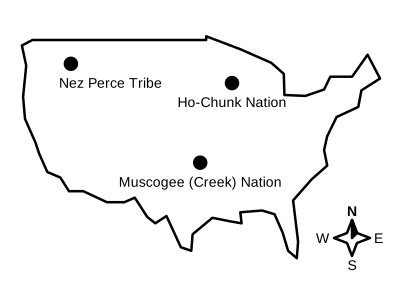
Record what you find on the Native Land map and a nation's own website.
| Nation's name | Where its government is today | One fact from its website |
|---|---|---|
- 1.
A nation whose homelands include where I live:
- 2.
Where its government is today:
- 3.
One fact from the nation's own website:
Use the reading to answer.
- 4.
Where is the Nez Perce Tribe's government?
- 5.
How many federally recognized tribal nations are in the U.S.?
- 6.
Do Native nations still exist today?
○ Yes○ No
Challenge: Why is a nation's own website the best place to check its name?
Materials: computer or library access (native-land.ca and a nation's website) · U.S. map