3
    Third GradePowered by ThirdGrade.com

    Standards this week

    Social Studies

    • D2.His.3.3-5 Generate questions about individuals and groups who have shaped a significant historical change.Day 1, 5
    • D2.His.4.3-5 Explain why individuals and groups during the same historical period differed in their perspectives.Day 1, 2, 3, 4, 5
    • D2.His.10.3-5 Compare information provided by different historical sources about the past.Day 2
    • D2.His.6.3-5 Day 2
    • D2.Geo.8.3-5 Day 3
    • D2.His.14.3-5 Explain probable causes and effects of events and developments.Day 3, 4, 5
    • D2.His.5.3-5 Explain connections among historical contexts and people's perspectives at the time.Day 4
    • D2.Civ.10.3-5 Identify the beliefs, experiences, perspectives, and values that underlie people's own and others' points of view about civic issues.Day 4

    Mathematics

    • 3.OA.C.7 Fluently multiply and divide within 100; know products of two one-digit numbers.Day 1, 2, 3, 4, 5
    • 3.OA.B.5 Apply the commutative, associative, and distributive properties.Day 1, 2, 3, 4
    • 3.OA.A.3 Use multiplication and division within 100 to solve word problems.Day 5

    English Language Arts

    • RI.3.2 Determine the main idea of a text and recount key details.Day 1, 2, 3, 4, 5
    • RI.3.1 Ask and answer questions to demonstrate understanding of a text.Day 1
    • RI.3.4 Determine the meaning of general academic and domain-specific words.Day 2
    • L.3.4.A Use sentence-level context as a clue to the meaning of a word or phrase.Day 2
    • RF.3.4.A Day 2
    • RF.3.4.C Day 2
    • L.3.6 Acquire and use grade-appropriate conversational, general academic, and domain-specific words and phrases.Day 3
    • W.3.2.A Introduce a topic and group related information together; include illustrations when useful.Day 3
    • W.3.2.B Develop the topic with facts, definitions, and details.Day 3
    • W.3.2.C Use linking words and phrases to connect ideas within categories of information.Day 3
    • W.3.2.D Provide a concluding statement or section.Day 3
    • W.3.8 Recall and gather information from sources; take brief notes and sort evidence into categories.Day 3
    • RI.3.8 Describe the logical connection between sentences and paragraphs in a text.Day 4, 5
    • RI.3.3 Describe relationships between events, ideas, or steps using sequence and cause/effect.Day 4
    • L.3.1.I Day 4

    Science

    • 3-PS2-4 Define a simple design problem that can be solved by applying scientific ideas about magnets.Day 1, 2, 3, 4, 5
    • 3-5-ETS1-1 Define a simple design problem reflecting a need or want with specified criteria.Day 1, 5
    • 3-5-ETS1-2 Generate and compare multiple possible solutions to a problem.Day 2, 3, 5
    • 3-5-ETS1-3 Plan and carry out fair tests of competing design solutions.Day 4, 5

    See what your state adds or places differently

    Suggested daily schedule
    8:30–8:45 AM15 minMorning Circle / Read-Aloud / Calendar
    8:45–10:00 AM75 minEnglish Language Arts
    10:00–11:00 AM60 minMathematics
    11:00–11:15 AM15 minSnack and Movement Break
    11:15–12:00 PM30–45 minScience (every day)
    12:00–12:45 PM30–45 minSocial Studies (every day)
    12:45–1:30 PM45 minLunch and Choice Time
    1:30–2:15 PM45 minSpecials: PE / Art / Music (rotating)
    2:15–2:45 PM30 minIndependent Reading & Journaling

    Mark Week 7 complete

    0 / 4 done

    Saved in this browser

    Day 1 · Monday

    Social Studies

    I can explain different reasons explorers and settlers came to North America, including people who did not choose to come.

    D2.His.3.3-5D2.His.4.3-5

    Builds on: Needs Week 6: Native nations lived across North America first and are living nations today. One-minute check: ask, "Who lived on this land long before the United States began?" (Native nations, and they still live here.)

    New words:
    • explorer – a person who travels to a place that is new to them to see what is there
    • settler – a person who moves to a new place to build a home and stay
    • enslaved – forced to work with no pay and no choice, and not allowed to leave

    Materials: World map or globe, Yarn or string, 3 pieces about as long as your arm, Tape, 4 index cards, Notebook, Pencil

    5 min · Day 31 — Why People Came — Big Question Warm-Up

    Spaced review from Week 6. Ask: "Name one Native nation and tell where its government is today." (Answers vary. Sample: the Cherokee Nation, in Tahlequah, Oklahoma.) Then ask the big question: "Why might someone leave home and cross an ocean?"

    10–15 min · Mini-Lesson

    Put a finger on Europe on the map. Say: "More than 500 years ago, ships from Europe began crossing this ocean. Native nations already lived all over the Americas." Say: "Explorers came first. They wanted gold, fame and a faster way to trade with Asia. Many wanted to spread Christianity." Say: "Settlers came to stay. They wanted land to farm, a new start, or to practice their religion their own way." Now put a finger on West Africa. Say: "Not everyone chose to come. Starting in the 1500s, millions of African people were captured and forced onto ships. They were enslaved. In 1619 a ship brought more than 20 captive Africans to Virginia, where English settlers lived. This was wrong, and it caused great suffering." Ask: "Who came looking for gold and trade routes?" (explorers) "Who came to farm and stay?" (settlers) "Who was forced to come?" (enslaved Africans) If your child is stuck, say: "Explorers look. Settlers stay. Enslaved people were forced."

    15–20 min · Activity / Source Work

    1) Tape yarn from Spain to the Caribbean islands. Say: "In 1492 Christopher Columbus sailed for Spain and reached these islands." 2) Tape yarn from England to Virginia. Say: "In 1607 English settlers built Jamestown, hoping for riches and land." 3) Tape yarn from West Africa to North America. Say: "Captured African people were carried this way against their will." 4) Your child writes a card for each journey: Who traveled? Why? By choice? 5) Read this source aloud. It was written for this lesson. "The Taíno people lived on the Caribbean islands long before 1492. They farmed, fished and traveled between islands in large canoes. Columbus and his men claimed the islands for Spain and forced many Taíno to work. Great numbers died from sickness and cruel treatment. Taíno descendants live in Puerto Rico, Cuba, the Dominican Republic and the United States today." Ask: "Which words show the Taíno were there first?" ("long before 1492") "Which words show they are here now?" ("live" and "today") Say: "So Columbus did not discover empty land. He reached islands where people already lived." 6) Your child writes a fourth card: Taíno, already home.

    10 min · Notebook Entry

    Your child draws a notebook chart with three columns: Group, Reason they came, By choice? Fill three rows. (Explorers: gold, trade routes; yes. Settlers: land or religion; yes. Enslaved Africans: captured and forced; no.) Then finish this frame: "When the ships arrived, the Taíno people may have thought ____ because ____." Sample: "They may have wondered what the strangers wanted."

    5 min · Wrap-Up & Exit Ticket

    Read the three exit questions aloud. Praise the words "arrived" or "reached" and any answer that names who was already here.

    Watch for: Saying explorers "discovered" America, as if no one lived here.

    Try: Point to the Taíno card. Ask, "Who was already home?" Then swap in "arrived" or "reached."

    Exit ticket (3 questions)
    1. A sea captain sails west to look for a shorter way to Asia. A family crosses the ocean to farm. Which is the explorer, and which are the settlers?
    2. What does enslaved mean? Which yarn journey shows people who were enslaved?
    3. Why is "discovered" the wrong word for what Columbus did in 1492? Use the Taíno in your answer.
    Show answers
    1. The captain is the explorer. The family are settlers, because they came to stay.
    2. Forced to work with no pay and no choice. The yarn from West Africa to North America.
    3. The Taíno already lived on the islands. Columbus arrived or reached them; he did not find empty land.

    Support: Touch each yarn journey and say its reason aloud before writing. Your child tells you the words and you write the cards.

    Extend: Your child writes two questions for a Jamestown settler and two for a Taíno farmer.

    Homework: Ask a family member about one move in your family's story. Write one sentence telling why they moved. Look for: a reason, and whether it was a choice.

    Mathematics

    I can use a double plus one more group to know my ×3 facts.

    3.OA.C.73.OA.B.5

    Builds on: Needs the ×2 facts from Week 6 Day 1 and adding within 100. One-minute check: ask 2 × 7 (14), then 14 + 7 (21).

    New words:
    • break apart – split an array into smaller parts you already know

    Materials: 30 counters (dried beans, coins or buttons), Plain sheet of paper, 10 index cards or paper slips, Notebook, Pencil

    5 min · Warm-Up

    Spaced review from Week 3. Your child solves 403 − 157 (246). Then ask 2 × 4 (8) and 2 × 9 (18). Count by 3s to 30 together.

    10–15 min · Mini-Lesson

    Say: "Today we build ×3 facts from ×2 facts." Write 3 × 4. Ask: "What does this tell us to build?" (3 groups of 4.) Build 3 rows of 4 beans on the paper. Lay a pencil under the second row. Say: "I can break apart this array." Ask: "How many rows are above the pencil?" (2) "What is 2 × 4?" (8) "What is below the pencil?" (1 row of 4.) Write 2 × 4 = 8, then 8 + 4 = 12. Write 3 × 4 = 12. Say: "3 groups is 2 groups and one more group. So double it, then add one more group." Next, write 3 × 7. Your child builds 3 rows of 7 on the paper. Say: "Double 7 is 14. One more 7 makes 21." Write 14 + 7 = 21 and 3 × 7 = 21. Turn the paper. Say: "7 × 3 is the same array turned. It is 21 too." Now your child does more. Your child builds 3 × 6 and lays the pencil under row 2. Your child writes 2 × 6 = 12, then 12 + 6 = 18, then 3 × 6 = 18.

    10–15 min · Guided Practice

    Your child says the double, then adds one more group. 1) 3 × 5 (10 + 5 = 15). 2) 3 × 8 (16 + 8 = 24). 3) 3 × 9 (18 + 9 = 27). 4) Write 4 × 3. Ask: "Which fact from today has the same product?" (3 × 4 = 12. It is the same array turned.) If stuck, say: "Cover the last row. What is the double? Now add the row you covered."

    15–20 min · Independent Practice

    Your child writes the double, the sum and the product. 1) 3 × 2 (4 + 2 = 6). 2) 3 × 3 (6 + 3 = 9). 3) 3 × 10 (20 + 10 = 30). 4) 8 × 3 (24). 5) 5 × 3 (15). 6) Your child draws 3 rows of 9 dots and a line under row 2. Your child writes both parts (2 × 9 = 18; 18 + 9 = 27). 7) Aiyana buys 3 packs of 7 pencils. How many pencils? (3 × 7 = 21) 8) A tricycle has 3 wheels. How many wheels are on 6 tricycles? (6 × 3 = 18) Last, your child makes fact cards for the ×3 facts. Sort them into "know it" and "still building" piles. Use no timer.

    5 min · Exit Ticket

    Put the beans and cards away. Read each question aloud; your child writes the answers.

    Watch for: Adding 1 instead of one more group, such as saying 3 × 7 is 15.

    Try: Build the third row with beans. Say: "One more group means a whole row of 7, not 1 bean." Your child counts the row.

    Fact fluency: ×3 facts
    Exit ticket (3 questions)
    1. What is 3 × 8? Show the double and one more group.
    2. What is 9 × 3?
    3. How can a ×2 fact help you find a ×3 fact?
    Show answers
    1. 24; 16 + 8 = 24
    2. 27
    3. Answers vary. Look for: 3 groups is 2 groups and one more group.

    Support: Use only 3 × 2 to 3 × 5. Your child builds every fact with beans and slides the pencil under row 2.

    Extend: Write 3 × 8 = 24. Ask: "Use it to find 3 × 9 without starting over." (Each of the 3 groups gets 1 more, so 24 + 3 = 27.)

    Homework: Use the ×3 fact cards for 10 minutes with no timer. Say the double and one more group each time. Sample: "3 × 6 is 12 and 6 more, so 18." Then count by 3s to 30 for a family member.

    English Language Arts

    I can find the main idea of a paragraph and the details that support it.

    RI.3.2RI.3.1

    Builds on: Needs Week 6: telling an informational text from a story. One-minute check: ask, "Does an informational text tell a made-up story or give facts?" (It gives facts.)

    New words:
    • main idea – what a whole paragraph or article is mostly about
    • supporting detail – a sentence that tells more about the main idea
    • topic sentence – the sentence that states the main idea; it is often first

    Materials: The three paragraphs in this lesson, printed or copied onto paper, Two highlighters or colored pencils in different colors, Reader's notebook, Pencil, Your child's own nonfiction book (homework)

    5 min · Warm-Up

    Word study, open syllables. Write ti|ger. Say: "A syllable is one beat of a word. You met open syllables in Week 4. An open syllable ends with a vowel. No consonant closes it in. The vowel is long and says its own name." Your child reads bacon, zero, even, pilot, open and music. For each word ask: "Which long vowel do you hear first?" (a, e, e, i, o, u) Spaced review from Week 4. Ask: "Which kind of old story explains something in nature?" (A myth.)

    10–15 min · Mini-Lesson

    Say: "Today we find the main idea of a paragraph. The main idea is what the whole paragraph is mostly about. The other sentences are supporting details. They tell more about the main idea." Draw a tree in the notebook. Say: "The trunk is the main idea. The branches are the details." Read aloud. Title: Sea Otters Stay Warm. 'Sea otters have several tricks for staying warm in cold ocean water. Their fur is the thickest of any animal. A patch the size of a postage stamp can hold up to a million hairs. Otters groom for hours, which fluffs air into the fur. They also eat about one quarter of their body weight each day. All that food helps their bodies make heat.' Think aloud: "I ask what every sentence is about. Fur, grooming and eating all help otters stay warm. The first sentence says that, so it is the topic sentence." Highlight it in one color and write it on the trunk. Highlight three details in the other color. Write them on branches: thick fur, grooming, eating a lot.

    10–15 min · Guided Practice

    Read aloud. Title: Built for the Desert. 'Camels are built for life in the desert. Two rows of long eyelashes keep blowing sand out of their eyes. Wide, flat feet let them walk on soft sand without sinking. A camel can even close its nostrils during a sandstorm. The hump stores fat that the camel can live on when food runs short.' 1) Ask: "Which sentence tells about the whole paragraph?" (Camels are built for life in the desert.) Your child highlights it. 2) Ask: "Name three details." (Any three: eyelashes, wide feet, closing nostrils, the hump.) Your child highlights them in the second color. 3) Ask: "How do wide feet help in the desert?" (They keep the camel from sinking into sand.) 4) Ask: "Would 'Camels can be brown or tan' belong here?" (No. It does not show how camels fit desert life.) If stuck, say: "Cover one sentence. Does it tell about the whole paragraph or just one part?"

    15–20 min · Independent Practice

    Say: "The topic sentence is not always first. Read this one alone." Title: One Busy Tail. 'A squirrel's bushy tail works like an umbrella in the rain. On cold nights the squirrel wraps the tail around its body like a blanket. The tail helps the squirrel balance on thin branches. A quick flick of the tail warns other squirrels of danger. A squirrel's tail does many jobs.' 1) Your child draws a tree and writes the main idea on its trunk. (The last sentence: a squirrel's tail does many jobs.) 2) Your child writes three details on the branches. (Any three: umbrella, blanket, balance, warning.) 3) Under the tree, your child writes how one detail shows a job the tail does. Look for: a main idea that covers every sentence, and details in your child's own short words.

    5 min · Exit Ticket

    Read each question aloud. Your child answers in the notebook in complete sentences and may look back at the paragraphs.

    Watch for: Choosing an exciting detail, such as the million hairs, as the main idea.

    Try: Ask: "Does this sentence tell about the whole paragraph or just one part?" Test it against two other sentences.

    Exit ticket (3 questions)
    1. What is a main idea?
    2. In 'Built for the Desert,' which detail tells how a camel keeps going when food runs short?
    3. Read these four sentences: 'Plants need care. Water them. Give them sunlight. Pull the weeds.' Which one is the main idea, and how do you know?
    Show answers
    1. It is what the whole paragraph is mostly about.
    2. The hump stores fat that the camel can live on.
    3. 'Plants need care.' The other three sentences each tell one way to care for plants.

    Support: Underline the topic sentence for your child first. Your child finds only the details and tells how each one fits.

    Extend: Your child writes a paragraph about an animal, with a topic sentence and three details. Then you find the main idea.

    Homework: Read a nonfiction book for 15 minutes. Your child tells a family member the main idea of one paragraph and one detail. Look for: a main idea that covers the whole paragraph.

    Science

    I can describe a design problem that magnets can solve, with criteria for success and constraints.

    3-PS2-43-5-ETS1-1

    Builds on: Needs Week 4: magnets attract iron and steel, and the pull is strongest up close. One-minute check: ask, "Will a magnet attract a steel paper clip? Aluminum foil?" (Yes. No.)

    New words:
    • criteria – the things a design must do to be a success (one of them is a criterion)
    • constraint – a limit on a design, such as what you may use or how much time you have
    • latch – a part that holds a door shut

    Materials: Shoebox, Scissors or craft knife (adult use only), 2 magnets (disc or fridge magnets), Test pile: 3 steel paper clips, 1 steel washer or bottle cap, 1 coin, 1 strip of aluminum foil, 1 plastic lid, Masking tape and thin cardboard, such as a cereal box, Science notebook and pencil

    5 min · Day 31 — Define a Magnet Design Problem — Wonder Warm-Up

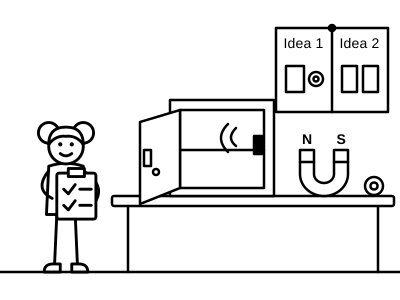
    Spaced review from Week 4. Ask: "What do opposite poles do? What do like poles do?" (Opposite poles attract. Like poles repel.) Then open the fridge door a little and let it pull shut. Ask: "What keeps this door shut?" (Most fridge doors have a magnet strip in the seal. It pulls on the steel frame.) Say: "Someone designed that. This week you design a magnet latch."

    10–15 min · Mini-Lesson

    Say: "Engineers use science to solve problems. They work in five steps: define the problem, plan, build, test, improve. Today is step one." Hold up the shoebox. Say: "This is a cabinet. Its door will swing open. We need a magnet latch to hold it shut." Say: "Criteria are what the design must do. We can test each one." Give three: it stays shut when the box is turned door-side down and shaken gently 5 times. It opens with one finger. It works 5 times in a row. Say: "Constraints are limits." Give three: at most 2 magnets. Only tape, thin cardboard, paper clips and steel washers or caps. About 20 minutes to build. Ask: "'The door must close flat.' Criterion or constraint?" (Criterion. It is something the design must do.) "'Use no glue.'" (Constraint. It is a limit.) "'Build it in 20 minutes.'" (Constraint.) If stuck, say: "Is this something the latch must DO, or a rule that LIMITS us?"

    15–20 min · Investigation / Hands-On

    1) An adult uses the scissors to cut a door in one long side of the shoebox. Make it about as wide as a hand. Cut three edges and fold the fourth as a hinge. 2) Your child shuts the door and turns the box door-side down. Ask: "What happened? What force pulled the door?" (It fell open. Gravity pulled it down.) 3) Magnet test. Keep the same magnet; change only the object. Your child touches the magnet to each item in the test pile and fills in a table: Object | Attracted? (Yes or No). Expect yes for the steel clips and washer, and no for foil, plastic and most coins. Some bottle caps are aluminum, so test yours. If results differ, say: "Real results vary. Look for the pattern." 4) Lay out the allowed materials: magnets, tape, cardboard, clips and washers. Together, say each criterion and constraint again. Safety: small magnets are dangerous if swallowed. Keep them away from little children, phones and bank cards.

    10 min · Science Notebook Entry

    In the notebook, your child writes: "Our cabinet door falls open. I will design a magnet latch that ___." Then two lists: Criteria (3) and Constraints (3). Last: "Magnets can help because ___." Sample: "Magnets can help because a magnet attracts steel and can hold the door shut."

    5 min · Wrap-Up & Exit Ticket

    Read the three exit questions aloud; your child answers on paper. Praise criteria that can be tested and reasons that use the word "limit."

    Watch for: Mixing up criteria (what the design must do) and constraints (limits).

    Try: For each item ask, "Is this something the latch must DO, or a rule that LIMITS us?" Sort it before writing it.

    Exit ticket (3 questions)
    1. A kite design rule says, "The kite must stay up for 10 seconds." Is that a criterion or a constraint? How do you know?
    2. Another rule says, "Use only 3 straws." Is that a criterion or a constraint? How do you know?
    3. Why can a magnet help keep our cabinet door shut?
    Show answers
    1. A criterion. It tells what the kite must do.
    2. A constraint. It is a limit on materials.
    3. Answers vary. Look for: a magnet attracts steel (or another magnet), and that pull can hold the door shut.

    Support: Write each criterion and constraint on its own paper slip. Your child sorts the slips into two piles: "Must do" and "Limits."

    Extend: Your child adds one criterion of their own and says how to test it. Sample: "The latch still works after 10 openings."

    Homework: Find 2 magnet closures at home, such as a cabinet catch, a fridge door or a bag snap. Sketch one. Look for: labels on the magnet and on the part it pulls.

    Day 2 · Tuesday

    Social Studies

    I can describe early meetings between Native nations and Europeans from more than one point of view.

    D2.His.4.3-5D2.His.10.3-5D2.His.6.3-5

    Builds on: Needs Day 1: why explorers and settlers came, and that Native nations already lived here. One-minute check: ask, "Who lived in North America before the ships came?" (Native nations, such as the Taíno.)

    New words:
    • cooperation – working together or helping each other
    • conflict – a serious disagreement or a fight
    • point of view – how one person or group sees and feels about something

    Materials: Notebook, U.S. map, 2 colored pencils, Pencil

    5 min · Day 32 — First Meetings: Many Points of View — Big Question Warm-Up

    Review from Day 1. Ask: "What is the difference between an explorer and a settler?" (An explorer travels to look. A settler stays and builds a home.) Then ask the big question: "Strangers in big ships land near your home. What might you feel? What might they feel?"

    10–15 min · Mini-Lesson

    Find Massachusetts on the map. Say: "In 1620 English settlers landed here and built Plymouth in the homeland of the Wampanoag people." Say: "Helping each other is cooperation. Disagreeing or fighting is conflict." Say: "A Wampanoag leader named Ousamequin made an agreement with the settlers. Each side promised to help protect the other." Say: "A Patuxet man named Tisquantum showed the settlers how to plant corn. He spoke English because an English captain had kidnapped him in 1614. When he got home, sickness had killed most of his village." Say: "Europeans carried sicknesses such as smallpox. Native people's bodies had no protection from them, and very many died." Say: "In Virginia, the Powhatan people traded food to the Jamestown settlers. Later they fought, because settlers kept taking more land." Ask: "Is planting corn together cooperation or conflict?" (cooperation) "Does taking more land lead to cooperation or conflict?" (conflict) Say: "Both peoples are here today. The Mashpee Wampanoag Tribe lives in Massachusetts. The Pamunkey Indian Tribe, part of the Powhatan people, lives in Virginia." If stuck, say: "Helping is cooperation. Fighting or taking is conflict."

    15–20 min · Activity / Source Work

    1) Read Account 1 aloud. William Bradford, the settlers' governor, wrote it. These are his words made simpler. "Squanto showed them how to plant their corn, where to catch fish, and how to get other things they needed. He was their guide to places they did not know." Squanto was the settlers' name for Tisquantum. 2) Read Account 2 aloud. It was written for this lesson from what Wampanoag historians teach today. It is not a paper from 1621. "Strangers built houses in our village fields. Sickness came before them and took many of our people. Our leader made an agreement to protect our nation, but we watched carefully to see if they would keep their word." 3) Read both again slowly. Your child lists helping words with one colored pencil and worry words with the other. (Sample: showed, guide, agreement; strangers, sickness, watched carefully.) 4) Ask: "Bradford was the settlers' governor. How does that explain what he wrote and what he left out?" (He wrote what helped the settlers. He left out how the Wampanoag felt.) 5) Ask: "What evidence shows the Wampanoag were unsure?" ("we watched carefully")

    10 min · Notebook Entry

    Your child draws a T-chart in the notebook: Settler point of view | Wampanoag point of view. Write two ideas on each side. Then finish: "The two groups saw the same events differently because ____." Sample: Settlers were glad for help and needed a guide. The Wampanoag had lost many people and were unsure about promises.

    5 min · Wrap-Up & Exit Ticket

    Read the exit questions aloud. Praise answers that give both sides and use the word "because."

    Watch for: Telling this as a simple happy story with one side left out.

    Try: After each fact, ask, "How would the other group tell about this same day?"

    Exit ticket (3 questions)
    1. Two groups trade food in spring. In fall they fight over a field. Which part is cooperation, and which is conflict?
    2. Who wrote Account 1? Name one thing he left out, and tell why he left it out.
    3. In Account 2, why did the leader make an agreement? Why did his people still watch carefully?
    Show answers
    1. Trading food is cooperation. Fighting over the field is conflict.
    2. William Bradford, the settlers' governor. He left out Wampanoag feelings and losses. He wrote from the settlers' side.
    3. To protect the nation after sickness took many people. They did not yet know if the strangers would keep their word.

    Support: Read one account at a time. After each, ask, "Who is talking? How do they feel?" before any writing.

    Extend: Your child writes two questions that each account leaves unanswered. Then name who could answer them, such as Wampanoag historians today.

    Homework: Tell a family member the Plymouth story from both points of view. Look for: one helping detail and one worry.

    Mathematics

    I can double the ×2 fact (double-double) to know my ×4 facts.

    3.OA.C.73.OA.B.5

    Builds on: Needs the ×2 facts and doubling a number up to 20. One-minute check: ask 2 × 8 (16), then 16 + 16 (32).

    New words:
    • double-double – double a number, then double the answer

    Materials: Grid paper, Crayons in 2 colors, 10 index cards or paper slips, Notebook, Pencil

    5 min · Warm-Up

    Spaced review from Week 1. Your child rounds 742 to the nearest 100 (700). Then ask 3 × 6 (18) and 3 × 8 (24). Count by 4s to 40 together.

    10–15 min · Mini-Lesson

    Say: "Today we build ×4 facts from ×2 facts." Write 4 × 6. Ask: "What does this tell us to draw?" (4 rows of 6.) Color the top 2 rows red and the bottom 2 rows blue. Ask: "What is the red part?" (2 rows of 6.) Write 2 × 6 = 12. Ask: "What is the blue part?" (2 rows of 6 again.) Write 12 + 12 = 24, then 4 × 6 = 24. Say: "4 groups is 2 groups and 2 more groups. So I double, then double again. Double 6 is 12. Double 12 is 24." Say: "We call this double-double." Ask: "Which fact did I use first?" (2 × 6.) Now your child does more. Your child colors 4 rows of 7 in two colors. Your child writes 2 × 7 = 14, then 14 + 14 = 28, then 4 × 7 = 28. Ask: "What were your two doubles?" (Double 7 is 14. Double 14 is 28.)

    10–15 min · Guided Practice

    Your child says both doubles aloud. 1) 4 × 5 (double 5 is 10; double 10 is 20). 2) 4 × 8 (double 8 is 16; double 16 is 32). 3) 4 × 9 (double 9 is 18; double 18 is 36). To double 18, add 10 + 10 = 20 and 8 + 8 = 16. Then 20 + 16 = 36. 4) Write 8 × 4. Ask: "Which fact you just solved helps?" (4 × 8 = 32. It is the same array turned.) If stuck, say: "Double the other factor and write it down. Now double what you wrote."

    15–20 min · Independent Practice

    Your child writes both doubles and the product. 1) 4 × 2 (double 2 is 4; double 4 is 8). 2) 4 × 3 (double 3 is 6; double 6 is 12). 3) 4 × 4 (16). 4) 4 × 10 (40). 5) 7 × 4 (28). 6) Your child colors 4 rows of 9 in two colors. Your child writes both parts (2 × 9 = 18; 18 + 18 = 36). 7) Kofi has 4 bags with 8 marbles in each bag. How many marbles? (4 × 8 = 32) 8) A car has 4 wheels. How many wheels are on 6 cars? (6 × 4 = 24) Last, your child makes fact cards for the ×4 facts. Sort them into "know it" and "still building" piles. Use no timer.

    5 min · Exit Ticket

    Put the grid paper and cards away. Read each question aloud; your child writes the answers.

    Watch for: Doubling only once and stopping at the ×2 fact, such as saying 4 × 7 is 14.

    Try: Say "double, double" and tap the table twice. Your child writes each double on its own line before the product.

    Fact fluency: ×4 facts
    Exit ticket (3 questions)
    1. What is 4 × 9?
    2. What is 8 × 4?
    3. Tell the two doubles you used for 8 × 4.
    Show answers
    1. 36
    2. 32
    3. Double 8 is 16. Double 16 is 32.

    Support: Use only 4 × 2 to 4 × 5. Your child colors each array, then folds it in half to see two equal parts.

    Extend: Ask: "Why is every ×4 product even?" (It is a double, so it makes two equal parts.) Your child tests it with 4 × 5 (10 + 10 = 20). Then your child tests 4 × 7 (14 + 14 = 28).

    Homework: Use the ×4 fact cards for 10 minutes with no timer. Then teach double-double to a family member with one fact. Sample: 4 × 7, double 7 is 14, double 14 is 28.

    English Language Arts

    I can find the main idea of a whole article and figure out new words from context.

    RI.3.2RI.3.4L.3.4.ARF.3.4.ARF.3.4.C

    Builds on: Needs Day 1: finding the main idea and details of one paragraph. One-minute check: ask, "What do we call the sentence that states the main idea?" (The topic sentence.)

    New words:
    • context clues – words near a new word that help you figure out what it means

    Materials: The 'Animal Builders' article (in the lesson), 4 sticky notes or small slips of paper, Reader's notebook, Pencil, Your child's own nonfiction book or magazine (homework)

    5 min · Warm-Up

    Word study, open syllables. Write bacon, even, music, robot and paper. Your child draws a line after the first syllable of each word and reads it. (ba|con, e|ven, mu|sic, ro|bot, pa|per) Ask: "Why is the first vowel long?" (The syllable ends with the vowel.) Spaced review from Week 6. Ask: "What does a heading tell you?" (The topic of that section.)

    10–15 min · Mini-Lesson

    Say: "A paragraph has a main idea. A whole article has a bigger main idea that covers every paragraph." Read aloud. Title: Animal Builders. 'Paragraph 1: Beavers gnaw through small trees with their strong front teeth. They pile branches, rocks and mud across a stream to build a dam. The dam blocks the water, so a pond forms. Then the beavers build a lodge in the pond, with a door under the water. Paragraph 2: Weaverbirds tie strips of grass into knots to weave hanging nests. The nests swing from the tips of thin branches, where snakes can hardly reach the eggs. Paragraph 3: Termites build tall mounds of soil. Thousands of termites, called a colony, live inside. Tunnels let air move through the mound, which keeps the colony from getting too hot.' Say: "Here is the strategy. Write each paragraph's main idea on a sticky note, in five words or fewer. Then ask what joins the notes." Think aloud on paragraph 1: "Every sentence is about beavers building. My note says: Beavers build dams and lodges."

    10–15 min · Guided Practice

    1) Reread paragraph 2. Ask: "What is it mostly about?" Your child writes a note. (Weaverbirds weave safe nests.) 2) Do the same for paragraph 3. (Termites build cool mounds.) 3) Line up the three notes. Ask: "What do all three share?" Your child writes the article's main idea on the fourth note. (Many animals build homes that protect them.) 4) Say: "In Week 6 you reread the sentence around a bold word. Nearby words that explain a new word are called context clues." Point to lodge. Ask: "Which words tell what a lodge is?" (Beavers build it in the pond, and it has a door. A lodge is a beaver's home.) If stuck, say: "Does your big idea fit the beavers, the birds and the termites?"

    15–20 min · Independent Practice

    1) Your child reads "Animal Builders" aloud to find what each animal builds. If a sentence sounds wrong, your child stops, rereads and fixes it. 2) In the notebook, your child writes the three paragraph main ideas, then the article's main idea. 3) Your child writes the meaning of colony and of mound, with the clue words for each. (Colony: thousands of termites living together. Clue: "thousands of termites, called a colony." Mound: a tall pile of soil. Clue: "tall mounds of soil.") 4) Your child reads the article aloud again, this time with expression, like a nature guide. Look for: an article main idea that says "animals," not only one animal.

    5 min · Exit Ticket

    Read each question aloud. Your child answers in the notebook and may reread the article.

    Watch for: Giving paragraph 1's main idea as the main idea of the whole article.

    Try: Ask: "Does your answer include the weaverbirds and the termites too?" If not, your child makes it bigger.

    Exit ticket (3 questions)
    1. How is the main idea of an article different from the main idea of a paragraph?
    2. Which paragraph would you reread to learn how eggs stay safe from snakes? What is that paragraph's main idea?
    3. What does 'dam' mean in the article? Which words helped you?
    Show answers
    1. An article's main idea covers the whole article. A paragraph's main idea covers only that paragraph.
    2. Paragraph 2. Weaverbirds weave safe nests.
    3. A wall of branches, rocks and mud that blocks a stream. Clues: 'pile branches, rocks and mud across a stream' and 'blocks the water.'

    Support: Use only paragraphs 1 and 2. Offer two choices for the article's main idea and let your child pick.

    Extend: Your child writes a one-sentence summary of the article with the main idea and one example.

    Homework: Read a short article or a few nonfiction pages for 15 minutes. Your child writes the main idea of two paragraphs, then of the whole. Look for: a big idea that covers both notes.

    Science

    I can draw more than one magnet latch design and choose the best one to build.

    3-PS2-43-5-ETS1-2

    Builds on: Needs the Day 1 criteria and constraints, and Week 4: a magnet's pull is strongest up close. One-minute check: ask, "What must our latch do when we shake the box?" (Stay shut.)

    New words:
    • solution – one way to solve a problem

    Materials: Shoebox cabinet from Day 1, 2 magnets, 2 steel washers or steel bottle caps, 2 steel paper clips, Plain paper, pencil and ruler, Science notebook

    5 min · Day 32 — Plan and Compare Designs — Wonder Warm-Up

    Spaced review from Week 5. Ask: "In Week 5, how did the magnet's pull change as we stacked more cardboard layers?" (It got weaker.) Then ask the wonder question: "How many different ways could a magnet hold our door shut?" Take every idea.

    10–15 min · Mini-Lesson

    Say: "Engineers draw more than one idea. Each idea is a possible solution. Then they compare the ideas with the criteria." Say: "Our door needs a cardboard tab that overlaps the box wall. One part goes under the tab. The other part goes on the wall." Sketch three designs while your child watches. Design A: magnet under the tab, steel washer on the wall. Design B: magnet under the tab, second magnet on the wall. Design C: magnet on the wall, two paper clips under the tab. Now hold a magnet near a washer and let them snap together. Ask: "Which designs use attraction?" (All three.) Hold two magnets so they push apart. Ask: "In Design B, what happens if like poles face each other?" (They repel. The door is pushed open.) "Why must the two parts meet when the door shuts?" (The pull is strongest up close.) Flat fridge magnets may not show clear poles, so use disc magnets for Design B. If stuck, say: "Hold the two parts. Move them apart slowly. Where is the pull strongest?"

    15–20 min · Investigation / Hands-On

    1) Your child sketches 2 or 3 designs on plain paper, using the shoebox cabinet as a guide. Each sketch has labels: magnet, steel part or second magnet, tab. 2) Quick hand test. Hold the parts for each design in place with fingers, with no tape. Keep the same door and the same spot. Change only the design. 3) Your child uses the ruler and pencil to draw a chart: Design | Holds the door shut? | Opens with one finger? | Uses only allowed materials? Write yes or no in each box. 4) Your child chooses one design and says why. Expect different results with different magnets. Two magnets often hold hardest but can be hard to open. Say: "Real results vary. Look for the pattern in your chart." Safety: keep small magnets away from little children.

    10 min · Science Notebook Entry

    Your child makes a plan page in the notebook. It needs a labeled sketch, a materials list with amounts, and 4 to 6 numbered build steps. Sample steps: "1. Cut a tab 1 inch wide. 2. Tape the tab to the door's loose edge. 3. Tape the magnet under the tab. 4. Shut the door and mark where the magnet lands. 5. Tape the washer on the mark." Ask: "Could someone else build it from these steps?"

    5 min · Wrap-Up & Exit Ticket

    Read the three exit questions aloud; your child answers on paper. Praise any reason that names a criterion.

    Watch for: Choosing the design that holds hardest and forgetting that it must open with one finger.

    Try: Your child touches every box in the chart row before choosing. A design with any "no" needs a fix first.

    Exit ticket (3 questions)
    1. Two designs both hold the door shut. Only one opens with one finger. Which design is better, and why?
    2. Which design did you choose? Give a reason that names one of our criteria.
    3. A new design needs 3 magnets. Why can we not choose it?
    Show answers
    1. The one that opens with one finger, because it meets more of the criteria.
    2. Answers vary. Look for: a reason tied to a criterion, such as "it held the door and still opened with one finger."
    3. It breaks a constraint. We may use at most 2 magnets.

    Support: Draw Designs A and C for your child. Your child adds the labels, hand-tests both and fills in the chart.

    Extend: Your child draws a backup design and writes when to switch to it. Sample: "If the washer design fails the shake test, I will try two magnets."

    Homework: Show the plan page to a family member. Ask which design they would choose and why. Write their reason. Look for: a reason that matches a criterion.

    Day 3 · Wednesday

    Social Studies

    I can explain how early settlements grew into towns and how that changed life for Native nations nearby.

    D2.His.4.3-5D2.Geo.8.3-5D2.His.14.3-5

    Builds on: Needs Day 2: settlers and Native nations cooperated and also came into conflict. One-minute check: ask, "What did settlers keep taking that led to conflict?" (land)

    New words:
    • settlement – a small new place where settlers build homes
    • effect – what happens because of something else

    Materials: Notebook, Paper strip for a flow chart (cut a sheet the long way and tape the two halves end to end), Tape, Markers, U.S. map, Pencil

    5 min · Day 33 — How Settlements Grew — Big Question Warm-Up

    Spaced review from Week 3. Say: "A map scale says 1 inch = 10 miles. Two towns are 2 inches apart. How far is that?" (20 miles) Then ask the big question: "How do a few houses in a field become a town?" Take two ideas.

    10–15 min · Mini-Lesson

    Find Plymouth, Massachusetts, on the map. Say: "A settlement is a small new place where settlers build homes. Settlements grew in four ways." Hold up one finger for each. Say: "One is building. People built homes, fields, mills and docks." Say: "Two is government. People chose leaders and made rules. In 1620 the Plymouth men signed the Mayflower Compact. They promised to make fair laws together and obey them. Women and the Wampanoag had no say in it." Say: "Three is trade. Settlers traded with other settlements, with Europe and with Native nations. Native hunters traded furs for metal tools and cloth." Say: "Four is more people. Families grew and new ships came." Now teach the effect. Say: "More people wanted more land. So Native nations lost farm fields and hunting grounds. Growth helped settlers and often hurt Native communities." Ask: "Which of the four is the Mayflower Compact?" (government) "Furs for metal tools is which one?" (trade) "What did Native nations lose as towns grew?" (fields, hunting grounds, land) If stuck, say: "Count on your fingers: building, government, trade, more people."

    15–20 min · Activity / Source Work

    Make a cause-and-effect flow chart. This chain is an example, not one real town. 1) Tape the strip flat. Your child draws four boxes on it with markers, with an arrow between each. 2) Write one sentence in each box, in order. Box 1: Settlers build a mill by the river. Box 2: Farmers bring grain to the mill. Box 3: More families move nearby. Box 4: Settlers want more land, and Native nations lose fields and hunting grounds. 3) At each arrow your child says a "so" sentence. Sample: "They built a mill, so farmers came." 4) Under each box, write two short notes: Who gained? Who lost? Expect settlers to gain at every box. Expect Native nations to lose land and food at Box 4. Your child may add that trade gave both sides useful goods. That is true too. 5) Ask: "Which box is the cause of Box 4?" (Box 3. More families needed more land.) Look for: each arrow shows a real cause and its effect.

    10 min · Notebook Entry

    In the notebook, your child writes the four ways settlements grew. Then finish these frames: "Growth helped ____ because ____. Growth hurt ____ because ____." Sample: "Growth helped settlers because they got homes, mills and trade. Growth hurt Native nations because they lost fields and hunting grounds."

    5 min · Wrap-Up & Exit Ticket

    Read the exit questions aloud; your child may look at the flow chart. Praise every answer that uses "so" or "because."

    Watch for: Seeing town growth as only good news, without noticing who lost land.

    Try: At each arrow on the flow chart, ask, "Who gained here? Who lost something?"

    Exit ticket (3 questions)
    1. A settlement builds a dock, and ships begin to stop there with goods. Which way of growing is the dock? Which is the ships?
    2. Why does a growing settlement need leaders and rules?
    3. Finish the chain: More settlers arrive, so ____. Then Native nations ____.
    Show answers
    1. The dock is building. The ships with goods are trade.
    2. Answers vary. Look for: so people can work together and settle arguments fairly.
    3. They want more land. Then Native nations lose fields, hunting grounds or homes.

    Support: Write the first two boxes together. Your child draws pictures for the last two and says the "so" sentences aloud.

    Extend: Your child explains why each side wanted the other's goods in the fur trade. Sample: metal pots last longer than clay, and furs sold for high prices in Europe.

    Homework: Tell a family member the four ways settlements grew, counting on your fingers. Add one effect on Native nations. Look for: all four ways, plus lost land.

    Mathematics

    I can use ×3 facts or ×5 facts to find my ×6 facts.

    3.OA.C.73.OA.B.5

    Builds on: Needs the ×5 facts from Week 6 Day 3 and the ×3 facts from Day 1. One-minute check: ask 5 × 7 (35) and 3 × 7 (21).

    Materials: Grid paper, Crayons in 2 colors, 10 index cards or paper slips, Notebook, Pencil

    5 min · Warm-Up

    Spaced review from Week 2. Your child solves 365 + 278 (643). Then ask 4 × 6 (24) and 4 × 9 (36). Count by 6s to 60 together.

    10–15 min · Mini-Lesson

    Say: "Today we build ×6 facts from facts we know." Write 6 × 7. Color 6 rows of 7 on grid paper. Use one color for the top 5 rows and another for the last row. Ask: "What is the big part?" (5 rows of 7.) Write 5 × 7 = 35. Ask: "What is left?" (1 row of 7.) Write 35 + 7 = 42, then 6 × 7 = 42. Say: "6 groups is 5 groups and one more group. I know my ×5 facts, so I start there." Next, say: "Here is a second way. 6 is double 3." Draw a dark line under row 3. Ask: "What is each half?" (3 rows of 7.) Write 3 × 7 = 21, then 21 + 21 = 42. Say: "Both ways break apart the same array. Both give 42. Pick the way you like." Now your child does more. Your child colors 6 rows of 8 and solves it both ways. Your child writes 5 × 8 = 40 and 40 + 8 = 48. Then your child writes 3 × 8 = 24 and 24 + 24 = 48.

    10–15 min · Guided Practice

    Your child names the strategy, then writes the steps. 1) 6 × 4 with the ×5 fact (5 × 4 = 20; 20 + 4 = 24). 2) 6 × 9 with the ×3 fact (3 × 9 = 27; 27 + 27 = 54). 3) 6 × 6 (5 × 6 = 30; 30 + 6 = 36). 4) Say: "For 6 × 9, Sam wrote 45 + 6. What went wrong?" (He added 6. One more group is 9, so 45 + 9 = 54.) If stuck, say: "Cover the last row. What are 5 rows? Now add the row you covered."

    15–20 min · Independent Practice

    Your child writes the steps and the product. 1) 6 × 2 (10 + 2 = 12). 2) 6 × 3 (15 + 3 = 18). 3) 6 × 5 (25 + 5 = 30). 4) 6 × 10 (50 + 10 = 60). 5) 9 × 6 (54). 6) Your child shows 6 × 4 as double a ×3 fact. (3 × 4 = 12; 12 + 12 = 24) 7) There are 6 tables with 6 chairs at each table. How many chairs? (6 × 6 = 36) 8) An insect has 6 legs. How many legs are on 7 insects? (7 × 6 = 42) Last, your child makes fact cards for the ×6 facts. Sort them into "know it" and "still building" piles. Use no timer.

    5 min · Exit Ticket

    Put the grid paper and cards away. Read each question aloud; your child writes the answers.

    Watch for: Adding 6 instead of one more group, such as 35 + 6 for 6 × 7 and saying 41.

    Try: Your child shades the last row of the array and counts its squares. It has 7 squares, so add 7.

    Fact fluency: ×6 facts
    Exit ticket (3 questions)
    1. What is 6 × 9?
    2. What is 4 × 6?
    3. Show one strategy for 6 × 6.
    Show answers
    1. 54
    2. 24
    3. Answers vary. Look for one of two ways. Way 1: 5 × 6 = 30 and 30 + 6 = 36. Way 2: 3 × 6 = 18 and 18 + 18 = 36.

    Support: Use only 6 × 2 to 6 × 5. Your child colors the split array for every fact before adding the parts.

    Extend: Ask: "Why do both strategies always give the same product?" (It is the same array. Nothing is added or taken away.) Your child shows it with 6 × 6 (30 + 6 = 36; 18 + 18 = 36).

    Homework: Use the ×6 fact cards for 10 minutes with no timer. Write the strategy steps for your two hardest ×6 facts. Sample: 6 × 8, 40 and 8 more, 48.

    English Language Arts

    I can sort supporting details into facts, examples and reasons and use those words correctly.

    RI.3.2L.3.6W.3.2.AW.3.2.BW.3.2.CW.3.2.DW.3.8

    Builds on: Needs Days 1 and 2: finding a main idea and its details. One-minute check: ask, "What is the main idea of 'Animal Builders'?" (Many animals build homes that protect them.)

    New words:
    • example – one case that shows an idea
    • reason – a detail that tells why
    • linking words – words or phrases that connect ideas, such as also, another and but

    Materials: The 'Paper Wasps' paragraph (in the lesson), printed or copied onto paper, Reader's notebook, Three colored pencils (blue, green, orange), 3 index cards, Pencil, Your child's own nonfiction book (homework)

    5 min · Warm-Up

    Word study, open syllables. Dictate: "The student drew a tiger on paper." Your child writes it, and you check it together word by word. Ask: "Where does the first syllable end in student, tiger and paper?" (stu|dent, ti|ger, pa|per) Spaced review from Week 2. Ask: "What do we call a word that tells what a character is like inside?" (A trait.)

    10–15 min · Mini-Lesson

    Say: "Details do different jobs. Today we name three jobs." Write each word on an index card with its meaning. Fact: something true that you can check, as in Week 6. Example: one case that shows an idea. Reason: a detail that tells why. Read aloud. Title: Paper Wasps. 'Paper wasps are skilled builders. They scrape tiny bits of wood from fences and dead trees. They chew the wood into a wet paste that dries into gray paper. A nest has many small rooms called cells, and the cells have jobs. For example, a new cell holds one egg. Wasps often hang the nest under a roof edge because the roof keeps rain off the paper.' Think aloud: "The main idea is that paper wasps are skilled builders. 'They scrape tiny bits of wood from fences' is a fact. I could check it in a book. 'A new cell holds one egg' is an example. It shows one job a cell can have. 'Because the roof keeps rain off the paper' is a reason. It tells why they build there." Underline the three details in blue, green and orange.

    10–15 min · Guided Practice

    Your child labels each detail fact, example or reason and tells how they know. 1) "Sea otters eat about one quarter of their body weight each day." (Fact. You can check it.) 2) "Weaverbirds are one kind of animal builder." (Example. It is one case.) 3) "Weaverbird nests hang from thin branches so snakes cannot reach the eggs." (Reason. It tells why.) 4) Draw a notes chart with three columns: Fact, Example, Reason. Your child jots one short note about paper wasps in each column. (Sample: chew wood into paste; a cell for one egg; a roof keeps rain off.) If stuck, say: "Does it tell why? Then it is a reason. Does it show one case? Then it is an example."

    15–20 min · Independent Practice

    Your child writes an informational paragraph of 4 or 5 sentences about paper wasps, using the notes chart. Plan: 1) A topic sentence that names the animal and the main idea. 2) Three details from the chart, joined with linking words such as also, another or but. Linking words connect ideas. 3) A closing sentence. Model: "Sea otters stay warm in cold water. They have very thick fur. They also groom for hours to fluff it. Another trick is eating a lot. That is how otters beat the cold." Checklist: a topic sentence; three details that fit it; at least two linking words; a closing sentence. Last, your child labels one detail in the paragraph: fact, example or reason.

    5 min · Exit Ticket

    Read each question aloud. Your child answers the first two aloud and uses the finished paragraph for the third.

    Watch for: Calling every detail a fact without thinking about its job.

    Try: Point to the clue words. "For example" signals an example. "Because" and "so" signal a reason.

    Exit ticket (3 questions)
    1. What is the difference between an example and a reason?
    2. Fact, example or reason? 'Camels have wide feet because wide feet do not sink into sand.' How do you know?
    3. Point to one linking word and one detail in your paragraph. What job does that detail do?
    Show answers
    1. An example shows one case of an idea. A reason tells why.
    2. A reason. It tells why, and it uses the word because.
    3. Answers vary. Look for: also, another or but, and a label of fact, example or reason that fits the detail.

    Support: Label two details for your child. Your child labels one more and tells you the clue word.

    Extend: Your child writes a paragraph on a topic they know well with one fact, one example and one reason, each labeled.

    Homework: Read a nonfiction book for 15 minutes. Your child copies one fact, one example and one reason and labels each. Look for: the reason tells why.

    Science

    I can build a prototype of my magnet latch by following my plan.

    3-PS2-43-5-ETS1-2

    Builds on: Needs the Day 2 plan page. One-minute check: your child reads build step 1 aloud. Ask, "Which part does the magnet pull on?" (The steel part, or the second magnet.)

    New words:
    • prototype – the first working model of a design, built so it can be tested

    Materials: Shoebox cabinet, 2 magnets, Steel washers, steel bottle caps or paper clips (the ones in the plan), 1 steel paper clip (for the demonstration), Thin cardboard, such as a cereal box, Masking tape and child-safe scissors, Notebook with the plan page, and pencil

    5 min · Day 33 — Build the Magnet Latch — Wonder Warm-Up

    Spaced review from Week 4. Ask: "Which will a magnet attract: a steel paper clip, a plastic spoon or aluminum foil?" (Only the steel paper clip.) Then ask: "Will your latch work the first time? What will you do if it does not?" (Change one thing and try again.)

    10–15 min · Mini-Lesson

    Say: "Today is step three: build. A prototype is the first working model. It does not have to be perfect. We build it so we can test it." Show why the gap matters. Lift a paper clip with a magnet. Then fold a cardboard scrap into 4 layers. Hold it between the magnet and the clip. Ask: "What changed?" (The pull is weaker, or the clip drops.) Say: "Keep the magnet and the steel close. Thick layers between them weaken the pull." Ask: "What is a prototype for?" (To test the idea and find what to fix.) "Where should the tape go on the magnet?" (On its edges, in a thin strip, not thick across its face.) "What do you do if a step does not work?" (Change one thing and write it down.) If stuck, say: "Shut the door. Where does the magnet land? Put the steel right there." Safety: small magnets are dangerous if swallowed. Keep them away from little children, phones and bank cards. An adult does any cutting with sharp tools.

    15–20 min · Investigation / Hands-On

    Allow about 20 minutes. 1) Your child gathers only the allowed materials and the shoebox cabinet. 2) Cut a cardboard tab about 1 inch by 2 inches. Tape half of it to the outside of the door's loose edge. The other half overlaps the box wall. 3) Your child follows the plan and checks off each step. 4) Tape the magnet under the tab with one thin strip. 5) Shut the door, mark where the magnet lands, and tape the steel part on the mark. 6) Quick check: shut the door and turn the box door-side down. Look for: does the door stay shut? 7) If it opens, your child makes one change and writes it down. Many latches hold on the first try, and many do not. Common fixes: line the parts up, use less tape, or stiffen a floppy tab. Say: "Real results vary. A problem tells us what to fix."

    10 min · Science Notebook Entry

    Your child sketches the prototype as it was really built, with labels. Then: "One thing that worked was ___. One problem I had was ___. I changed ___." Sample: "One thing that worked was the tab. One problem was the washer sat too low. I moved it up."

    5 min · Wrap-Up & Exit Ticket

    Read the three exit questions aloud; your child answers on paper. Praise honest notes about what went wrong.

    Watch for: Wrapping tape thickly over the magnet's face, so the gap grows and the latch fails.

    Try: Use one thin strip across the magnet's edge. Then check that the magnet and steel touch when the door is shut.

    Exit ticket (3 questions)
    1. Why do engineers build a prototype before the final product?
    2. Did your build match your plan? Tell one thing that changed, or say that nothing changed.
    3. On a friend's box, the magnet and washer sit 2 inches apart when the door is shut. What will probably happen? Why?
    Show answers
    1. To test the idea and find out what needs to be fixed.
    2. Answers vary. Look for: one specific change, such as "I moved the washer closer," or a clear "nothing changed."
    3. The door will probably fall open. A magnet's pull is too weak that far away.

    Support: Hold the box steady and cut tape strips ahead of time. Your child does the placing and marking.

    Extend: Your child sketches how the latch would change with two magnets, opposite poles facing. They predict which version holds more clips.

    Homework: Your child shows the prototype to a family member and explains how it works. Look for: the word "attracts," as in "The magnet attracts the steel washer."

    Day 4 · Thursday

    Social Studies

    I can explain what a treaty is and describe the Trail of Tears from more than one point of view.

    D2.His.4.3-5D2.His.5.3-5D2.His.14.3-5D2.Civ.10.3-5

    Builds on: Needs Day 3: growing settlements wanted more land, and Native nations lost land. One-minute check: ask, "Why did growing towns lead to conflict?" (Settlers wanted land where Native nations lived.)

    New words:
    • treaty – a written agreement between nations
    • removal – forcing people to leave their homes and move far away
    • petition – a letter that many people sign to ask leaders for something

    Materials: Notebook, U.S. map, Yarn, 1 piece about as long as your hand, Tape, Pencil

    5 min · Day 34 — Treaties, Conflict, and Removal — Big Question Warm-Up

    Review from Day 3. Ask: "Name two ways settlements grew." (Any two: building, government, trade, more people.) Then ask the big question: "Two groups both want the same land. What are fair ways to solve it?" Say: "Today is about promises between nations. Some of it is sad."

    10–15 min · Mini-Lesson

    Say: "A treaty is a written agreement between nations. The United States signed hundreds of treaties with Native nations. Many promised land to a nation, and many were broken." Find Georgia on the map. Say: "The Cherokee homeland was here and in nearby states. The Cherokee Nation had farms, schools, a written language and its own government." Say: "In 1829 news spread of gold on Cherokee land. Settlers also wanted cotton farms there. In 1830 a law, the Indian Removal Act, pushed Native nations in the Southeast to move west." Say: "In 1832 the Supreme Court, the country's highest court, said Georgia could not make laws for Cherokee land. Georgia ignored the ruling, and the president did not make Georgia obey. In 1835 a small group who were not the nation's leaders signed a treaty giving up the land. Principal Chief John Ross and most Cherokee people said no." Say: "In 1838 and 1839 the U.S. Army forced about 16,000 Cherokee people to leave. Most walked. Thousands died. This is called the Trail of Tears. The Muscogee (Creek), Choctaw, Chickasaw and Seminole nations were forced west too." Ask: "Finish this: a treaty is ____." (a written agreement between nations) "Did most Cherokee people agree to the 1835 treaty?" (No.) If stuck, say: "A treaty is a promise on paper between nations."

    15–20 min · Activity / Source Work

    1) Tape yarn from northern Georgia to northeastern Oklahoma. 2) Read this source aloud. It was written for this lesson. "The Cherokee did not go quietly. They printed a newspaper, went to court and sent leaders to Washington. In 1838 more than 15,000 Cherokee people signed a petition asking Congress to cancel the removal treaty. Congress did not cancel it. Some other Americans also said the treaties must be kept." 3) Ask: "What evidence shows most Cherokee people opposed removal?" (More than 15,000 signed the petition.) 4) Draw a three-row chart in the notebook for the question "Who should live on this land?" Row 1, many settlers and U.S. leaders: "We want this land for farms and gold." Row 2, the Cherokee Nation: "This is our homeland, and treaties promised it to us." Row 3, Americans against removal: "Treaties are promises and must be kept." 5) Your child says each view in one fair sentence and tells what that group wanted or valued. Say: "We can explain a view without agreeing with it. Forcing people from their homes was wrong."

    10 min · Notebook Entry

    Your child finishes these frames: "A treaty is ____. The Trail of Tears happened because ____. Today the Cherokee Nation ____." Sample: "The Trail of Tears happened because settlers and leaders wanted Cherokee land and broke promises."

    5 min · Wrap-Up & Exit Ticket

    Leave a minute for your child's questions, then read the exit questions aloud. Praise fair wording and present-tense words about the Cherokee today.

    Watch for: Thinking everyone back then agreed with removal, or that the Cherokee story ended in 1839.

    Try: Point to Row 3 and ask, "Who disagreed, and why?" Then reread the last notebook frame.

    Exit ticket (3 questions)
    1. Two nations sign a paper that says where each will live. What is the paper called, and what must both sides do?
    2. Name two peaceful ways Cherokee people tried to stop the removal.
    3. Where is the Cherokee Nation's capital today? Why is it so far from Georgia?
    Show answers
    1. A treaty. Both sides must keep the promises in it.
    2. Any two: a petition, going to court, printing a newspaper, sending leaders to Washington.
    3. Tahlequah, Oklahoma. The nation was forced west on the Trail of Tears. The Eastern Band of Cherokee Indians lives in North Carolina today.

    Support: Teach three things only: what a treaty is, the yarn route, and where Cherokee nations are today.

    Extend: Your child writes a short letter to a lawmaker of 1838, giving two reasons to keep the treaties.

    Homework: Tell a family member what a treaty is and why both sides must keep it. Look for: the words "between nations."

    Mathematics

    I can choose a strategy to solve mixed ×3, ×4 and ×6 facts.

    3.OA.C.73.OA.B.5

    Builds on: Needs Days 1 to 3: double plus one more group, double-double, and the ×5 fact plus one more group. One-minute check: ask 3 × 5 (15), 4 × 5 (20) and 6 × 5 (30).

    Materials: Fact cards made on Days 1 to 3, Grid paper, Crayons, Notebook, Pencil

    5 min · Warm-Up

    Spaced review from Week 3. Your child solves 700 − 345 (355). Then count by 4s to 40 and by 6s to 60 together.

    10–15 min · Mini-Lesson

    Say: "Look at the factors first. Find one you have a strategy for." Write 3 × 9, 4 × 9 and 6 × 9 in a column. Point to 3 × 9. Ask: "Which strategy fits?" (Double plus one more group. 18 + 9 = 27.) Write 3 × 9 = 27. Point to 4 × 9. Ask again. (Double-double. Double 9 is 18. Double 18 is 36.) Write 4 × 9 = 36. Point to 6 × 9. Ask again. (The ×5 fact plus one more group. 45 + 9 = 54.) Write 6 × 9 = 54. Next, write 6 × 4. Say: "Some facts fit two strategies." Say: "As a ×6 fact, I think 5 × 4 = 20, then 20 + 4 = 24." Say: "Turned, it is 4 × 6. Double 6 is 12. Double 12 is 24." Ask: "Did both ways agree?" (Yes. 24.) Now your child does more. Write 3 × 7, 4 × 7 and 6 × 7. Your child names each strategy and writes the products (21, 28, 42).

    10–15 min · Guided Practice

    Mix the fact cards. Your child names the strategy before the product. 1) 4 × 8 (double 8 is 16; double 16 is 32). 2) 6 × 8 (40 + 8 = 48). 3) 8 × 3. Turn it to 3 × 8 (16 + 8 = 24). 4) Ask: "Jo says 6 × 8 is 32. Is that right?" (No. 32 is the product of 4 × 8. 6 × 8 = 48.) If stuck, say: "Which factor is 3, 4 or 6? Say its strategy, then do one step." Then go through the other cards with no timer. Your child sorts them into "know it" and "still building" piles. For each still-building card, your child says the strategy aloud.

    15–20 min · Independent Practice

    Your child writes the strategy steps and the product. 1) 3 × 6 (12 + 6 = 18). 2) 4 × 4 (double 4 is 8; double 8 is 16). 3) 6 × 6 (30 + 6 = 36). 4) 4 × 5 (20). 5) 7 × 3 (21). 6) Your child colors 6 rows of 3 on grid paper and splits it. (5 × 3 = 15; 15 + 3 = 18) 7) Nia packs 4 boxes with 9 muffins in each box. How many muffins? (4 × 9 = 36) 8) Ben has 6 shelves with 7 books on each shelf. How many books? (6 × 7 = 42) Check each answer by drawing or by using a second strategy.

    5 min · Exit Ticket

    Put the cards away. Read each question aloud; your child writes the answers.

    Watch for: Mixing up ×4 and ×6 products, such as saying 6 × 8 is 32.

    Try: Your child says the ×5 fact first. Say: "5 × 8 = 40, so 6 × 8 must be more than 40."

    Fact fluency: ×3, ×4 and ×6 facts
    Exit ticket (3 questions)
    1. What is 8 × 4? Name your strategy.
    2. What is 3 × 6?
    3. Which ×3, ×4 or ×6 fact is hardest for you? Which strategy helps?
    Show answers
    1. 32; double-double (double 8 is 16, double 16 is 32)
    2. 18
    3. Answers vary. Look for: a named fact and a strategy that matches its table.

    Support: Sort the cards by table. Practice one table with its strategy for a few minutes before mixing the piles.

    Extend: Write 6 × 8 = 48. Ask: "Find it a third way. Start with 6 × 4." (6 × 4 = 24 and 24 + 24 = 48.) Ask: "Why does that work?" (Each row of 8 is two 4s. So the array is two arrays of 6 × 4.)

    Homework: Practice the still-building pile for 10 minutes with no timer. Say the strategy for each card. Sample: 6 × 9, 45 and 9 more, 54.

    English Language Arts

    I can explain how a detail supports the main idea and how one event causes another.

    RI.3.2RI.3.8RI.3.3L.3.1.I

    Builds on: Needs Day 3: naming the job a detail does. One-minute check: ask, "Which kind of detail tells why?" (A reason.)

    New words:
    • cause – why something happens
    • effect – what happens because of the cause
    • simple sentence – one complete thought
    • compound sentence – two complete thoughts joined by a comma and a word like and, but or so
    • complex sentence – a complete thought with an added part that begins with because, when or if

    Materials: The 'A Beaver Pond' paragraph (in the lesson), printed or copied onto paper, Reader's notebook, Pencil, Highlighter, Your child's own nonfiction book (homework)

    5 min · Warm-Up

    Word study, open syllables. Ask: "Which word means making no sound?" (silent) "Which word names a person who is learning?" (student) "Which number means none at all?" (zero) Your child says one sentence with spider. Spaced review from Week 3. Ask: "Which marks go around an author's exact words?" (Quotation marks.)

    10–15 min · Mini-Lesson

    Read aloud. Title: A Beaver Pond. 'A beaver pond helps many other animals. The dam slows the stream, so the water spreads out and grows deep. Fish swim in the deep water. Because fish live there, herons come to hunt. Ducks nest in the tall grass at the edge. When summer is dry, the pond still holds water for deer. Beavers have orange front teeth.' Say: "A strong detail helps prove the main idea. Use this stem: This detail supports the main idea because ___." Model: "The duck detail supports the main idea because it shows one animal the pond helps." Then say: "A cause makes something happen. An effect is the thing that happens. The word so points to the effect." Highlight the second sentence. Write: Cause: the dam slows the stream. Effect: the water spreads out and grows deep.

    10–15 min · Guided Practice

    1) Ask: "Which sentence does not belong with the main idea? Why?" (Beavers have orange front teeth. It is true, but it is not about helping animals.) 2) Read: "Because fish live there, herons come to hunt." Ask: "Which part is the cause? Which part is the effect?" (Cause: fish live there. Effect: herons come to hunt.) 3) Write S, C and X. Say: "A simple sentence is one complete thought, like 'Fish swim in the deep water.' A compound sentence joins two complete thoughts with and, but or so. A complex sentence adds a part that begins with because, when or if." Your child labels the dam sentence and the heron sentence. (C, X) Say: "Put a comma after the because part when it starts the sentence." 4) Ask: "What type is the sentence about summer?" (X. It starts with when.) If stuck, say: "Which happened first? That is the cause."

    15–20 min · Independent Practice

    Your child works in the notebook. 1) Write a "supports the main idea because" sentence for the fish detail and for the deer detail. (Sample: The deer detail supports the main idea because deer get water from the pond.) 2) Write one cause and effect from the paragraph as "Because ___, ___." (Sample: Because the dam slows the stream, the water grows deep.) 3) Rewrite the same idea with so. (The dam slows the stream, so the water grows deep.) 4) Write one simple sentence about beavers and label it S. Check for a comma after the because part and a comma before so. Look for explanations in your child's own words.

    5 min · Exit Ticket

    Read each question aloud. Your child answers in the notebook and may look back at the paragraph.

    Watch for: Mixing up the cause and the effect.

    Try: Ask: "Which happened first?" Then your child says it as "___ made ___ happen."

    Exit ticket (3 questions)
    1. What is the difference between a cause and an effect?
    2. Simple, compound or complex? 'Ducks nest in the tall grass at the edge.' How do you know?
    3. Finish in your own words: 'Herons come to hunt' supports the main idea because ___.
    Show answers
    1. A cause makes something happen. An effect is the thing that happens.
    2. Simple. It has one complete thought and no joining word.
    3. Answers vary. Look for: herons find food at the pond, so the pond helps them.

    Support: Say three details aloud, one at a time. Your child answers "shows the pond helping" or "does not fit" before writing.

    Extend: Your child writes one cause and effect three ways: with so, with because first, and with because in the middle.

    Homework: Read a nonfiction book for 15 minutes. Your child writes one cause and its effect in a sentence with because. Look for: the because part tells why.

    Science

    I can run fair tests on my latch, find where it fails and make it better.

    3-PS2-43-5-ETS1-3

    Builds on: Needs the Day 3 prototype and fair tests from Weeks 3 and 6. One-minute check: ask, "What makes a test fair?" (Change one thing. Keep everything else the same.)

    Materials: Prototype shoebox cabinet, About 20 steel paper clips, all the same size, Masking tape, 1 spare magnet, if you have one (for the demonstration), 3 thin cardboard squares (extension only), Science notebook and pencil

    5 min · Day 34 — Test and Improve — Wonder Warm-Up

    Spaced review from Week 4. Ask: "Which pulls harder on a paper clip: a magnet 1 inch away or 4 inches away?" (1 inch away. The pull is stronger up close.) Then your child predicts: "How many paper clips can hang on your door before it falls open?" Write the prediction down.

    10–15 min · Mini-Lesson

    Say: "Today is steps four and five: test and improve. Engineers test against the criteria. They look for the failure point. You met that word with the marble run. It is the moment a design stops working. A failure is information, not a mistake." Show one. Hang paper clips in a chain from a magnet, one at a time, until the chain drops. Count them. Say: "The chain dropped at ___ clips. That was its failure point." With no spare magnet, just describe this. Explain the three tests below. Say: "We do each test the same way every time." Ask: "Why shake 5 times in every test, not 2 times and then 10?" (To keep the test fair, so we can compare.) "A shelf holds 3 books and breaks at 4. At what number did it fail?" (4 books. That is its failure point.) "How many things do we change before we test again?" (One.) If stuck, say: "What did we do the first time? Do exactly that again."

    15–20 min · Investigation / Hands-On

    Change: one part of the latch. Keep the same: the box, the hook spot, the clips and the shaking. Measure: the clip count. 1) Shake test. Turn the box door-side down and shake gently 5 times. Record: stayed shut, yes or no. 2) Open test. Can one finger open it? Open and shut it 5 times. Does it work every time? 3) Strength test. Bend one clip into a hook and tape it to the door near the latch. Hold the box door-side down past a table edge. Your child adds clips to the hook one at a time until the door drops. Record the count. If it holds all the clips, write "more than 19." 4) Your child writes one improvement, then makes it. Ideas: line the steel up better, add a second washer, or use thinner tape. 5) Repeat all three tests. Chart: Test | Version 1 | Version 2, with rows for shake, open and strength. Version 2 often holds more, but not always. Say: "Real results vary. If it did not help, that is information too." Safety: small magnets are dangerous if swallowed. Keep them away from little children, phones and bank cards.

    10 min · Science Notebook Entry

    Your child copies the chart into the notebook and writes: "My latch failed when ___. I improved it by ___. Version 2 held ___ clips." Sample: "My latch failed when I hung 5 clips. I improved it by moving the washer under the magnet. Version 2 held 9 clips."

    5 min · Wrap-Up & Exit Ticket

    Read the three exit questions aloud; your child answers on paper. Praise before-and-after numbers used as evidence.

    Watch for: Changing two things at once, then not knowing which change helped.

    Try: Your child writes the one change on paper before touching the latch. Any second idea waits for Version 3.

    Exit ticket (3 questions)
    1. A paper bridge holds 8 coins. It falls when the 9th coin is added. What is its failure point?
    2. What one improvement did you make to your latch?
    3. How do your numbers show whether the improvement helped?
    Show answers
    1. 9 coins (or: when the 9th coin was added).
    2. Answers vary. Look for: one specific change, such as "I added a second washer."
    3. Answers vary. Look for: both clip counts compared, such as "It held 5 before and 9 after, so it helped."

    Support: Run only the shake test and the strength test. Count the clips aloud together, and you write the numbers.

    Extend: New fair test: slip one thin cardboard square at a time between magnet and steel. Record the clip count for 0, 1, 2 and 3 squares.

    Homework: Your child tells a family member the latch's failure point and the fix. Look for: two numbers, one from Version 1 and one from Version 2.

    Day 5 · Friday

    Social Studies

    I can show what I know about explorers, settlers, first meetings, and treaties, using more than one point of view.

    D2.His.3.3-5D2.His.4.3-5D2.His.14.3-5

    Builds on: Needs Days 1 to 4: why people came, first meetings, how settlements grew, and treaties. One-minute check: ask, "Explorer or settler: who came to stay?" (settler)

    Materials: Stored Week 7 check and its answer key, Pencil, Notebook, Day 2 T-chart and Day 4 three-row chart, 4 journey cards from Day 1, World map and yarn from Day 1 (for reteaching)

    5 min · Day 35 — Week 7 Check: Explorers and Settlers — Big Question Warm-Up

    Spaced review from Week 4. Ask: "Name one natural resource and one thing people make from it." (Sample: trees, paper.) Then do a two-views warm-up. Say: "Settlers cut a new road through the woods." Ask for two points of view. (Settler: "Now we can reach the market." Native family: "The road cuts through woods where we gather food, and more strangers will come.")

    10–15 min · Mini-Lesson

    Today is review; teach nothing new. First play Flip and Tell. Lay the four journey cards face down. Your child flips one and tells who traveled, why, and choice or no choice. Model the first card yourself. Next, teach one frame for telling both sides: "Some ____, but also ____." Model it: "Some settlers and Wampanoag people helped each other, but also they came into conflict over land." Open the Day 2 T-chart. Your child reads one idea from each side and says it in the frame. Then ask: "Ousamequin and the Plymouth settlers promised to protect each other. Is that cooperation or conflict?" (cooperation) "A nation is promised land in writing and then forced off it. What was broken?" (a treaty) "Which word is fairer for Columbus in 1492, discovered or arrived? Why?" (Arrived. The Taíno already lived there.) If your child is stuck, say: "Find it on your T-chart or your cards, then tell me."

    15–20 min · Activity / Source Work

    Give the stored Week 7 check now. It has 7 items and takes about 15 minutes. It includes a short reading, which you may read aloud. Your child works alone. Then score it with the answer key and talk over any misses. Choose a route by the result. 6 or more right: move on to Week 8, and offer the extension below. 4 or 5 right: redo the Day 2 notebook T-chart. Then make a new T-chart with two views of a town built by a river. 3 or fewer right: reteach Day 1 with the yarn journeys and a reason card for each group. Then reread the Day 2 accounts together. If the treaty item was missed, reread the Day 4 notebook frames. On the point-of-view items, look for both sides in your child's answers.

    10 min · Notebook Entry

    Your child writes a short reflection with these frames: "The easiest item was ____ because ____. The hardest item was ____ because ____. One question I still have about this history is ____." Sample: "I still wonder how Tisquantum felt when he came home."

    5 min · Wrap-Up & Exit Ticket

    After the check, read the three exit questions aloud. Praise any answer that tells more than one side.

    Watch for: Writing only one side when asked about early meetings.

    Try: Before the check, practice the frame "Some ____, but also ____" aloud two times.

    Exit ticket (3 questions)
    1. Put these in order from first to last: the Trail of Tears, Jamestown is built, Columbus reaches the Caribbean.
    2. A history book tells only what settlers thought. Whose point of view is missing, and where could you look for it?
    3. Use the frame "Some ____, but also ____" to tell about the Powhatan people and the Jamestown settlers.
    Show answers
    1. Columbus reaches the Caribbean (1492), Jamestown is built (1607), the Trail of Tears (1838 to 1839).
    2. Native nations' point of view. Look in books and websites by the nations' own historians and teachers.
    3. Sample: Some Powhatan people traded food to the settlers, but also they fought when settlers took more land.

    Support: Read the check aloud. Your child answers aloud while you write the words down.

    Extend: Your child writes a short paragraph comparing two views of one event from this week, with a reason for each view.

    Homework: Tell a family member the question you still have. Look for the answer together in a library book. Look for: who wrote the book, and whose point of view it gives.

    Mathematics

    I can show what I know about ×3, ×4 and ×6 facts (Week 7 check).

    3.OA.C.73.OA.A.3

    Builds on: Needs everything from Days 1 to 4. One-minute check: ask 6 × 3 (18) and which strategy helped (15 + 3, or double 9).

    Materials: Stored Week 7 check and its answer key, Playing cards, aces through 10s, 3 paper slips marked 3, 4 and 6, Grid paper and counters (for reteaching), Notebook, Pencil

    5 min · Warm-Up

    Spaced review from Week 1 and Week 6. Your child rounds 586 to the nearest 100 (600). Then ask 5 × 7 (35) and 10 × 4 (40). Count by 6s to 60 together.

    10–15 min · Mini-Lesson

    Play Flip and Solve for 10 minutes. Place the three slips face down. An ace is 1. Say: "The slip is the number of groups. The card is how many in each group." Model one turn. Draw the 4 slip, then flip an 8. Say: "4 × 8. That is double-double. Double 8 is 16. Double 16 is 32." Write 4 × 8 = 32. Now your child takes every turn: draw a slip, flip a card, name the strategy and say the steps. Then your child writes the multiplication sentence. Ask each turn: "Which strategy goes with that number of groups?" A correct turn wins the card. Play about 8 turns. If a product is wrong, your child draws the array on grid paper and splits it.

    10–15 min · Guided Practice

    Do three check-style problems together. Your child says the strategy steps aloud. 1) 3 × 7 (14 + 7 = 21). 2) 6 × 6 (30 + 6 = 36). 3) A shelf has 4 rows of 9 jars. How many jars are there? (4 × 9 = 36) If stuck, say: "Which factor has a strategy? Say the strategy, then do one step at a time."

    15–20 min · Independent Practice

    Give the stored Week 7 check now. It has 8 items. Do not time it. Your child works alone for about 15 minutes, then you score it with the answer key. Choose a route by the result. 6 or more right: move on to Week 8, and play Flip and Solve again for fun. Your child explains the strategy for each fact aloud. 4 or 5 right: find the table your child missed most. For ×3 facts, redo Day 1 Guided Practice with beans. For ×4 facts, redo Day 2 Guided Practice on grid paper. For ×6 facts or word problems, redo Day 3 Guided Practice on grid paper. 3 or fewer right: reteach the Day 1 and Day 2 Mini-Lessons before starting Week 8. Build the ×2 fact with counters first. Then add one more group for ×3, or double it for ×4. Teach one each day, then give the check again. Keep every route slow and untimed.

    5 min · Exit Ticket

    After the check, your child answers these three questions. Then go over any missed check items together.

    Watch for: Freezing on one hard fact and then guessing.

    Try: Say: "Circle it and finish the others." Afterward, your child draws that array and splits it into parts.

    Fact fluency: ×3, ×4 and ×6 facts
    Exit ticket (3 questions)
    1. What is 9 × 6?
    2. What is 7 × 4?
    3. What is your goal for next week's facts?
    Show answers
    1. 54
    2. 28
    3. Answers vary. Look for: a named table or fact and a plan to practice it.

    Support: Read each word problem aloud. Let your child draw and split arrays on grid paper during the check.

    Extend: Your child writes 2 word problems that use ×6 facts, then solves them. Sample: 6 bags hold 9 rolls each, so 6 × 9 = 54 rolls.

    Homework: Play 10 rounds of Flip and Solve with a family member. Say the strategy on each turn. Sample: the 6 slip and a 5 card make 6 × 5 = 30.

    English Language Arts

    I can show what I know about main idea, key details, and cause and effect.

    RI.3.2RI.3.8

    Builds on: Needs Days 1 to 4: main idea, kinds of details, cause and effect. One-minute check: ask, "On a paragraph tree, what goes on the trunk?" (The main idea.)

    Materials: Week 7 English Language Arts Check and its answer key (find it with the Week 7 lessons), Reader's notebook, Highlighter, Pencil, Your child's own nonfiction book

    5 min · Warm-Up

    Word study, open syllables. Give a spelling check with no timer. Say each word, then a short sentence: paper, bacon, even, spider, robot, music. Challenge word: tomato. Correct it together, and your child rewrites any missed word. Spaced review from Week 5. Ask: "Is 'the hare lost the race' an event or a central message?" (An event.)

    10–15 min · Mini-Lesson

    Say: "Let's pull the week together with one new paragraph." Write it in the notebook or read it aloud. Title: Tall Eaters. 'Giraffes are built to reach food that other animals cannot. A long neck lifts a giraffe's head as high as a second-floor window. Its tongue is about 18 inches long, so it can pull leaves from between sharp thorns. Tough lips protect its mouth because the branches are prickly. A baby giraffe is called a calf.' Think aloud: "The neck, tongue and lips all help a giraffe reach its food. The first sentence covers them all, so it is the main idea." Your child highlights it. Say: "Now I test a detail. The neck detail supports the main idea because height lets a giraffe reach leaves no other animal can."

    10–15 min · Guided Practice

    1) Ask: "Which sentence does not belong? Why?" (A baby giraffe is called a calf. It is not about reaching food.) 2) Ask: "Find a reason in the paragraph. Which word signals it?" (The branches are prickly. The signal word is because.) 3) Ask: "What type is the sentence about the tongue: simple, compound or complex?" (Compound. The word so joins two complete thoughts.) 4) Ask: "What type is the last sentence?" (Simple. It is one complete thought.) If stuck, say: "Go back to the paragraph. Put your finger on the words that prove it."

    15–20 min · Independent Practice

    Give the Week 7 English Language Arts Check now. It has 8 items. Your child works alone for about 15 minutes and may highlight in the passage. Score it with the answer key, then choose a route. 6 or more right: move on to Week 8. 4 or 5 right: redo the Day 4 practice page and the Day 4 Guided Practice. 3 or fewer right: reteach the Day 1 Mini-Lesson with the paragraph tree, then Day 2. After the check, your child reads their own nonfiction book.

    5 min · Exit Ticket

    After the check, your child answers these three questions in the notebook. Then go over any missed check items together.

    Watch for: Writing a detail when a question asks for the main idea.

    Try: Before answering, your child asks, "Does my answer cover every sentence, or just one?"

    Exit ticket (3 questions)
    1. In 'Tall Eaters,' which detail explains how a giraffe gets its head up so high?
    2. Write the tongue sentence as two parts: the cause and the effect.
    3. Write one compound sentence about giraffes. Use and, but or so.
    Show answers
    1. A long neck lifts its head as high as a second-floor window.
    2. Cause: its tongue is about 18 inches long. Effect: it can pull leaves from between sharp thorns.
    3. Answers vary. Check for two complete thoughts, a comma and one of the three words. Sample: 'Giraffes are tall, so they eat the highest leaves.'

    Support: Read the check's questions aloud. Your child reads the passage alone and may answer the longer items aloud.

    Extend: After the check, your child writes a one-sentence summary of 'Tall Eaters' with the main idea and two details.

    Homework: Read a nonfiction book for 15 minutes. Your child writes one sentence that gives the main idea of a page. Look for: an idea that covers the whole page.

    Science

    I can present my magnet design, explain the science and check it against the criteria.

    3-PS2-43-5-ETS1-13-5-ETS1-23-5-ETS1-3

    Builds on: Needs Days 1 to 4: the problem, the plan, the prototype and the test chart. One-minute check: your child reads the Version 1 and Version 2 clip counts from the chart.

    Materials: Finished shoebox cabinet, Science notebook with the test chart, Stored Week 7 Science Check and its answer key, Pencil

    5 min · Day 35 — Present and Check — Wonder Warm-Up

    Spaced review from Week 2. Ask: "A book rests on a table. Are the forces on it balanced or unbalanced?" (Balanced. Its motion is not changing.) Say: "Your shut door stays still too. The forces on it are balanced." Then ask: "How do engineers show other people that a design works?" (They show test results.)

    10–15 min · Mini-Lesson

    Keep this to 10 minutes and the presentation to 15, so the check fits. Say: "A design talk has four parts: the problem, the design, the science and the evidence. Evidence is what your tests showed." Model a talk about a different design. Say: "My problem: papers slid off the fridge. My design: a clothespin with a magnet on the back. The science: the magnet attracts the steel door. My evidence: it held 4 sheets and dropped at 5." Ask: "Which sentence gave my test result?" (It held 4 sheets and dropped at 5. That is the evidence.) "Which sentence told the science?" (The magnet attracts the steel door.) "What numbers will you give as your evidence?" (The two clip counts.) Then your child holds up five fingers and names the engineering steps in order. (Define the problem, plan, build, test, improve.) Your child finds the notebook page for each step. If stuck, say: "Point to your chart. Read me the two numbers." Your child practices the talk once.

    15–20 min · Investigation / Hands-On

    Your child presents the finished shoebox cabinet to a family member, or to you. 1) State the problem and one criterion. 2) Show the design. Say what the magnet attracts. 3) Run the shake test live: door-side down, 5 gentle shakes. 4) Share the clip counts for Version 1 and Version 2. 5) Ask the listener, "How would you improve it?" Then answer one question from the listener. Look for the science and the numbers. If the live test fails, say: "Real results vary. Tell us what you would check first." Safety: put the magnets away afterward, out of reach of little children.

    10 min · Science Notebook Entry

    In the notebook, your child writes each criterion in pencil and marks Yes or No, using the test chart. Then: "My latch meets ___ of the 3 criteria. Next time I would ___." Sample: "My latch meets 2 of the 3 criteria. Next time I would use thinner tape so it opens with one finger."

    5 min · Wrap-Up & Exit Ticket

    Ask the three exit questions. Praise answers that use test results. Then give the stored Week 7 Science Check: 7 items, about 10 minutes, working alone. Score it with the key. 6 or more right: move on. 4 or 5 right: redo the Day 4 tests after one new change. 3 or fewer right: reteach the Day 1 Mini-Lesson. Sort criteria and constraints for a new problem, such as a lunchbox lid.

    Watch for: Telling how the latch was built but never explaining the magnetic force that makes it work.

    Try: Ask, "What is the magnet pulling on? What would happen if that part were plastic?" (Nothing would hold. Magnets do not attract plastic.)

    Exit ticket (3 questions)
    1. Which criterion did your latch meet best? What test result shows it?
    2. Why does your latch hold the door shut? Use the word "attracts."
    3. Which engineering step did you find hardest, and what helped you get through it?
    Show answers
    1. Answers vary. Look for: a criterion backed by a result, such as "It stayed shut for all 5 shakes."
    2. Answers vary. Look for: "The magnet attracts the steel part (or the other magnet), and that pull holds the door."
    3. Answers vary. Look for: a named step (define, plan, build, test or improve) and one thing that helped.

    Support: Your child uses the notebook pages as a script and presents to one person. Skip the listener's question if needed.

    Extend: Your child defines a second magnet problem: a tool that lifts paper clips out of a cup without fingers touching them. List 2 criteria and 2 constraints.

    Homework: Your child tells a family member about the design and its one improvement. Look for: the problem, the change and one number from the tests.

    Friday Checks & Answer Keys

    Mathematics · Week 7 Mathematics Check

    3.OA.C.73.OA.B.53.OA.A.3

    Goals

    • I can use a double plus one group for ×3 facts.
    • I can use double-double for ×4 facts.
    • I can use ×3 or ×5 facts to find ×6 facts.

    Answer each question. Show your thinking in the box when there is one.

    1. 3 × 9 = ____
    2. 7 × 4 = ____
    3. 6 × 7 = ____
    4. 4 × 4 = ____
    5. 9 × 6 = ____
    6. 3 × 8 = ____
    7. A spider has 8 legs. How many legs do 3 spiders have?
    8. Dev has 6 boxes with 4 crayons in each. How many crayons?
    Show answer key
    1. 27
    2. 28
    3. 42
    4. 16
    5. 54
    6. 24
    7. 24
    8. 24

    What to do next

    Most right
    If 6 or more are right: play Flip and Solve with a family member and explain your strategy for each fact.
    Some right
    If 4–5 are right: redo the Day 3 page, then play Flip and Solve using only the 6 slip, with no clock.
    Few right
    If 3 or fewer are right: reteach Day 1 (×3) and Day 2 (×4), one each day. Build the ×2 fact with counters first, then add one more group for ×3 or double it for ×4.

    English Language Arts · Week 7 English Language Arts Check

    RI.3.2RI.3.1RI.3.4L.3.4.ARF.3.4.ARF.3.4.CL.3.6W.3.2.A

    Goals

    • I can find the main idea and the details that support it.
    • I can find causes and effects.
    • I can name sentence types and split open syllables.

    Bats Help Us

    Bats are helpful animals. Many bats eat insects, and one small bat can catch hundreds of insects, such as moths and mosquitoes, in a single night. Other bats drink nectar, so they carry pollen from flower to flower. This helps plants make seeds. Some bats eat fruit and drop the seeds far away, so new trees can grow. Bats sleep upside down during the day.

    Answer each question. Show your thinking in the box when there is one.

    1. What is the main idea?
      ○ Bats sleep upside down.○ Bats are helpful animals.○ Bats eat fruit.
    2. Which sentence does NOT support the main idea?
    3. "Bats drink nectar, so they carry pollen." What is the cause?
    4. Finish the effect: Bats drop seeds far away, so ____.
    5. Explain how the fruit detail supports the main idea.
    6. "Bats sleep upside down during the day." What type of sentence is this?
      ○ simple○ compound○ complex
    7. "Many bats eat insects, and they catch mosquitoes at night." What type of sentence is this?
      ○ simple○ compound○ complex
    8. Split: pilot, silent
    Show answer key
    1. Bats are helpful animals.
    2. Bats sleep upside down during the day.
    3. Bats drink nectar.
    4. new trees can grow
    5. Answers vary. Look for: dropping seeds helps new trees grow, so it shows bats are helpful.
    6. simple
    7. compound
    8. pi|lot, si|lent

    What to do next

    Most right
    If 6 or more are right: read a short nonfiction article and write a one-sentence summary with its main idea.
    Some right
    If 4–5 are right: redo the Day 4 page, then find two cause-and-effect pairs in a science book.
    Few right
    If 3 or fewer are right: reteach Day 1 (main idea). Draw a tree: write the main idea on the trunk and details on the branches.

    Science · Week 7 Science Check

    3-PS2-43-5-ETS1-13-5-ETS1-23-5-ETS1-3

    Goals

    • I can explain the steps engineers use.
    • I can tell what a design must do from the limits on it.

    Answer each question. Show your thinking in the box when there is one.

    1. Put the steps in order: build, test, define the problem, improve, plan.
    2. The latch has a magnet on the door. Should the part on the frame be steel or aluminum? Why?
    3. A latch must open with one finger. Criterion or constraint?
      ○ criterion○ constraint
    4. You may use only one roll of tape. Criterion or constraint?
      ○ criterion○ constraint
    5. What is a failure point?
    6. Why do engineers sketch more than one design before they build?
    7. Version 1 held 6 clips and Version 2 held 11. Did the change help?
    Show answer key
    1. Define the problem, plan, build, test, improve.
    2. Steel, because a magnet attracts steel (it has iron in it) but does not attract aluminum.
    3. criterion
    4. constraint
    5. The moment when the design stops working.
    6. To compare the ideas and choose the one most likely to meet the criteria and constraints.
    7. Yes. Version 2 held 5 more clips.

    What to do next

    Most right
    If 6 or more are right: Design a magnet holder that keeps a pencil on the side of the fridge and test it.
    Some right
    If 4–5 are right: Redo the Day 4 page, then run one more strength test after a new change.
    Few right
    If 3 or fewer are right: Reteach Day 1 (Design Problem) by sorting criterion and constraint cards for a new problem, such as a lunchbox lid.

    Social Studies · Week 7 Social Studies Check

    D2.His.3.3-5D2.His.4.3-5D2.His.10.3-5D2.Geo.8.3-5D2.His.14.3-5D2.His.5.3-5D2.Civ.10.3-5

    Goals

    • I can explain why different groups came to North America.
    • I can describe early history from more than one point of view.

    A New Fort

    Settler: "We built a fort by the river. Now our families are safe, and boats can bring us supplies." Native fisher, written for this lesson: "The fort stands on the riverbank where my family has fished for many generations. The newcomers trade us iron pots, but they keep asking for more land."

    Answer each question. Show your thinking in the box when there is one.

    1. Name one reason explorers came to the Americas.
    2. Name one reason settlers came.
    3. Which group did NOT come by choice?
      ○ explorers○ settlers○ enslaved Africans
    4. How does the settler feel about the fort?
    5. How does the Native fisher feel about the fort?
    6. Find one example of cooperation in the reading.
    7. What is a treaty?
    Show answer key
    1. Any of: gold, riches, trade, trade routes, fame, adventure.
    2. Any of: land to farm, religion, escaping poverty, a new start.
    3. enslaved Africans
    4. Safe and glad for supplies.
    5. Worried, because it is on the family's fishing place and settlers want more land.
    6. Trading iron pots.
    7. A written agreement between nations.

    What to do next

    Most right
    If 6 or more are right: write a short diary entry for the same day from both the settler's and the fisher's point of view.
    Some right
    If 4–5 are right: redo the Day 2 page, then make a new T-chart with two views of building a town by a river.
    Few right
    If 3 or fewer are right: reteach Day 1 (Why People Came) by tracing journeys on a map with yarn and making a reason card for each group.

    Week 7

    Home Connection

    Big ideas

    • Known facts help me find times 3, 4 and 6.
    • The main idea is what a text is mostly about.
    • Engineers design, test and improve to solve problems.
    • People came to North America for many different reasons.

    Mathematics

    Try it (10 min): Use egg cartons or muffin tins to make 4 groups of 6 and find the total by doubling 2 groups of 6. Then find 3 × 7 as double 7 plus one more 7.

    Talk about it: Which fact strategy helps you the most?

    English Language Arts

    Try it (10 min): Read a short article or a page of a nonfiction book together. Your child says the main idea in one sentence and names two details that support it.

    Talk about it: How do the details help prove the main idea?

    Science

    Try it (10 min): Use a fridge magnet and paper clips to design a way to keep a box lid or a book closed. Test it, find where it fails and make one change to improve it.

    Talk about it: What would you change to make your design stronger?

    Social Studies

    Try it (10 min): Read a picture book or short article about early meetings between Native nations and European settlers. Retell the same event from two different points of view.

    Talk about it: Why might two groups remember the same event in different ways?

    This week’s words

    strategy · main idea · detail · prototype · settler · point of view

    Celebrate

    Celebrate three things: a fact strategy you used, a main idea you found, and a design you made better.

    This week's read-aloud

    The Boy Who Harnessed the Wind (Picture Book Edition) by William Kamkwamba and Bryan Mealer

    Your child is learning the engineering design steps in science and main idea in reading, and William's windmill is a true story of defining a problem, building and improving.

    See the five daily prompts →

    Math catch-up · 3.OA.C.7

    Build From a Fact You Know

    The ×3, ×4 and ×6 facts can be built from the ×2 and ×5 facts your child already knows, so no fact has to be learned from scratch.

    Builds on: 3.OA.B.5

    Materials: grid paper · crayons in two colors · scissors

    1. Color a 4-by-7 array on grid paper. Cut it into two 2-by-7 arrays. 2 × 7 = 14, and double 14 is 28, so 4 × 7 = 28.
    2. Color a 3-by-8 array: 2 rows in one color and 1 row in another. 2 × 8 = 16, plus one more 8 is 24, so 3 × 8 = 24.
    3. Color a 6-by-6 array: 5 rows in one color and 1 row in another. 5 × 6 = 30, plus one more 6 is 36, so 6 × 6 = 36.
    4. Each day, your child chooses 3 facts, colors the arrays and says the helper fact out loud.

    Try again

    1. Use 2 × 9 to find 4 × 9.
    2. Use 5 × 8 to find 6 × 8.
    3. Use 2 × 7 to find 3 × 7.

    Reading About Our World · Week 7 · Science

    Engineers Solve Problems with Magnets

    Engineering a magnet solution · This week's Science lessons

    A young engineer with a checklist tests a prototype cabinet door that uses a magnet latch, with a horseshoe magnet on the table and two idea sketches on the wall.

    Read it aloud first while your child follows along. Then read it together, and let your child read the parts they can. Talk about the words in the word box.

    A Problem to Solve

    Engineers are people who use science to solve problems. They design things that make life safer or easier. Many of their designs use magnets, because magnets can push and pull without touching and never need batteries. A magnet keeps its pull for a very long time.

    Magnets Hiding at Home

    Look closely, and you will find magnets all around you. A refrigerator door has a soft magnetic strip around its edge. It pulls the door tight against the steel frame, so cold air stays inside. Some cabinet doors have a small magnet that clicks onto a metal plate to keep the door shut. Many toy trains connect with magnets on each car.

    Criteria and Constraints

    Before they build, engineers write down what the design must do. These goals are called criteria. A cabinet latch might need to keep the door closed when the cabinet is bumped, yet open with one gentle pull. Engineers also list their constraints, which are limits, such as how much money, time or material they can use.

    Many Ideas First

    Good engineers sketch more than one idea. One latch might use a magnet and a steel washer. Another might use two magnets with opposite poles facing. The engineers compare each idea to the criteria and pick the one that seems best.

    Build, Test, Improve

    Next, they build a first model, called a prototype. Then they test it again and again in the same way. They look for the failure point, the moment when the design stops working. A failure is not a mistake. It is information that shows what to fix. After each change, they test again. Engineers might change one part, such as moving the magnet closer to the steel.

    You Can Be an Engineer

    You can follow the same steps at home. Define the problem, plan several ideas, build a prototype, test it and make it better. Each time you improve a design, you are thinking like an engineer. Remember to keep small magnets away from young children.

    Word box

    • An engineer in a hard hat holds a wrench and a plan.engineer: a person who uses science to design and build solutions to problems
    • criteria: the goals a design must meet to be successful
    • constraint: a limit on a design, such as time, money or materials
    • A first model of a bridge, made of sticks and tape, holds a weight for its first test.prototype: the first working model of a design

    Questions

    1. What does the magnetic strip on a refrigerator door do?
    2. What is a constraint? Give one example from the passage.
    3. Why would an engineer want to find the failure point of a design?
    4. The section Build, Test, Improve tells steps in order. Which step comes right after building a prototype?

    Week 7 spelling words →