3
    Third GradePowered by ThirdGrade.com

    Daily lesson plan

    Day 2 · Tuesday

    Week 7 · Foundations: Place Value, Stories, Forces & Communities

    See what your state adds or places differently

    Suggested daily schedule
    8:30–8:45 AM15 minMorning Circle / Read-Aloud / Calendar
    8:45–10:00 AM75 minEnglish Language Arts
    10:00–11:00 AM60 minMathematics
    11:00–11:15 AM15 minSnack and Movement Break
    11:15–12:00 PM30–45 minScience (every day)
    12:00–12:45 PM30–45 minSocial Studies (every day)
    12:45–1:30 PM45 minLunch and Choice Time
    1:30–2:15 PM45 minSpecials: PE / Art / Music (rotating)
    2:15–2:45 PM30 minIndependent Reading & Journaling

    Social Studies

    Objective: I can describe early meetings between Native nations and Europeans from more than one point of view.

    Standards: D2.His.4.3-5, D2.His.10.3-5, D2.His.6.3-5

    Builds on: Needs Day 1: why explorers and settlers came, and that Native nations already lived here. One-minute check: ask, "Who lived in North America before the ships came?" (Native nations, such as the Taíno.)

    New words:
    • cooperation – working together or helping each other
    • conflict – a serious disagreement or a fight
    • point of view – how one person or group sees and feels about something

    Materials: Notebook, U.S. map, 2 colored pencils, Pencil

    1. Day 32 — First Meetings: Many Points of View — Big Question Warm-Up · 5 min

      Review from Day 1. Ask: "What is the difference between an explorer and a settler?" (An explorer travels to look. A settler stays and builds a home.) Then ask the big question: "Strangers in big ships land near your home. What might you feel? What might they feel?"

    2. Mini-Lesson · 10–15 min

      Find Massachusetts on the map. Say: "In 1620 English settlers landed here and built Plymouth in the homeland of the Wampanoag people." Say: "Helping each other is cooperation. Disagreeing or fighting is conflict." Say: "A Wampanoag leader named Ousamequin made an agreement with the settlers. Each side promised to help protect the other." Say: "A Patuxet man named Tisquantum showed the settlers how to plant corn. He spoke English because an English captain had kidnapped him in 1614. When he got home, sickness had killed most of his village." Say: "Europeans carried sicknesses such as smallpox. Native people's bodies had no protection from them, and very many died." Say: "In Virginia, the Powhatan people traded food to the Jamestown settlers. Later they fought, because settlers kept taking more land." Ask: "Is planting corn together cooperation or conflict?" (cooperation) "Does taking more land lead to cooperation or conflict?" (conflict) Say: "Both peoples are here today. The Mashpee Wampanoag Tribe lives in Massachusetts. The Pamunkey Indian Tribe, part of the Powhatan people, lives in Virginia." If stuck, say: "Helping is cooperation. Fighting or taking is conflict."

    3. Activity / Source Work · 15–20 min

      1) Read Account 1 aloud. William Bradford, the settlers' governor, wrote it. These are his words made simpler. "Squanto showed them how to plant their corn, where to catch fish, and how to get other things they needed. He was their guide to places they did not know." Squanto was the settlers' name for Tisquantum. 2) Read Account 2 aloud. It was written for this lesson from what Wampanoag historians teach today. It is not a paper from 1621. "Strangers built houses in our village fields. Sickness came before them and took many of our people. Our leader made an agreement to protect our nation, but we watched carefully to see if they would keep their word." 3) Read both again slowly. Your child lists helping words with one colored pencil and worry words with the other. (Sample: showed, guide, agreement; strangers, sickness, watched carefully.) 4) Ask: "Bradford was the settlers' governor. How does that explain what he wrote and what he left out?" (He wrote what helped the settlers. He left out how the Wampanoag felt.) 5) Ask: "What evidence shows the Wampanoag were unsure?" ("we watched carefully")

    4. Notebook Entry · 10 min

      Your child draws a T-chart in the notebook: Settler point of view | Wampanoag point of view. Write two ideas on each side. Then finish: "The two groups saw the same events differently because ____." Sample: Settlers were glad for help and needed a guide. The Wampanoag had lost many people and were unsure about promises.

    5. Wrap-Up & Exit Ticket · 5 min

      Read the exit questions aloud. Praise answers that give both sides and use the word "because."

    Watch for: Telling this as a simple happy story with one side left out.

    Try: After each fact, ask, "How would the other group tell about this same day?"

    Exit ticket:
    1. Two groups trade food in spring. In fall they fight over a field. Which part is cooperation, and which is conflict?
    2. Who wrote Account 1? Name one thing he left out, and tell why he left it out.
    3. In Account 2, why did the leader make an agreement? Why did his people still watch carefully?
    Show answers
    1. Trading food is cooperation. Fighting over the field is conflict.
    2. William Bradford, the settlers' governor. He left out Wampanoag feelings and losses. He wrote from the settlers' side.
    3. To protect the nation after sickness took many people. They did not yet know if the strangers would keep their word.

    Support: Read one account at a time. After each, ask, "Who is talking? How do they feel?" before any writing.

    Extend: Your child writes two questions that each account leaves unanswered. Then name who could answer them, such as Wampanoag historians today.

    Homework: Tell a family member the Plymouth story from both points of view. Look for: one helping detail and one worry.

    Practice page · Week 7, Day 2

    Social Studies

    I can describe one event from two points of view.

    Two Voices on Manahatta

    A Dutch letter from 1626 (real words): "They have purchased the Island Manhattes from the Indians for the value of 60 guilders." Dutch trader, written for this lesson: "We traded goods to the Lenape. Now this island is ours, and we will build a town for trade." Lenape elder, written for this lesson: "We welcomed the traders and shared our island. We thought we were agreeing to let them use the land with us. No one can own the land forever. Now their fences keep us from our fields."
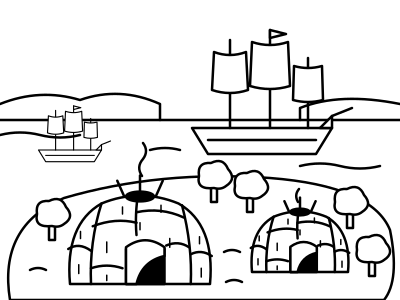
    A Dutch sailing ship is anchored near the island of Manahatta, where two Lenape wigwams covered in bark stand among trees.

    Mark the reading.

    1. 1.

      Underline one sign of cooperation.

    2. 2.

      Circle one sign of conflict or worry.

    Fill in the T-chart and answer.

    Dutch point of viewLenape point of view
      
      
    1. 3.

      What did the Dutch think the deal meant?

    2. 4.

      What did the Lenape think the deal meant?

    3. 5.

      Why did the two groups see the same deal differently?

    4. 6.

      Why did so many Native people get sick after Europeans came?

    Challenge: The Lenape still live today. Name one place Lenape nations are based now.

    Materials: two colors of pencil

    Mathematics

    Objective: I can double the ×2 fact (double-double) to know my ×4 facts.

    Standards: 3.OA.C.7, 3.OA.B.5

    Builds on: Needs the ×2 facts and doubling a number up to 20. One-minute check: ask 2 × 8 (16), then 16 + 16 (32).

    New words:
    • double-double – double a number, then double the answer

    Materials: Grid paper, Crayons in 2 colors, 10 index cards or paper slips, Notebook, Pencil

    1. Warm-Up · 5 min

      Spaced review from Week 1. Your child rounds 742 to the nearest 100 (700). Then ask 3 × 6 (18) and 3 × 8 (24). Count by 4s to 40 together.

    2. Mini-Lesson · 10–15 min

      Say: "Today we build ×4 facts from ×2 facts." Write 4 × 6. Ask: "What does this tell us to draw?" (4 rows of 6.) Color the top 2 rows red and the bottom 2 rows blue. Ask: "What is the red part?" (2 rows of 6.) Write 2 × 6 = 12. Ask: "What is the blue part?" (2 rows of 6 again.) Write 12 + 12 = 24, then 4 × 6 = 24. Say: "4 groups is 2 groups and 2 more groups. So I double, then double again. Double 6 is 12. Double 12 is 24." Say: "We call this double-double." Ask: "Which fact did I use first?" (2 × 6.) Now your child does more. Your child colors 4 rows of 7 in two colors. Your child writes 2 × 7 = 14, then 14 + 14 = 28, then 4 × 7 = 28. Ask: "What were your two doubles?" (Double 7 is 14. Double 14 is 28.)

    3. Guided Practice · 10–15 min

      Your child says both doubles aloud. 1) 4 × 5 (double 5 is 10; double 10 is 20). 2) 4 × 8 (double 8 is 16; double 16 is 32). 3) 4 × 9 (double 9 is 18; double 18 is 36). To double 18, add 10 + 10 = 20 and 8 + 8 = 16. Then 20 + 16 = 36. 4) Write 8 × 4. Ask: "Which fact you just solved helps?" (4 × 8 = 32. It is the same array turned.) If stuck, say: "Double the other factor and write it down. Now double what you wrote."

    4. Independent Practice · 15–20 min

      Your child writes both doubles and the product. 1) 4 × 2 (double 2 is 4; double 4 is 8). 2) 4 × 3 (double 3 is 6; double 6 is 12). 3) 4 × 4 (16). 4) 4 × 10 (40). 5) 7 × 4 (28). 6) Your child colors 4 rows of 9 in two colors. Your child writes both parts (2 × 9 = 18; 18 + 18 = 36). 7) Kofi has 4 bags with 8 marbles in each bag. How many marbles? (4 × 8 = 32) 8) A car has 4 wheels. How many wheels are on 6 cars? (6 × 4 = 24) Last, your child makes fact cards for the ×4 facts. Sort them into "know it" and "still building" piles. Use no timer.

    5. Exit Ticket · 5 min

      Put the grid paper and cards away. Read each question aloud; your child writes the answers.

    Watch for: Doubling only once and stopping at the ×2 fact, such as saying 4 × 7 is 14.

    Try: Say "double, double" and tap the table twice. Your child writes each double on its own line before the product.

    Fact fluency: ×4 facts

    Exit ticket:
    1. What is 4 × 9?
    2. What is 8 × 4?
    3. Tell the two doubles you used for 8 × 4.
    Show answers
    1. 36
    2. 32
    3. Double 8 is 16. Double 16 is 32.

    Support: Use only 4 × 2 to 4 × 5. Your child colors each array, then folds it in half to see two equal parts.

    Extend: Ask: "Why is every ×4 product even?" (It is a double, so it makes two equal parts.) Your child tests it with 4 × 5 (10 + 10 = 20). Then your child tests 4 × 7 (14 + 14 = 28).

    Homework: Use the ×4 fact cards for 10 minutes with no timer. Then teach double-double to a family member with one fact. Sample: 4 × 7, double 7 is 14, double 14 is 28.

    Practice page · Week 7, Day 2

    Mathematics

    I can double the ×2 fact (double-double) to know my ×4 facts.

    Look: 8 × 4

    1. Find the ×2 fact first: 8 × 2 = 16.
    2. Double it: 16 + 16 = 32.
    3. So 8 × 4 = 32.

    Multiply.

    1. 1.

      4 × 3 = ____

    2. 2.

      5 × 4 = ____

    3. 3.

      4 × 9 = ____

    4. 4.

      6 × 4 = ____

    5. 5.

      4 × 4 = ____

    6. 6.

      4 × 10 = ____

    Solve.

    1. 7.

      A wagon has 4 wheels. How many wheels are on 7 wagons?

    2. 8.

      Show the double-double steps for 9 × 4.

    Challenge: Jin says 4 × 6 is the same as 2 × 6 doubled. Is he right? Explain.

    Materials: Counters (optional)

    English Language Arts

    Objective: I can find the main idea of a whole article and figure out new words from context.

    Standards: RI.3.2, RI.3.4, L.3.4.A, RF.3.4.A, RF.3.4.C

    Builds on: Needs Day 1: finding the main idea and details of one paragraph. One-minute check: ask, "What do we call the sentence that states the main idea?" (The topic sentence.)

    New words:
    • context clues – words near a new word that help you figure out what it means

    Materials: The 'Animal Builders' article (in the lesson), 4 sticky notes or small slips of paper, Reader's notebook, Pencil, Your child's own nonfiction book or magazine (homework)

    1. Warm-Up · 5 min

      Word study, open syllables. Write bacon, even, music, robot and paper. Your child draws a line after the first syllable of each word and reads it. (ba|con, e|ven, mu|sic, ro|bot, pa|per) Ask: "Why is the first vowel long?" (The syllable ends with the vowel.) Spaced review from Week 6. Ask: "What does a heading tell you?" (The topic of that section.)

    2. Mini-Lesson · 10–15 min

      Say: "A paragraph has a main idea. A whole article has a bigger main idea that covers every paragraph." Read aloud. Title: Animal Builders. 'Paragraph 1: Beavers gnaw through small trees with their strong front teeth. They pile branches, rocks and mud across a stream to build a dam. The dam blocks the water, so a pond forms. Then the beavers build a lodge in the pond, with a door under the water. Paragraph 2: Weaverbirds tie strips of grass into knots to weave hanging nests. The nests swing from the tips of thin branches, where snakes can hardly reach the eggs. Paragraph 3: Termites build tall mounds of soil. Thousands of termites, called a colony, live inside. Tunnels let air move through the mound, which keeps the colony from getting too hot.' Say: "Here is the strategy. Write each paragraph's main idea on a sticky note, in five words or fewer. Then ask what joins the notes." Think aloud on paragraph 1: "Every sentence is about beavers building. My note says: Beavers build dams and lodges."

    3. Guided Practice · 10–15 min

      1) Reread paragraph 2. Ask: "What is it mostly about?" Your child writes a note. (Weaverbirds weave safe nests.) 2) Do the same for paragraph 3. (Termites build cool mounds.) 3) Line up the three notes. Ask: "What do all three share?" Your child writes the article's main idea on the fourth note. (Many animals build homes that protect them.) 4) Say: "In Week 6 you reread the sentence around a bold word. Nearby words that explain a new word are called context clues." Point to lodge. Ask: "Which words tell what a lodge is?" (Beavers build it in the pond, and it has a door. A lodge is a beaver's home.) If stuck, say: "Does your big idea fit the beavers, the birds and the termites?"

    4. Independent Practice · 15–20 min

      1) Your child reads "Animal Builders" aloud to find what each animal builds. If a sentence sounds wrong, your child stops, rereads and fixes it. 2) In the notebook, your child writes the three paragraph main ideas, then the article's main idea. 3) Your child writes the meaning of colony and of mound, with the clue words for each. (Colony: thousands of termites living together. Clue: "thousands of termites, called a colony." Mound: a tall pile of soil. Clue: "tall mounds of soil.") 4) Your child reads the article aloud again, this time with expression, like a nature guide. Look for: an article main idea that says "animals," not only one animal.

    5. Exit Ticket · 5 min

      Read each question aloud. Your child answers in the notebook and may reread the article.

    Watch for: Giving paragraph 1's main idea as the main idea of the whole article.

    Try: Ask: "Does your answer include the weaverbirds and the termites too?" If not, your child makes it bigger.

    Exit ticket:
    1. How is the main idea of an article different from the main idea of a paragraph?
    2. Which paragraph would you reread to learn how eggs stay safe from snakes? What is that paragraph's main idea?
    3. What does 'dam' mean in the article? Which words helped you?
    Show answers
    1. An article's main idea covers the whole article. A paragraph's main idea covers only that paragraph.
    2. Paragraph 2. Weaverbirds weave safe nests.
    3. A wall of branches, rocks and mud that blocks a stream. Clues: 'pile branches, rocks and mud across a stream' and 'blocks the water.'

    Support: Use only paragraphs 1 and 2. Offer two choices for the article's main idea and let your child pick.

    Extend: Your child writes a one-sentence summary of the article with the main idea and one example.

    Homework: Read a short article or a few nonfiction pages for 15 minutes. Your child writes the main idea of two paragraphs, then of the whole. Look for: a big idea that covers both notes.

    Practice page · Week 7, Day 2

    English Language Arts

    I can find the main idea of a whole article and figure out new words from context.

    Animal Travelers

    Each fall, monarch butterflies fly thousands of miles from Canada and the United States to forests in Mexico. Gray whales swim from cold Arctic waters to warm lagoons in Mexico, where they have their babies. Arctic terns fly from the far north of Earth to the far south and back again each year. The tern's long trip, called a migration, is the longest of any animal.

    Write each main idea in five words or fewer.

    1. 1.

      Monarch sentence:

    2. 2.

      Gray whale sentence:

    3. 3.

      Arctic tern sentence:

    4. 4.

      What is the main idea of the whole article?

    5. 5.

      What does "migration" mean? Which words helped?

    6. 6.

      Read the article aloud once. If a sentence does not make sense, reread it. Check when done.

    Which long vowel does the open syllable have? Circle one.

    1. 7.

      ze|ro

      ○ long e○ long i○ long u
    2. 8.

      mu|sic

      ○ long e○ long i○ long u
    3. 9.

      si|lent

      ○ long e○ long i○ long u

    Challenge: Find the word "lagoons." Use the sentence to guess what it means.

    Science

    Objective: I can draw more than one magnet latch design and choose the best one to build.

    Standards: 3-PS2-4, 3-5-ETS1-2

    Builds on: Needs the Day 1 criteria and constraints, and Week 4: a magnet's pull is strongest up close. One-minute check: ask, "What must our latch do when we shake the box?" (Stay shut.)

    New words:
    • solution – one way to solve a problem

    Materials: Shoebox cabinet from Day 1, 2 magnets, 2 steel washers or steel bottle caps, 2 steel paper clips, Plain paper, pencil and ruler, Science notebook

    1. Day 32 — Plan and Compare Designs — Wonder Warm-Up · 5 min

      Spaced review from Week 5. Ask: "In Week 5, how did the magnet's pull change as we stacked more cardboard layers?" (It got weaker.) Then ask the wonder question: "How many different ways could a magnet hold our door shut?" Take every idea.

    2. Mini-Lesson · 10–15 min

      Say: "Engineers draw more than one idea. Each idea is a possible solution. Then they compare the ideas with the criteria." Say: "Our door needs a cardboard tab that overlaps the box wall. One part goes under the tab. The other part goes on the wall." Sketch three designs while your child watches. Design A: magnet under the tab, steel washer on the wall. Design B: magnet under the tab, second magnet on the wall. Design C: magnet on the wall, two paper clips under the tab. Now hold a magnet near a washer and let them snap together. Ask: "Which designs use attraction?" (All three.) Hold two magnets so they push apart. Ask: "In Design B, what happens if like poles face each other?" (They repel. The door is pushed open.) "Why must the two parts meet when the door shuts?" (The pull is strongest up close.) Flat fridge magnets may not show clear poles, so use disc magnets for Design B. If stuck, say: "Hold the two parts. Move them apart slowly. Where is the pull strongest?"

    3. Investigation / Hands-On · 15–20 min

      1) Your child sketches 2 or 3 designs on plain paper, using the shoebox cabinet as a guide. Each sketch has labels: magnet, steel part or second magnet, tab. 2) Quick hand test. Hold the parts for each design in place with fingers, with no tape. Keep the same door and the same spot. Change only the design. 3) Your child uses the ruler and pencil to draw a chart: Design | Holds the door shut? | Opens with one finger? | Uses only allowed materials? Write yes or no in each box. 4) Your child chooses one design and says why. Expect different results with different magnets. Two magnets often hold hardest but can be hard to open. Say: "Real results vary. Look for the pattern in your chart." Safety: keep small magnets away from little children.

    4. Science Notebook Entry · 10 min

      Your child makes a plan page in the notebook. It needs a labeled sketch, a materials list with amounts, and 4 to 6 numbered build steps. Sample steps: "1. Cut a tab 1 inch wide. 2. Tape the tab to the door's loose edge. 3. Tape the magnet under the tab. 4. Shut the door and mark where the magnet lands. 5. Tape the washer on the mark." Ask: "Could someone else build it from these steps?"

    5. Wrap-Up & Exit Ticket · 5 min

      Read the three exit questions aloud; your child answers on paper. Praise any reason that names a criterion.

    Watch for: Choosing the design that holds hardest and forgetting that it must open with one finger.

    Try: Your child touches every box in the chart row before choosing. A design with any "no" needs a fix first.

    Exit ticket:
    1. Two designs both hold the door shut. Only one opens with one finger. Which design is better, and why?
    2. Which design did you choose? Give a reason that names one of our criteria.
    3. A new design needs 3 magnets. Why can we not choose it?
    Show answers
    1. The one that opens with one finger, because it meets more of the criteria.
    2. Answers vary. Look for: a reason tied to a criterion, such as "it held the door and still opened with one finger."
    3. It breaks a constraint. We may use at most 2 magnets.

    Support: Draw Designs A and C for your child. Your child adds the labels, hand-tests both and fills in the chart.

    Extend: Your child draws a backup design and writes when to switch to it. Sample: "If the washer design fails the shake test, I will try two magnets."

    Homework: Show the plan page to a family member. Ask which design they would choose and why. Write their reason. Look for: a reason that matches a criterion.

    Practice page · Week 7, Day 2

    Science

    I can draw more than one magnet latch design and choose the best one to build.

    Sketch two latch designs. Label the magnet, the steel part and the gap.

    1. 1.

      Design 1

    2. 2.

      Design 2

    Test each idea by hand for 1 minute and fill in the chart.

    DesignHolds well?Opens with one finger?Uses allowed materials?
        
        
    1. 3.

      I chose Design ____ because ____.

    2. 4.

      Why must the magnet and the steel part line up when the door is shut?

    Materials: the shoebox cabinet · 2 magnets · steel washers or bottle caps · masking tape

    Standards-matched clips that reinforce today's objectives.

    Mathematics

    4's Multiplication Facts Practice | Multiplying by 4 | Math with Mr. J

    Math with Mr. J

    Supports: I can double the ×2 fact (double-double) to know my ×4 facts.

    3.OA.C.7
    3.OA.B.5
    Watch on YouTube
    Social Studies

    Christopher Columbus for Kids | Learn about his life and what actually happened on his adventures

    Learn Bright

    Supports: I can describe early meetings between Native nations and Europeans from more than one point of view.

    D2.His.4.3-5
    D2.His.10.3-5
    Watch on YouTube