Day 1 · Monday
Mathematics
I can switch the order of factors and get the same product (commutative property).
Builds on: Needs arrays from Week 4 and turning an array from Week 9 Day 3. One-minute check: your child draws 2 rows of 7. Then your child writes two equations (2 × 7 = 14 and 7 × 2 = 14).
- commutative property – the rule that you can switch the order of the factors and the product stays the same
Materials: 30 counters (dried beans, coins or buttons), Sheet of plain paper, Grid paper, Notebook, Pencil
5 min · Warm-Up
Spaced review from Week 12. Ask 18 ÷ 3 and 40 ÷ 8 (6, 5). Write 6 × ? = 54. Your child finds the unknown (9). Then your child says the ×4 facts in order, with no clock. For a slow fact, double the ×2 fact. Sample: 4 × 7 is 14 doubled, which is 28.
10–15 min · Mini-Lesson
Say: "You have turned arrays before. Today that idea gets a name." On the plain paper, your child builds 3 rows of 4 beans. Ask: "How many rows? How many in each?" (3; 4) Write 3 × 4 = 12. Turn the paper a quarter turn. Ask: "How many rows now? How many in each?" (4; 3) Write 4 × 3 = 12. Ask: "Did any beans come or go?" (No.) Say: "So 3 × 4 = 4 × 3. Both are 12." Say: "Switching the order of the factors keeps the product the same. This is the commutative property." Say: "Commutative sounds like commute. The factors trade places." Say: "It saves work. If you know 6 × 7 = 42, you also know 7 × 6 = 42." Ask: "Does switching work for division?" Say: "12 cookies shared by 3 friends is 4 each." Say: "But 3 cookies cannot give 12 friends 4 each. So switching does not work for division." Now your child does more. Your child builds 2 rows of 5, turns it and writes both equations. (2 × 5 = 10 and 5 × 2 = 10)
10–15 min · Guided Practice
Your child says "commutative property" each time the factors trade places. 1) Your child outlines 3 rows of 8 on grid paper and turns it. Your child writes both equations (3 × 8 = 24 and 8 × 3 = 24). 2) Write 4 × 7 = 7 × ?. Your child finds the unknown, then the product (4; product 28). 3) Write 9 × 2. Ask: "Which fact that you know helps?" (2 × 9 = 18, a double) 4) Ask: "Is 15 ÷ 3 the same as 3 ÷ 15?" (No. 15 ÷ 3 = 5. Sharing 3 things among 15 does not give 5 each.) If stuck, say: "Build the array with beans. Turn the paper. Count the rows again."
15–20 min · Independent Practice
For problems 1 to 3, your child finds the unknown and the product. 1) 6 × 9 = ? × 6 (9; product 54). 2) ? × 2 = 2 × 9 (9; product 18). 3) 8 × 5 = 5 × ? (8; product 40). 4) If 7 × 8 = 56, what is 8 × 7? (56) 5) Draw arrays for 5 × 6 and 6 × 5 on grid paper. Count each one. (30 each) 6) Write the switched fact for 10 × 3. Solve both. (3 × 10 = 30; both are 30) 7) One tray has 2 rows of 9 muffins. Another tray has 9 rows of 2. Which tray holds more? (Neither. Both hold 18.) 8) Sam has 7 bags of 3 limes. Eva has 3 bags of 7 limes. Who has more? (Neither. Both have 21 limes, but the bags look different.) Last, ask: "Which fact today did you know from its partner?"
5 min · Exit Ticket
Put the beans away. Read each question aloud; your child answers on paper.
Watch for: Treating 7 × 9 and 9 × 7 as two different facts to learn.
Try: Your child outlines 7 rows of 9 on grid paper and turns it. Say: "One array, two facts, one product."
Exit ticket (3 questions)
- If 6 × 4 = 24, what is 4 × 6? How do you know?
- Fill in the unknown: 7 × 9 = 9 × ?
- Does switching the order work for 20 ÷ 4? Explain.
Show answers
- 24. Switching the factors keeps the product the same.
- 7
- No. 20 ÷ 4 = 5, but sharing 4 things among 20 does not give 5 each.
Support: Use facts with 2, such as 2 × 3 and 3 × 2. Your child builds every array with beans and turns the paper.
Extend: Your child finds every array for 24 beans and pairs the turned partners. Pairs: 1 × 24 and 24 × 1. 2 × 12 and 12 × 2. 3 × 8 and 8 × 3. 4 × 6 and 6 × 4.
Homework: Your child writes 5 switched pairs from the ×4 facts with their products. Sample: 4 × 8 = 32 and 8 × 4 = 32.
English Language Arts
I can tell the difference between revising and editing and do both to my writing.
Builds on: Needs the finished narrative from Week 12 and the three sentence types from Week 7. One-minute check: ask, "Is 'We ran, but we missed the bus' simple or compound?" (Compound. Two thoughts are joined with but.)
- edit – to fix small mistakes in spelling, capital letters, punctuation and grammar
- prefix – a word part added to the front of a word that changes its meaning
Materials: Narrative from Week 12, Two colored pencils, Sticky notes, Notebook, Pencil
5 min · Warm-Up
Word study, about 3 minutes. Say: "A prefix is a word part added to the front of a word. It changes the meaning. Un- means not or the opposite. Re- means again. Dis- means not or the opposite of." Write unlock, unhappy, redo, reread, dislike and disagree in the notebook. Your child reads each word, circles the prefix and sorts it under un-, re- or dis-. Ask: "Which prefix means again?" (Re-, as in redo and reread.) Spaced review from Week 12. Ask: "Name the five parts of a story arc." (Opening, rising action, climax, falling action, ending.)
10–15 min · Mini-Lesson
Say: "Revising means big changes. We add, cut, move or change ideas and words. Editing means small fixes: spelling, capitals, punctuation and grammar. Writers revise first and edit last." Write this student sample. "The Sled Hill": Last winter me and my cousin went to the sled hill. The snow was fun. We ate crackers. i sat on the sled. My cousin pushed. Then the sled hit a bump, and I flew into a snowbank! Think aloud. Say: "First I revise. 'We ate crackers' does not help the story, so I cut it. 'The snow was fun' is dull. I change it to 'The snow squeaked under our boots.'" Mark those changes in one color. Say: "Two short sentences sound choppy. I join them with a comma and the word and: 'I sat on the sled, and my cousin pushed.' That is a compound sentence." Say: "Now I edit." In the other color, capitalize the word I. Change "me and my cousin" to "my cousin and I". Ask: "Which color shows the big changes?" (The revising color.)
10–15 min · Guided Practice
Hold a short writing conference. Agree on two talk rules first: listen without interrupting, and begin with "I noticed" or "I wonder". 1) Your child reads the Week 12 narrative aloud. Give one glow, something that works. (Sample: "I noticed your ending solves the problem.") 2) Give one grow as a question. (Sample: "I wonder what the room looked like.") Your child writes it on a sticky note and sticks it at that spot. 3) Switch roles with "The Sled Hill". Your child gives you a glow and a grow. (Listen for "I noticed" or "I wonder" and a detail from the paragraph.) 4) Say: "Join these with when: The sled tipped. I grabbed the rope." (When the sled tipped, I grabbed the rope.) Say: "That is a complex sentence." If stuck, say: "Say both short sentences. Now say them in one breath with the joining word."
15–20 min · Independent Practice
Your child revises and edits the Week 12 narrative with a pencil and both colors. 1) Read it aloud once. 2) In the first color, make at least 2 revisions: add a detail, cut a sentence or change a dull word. Use the sticky note. 3) Join two short sentences into one compound or complex sentence. Use and, but, so, because or when. 4) In the second color, make at least 3 edits, or every one you can find. Look for three things. The revising color changes ideas or words, not spelling. The joined sentence has a joining word. A comma comes before and, but or so.
5 min · Exit Ticket
Ask the three questions aloud. Your child answers the first two by speaking and reads the joined sentence from the draft.
Watch for: Fixing only spelling and calling the piece revised.
Try: Ask: "Did any idea or word change?" Your child adds one new sentence before any editing starts.
Exit ticket (3 questions)
- A writer adds a sentence that tells how the kitchen smelled. Is that revising or editing?
- A writer fixes the spelling of 'becuase'. Is that revising or editing?
- Read me the sentence you joined today. Which joining word did you use?
Show answers
- Revising. It adds an idea.
- Editing. It is a small fix.
- Answers vary. Look for: two complete thoughts joined with and, but, so, because or when.
Support: Make a two-column chart in the notebook. Left: Revise = Add, Remove, Move, Substitute (ARMS). Right: Edit = capitals, punctuation, spelling. Your child points to a column before each change.
Extend: Your child moves one sentence to a new place in the narrative. They tell how the move changes the story for a reader.
Homework: Read the revised narrative aloud to someone at home. Ask where they wanted to know more and mark that spot. Look for: one mark to use tomorrow.
Science
I can explain how living in a group helps some animals survive.
Builds on: Needs Week 12: animals eat and are eaten in food webs. One-minute check: ask, "What is a predator?" (An animal that hunts and eats other animals.)
- prey – an animal that is hunted and eaten by another animal
- benefit – a good thing you get; a way something helps
Materials: 12 index cards: 6 with animal names (wolves, honeybees, geese, fish, dolphins, elephants) and 6 with group words (pack, colony, flock, school, pod, herd), 10 blocks, 1 stuffed animal or puppet (the predator), 3 more stuffed animals (the herd), Science notebook and pencil
5 min · Day 61 — Why Animals Live in Groups — Wonder Warm-Up
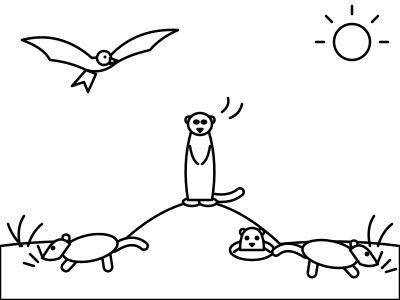
Spaced review from Week 12. Ask: "What might happen in a food web if all the rabbits disappear?" (Foxes and hawks have less food. The plants they ate may spread.) Then the wonder. Say: "Wolves hunt in packs. Bees live in colonies. Why might living together help an animal stay alive?" Write down two guesses to check later.
10–15 min · Mini-Lesson
Say: "Some animals live in groups. The group helps its members survive." Raise one finger for each benefit. Say: "One, protection. More eyes and ears notice danger sooner. Two, food. Wolves together can catch prey bigger than one wolf. Three, care of young. Older wolves help feed the pups. Four, warmth. Emperor penguins huddle close in freezing wind." Say: "Geese fly in a V. Each goose gets a lift from the air moved by the wings ahead. Flying takes less energy, and they take turns leading." Ask: "Which benefit do penguins get from a huddle?" (Warmth.) "Why can a pack catch a moose when one wolf cannot?" (They chase and surround it together.) If stuck, say: "Picture one deer eating with its head down. Who watches for danger? Now picture ten deer."
15–20 min · Investigation / Hands-On
Group Match and Many Eyes Test. 1) Your child pairs each animal card with its group word. (Wolves, pack. Honeybees, colony. Geese, flock. Fish, school. Dolphins, pod. Elephants, herd.) 2) Alone. Your child sits facing a wall and stacks the 10 blocks one at a time. Start 10 steps behind with the predator. Take one quiet step for each block stacked. Your child may glance back but must keep building. When they spot the predator, record the steps left. 3) With a lookout. Set the 3 stuffed animals beside your child as a herd that eats. Your child is the lookout and only watches, turning to look every way. Sneak up again. 4) Do each test twice. Change only one thing: alone or with a lookout. Keep the same start and steps. Table: Test | Try 1 steps left | Try 2 steps left. Expect more steps left with a lookout. If not, say: "Real results vary. Look for the pattern." Ask: "Why did the lookout help?" (One animal watches while the others eat.)
10 min · Science Notebook Entry
In the notebook, your child draws a chart with 3 columns: Animal, Group word, Main benefit. They fill 6 rows. Accept any benefit your child can explain. Then they finish: "Alone, the predator got ___ steps away. With a lookout, it was ___ steps away. Groups help because ___." Sample: "Groups help because someone can watch while the others eat."
5 min · Wrap-Up & Exit Ticket
Read the three questions aloud, then check the warm-up guesses together. Praise answers that tell how the group helps an animal stay alive.
Watch for: Thinking animals gather in groups only because they are friends.
Try: For each group ask, "How does this help a member stay alive or raise young?" Your child names the benefit.
Exit ticket (3 questions)
- What is a group of dolphins called?
- Ten geese feed in a field while one keeps its head up and watches. Which benefit of group living is this?
- Name two ways living in a group can help an animal survive.
Show answers
- A pod.
- Protection. The one watching can spot danger and warn the others.
- Any 2: protection from predators, finding or catching food, caring for young, staying warm, saving energy.
Support: Use only 3 pairs of cards: wolves, fish and honeybees. Say the four benefit words slowly, and your child picks one.
Extend: Add a family member as a second lookout facing another way. Your child predicts the result, then tests it.
Homework: Watch birds, ants or squirrels for 10 minutes, outdoors or through a window. Write what you saw and one way a group might help. Look for a named benefit, such as more eyes.