Day 1 · Monday
Mathematics
I can catch up on division by modeling sharing and grouping and using fact families.
Builds on: Needs the two meanings of division from Week 10 and fact families from Week 10 Day 4. One-minute check: ask 20 ÷ 4 and the multiplication fact that proves it (5; 4 × 5 = 20).
Materials: 30 counters (dried beans, coins or buttons), 6 cups or paper plates, 4 paper triangles (cut 2 paper squares corner to corner), Notebook, Pencil
5 min · Warm-Up
Spaced review from Week 13. Ask 6 × 0 and 9 × 1 (0, 9). Then try ÷3 and ÷4 facts with no clock. Ask 12 ÷ 3, 21 ÷ 3, 16 ÷ 4 and 28 ÷ 4 (4, 7, 4, 7). Your child names the multiplication fact that helped with one of them.
10–15 min · Mini-Lesson
Say: "This week we catch up. Today is division. Division tells two stories." Count out 24 beans and set out 6 cups. Say: "Sharing story. 24 beans are shared equally among 6 cups. How many go in each cup?" Your child deals the beans one at a time. Ask: "How many in each cup?" (4) Write 24 ÷ 6 = 4. Ask: "What did the 6 tell us?" (The number of cups.) Tip the beans back into one pile. Say: "Grouping story. 24 beans go in piles of 6. How many piles?" Your child scoops piles of 6. Ask: "How many piles?" (4) "What did the 6 tell us this time?" (How many in each pile.) Say: "Same equation, two stories. So 24 ÷ 6 = 4." Ask: "Which multiplication fact is in the same family?" (6 × 4 = 24) Now your child does more. Say: "Show 15 ÷ 3 as sharing, then as grouping." (Sharing: 3 cups with 5 in each. Grouping: 5 piles of 3. Both show 15 ÷ 3 = 5.)
10–15 min · Guided Practice
Make fact-family triangles together. 1) Write 4, 6 and 24 in the corners of a paper triangle, with 24 at the top. Your child writes the two multiplication facts (4 × 6 = 24, 6 × 4 = 24). Then your child writes the two division facts (24 ÷ 4 = 6, 24 ÷ 6 = 4). 2) Make a triangle for 5, 8 and 40. Cover the 8. Ask: "Which fact finds the hidden number?" (40 ÷ 5 = 8) 3) Cover the 40 instead. Ask the same question. (5 × 8 = 40) 4) Read: "30 crayons go in boxes of 5." Ask: "Sharing or grouping? How many boxes?" (Grouping; 30 ÷ 5 = 6) If stuck, say: "Do we know the number of groups, or how many are in each group?"
15–20 min · Independent Practice
Your child works alone and checks each answer with multiplication. 1) 18 ÷ 3 (6). 2) 32 ÷ 4 (8). 3) 27 ÷ 3 (9). 4) Draw 12 ÷ 4 as sharing: 4 circles with dots dealt out (3 in each). 5) Draw 12 ÷ 4 as grouping: rings around every 4 dots (3 groups). 6) Make a triangle for 3, 7 and 21. Write the multiplication facts (3 × 7 = 21, 7 × 3 = 21). Write the division facts (21 ÷ 3 = 7, 21 ÷ 7 = 3). 7) 36 stickers are shared equally among 4 children. How many does each child get? (9) 8) 24 muffins go in boxes of 3. How many boxes? (8) Last, your child tells which story was sharing and which was grouping. (Problem 7 is sharing; problem 8 is grouping.)
5 min · Exit Ticket
Put the cups and beans away. Read each question aloud; your child answers on paper and draws for question 1.
Watch for: Mixing up which number tells the groups and which tells how many are in each group.
Try: Before building, your child points to the divisor and says "cups" or "in each cup." Then your child builds it.
Exit ticket (3 questions)
- Draw 20 ÷ 5 as sharing. How many are in each group?
- Write the two division facts for 6, 7 and 42.
- Sharing or grouping? 35 pencils go 5 in each cup. How many cups?
Show answers
- 4 (drawing shows 5 circles with 4 dots in each)
- 42 ÷ 6 = 7 and 42 ÷ 7 = 6
- Grouping; 7 cups
Support: Use 12 beans and 3 cups only. Your child says each equation aloud while touching the cups.
Extend: Your child writes a sharing story and a grouping story for 42 ÷ 7, then draws both. Sample: 42 beads on 7 strings is 6 on each. 42 beads in groups of 7 makes 6 groups.
Homework: Make a fact-family triangle for 4, 9 and 36. Cover one corner and quiz a family member. Answers: 4 × 9 = 36, 9 × 4 = 36, 36 ÷ 4 = 9, 36 ÷ 9 = 4.
English Language Arts
I can punctuate dialogue correctly every time (catch-up day).
Builds on: Needs the three dialogue rules from Week 11 Day 4. One-minute check: write I found it said Pia. Ask: "Which words did Pia say?" (I found it.)
Materials: Narrative draft, 4 index cards, Two colored pens, 4 sticky notes, Notebook
5 min · Warm-Up
Flex week, catch-up day 1. Word study, about 3 minutes: review un-, re- and dis-. Ask: "What does each prefix mean?" (Un-: not or the opposite. Re-: again. Dis-: not or the opposite of.) Write unlock, untie, redo, replay, disobey and distrust in the notebook. Your child reads each word and sorts it by prefix. Spaced review from Week 13. Ask: "Is adding a missing period revising or editing?" (Editing.)
10–15 min · Mini-Lesson
Say: "Today we fix the trickiest skill from Week 11. Dialogue is a sandwich. The two quotation marks are the slices of bread. The filling is the spoken words plus their comma or end mark. The speaker tag stays outside the sandwich." Write four patterns in the notebook. 1) "The bus is here," said Theo. 2) "Is that my seat?" asked Theo. 3) "Hold on tight!" yelled Theo. 4) Theo said, "The bus is here." Think aloud on pattern 1. Say: "Theo's words get bread on both sides. The comma is filling, so it sits inside. The period waits until the very end." On patterns 2 and 3, say: "The question mark or exclamation point is filling too. The tag still starts with a small letter, unless it starts with a name." On pattern 4, say: "The tag comes first, so a comma follows it. The first spoken word gets a capital." Your child points to every comma and end mark.
10–15 min · Guided Practice
Write one spoken line on each of four sticky notes. Note 1: I lost my boot. Note 2: Where did you leave it. Note 3: It is floating away. Note 4: Grab the net. Write one tag on each of four index cards: said Jo, asked Dad, yelled Jo, Dad said. Your child pairs a note with a tag. Then they write the sentence, with spoken words and marks in one color and the tag in the other. Check each one against these answers. 1) ("I lost my boot," said Jo.) 2) ("Where did you leave it?" asked Dad.) 3) ("It is floating away!" yelled Jo.) 4) (Dad said, "Grab the net.") If stuck, say: "Read only the words that come out of the mouth. Put bread around those."
15–20 min · Independent Practice
1) Your child finds every line of dialogue in the narrative. They check each line against the four patterns and fix mistakes. 2) They write a new 6-line conversation in the notebook. Two cousins hear a strange noise in the attic. Each pattern appears at least once, and each new speaker starts a new line. Short model: "Did you hear that?" asked Ravi. Lin said, "It came from the attic." 3) They check every line for three rules. Quotation marks hug the spoken words. The comma, question mark or exclamation point sits inside them. The first spoken word has a capital.
5 min · Exit Ticket
Write the first two items with no marks. Your child rewrites them, then answers the third aloud.
Watch for: Forgetting the comma when the tag comes first, as in Mom said "Come in."
Try: Your child says "pause" aloud where the speaker tag ends. That pause is where the comma goes.
Exit ticket (3 questions)
- Punctuate: can we go now asked Mei
- Punctuate: Coach said tie your shoes
- In "We made it," said Ruth, why is there a comma after it and not a period?
Show answers
- "Can we go now?" asked Mei.
- Coach said, "Tie your shoes."
- The sentence is not finished, because the tag still follows. The period goes at the very end.
Support: Keep the four model sentences in view in the notebook. Your child copies the matching pattern while writing each line.
Extend: Your child writes a 6-line conversation with no "said". Each tag uses an exact verb, such as whispered or groaned.
Homework: Listen at dinner. Write 3 things a family member says as dialogue. Look for: quotation marks, the right mark inside them, and a speaker tag.
Science
I can sort producers, consumers and decomposers and draw food chain arrows the right way.
Builds on: Needs Week 10 Day 3 (food roles) and Week 12 Day 1 (food chains). One-minute check: ask, "How does a producer get its food?" (It makes its own from sunlight, air and water.)
Materials: 11 role cards from Week 10: oak tree, grass, sunflower, rabbit, deer, hawk, raccoon, honeybee, mushroom, bread mold, earthworm (remake on index cards if lost), 9 food chain cards: sun, clover, rabbit, fox, grass, grasshopper, frog, snake, hawk (reuse the role cards where names repeat), 3 paper plates labeled Producer, Consumer, Decomposer, 6 paper arrows cut from scrap paper, Soft ball or rolled-up sock (the energy), Scored Week 10 and Week 12 checks, if you kept them, Science notebook and pencil
5 min · Day 66 — Flex Catch-Up: Food Roles and Arrows — Wonder Warm-Up
Spaced review from Week 10. Name six living things, one at a time: oak tree, robin, mushroom, deer, sunflower, bread mold. Your child points to the right plate for each. (Producer, consumer, decomposer, consumer, producer, decomposer.) Note any misses. Then the big question: "What does a food chain arrow really carry?"
10–15 min · Mini-Lesson
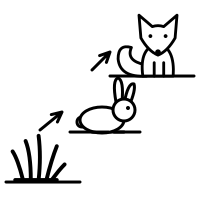
Say: "Today we fix the two trickiest ideas. First, roles. A producer makes its own food from sunlight, air and water. A consumer eats other living things. A decomposer breaks down dead things and returns nutrients to the soil." Hold up the grass, deer and mushroom cards. Your child names each role and tells how it gets food. (Producer, consumer, decomposer.) Say: "Second, arrows. An arrow shows where the energy goes. It points from the food to the eater." Lay clover, rabbit and fox in a row with arrows between them. Say: "The rabbit gets energy from the clover. The fox gets energy from the rabbit." Ask: "Which way does the arrow point between clover and rabbit?" (Toward the rabbit.) "Who gets the energy?" (The rabbit.) "Is an earthworm a producer?" (No. It is a consumer that eats dead leaves.) If stuck, say: "Point to the eater. The arrow's tip touches the eater."
15–20 min · Investigation / Hands-On
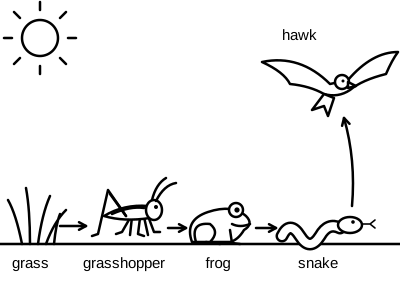
Energy Toss. 1) Lay four cards in a line on the floor: sun, clover, rabbit, fox. 2) Your child holds the ball, the energy, at the sun. They carry it to each card and say: "The sun gives energy to the clover. The clover is eaten by the rabbit. The rabbit is eaten by the fox." 3) Your child lays a paper arrow along each path the ball took. 4) Mistake hunt. Turn one arrow backward while your child looks away. They find it and fix it. 5) Your child builds a new chain: sun, grass, grasshopper, frog, snake, hawk. They repeat the walk and lay the arrows. 6) Role sort. Your child sorts the 11 role cards onto the plates. (Producers: oak tree, grass, sunflower. Consumers: rabbit, deer, hawk, raccoon, honeybee, earthworm. Decomposers: mushroom, bread mold. The earthworm eats dead leaves, which helps the decomposers.) Look for two things. Every chain starts with the sun and a producer. Every arrow tip touches the eater.
10 min · Science Notebook Entry
In the notebook, your child draws one food chain that starts with the sun and has three living things. Above it they write: "The arrow carries the energy." They label each living thing P or C. If you kept the Week 10 and Week 12 checks, they redo missed items in another color. Sample: sun → grass → grasshopper → frog.
5 min · Wrap-Up & Exit Ticket
Read the three questions aloud, and let your child draw for question 2. Praise any idea they missed before and get right now.
Watch for: Pointing arrows backward by reading the arrow as "eats."
Try: Your child says "is eaten by" while tracing each arrow. Then repeat the ball walk.
Exit ticket (3 questions)
- Bread mold grows on an old orange. Is the mold a producer, a consumer or a decomposer?
- Fix this chain: cat → sparrow → seeds.
- In the chain grass → rabbit → hawk, what does the arrow between rabbit and hawk tell you?
Show answers
- A decomposer.
- Seeds → sparrow → cat.
- Energy moves from the rabbit to the hawk, because the hawk eats the rabbit.
Support: Sort only producers and consumers first. Add the Decomposer plate once those two are solid.
Extend: Your child builds a chain with five living things, then adds a decomposer after the last consumer. They explain where the nutrients go.
Homework: Draw two food chains from your yard or kitchen. Label each part P, C or D. Look for arrows that point to the eater.