3
    Third GradePowered by ThirdGrade.com

    Quarter 2 · Building Meaning: Division, Narratives, Ecosystems & Regions

    Week 15: Two-step word problems with a letter for the unknown · Poetry: stanza, rhyme, rhythm, imagery

    Standards this week

    Social Studies

    • D2.Geo.4 Explain how culture influences how people modify and adapt to their environments.Day 1, 2, 3, 4, 5
    • D2.Civ.14.3-5 Illustrate historical and contemporary means of changing society.Day 2, 4, 5
    • D2.Geo.7.3-5 Explain how cultural and environmental characteristics affect the distribution and movement of people, goods, and ideas.Day 3, 4

    Mathematics

    • 3.OA.D.8 Solve two-step word problems using the four operations.Day 1, 2, 3, 4, 5
    • 3.OA.A.4 Determine the unknown whole number in a multiplication or division equation.Day 2, 5
    • 3.NBT.A.1 Use place value to round whole numbers to the nearest 10 or 100.Day 4
    • 3.NBT.A.2 Fluently add and subtract within 1,000 using strategies and algorithms.Day 4, 5

    English Language Arts

    • RL.3.5 Refer to parts of stories, dramas, and poems using terms such as chapter, scene, and stanza.Day 1, 2, 3, 5
    • L.3.6 Acquire and use grade-appropriate conversational, general academic, and domain-specific words and phrases.Day 1
    • RF.3.3.A Day 1
    • L.3.4.B Day 1
    • RL.3.4 Determine the meaning of words and phrases, distinguishing literal from nonliteral language.Day 2, 4, 5
    • RF.3.4.B Read grade-level prose and poetry orally with accuracy, appropriate rate, and expression on successive readings.Day 3
    • SL.3.2 Determine the main ideas and supporting details of a text read aloud or information presented in diverse media.Day 3
    • RL.3.7 Explain how illustrations contribute to what is conveyed by the words in a story.Day 4
    • L.3.5.A Distinguish the literal and nonliteral meanings of words and phrases in context.Day 4, 5
    • W.3.4 Produce writing in which development and organization are appropriate to task and purpose.Day 5

    Science

    • 3-LS1-1 Develop models to describe that organisms have unique and diverse life cycles.Day 1, 2, 3, 4, 5

    See what your state adds or places differently

    Suggested daily schedule
    8:30–8:45 AM15 minMorning Circle / Read-Aloud / Calendar
    8:45–10:00 AM75 minEnglish Language Arts
    10:00–11:00 AM60 minMathematics
    11:00–11:15 AM15 minSnack and Movement Break
    11:15–12:00 PM30–45 minScience (every day)
    12:00–12:45 PM30–45 minSocial Studies (every day)
    12:45–1:30 PM45 minLunch and Choice Time
    1:30–2:15 PM45 minSpecials: PE / Art / Music (rotating)
    2:15–2:45 PM30 minIndependent Reading & Journaling

    Mark Week 15 complete

    0 / 4 done

    Saved in this browser

    Day 1 · Monday

    Social Studies

    I can explain what culture is and name parts of my own family's culture.

    D2.Geo.4.3-5

    Builds on: Needs Week 12, where each Native nation has its own way of life. Also needs your child's own family life. One-minute check: ask "What is one food our family eats on a special day?" (Any real food.)

    New words:
    • culture – the way of life a group of people share

    Materials: Notebook, Large sheet of paper, Crayons, Pencil, Tape, One family object, such as a recipe card, a game or a photo

    5 min · Warm-Up

    Spaced review from Week 12. Ask: "How do thick adobe walls help Pueblo families in the desert?" (They stay cool in the day and warm at night.) Then ask the big question: "What makes our family's way of living special?"

    10–15 min · Mini-Lesson

    Say: "Culture is the way of life a group of people share." Name its parts and count them on your fingers: language, food, music, celebrations, art, clothing, stories, games and beliefs. Say: "Everyone has a culture. Many people belong to more than one." "Culture is learned. Grandparents, parents and neighbors pass it down." Hold up the family object. Say: "This is part of our culture." Ask: "Who taught us this?" Read aloud: "Daniela's family speaks Spanish and English at home. They make tamales in December and play a picture game called lotería on Sundays." Ask: "Which parts of culture did you hear?" (Language, food and a game.) Say: "Culture and place work together. Families who live near the sea often have fish recipes." Ask: "Is a recipe your uncle taught you part of culture?" (Yes. It is food that was passed down.) Ask: "Is having brown eyes part of culture?" (No. You are born with it. Nobody teaches it.) If stuck, say: "Did someone teach it to you? Do other people share it? Then it is culture."

    15–20 min · Activity / Source Work

    Six-box culture chart. 1) Fold the large paper into six boxes. Label them Language, Food, Music, Celebrations, Games or Sports, and Stories or Sayings. 2) Your child fills each box with one thing from your own family. Drawing with crayons or writing is fine. Family means the people who raise your child. 3) For each box, ask: "Who taught you this?" Your child writes that person's name in the box. 4) Look at the family object again. Ask: "What does this tell about our family? Which box does it fit?" 5) Check each box for a specific example. "Food" is too general. "Grandpa's Sunday pancakes" is specific. Every family's chart will differ. Look for the pattern: every family can fill every box. If a box stays empty, say: "What do we say, sing or play at home?"

    10 min · Notebook Entry

    Tape the chart into the notebook, or your child copies three boxes. Then finish the frame: "One part of my family's culture I want to keep is ___ because ___." Sample: "I want to keep our Friday soup because Grandma taught it to Mom."

    5 min · Exit Ticket

    Read the questions aloud. Your child answers in the notebook. Praise specific examples and the word "learned."

    Watch for: Thinking culture belongs only to people from other countries, or that their own family "has no culture."

    Try: Point to your child's chart. Say: "Our family's foods, sayings and games are our culture too."

    Exit ticket (3 questions)
    1. Amara's family tells Anansi stories, cooks jollof rice and speaks Twi and English. Name two parts of culture in her family.
    2. Is being tall part of a person's culture? Why or why not?
    3. How do children get their culture?
    Show answers
    1. Answers vary. Look for any two of: stories, food, language.
    2. No. Culture is learned and shared. Nobody teaches you to be tall.
    3. They learn it from family and the people around them. It is passed down.

    Support: Draw a small picture clue beside each box label. Your child tells you the answers while you write.

    Extend: Your child compares the chart with a relative's or friend's answers. List two things that are the same and two that differ.

    Homework: Your child asks a family member about one tradition and why the family keeps it. Write one sentence. Look for a reason.

    Mathematics

    I can find the two steps in a word problem before I solve it.

    3.OA.D.8

    Builds on: Needs the two-step party problems from Week 14 Day 4 and one-step word problems from Week 12. One-minute check: read "5 bags hold 3 apples each. How many apples?" Your child names the operation and solves (multiply; 15).

    New words:
    • hidden question – a question the story does not ask out loud, but you must answer it first

    Materials: Notebook (copy the two Mini-Lesson stories into it before the lesson), Crayons (two colors), 30 counters (dried beans, coins or buttons), Pencil

    5 min · Warm-Up

    Spaced review from Week 12. Your child solves 6 × ? = 54 (9). Then try ×7 facts with no clock. Ask 7 × 4, 7 × 5, 7 × 8 and 7 × 6 (28, 35, 56, 42). Your child names the strategy for one.

    10–15 min · Mini-Lesson

    Say: "A two-step problem has a hidden question. You must answer it first." Read: "Sara has 20 stickers. She buys 12 more. Then she puts all of them equally on 4 pages. How many stickers go on each page?" Ask: "What does the story ask?" (How many on each page.) Ask: "What must we know first?" (How many stickers in all.) Say: "That is the hidden question." Your child colors the Step 1 facts in one color: 20 stickers, 12 more. Write Step 1: 20 + 12 = 32. Your child colors the Step 2 fact in the other color: 4 pages. Write Step 2: 32 ÷ 4 = 8. Say: "So 8 stickers go on each page." Now your child does more. Read: "Jamal has 3 boxes of 8 crayons. He gives away 5. How many are left?" Ask: "What is the hidden question? What are the two steps?" (How many crayons in all; 3 × 8 = 24, then 24 − 5 = 19)

    10–15 min · Guided Practice

    Your child tells the hidden question, names both steps, then solves. 1) Ines buys 4 packs of 6 juice boxes. She drinks 3. How many are left? (4 × 6 = 24; 24 − 3 = 21) 2) 35 cards are shared equally by 5 friends. Then each friend gets 2 more. How many does each friend have? (35 ÷ 5 = 7; 7 + 2 = 9) 3) 18 big blocks and 22 small blocks go in stacks of 5. How many stacks? (18 + 22 = 40; 40 ÷ 5 = 8) If stuck, say: "What must we know before we can answer? Is that number in the story?"

    15–20 min · Independent Practice

    Your child writes Step 1 and Step 2 for each one. 1) Read: "7 rows of 6 chairs, plus 9 more chairs." Name the two steps only (multiply, then add). 2) Now solve it (7 × 6 = 42; 42 + 9 = 51). 3) Mr. Lee has 50 apples. He uses 14. He puts the rest in bags of 4. How many bags? (50 − 14 = 36; 36 ÷ 4 = 9) 4) Draw 2 bunches of 8 grapes, then cross out 5. Write both steps (2 × 8 = 16; 16 − 5 = 11). 5) 6 vans carry 5 children each. 4 more children walk. How many children? (6 × 5 = 30; 30 + 4 = 34) 6) 45 beads are shared equally on 9 strings. Each string then loses 2 beads. How many are on each string? (45 ÷ 9 = 5; 5 − 2 = 3) 7) Nia has 27 shells and finds 9 more. She fills 4 jars equally. How many in each jar? (27 + 9 = 36; 36 ÷ 4 = 9) 8) A book has 80 pages. Omar reads 8 pages a day for 7 days. How many pages are left? (7 × 8 = 56; 80 − 56 = 24)

    5 min · Exit Ticket

    Read each question aloud; your child answers on paper with no beans.

    Watch for: Using only two numbers from the story and doing one step.

    Try: Ask: "What must I know before I can answer?" If that number is not in the story, find it first.

    Fact fluency: ×7 facts
    Exit ticket (3 questions)
    1. Kai has 4 bags of 5 apples and eats 2. What is the hidden question?
    2. Solve Kai's problem. Show both steps.
    3. Lina has 30 beads and gets 10 more. She makes 5 bracelets with the same number of beads. How many beads are on each?
    Show answers
    1. How many apples are in the 4 bags? (20)
    2. 18 apples (4 × 5 = 20; 20 − 2 = 18)
    3. 8 beads (30 + 10 = 40; 40 ÷ 5 = 8)

    Support: Your child acts out Step 1 with beans, then writes it. Give the frame "Step 1: __. Step 2: __."

    Extend: Your child writes a two-step story that uses × and then −, and you solve it. Sample: 3 bags of 7 buns, 5 eaten; 21 − 5 = 16.

    Homework: Find a two-step story at home and solve it. Sample: 2 packs of 6 yogurts, 3 eaten; 2 × 6 = 12, then 12 − 3 = 9 left.

    English Language Arts

    I can find the lines and stanzas in a poem and use poetry words to talk about it.

    RL.3.5L.3.6RF.3.3.AL.3.4.B

    Builds on: Needs the word stanza from Week 1 Day 3, where your child met chapter, scene and stanza. One-minute check: ask, "What do we call a group of lines in a poem?" (A stanza.)

    New words:
    • line – a single row of words in a poem
    • poet – the person who writes a poem

    Materials: A sheet of paper with 'Morning on Maple Street' copied by hand (8 lines; keep it for Day 2), Any storybook from your child's shelf, Notebook, Colored pencils, Pencil

    5 min · Warm-Up

    Word study, about 3 minutes. Say: "Three new prefixes. Pre- means before. Mis- means wrongly or badly. Non- means not or without." Write preheat, preview, misread, misplace, nonsense and nonliving in the notebook. Your child reads each word, circles the prefix and sorts it under pre-, mis- or non-. Ask: "What does preheat mean?" (To heat before.) Spaced review from Week 13. Ask: "Which words get capitals in a title?" (The first and last words, plus every important word.)

    10–15 min · Mini-Lesson

    Before the lesson, copy this poem on paper. You will use the same copy tomorrow. Start a new row at each slash, and leave a blank row at the double slash. "Morning on Maple Street": The bakery lights blink on at five. / The sleepy street comes back alive. / A bus sighs open at the stop, / And on the curb the sparrows hop. // My sister hums a little tune. / The kettle whistles, much too soon. / I pull my socks on, one and two. / Another day is fresh and new. Lay the copy beside an open page of the storybook. Ask: "How do they look different?" (The poem has short rows and a gap. The story fills the page.) Say: "A poem is writing set out in lines. The poet is the writer. Each row of words is called a line. A stanza is a set of lines that belong together, followed by a blank space. It is like a paragraph in a poem." Read the poem aloud. Think aloud. Say: "I put my finger on the first row. That is line 1. I count down to the blank space: 1, 2, 3, 4. Those four lines make stanza 1." Write 1 to 4 in the margin with a pencil and bracket the stanza.

    10–15 min · Guided Practice

    1) Your child numbers the lines of the second stanza and brackets it. Ask: "How many lines does the poem have altogether? How many stanzas?" (8 lines; 2 stanzas.) 2) Say: "Read line 6 aloud." (The kettle whistles, much too soon.) 3) Ask: "Where does stanza 1 happen? Where does stanza 2 happen?" (Outside on the street; inside the speaker's home.) 4) Ask: "What does stanza 2 add after stanza 1?" (First the street wakes up. Then the family wakes up and gets ready.) If stuck, say: "Put a finger at the start of each row. Count rows, not periods. A blank space means a new stanza."

    15–20 min · Independent Practice

    1) Your child copies the poem into the notebook, keeping every line break and the stanza space. 2) They label the title, line 1 and each stanza. They shade each stanza lightly in a different color. 3) They copy a favorite line and write one or two sentences about it, using at least two poetry words. Sample: "My favorite line is line 3 in the first stanza. The poet makes the bus sound tired." Look for three things. The copy has 8 lines on 8 rows. A blank row sits between the stanzas. The poetry words are used correctly.

    5 min · Exit Ticket

    Your child keeps the poem in view. Ask the three questions aloud.

    Watch for: Counting sentences instead of lines, so the count does not match.

    Try: Your child puts a finger at the start of each row and counts rows, not periods.

    Exit ticket (3 questions)
    1. In which stanza do the sparrows hop? Which line number is it?
    2. What does the blank space in the middle of the poem show?
    3. Is a line always a whole sentence? Use lines 3 and 4 to explain.
    Show answers
    1. Stanza 1, line 4.
    2. One stanza has ended and a new stanza begins.
    3. No. Lines 3 and 4 together make one sentence. A line is just one row of words.

    Support: Your child colors each stanza a different color first. Then they count the lines inside one color at a time.

    Extend: Your child rewrites the poem as a paragraph. They explain what is lost without the lines and stanzas.

    Homework: Read one poem from any book at home to a family member, or reread today's poem. Tell how many lines and stanzas it has.

    Science

    I can describe the stages of a plant's life cycle and start a bean plant to observe.

    3-LS1-1

    Builds on: Needs Week 10 Day 2: a seed is living and resting. One-minute check: ask, "What does a plant use to make its own food?" (Sunlight, air and water.)

    New words:
    • life cycle – the stages a living thing goes through as it starts, grows, makes young and dies
    • germinate – to sprout; a seed starts to grow
    • seedling – a young plant that has just sprouted
    • pollination – when pollen lands on the part of a flower that makes seeds

    Materials: 5 dry pinto or kidney beans, soaked in water overnight, Paper cup with 2 small holes poked in the bottom by an adult, Potting soil, about 1 cup, Saucer or plate to catch drips, Water and a warm, sunny windowsill, Marker, Science notebook and pencil, 1 dried pea and a second cup of soil (only for the extension)

    5 min · Day 71 — Plant Life Cycle — Wonder Warm-Up

    Spaced review from Week 10. Ask: "Is a dry bean living or never alive?" (Living. It is resting and can sprout.) Then the wonder. Say: "This bean came from a bean plant. How does a bean plant begin, and how does it make new beans?" Take two ideas.

    10–15 min · Mini-Lesson

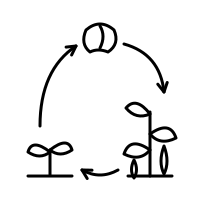
    Say: "A life cycle is the set of stages a living thing goes through. It starts, grows, makes young and dies." Split one soaked bean with your fingers. Slip off the thin skin and open the two halves. Your child opens a second bean. Ask: "What do you see?" (A tiny plant and two thick halves.) Say: "The halves are stored food. The tiny plant uses it until its first leaves make food from sunlight." Draw a circle. Add each stage as you say it. Say: "Seed. The seed germinates, which means it sprouts. Seedling. Adult plant. Flowers. Pollen lands on the seed-making part of a flower. That is pollination. A fruit grows with new seeds inside. A bean pod is a fruit. The seeds scatter, and the cycle starts again." Say: "A bean plant dies at the end of its season." Ask: "Which stage comes first after a seed germinates?" (The seedling.) "Where do new seeds form?" (Inside the fruit.) If stuck, say: "Trace the circle with your finger and name each stop."

    15–20 min · Investigation / Hands-On

    Plant a Bean. Safety: raw beans are not for eating. Wash hands after handling soil. 1) Fill the cup with soil to a finger's width below the rim. 2) Your child pushes 3 soaked beans in as deep as the first knuckle and covers them. 3) Water until the soil is damp, not soggy. Set the cup on the saucer in the warm, sunny window. 4) Write your child's name and the date on the cup with the marker. 5) Your child predicts the day the first sprout will show. Most beans sprout in 1 to 2 weeks. 6) Start a Bean Log table: Date | What I see | Height (cm). Look every day. Keep the soil as damp as a wrung-out sponge. Cold soil slows sprouting, so move the cup away from a cold window at night. If nothing sprouts on time, say: "Real results vary. Seeds need warmth and water. Let's keep looking."

    10 min · Science Notebook Entry

    In the notebook, your child draws the plant life cycle as a circle with arrows. Labels: seed, seedling, adult plant, flowers, fruit with seeds. They add a small drawing of the old plant dying. Then they write the first Bean Log line: "Day 1: I planted ___ beans. I predict a sprout on ___."

    5 min · Wrap-Up & Exit Ticket

    Read the three questions aloud, and let your child point to the circle drawing. Praise answers that use the words germinate, seedling or pollination correctly.

    Watch for: Thinking the flower is the end of the cycle, or that a seed's first food comes from the soil.

    Try: Point to the fruit and seeds after the flower on the circle. Then show the stored food in the split bean again.

    Exit ticket (3 questions)
    1. What two things are inside a bean seed's skin?
    2. A bean plant has flowers. What must happen before pods with seeds can grow?
    3. Why do we draw a life cycle as a circle?
    Show answers
    1. A tiny plant and stored food.
    2. Pollination. Pollen must land on the seed-making part of the flower.
    3. Answers vary. Look for: the new seeds grow into new plants, so the stages happen again.

    Support: Write the five stage names on scraps of paper. Your child arranges them in a circle before drawing.

    Extend: Plant the dried pea in the second cup. Your child predicts which seed sprouts first and logs both.

    Homework: Check the bean each day and keep the soil damp. Draw anything new in the Bean Log. Look for a dated entry.
    Day 2 · Tuesday

    Social Studies

    I can describe celebrations people in the U.S. observe and explain why there are so many.

    D2.Geo.4.3-5D2.Civ.14.3-5

    Builds on: Needs Day 1: celebrations are one part of culture. One-minute check: ask "Is a holiday meal part of culture? Which parts?" (Yes. Food and celebrations.)

    New words:
    • national holiday – a day the whole country marks by law
    • powwow – a gathering where Native people dance, drum, sing and visit

    Materials: Calendar that shows all 12 months, 8 index cards, Notebook, Crayons, Pencil

    5 min · Warm-Up

    Spaced review from Week 11. Ask: "Name two features of the Northeast." (Any two: big cities, cold snowy winters, the Atlantic coast, maple syrup.) Then ask the big question: "Why do neighbors sometimes celebrate different days?"

    10–15 min · Mini-Lesson

    Say: "People in the United States come from many backgrounds. So there are many celebrations." Teach three kinds. Say: "A national holiday is a day the whole country marks by law." "Independence Day, Thanksgiving and Juneteenth are national holidays." Tell the Juneteenth story. Say: "On June 19, 1865, enslaved people in Galveston, Texas, learned that slavery had ended." "Black families celebrated that day every year. For many years, people asked leaders to make it a national holiday." "In 2021 it became one. People can change their country by speaking up." Say: "Other celebrations come from a religion or a culture, like Christmas, Hanukkah, Diwali and Lunar New Year." "Some honor a heritage. Native nations hold powwows today, where people dance, drum, sing and visit." Say: "No family celebrates all of these. When a day is new to us, we ask kindly: What do you do on that day?" Ask: "What happened on June 19, 1865?" (Enslaved people in Galveston learned that slavery had ended.) Ask: "How did Juneteenth become a national holiday?" (People asked for years, and a law passed in 2021.) If stuck, say: "Listen again." Then reread the Juneteenth story.

    15–20 min · Activity / Source Work

    Celebration cards. Your child writes one name on each of eight cards. Read each fact below aloud. Your child finds the month on the calendar, then writes the month and one thing people do. Independence Day: July 4. Parades and fireworks. Juneteenth: June 19. Parades, cookouts and music. Thanksgiving: November. Families share a meal and give thanks. Lunar New Year: January or February. Family meals and red envelopes. Diwali: October or November. Families light lamps and share sweets. Hanukkah: November or December. Families light candles for eight nights. Eid al-Fitr: the date moves each year. It ends Ramadan, a month of fasting, with prayers and a feast. Kwanzaa: December 26 to January 1. Families light candles and honor African American heritage. Next, your child sorts the cards into two piles. National holidays: the first three. Cultural or religious traditions: the other five. Ask: "Which card has no set month? What did the fact say?" (Eid al-Fitr. Its date moves each year.) Check that each card has a month and one true activity.

    10 min · Notebook Entry

    Your child makes a chart of five celebrations with three columns: Name, Month, One thing people do. Decorate it with crayons. Sample row: "Diwali, October or November, families light lamps."

    5 min · Exit Ticket

    Read the questions aloud. Your child answers in the notebook. Praise kind, curious words about new celebrations.

    Watch for: Calling an unfamiliar celebration "weird" or saying only one celebration is "right."

    Try: Model curious words: "That is new to me. I wonder why people do that?" Your child turns one comment into a question.

    Exit ticket (3 questions)
    1. Name one national holiday and one cultural or religious celebration.
    2. People asked for many years to make Juneteenth a national holiday. What does that show about how a country can change?
    3. A neighbor celebrates a day you do not know. What is one respectful question you could ask?
    Show answers
    1. Answers vary. Look for one from each pile, such as Independence Day and Hanukkah.
    2. Answers vary. Look for: people can change laws by speaking up and asking leaders, even if it takes years.
    3. Answers vary. Look for a kind, curious question, such as: What do you do on that day?

    Support: Use five cards, and write the month on each ahead of time. Your child adds only the activity.

    Extend: Your child makes a card for one more celebration your family or a neighbor keeps. Add its month, one activity and who taught it.

    Homework: Your child asks a friend, neighbor or relative about a celebration they enjoy. Write two things learned. Look for a month and an activity.

    Mathematics

    I can write equations with a letter for the unknown and solve two-step problems.

    3.OA.D.83.OA.A.4

    Builds on: Needs equations with ? from Week 12 Day 4 and the two steps from Day 1. One-minute check: your child solves 5 × ? = 35 and ? − 6 = 10 (7; 16).

    New words:
    • letter for the unknown – a letter, such as n, that stands for a number we do not know yet

    Materials: Small sticky notes or paper scraps, Notebook, Pencil

    5 min · Warm-Up

    Spaced review from Day 1. Read: "Omar has 2 boxes of 9 pencils and loses 3." Your child names the two steps and solves (multiply, then subtract; 15). Then try ×6 and ÷6 facts with no clock. Ask 6 × 7, 6 × 9, 48 ÷ 6 and 36 ÷ 6 (42, 54, 8, 6).

    10–15 min · Mini-Lesson

    Write 24 + ? = 30. Say: "You know the ? stands for a number. A letter can do the same job. Any letter works." Stick a note marked n over the ?. Read it aloud: "24 plus n equals 30." Ask: "What number is n?" (6) Write n = 6. Say: "Check by putting 6 back in. 24 + 6 = 30." Say: "Now a two-step story with letters." Read: "4 tables have 6 children each. 5 children leave for music. How many stay?" Ask: "What is the hidden question?" (How many children in all.) Write 4 × 6 = t. Ask: "What is t?" (24) Write t = 24, then 24 − 5 = s. Ask: "What is s?" (19) Say: "So s = 19. That means 19 children stay." Now your child does more. Read: "Zoe has 28 cards and finds 8 more. She makes 4 equal piles. How many are in each pile?" Your child writes both equations with letters. (28 + 8 = c, c = 36; 36 ÷ 4 = p, p = 9)

    10–15 min · Guided Practice

    Your child writes each equation on its own line and circles the letter. 1) 18 + n = 25 (n = 7). 2) 6 × m = 42 (m = 7). Read it as "6 times what number is 42?" 3) 45 ÷ k = 9 (k = 5). 4) Omar has 9 bags of 4 oranges. He gives away 6. How many are left? (9 × 4 = b, b = 36; 36 − 6 = r, r = 30). If stuck, say: "Cover the letter with your finger. What number makes the equation true?"

    15–20 min · Independent Practice

    Your child solves each one, then puts the answer back in to check. 1) n + 15 = 40 (n = 25). 2) 7 × m = 56 (m = 8). 3) 54 ÷ k = 6 (k = 9). 4) y − 8 = 12 (y = 20). 5) Draw 3 rows of 6 dots and 4 more dots. Write equations with letters. (3 × 6 = d, d = 18; 18 + 4 = t, t = 22) 6) 6 boxes hold 8 pears each. 10 pears are eaten. How many are left? (6 × 8 = p, p = 48; 48 − 10 = r, r = 38) 7) Ravi has 19 stamps and gets 11 more. He fills 6 pages equally. How many on each page? (19 + 11 = s, s = 30; 30 ÷ 6 = g, g = 5) 8) 63 chairs stand in 7 equal rows. Then 2 chairs are added to each row. How many in each row now? (63 ÷ 7 = c, c = 9; 9 + 2 = n, n = 11)

    5 min · Exit Ticket

    Read each question aloud; your child writes every equation on paper and circles each letter.

    Watch for: Treating the letter as a label, such as writing "m = muffins," instead of a number to find.

    Try: Say: "m stands for a number." Your child swaps m for the answer and reads the equation aloud. Ask: "Is it true now?"

    Fact fluency: ×6 and ÷6 facts
    Exit ticket (3 questions)
    1. Solve: 16 + n = 30
    2. Solve: 8 × m = 72
    3. 5 bags hold 6 rolls each. 4 rolls are eaten. Write equations with letters and solve.
    Show answers
    1. n = 14
    2. m = 9
    3. 5 × 6 = t, t = 30; 30 − 4 = r, r = 26 rolls

    Support: Write each equation with a box first. Your child covers the box with a sticky note marked with a letter.

    Extend: Your child writes one equation that holds both steps of a story and solves it. Sample: (17 + 13) ÷ 5 = p, so p = 6.

    Homework: Write and solve a two-step problem with a letter for each unknown. Sample: 3 packs of 5 pens, 2 lost. Equations: 3 × 5 = p, p = 15; 15 − 2 = k, k = 13.

    English Language Arts

    I can find and label the rhyme scheme of a poem.

    RL.3.5RL.3.4

    Builds on: Needs lines and stanzas from Day 1 and rhyming from earlier grades. One-minute check: ask, "Say three words that rhyme with rain." (Sample: lane, train, cane.)

    New words:
    • rhyme scheme – the pattern of rhymes at the ends of the lines, shown with letters

    Materials: The paper copy of 'Morning on Maple Street' from Day 1, A sheet of paper with 'The Wind' copied by hand (4 lines; keep it for Day 3), Notebook, Two highlighters, Pencil

    5 min · Warm-Up

    Word study, about 3 minutes. Write these base words in the notebook: test, view, spell, place, stop, fiction. Your child adds pre-, mis- or non- to build pretest, preview, misspell, misplace, nonstop and nonfiction. They draw a line between each prefix and its base word. Ask: "Why does misspell have two s's?" (One s ends mis- and one s starts spell.) Spaced review from Week 14. Ask: "Where does the comma go in Boise Idaho 83702?" (Between Boise and Idaho.)

    10–15 min · Mini-Lesson

    Say: "Rhyming words end with the same sound. A rhyme scheme uses letters to show which lines rhyme." Teach three steps. Say: "The end sound of the first line gets A. A new end sound gets the next letter, B. If a line rhymes with one above it, it reuses that letter." Model on stanza 1 of the Day 1 copy. Say: "Line 1 ends in five. I write A. Line 2 ends in alive. It rhymes with five, so it gets A too." Highlight both in one color. Say: "Line 3 ends in stop. That is a new sound, so I write B. Line 4 ends in hop. It rhymes with stop, so it gets B." Highlight those in the second color. Say: "The rhyme scheme of this stanza is AABB."

    10–15 min · Guided Practice

    Copy this poem on paper with a new row at each slash, then read it aloud. "The Wind": The wind went racing down the lane, / It tugged at every tree, / It rattled on the window pane, / And whistled loud at me. 1) Your child highlights the last word of each line. (Lane, tree, pane, me.) 2) Ask: "Line 1 ends in lane. Which letter?" (A.) "Is tree the same sound or a new one?" (New, so B.) "Pane?" (It rhymes with lane, so A.) "Me?" (It rhymes with tree, so B.) 3) Ask: "What is the rhyme scheme? Which lines rhyme?" (ABAB. Lines 1 and 3 rhyme, and lines 2 and 4 rhyme.) 4) Ask: "Can wind really race? What does the poet mean?" (No. The wind moves fast, like a runner.) If stuck, say: "Say the two end words out loud. Same sound, same letter."

    15–20 min · Independent Practice

    1) Your child marks the rhyme scheme of stanza 2 of the Day 1 poem with a pencil. (Tune, soon, two, new: AABB.) 2) They write a 4-line poem in the notebook about a food or an animal. First they list two rhyme pairs. Then they pick AABB or ABAB. 3) They label each line with its letter. Short model, "Toast": The toast pops up, all warm and brown, / I spread the butter up and down. / The jam goes on, a sticky red, / And crumbs go tumbling off my bread. (AABB.) Checklist: the poem has four lines. The rhyming words truly share an end sound. The letters match the rhymes.

    5 min · Exit Ticket

    Say the end words in the first item slowly. Your child may look at both poems for the others.

    Watch for: Giving every line a new letter because the words are spelled differently, like two and new.

    Try: Say the two words aloud. Ask: "Do they sound the same at the end?" Rhyme is about sound, not spelling.

    Exit ticket (3 questions)
    1. The four lines of a stanza end with day, glow, play and snow. What is the rhyme scheme?
    2. In 'The Wind', which end word rhymes with tree?
    3. Do two and new rhyme, even though they are spelled differently? Why?
    Show answers
    1. ABAB.
    2. Me.
    3. Yes. Rhyme is about the end sound, not the spelling.

    Support: Your child says each end word aloud and claps when two sound the same. Only then do they write letters.

    Extend: Your child writes a 4-line poem with the scheme ABCB. They explain which two lines rhyme.

    Homework: Find a poem or song at home. Label the rhyme scheme of 4 lines. Look for: lines with the same end sound share a letter.

    Science

    I can describe the four stages in a butterfly's life cycle.

    3-LS1-1

    Builds on: Needs Day 1: a life cycle is a circle of stages. One-minute check: ask, "What does germinate mean?" (A seed sprouts and starts to grow.)

    New words:
    • metamorphosis – a big change in body form as an animal grows up
    • larva – the young, worm-like stage of an insect, such as a caterpillar
    • pupa – the stage when an insect's body changes into the adult form
    • chrysalis – the pupa of a butterfly

    Materials: Paper plate, Glue, 1 grain of rice, 1 spiral pasta, 1 pasta shell and 1 bow-tie pasta (all dry), Marker, Bean cup and Bean Log, Science notebook and pencil

    5 min · Day 72 — Butterfly Metamorphosis — Wonder Warm-Up

    Spaced review from Week 11. Ask: "Monarch butterflies fly to Mexico for winter. What is that behavior called?" (Migration.) Check the bean cup and add a Bean Log line. Then the wonder. Say: "A caterpillar crawls and chews leaves. A butterfly flies and sips nectar. How can they be the same animal?"

    10–15 min · Mini-Lesson

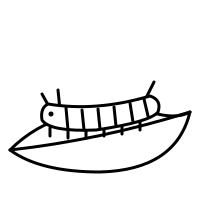
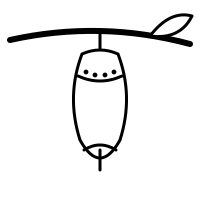
    Say: "Many insects go through metamorphosis. That means the body changes form as the animal grows up." Hold up four fingers. Say: "A monarch butterfly has four stages. One, egg. The mother lays it on a milkweed leaf. Two, larva, also called a caterpillar. It eats milkweed and grows fast. It sheds its skin several times. Three, pupa, also called a chrysalis. The caterpillar hangs still. Its last skin splits and shows a hard green shell. Inside, the body is rebuilt. Four, adult. The butterfly comes out, dries its wings and flies. It sips nectar and lays eggs, and the cycle starts again." Say: "In summer, all of this takes about a month." Ask: "Which stage does the eating and growing?" (The larva.) "Which stage lays eggs?" (The adult.) "What is a butterfly's pupa called?" (A chrysalis.) Say: "Many moths spin a silk cocoon around the pupa. Butterflies do not." If stuck, say: "Count the stages on your fingers: egg, larva, pupa, adult."

    15–20 min · Investigation / Hands-On

    Pasta Life Cycle Model. 1) Your child draws lines with the marker to split the plate into 4 equal parts. 2) They glue the rice in part 1 and write Egg. 3) They glue the spiral in part 2 and write Larva (caterpillar). 4) They glue the shell in part 3 and write Pupa (chrysalis). 5) They glue the bow-tie in part 4 and write Adult (butterfly). 6) They draw an arrow from each part to the next, and from the adult back to the egg. 7) Your child tells the life story aloud, touching each piece. Look for four stages in order, both names on parts 2 and 3, and a full circle of arrows. Ask: "How is this model like a real butterfly's life?" (It has the same stages in the same order.) "How is it different?" (Real stages are alive and take days or weeks.)

    10 min · Science Notebook Entry

    In the notebook, your child draws the four-stage cycle with labels and one fact for each stage. Sample fact: "Larva: eats, grows and sheds its skin." Then they finish: "Metamorphosis means ___." Look for: a big change in body form as an animal grows up.

    5 min · Wrap-Up & Exit Ticket

    Read the three questions aloud, and let your child look at the pasta plate. Praise the correct use of larva, pupa and chrysalis.

    Watch for: Thinking small butterflies are babies that will grow into big ones.

    Try: Say: "The caterpillar does all the growing. An adult butterfly stays the same size." Point to the spiral pasta.

    Exit ticket (3 questions)
    1. A caterpillar hangs still, and its skin splits to show a hard shell. Which stage is starting?
    2. Name one thing an adult butterfly can do that a caterpillar cannot.
    3. A small butterfly lands beside a big one. Is the small one a baby? Explain.
    Show answers
    1. The pupa, also called the chrysalis.
    2. Any 1: fly, lay eggs, sip nectar.
    3. No. Adult butterflies do not grow. A young butterfly is a caterpillar. The small one is probably a different kind.

    Support: Write the four stage names on scraps of paper. Your child places them on the plate before gluing.

    Extend: Your child draws a moth's life cycle beside the butterfly's and circles one difference. (Many moths spin a silk cocoon.)

    Homework: Look for a butterfly, moth or caterpillar outdoors or in a book. Draw it and name its stage. Keep the bean's soil damp.

    Day 3 · Wednesday

    Social Studies

    I can explain how foods, music and festivals show where a culture comes from.

    D2.Geo.4.3-5D2.Geo.7.3-5

    Builds on: Needs Week 13 Day 1 (people move) and Day 1 of this week (parts of culture). One-minute check: ask "When a family moves, what parts of culture can come along?" (Food, music, language, celebrations, stories.)

    Materials: World map, 9 index cards, Notebook, Pencil

    5 min · Warm-Up

    Spaced review from Week 13. Ask: "Name one push reason and one pull reason people move." (Sample: a flood is a push, and a new job is a pull.) Then ask the big question: "What does our family cook on a special day? Where did that recipe come from?"

    10–15 min · Mini-Lesson

    Say: "When people move, their foods, music and festivals travel with them." "In the new home, these often change and mix." Example 1. Find Italy on the map and slide a finger to the United States. Say: "Italian families brought pizza from Italy. Cooks here made new kinds, like thick deep-dish pizza in Chicago." Example 2. Find West Africa, France and Louisiana. Say: "Gumbo is a stew from Louisiana. It mixes three cultures." "Okra came with enslaved West Africans, who were brought here by force. The thick base is a French way of cooking." "Filé powder, made from sassafras leaves, comes from the Choctaw." Example 3. Say: "Jazz began in New Orleans over 100 years ago, mainly among African American musicians." Ask: "Did pizza stay the same in its new home?" (No. Cooks made new kinds.) Ask: "Which three cultures meet in a pot of gumbo?" (West African, French and Choctaw.) If stuck, say: "Ask two things. Where did it start? What changed here?"

    15–20 min · Activity / Source Work

    Culture map. Your child writes one name on each of nine cards. Read each fact aloud. Your child writes the starting place on the card. Foods. Tacos: Mexico. Sushi: Japan. Bagels: Jewish families brought them from Poland and Eastern Europe. Music. Mariachi: Mexico. Blues: began among African Americans in the South. Country: grew in the Appalachians and the South from British and Irish folk songs and the blues. Festivals. Mardi Gras: French settlers brought it, and New Orleans is famous for it. Lunar New Year parades: China and other parts of Asia. St. Patrick's Day parades: Irish families brought the day, and parades grew big in U.S. cities. Next, your child lays each card on its starting place on the map. Then slide it to the United States. Ask: "Which cards started inside the United States? What is your evidence?" (Blues and country. The facts name the South.) Ask: "Sushi cooks in North America added avocado. What does that show?" (Foods change in a new home.) Check that every card names a starting place.

    10 min · Notebook Entry

    Your child makes a chart with three columns: Food, Music, Festival. Write each name and where it began. Then finish the frame: "___ came from ___ and changed by ___." Sample: "Pizza came from Italy and changed by getting a thick crust in Chicago."

    5 min · Exit Ticket

    Read the questions aloud. Your child answers in the notebook. Praise answers that name a place.

    Watch for: Thinking a food "belongs" to only one country and never changes.

    Try: Compare thin pizza in Italy with deep-dish pizza in Chicago. Ask: "What changed? Why might cooks change it?"

    Exit ticket (3 questions)
    1. Where did mariachi music begin?
    2. Bagels came with Jewish families from Eastern Europe. What does that tell you about how foods reach new places?
    3. Country music grew from British and Irish folk songs and the blues. What does that show about cultures that meet?
    Show answers
    1. Mexico.
    2. People carry their foods with them when they move.
    3. Answers vary. Look for: cultures mix and make something new.

    Support: Use three cards only, one food, one kind of music and one festival. Your child draws a picture on each.

    Extend: Your child draws a gumbo pot. Label okra, the thick base and filé powder with the culture each came from.

    Homework: Your child tells a family member one new fact about where a food or song came from. Look for a place name.

    Mathematics

    I can multiply or divide before I add or subtract when solving an expression.

    3.OA.D.8

    Builds on: Needs two-step equations from Day 2 and grouping with parentheses from Week 13 Day 2. One-minute check: your child solves (2 × 5) × 4 and tells which part came first (40; the part in parentheses).

    New words:
    • expression – numbers and signs written together with no equal sign, such as 5 + 2 × 3
    • order of operations – the rule that tells which part to do first

    Materials: Red and blue crayons, 20 counters (dried beans, coins or buttons), Notebook, Pencil

    5 min · Warm-Up

    Spaced review from Day 2. Your child solves 7 × n = 56 (n = 8). Then try ×3 facts with no clock. Ask 3 × 6, 3 × 8, 3 × 9 and 3 × 7 (18, 24, 27, 21). Listen for: a double plus one more group. Then ask: "What does a multiplication sign tell you to make?" (Equal groups.)

    10–15 min · Mini-Lesson

    Read: "Mia has 3 toy cars. She gets 4 packs of 2 cars. How many cars now?" Your child builds it with beans: 3 beans, then 4 groups of 2. Ask: "How many are in the packs?" (8) "How many in all?" (11) Write 3 + 4 × 2. Say: "This expression tells Mia's story. The packs must be found first." Say: "Everyone agrees on this order. Multiply and divide before you add and subtract." Your child circles 4 × 2 in red and underlines the + in blue. Write 3 + 8 beneath it, then 11. Say: "So 3 + 4 × 2 = 11." Ask: "What if we added first?" (We would get 7 packs of 2. That is not Mia's story.) Say: "Parentheses mean do this part first." Write (3 + 4) × 2. Say: "Here we add first. 7 × 2 = 14. That would be 7 packs of 2 cars." Say: "Division follows the same rule." Write 10 + 12 ÷ 4. Ask: "Which part comes first?" (12 ÷ 4 = 3; 10 + 3 = 13) Now your child does more. Write 20 − 6 × 2. Ask: "Which part comes first? What is the value?" (6 × 2 = 12; 20 − 12 = 8)

    10–15 min · Guided Practice

    Your child circles the × or ÷ part in red and writes its value beneath. Then your child underlines the + or − sign in blue and finishes. 1) 4 + 6 × 3 (6 × 3 = 18; 4 + 18 = 22). 2) (4 + 6) × 3 (4 + 6 = 10; 10 × 3 = 30). Ask: "Why are the two answers different?" (The parentheses changed what comes first.) 3) 12 + 18 ÷ 3 (18 ÷ 3 = 6; 12 + 6 = 18). 4) 5 × 3 + 2 (5 × 3 = 15; 15 + 2 = 17). Say: "The × part is not always second. Look for the sign, not the place." If stuck, say: "Find the × or ÷ sign. Circle that part in red and solve it first."

    15–20 min · Independent Practice

    Your child circles the first part in red and writes that step on its own line. Remind your child that parentheses come first. 1) 6 + 3 × 4 (18). 2) (6 + 3) × 4 (36). 3) 30 − 4 × 5 (10). 4) 6 × 2 + 9 (21). 5) 4 + 20 ÷ 5 (8). 6) (10 − 4) × 3 (18). 7) Draw 5 dots, then 2 rows of 6 dots. Write the expression and its value (5 + 2 × 6 = 17). 8) Write an expression for each story and solve. Leo has 9 pens and buys 3 packs of 4. How many pens? (9 + 3 × 4 = 21) Ana has 25 beads and fills 2 strings with 7 each. How many are left? (25 − 2 × 7 = 11)

    5 min · Exit Ticket

    Put the beans and crayons away. Read each question aloud; your child writes each step on paper.

    Watch for: Working left to right every time, so 3 + 4 × 2 becomes 14.

    Try: Your child circles the × part first and writes its product beneath. Then your child rewrites the line as 3 + 8. Ask: "Which story does this tell, 4 packs or 7 packs?"

    Fact fluency: ×3 facts
    Exit ticket (3 questions)
    1. In 9 + 2 × 5, which part do you do first?
    2. Solve 4 + 3 × 5.
    3. Solve (4 + 3) × 5.
    Show answers
    1. 2 × 5, because we multiply before we add
    2. 19
    3. 35

    Support: Use small numbers, such as 2 + 3 × 2. Your child builds 2 beans and 3 groups of 2, then counts (8). Tell a short story for each expression first.

    Extend: Your child writes two expressions with the same three numbers and different values. Sample: 2 + 3 × 4 = 14 and (2 + 3) × 4 = 20. Your child tells a story for each one.

    Homework: Solve 6 + 2 × 5, (6 + 2) × 5 and 18 − 3 × 4. Answers: 16, 40, 6. Your child circles the first part of each one before solving.

    English Language Arts

    I can hear and tap the rhythm of a poem and read it aloud with expression.

    RL.3.5RF.3.4.BSL.3.2

    Builds on: Needs yesterday's poem "The Wind" and syllable clapping from Weeks 7 and 8. One-minute check: your child claps the syllables in window. (Two claps.)

    New words:
    • rhythm – the beat of a poem: its pattern of strong and weak beats
    • strong beat – a part of a word that you say a little louder

    Materials: The paper copy of 'The Wind' from Day 2, Notebook, A pencil to tap with

    5 min · Warm-Up

    Word study, about 3 minutes. Dictate this sentence: "The preschool class sang a nonsense song." Your child writes it in the notebook. Check it together. Ask: "Which two words have a prefix?" (Preschool and nonsense.) Your child underlines each prefix and fixes any misspelled word. Spaced review from Week 13. Ask: "The buses stop or stops here?" (Stop.)

    10–15 min · Mini-Lesson

    Say: "Rhythm is the beat of a poem. Some beats are strong and some are weak, and they make a pattern, as in music." Lay out the copy of "The Wind". Read line 1 with the strong beats loud: "The WIND went RAC-ing DOWN the LANE." Tap the table with the pencil on each strong beat. Say: "I tapped 4 strong beats." Read line 2 the same way: "It TUGGED at EV-ery TREE." Say: "That line has 3." Now your child taps lines 3 and 4 while you read. (It RAT-tled ON the WIN-dow PANE: 4. And WHIS-tled LOUD at ME: 3.) Say: "The pattern is 4, 3, 4, 3. A steady pattern makes the poem bounce along."

    10–15 min · Guided Practice

    Do not copy this poem. Your child works by ear. "Pony in the Rain": The pony trots across the hill, / With clip and clop, she's never still. / She shakes her mane, she flicks her tail, / Then drinks the rain that fills her pail. 1) Read it aloud twice while your child listens with eyes closed. Say: "Tell me in two sentences what happens in the poem." (A pony trots over a hill in the rain. She shakes herself and drinks rainwater from her pail.) 2) Ask: "Which picture stays in your mind?" (Any one: the clip-clop steps, the flicking tail, the pail of rain.) 3) Say line 1 together and tap. (The PO-ny TROTS a-CROSS the HILL: 4.) 4) Say lines 2 to 4 one at a time. Your child taps each line and writes its count in the notebook. (4, 4, 4.) Ask: "How is this pattern different from 'The Wind'?" (Every line has 4 beats.) If stuck, say: "Listen: da-DUM, da-DUM. Tap only on the DUM."

    15–20 min · Independent Practice

    1) Your child writes the number of strong beats beside every line of "The Wind". 2) They read "The Wind" aloud three times. The first time is slow, with taps. The second time is smooth, at a steady pace. The third time has expression, so the wind sounds fast and wild. 3) They stand and perform it for you once more. Look for three things. The beat is steady. The voice does not sound like a robot. The words get louder or quicker where the poem gets wild.

    5 min · Exit Ticket

    Say each line in the first two questions twice in a normal voice. Your child taps and counts.

    Watch for: Stressing every word equally or tapping every syllable, so the beat is lost.

    Try: Exaggerate the reading: "da-DUM, da-DUM." Your child echoes it before tapping.

    Exit ticket (3 questions)
    1. Tap and count the strong beats: 'The rain came tapping on the roof.'
    2. Tap and count the strong beats: 'We heard it in our beds.'
    3. On your last reading of 'The Wind', what did you do with your voice to make the wind sound wild?
    Show answers
    1. 4 (the RAIN came TAP-ping ON the ROOF).
    2. 3 (we HEARD it IN our BEDS).
    3. Answers vary. Look for: louder or quicker words such as racing and rattled, with the beat still steady.

    Support: March in place to the strong beats while you read the poem together. Then your child taps alone.

    Extend: Your child writes a 2-line poem with exactly 4 strong beats in each line and taps it for you.

    Homework: Read a poem aloud to a family member with expression. Tap the beat on the first stanza. Look for: a steady beat and a lively voice.

    Science

    I can describe the stages of a frog's life cycle and how a frog's body changes.

    3-LS1-1

    Builds on: Needs Day 2: metamorphosis and the butterfly's four stages. One-minute check: your child names the butterfly stages in order. (Egg, larva, pupa, adult.)

    New words:
    • tadpole – a young frog that lives in water and has a tail and gills
    • gills – body parts that let an animal breathe underwater
    • froglet – a young frog that has legs and lungs and a shrinking tail
    • amphibian – an animal with moist skin that usually lives in water when young and can live on land as an adult

    Materials: 4 index cards, Crayons, Butterfly plate from Day 2, Bean cup and Bean Log, Science notebook and pencil, Library book with frog life cycle pictures (optional)

    5 min · Day 73 — Frog Life Cycle — Wonder Warm-Up

    Spaced review from Week 11. Ask: "Name a habitat where a frog survives well. Why?" (A pond edge. It has water for eggs and insects to eat.) Check the bean cup and add a Bean Log line. Then the wonder. Say: "A tadpole looks like a tiny fish. How does it become a frog that hops on land?"

    10–15 min · Mini-Lesson

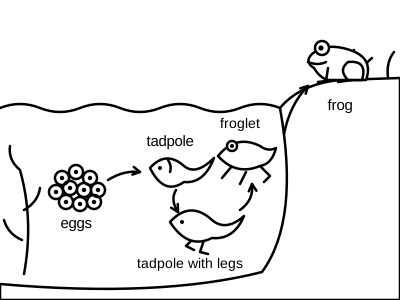
    Say: "Frogs go through metamorphosis too. Listen for how the frog breathes and moves at each stage." Say: "One, eggs. The mother lays them in water in a clump of jelly. Two, tadpole. It lives in water, breathes with gills and swims with a tail. It eats mostly algae. Three, froglet. Back legs grow first, then front legs. Lungs grow. The tail shrinks as the body absorbs it. A froglet is a young frog with legs, lungs and a little tail. Four, adult frog. It breathes with lungs and through its moist skin. It eats insects and lays eggs in water." Draw a tadpole. Add back legs, then front legs, then shorten the tail. Your child names each change. Say: "Frogs are amphibians. Amphibians have moist skin. Most live in water when young and can live on land as adults." Ask: "How does a tadpole breathe?" (With gills.) "Which legs grow first?" (The back legs.) "Does a frog have a pupa stage?" (No.) If stuck, say: "Look at the drawing. What changed from the last picture?" If you have the library book, compare its pictures.

    15–20 min · Investigation / Hands-On

    Frog Flip Cards. 1) Your child draws one stage on each card with crayons: eggs, tadpole, froglet, adult frog. 2) On the back they write how it breathes and moves. (Eggs: rest in jelly. Tadpole: gills, tail. Froglet: lungs, legs and a short tail. Adult: lungs and skin, legs.) 3) Shuffle the cards. Your child puts them in order and tells the life story aloud. 4) Mix-up test. Swap two cards while your child looks away. They find and fix the order. 5) Compare with the butterfly plate. Table: Animal | Starts as | Number of stages | Pupa? Your child fills one row for each animal. (Butterfly: egg, 4, yes. Frog: egg, 4, no.) Ask: "What is the same?" (Both start as eggs and change form.) "Which one rests in a hard case while it changes?" (The butterfly, as a pupa.)

    10 min · Science Notebook Entry

    In the notebook, your child draws the frog cycle as a circle with arrows. They label two key changes: gills to lungs, and tail to legs. Then they finish: "An amphibian is ___." Sample: "An amphibian is an animal with moist skin that starts life in water."

    5 min · Wrap-Up & Exit Ticket

    Read the three questions aloud, and let your child use the flip cards. Praise answers that tell how the body changes.

    Watch for: Thinking the tadpole's tail falls off.

    Try: Say: "The body absorbs the tail and uses it for energy." Redraw the tail shorter in three steps.

    Exit ticket (3 questions)
    1. You find a small animal with four legs, lungs and a short tail stub. Which frog stage is it?
    2. Adult frogs can live on land. Give one reason frogs still need water.
    3. What happens to a tadpole's tail?
    Show answers
    1. A froglet.
    2. Any 1: they lay their eggs in water, tadpoles live in water, or their skin must stay moist.
    3. It shrinks as the body absorbs it. It does not fall off.

    Support: Draw the four pictures together. Your child adds one word to the back of each card, not a sentence.

    Extend: Your child explains why a pond that dries up in spring is a problem for frogs. (Eggs and tadpoles need water.)

    Homework: Visit a pond with an adult, or look at a pond picture. List 3 things a tadpole needs there. Look for water, algae and hiding places. Keep the bean damp.

    Day 4 · Thursday

    Social Studies

    I can describe the many languages spoken in the U.S., including Native languages.

    D2.Geo.4.3-5D2.Geo.7.3-5D2.Civ.14.3-5

    Builds on: Needs Day 1 (language is part of culture) and Week 12 (the Navajo Nation). One-minute check: ask "In which region is the Navajo Nation?" (The Southwest.)

    New words:
    • bilingual – able to use two languages
    • multilingual – able to use more than two languages

    Materials: 5 index cards, World map, Notebook, Pencil

    5 min · Warm-Up

    Spaced review from Week 6. Ask: "What is a reservation?" (Land set aside by treaty or law as a homeland for a Native nation.) Then ask the big question: "How many ways can you say hello?"

    10–15 min · Mini-Lesson

    Say: "People in the United States speak at least 350 languages at home." "English is spoken most. Spanish is second. Chinese, Tagalog, Vietnamese, Arabic, French and Korean are common too." Say: "A bilingual person can use two languages. A multilingual person can use more than two." Say: "Native nations have their own languages. Navajo is the most widely spoken Native language in the United States." Tell the hard part honestly. Say: "Long ago, the government sent many Native children to boarding schools far from home." "Children there were punished for speaking their own languages. So many languages lost speakers." Say: "Today the Cherokee, Wampanoag and Lakota nations run language classes and schools." "Native leaders also worked to change the law. In 1990, Congress passed the Native American Languages Act." "It says the United States will protect Native languages." Ask: "Why did many Native languages lose speakers?" (Children were punished for speaking them at boarding schools.) Ask: "What are Native nations doing about it today?" (Teaching their languages in classes and schools.) Ask: "Mia speaks Tagalog, English and Spanish. Which new word fits her?" (Multilingual.) If stuck, say: "Listen again." Then reread that part slowly.

    15–20 min · Activity / Source Work

    Hello cards. 1) Your child makes five cards. Write the greeting, how to say it and the language. Hola (OH-lah), Spanish. Spoken in Spain, Mexico and most of Central and South America. Ni hao (nee how), Mandarin Chinese. Spoken in China. Bonjour (bohn-ZHOOR), French. Spoken in France and parts of Canada. Marhaba (MAR-hah-bah), Arabic. Spoken in Egypt and across North Africa and the Middle East. Yá'át'ééh (yah-ah-teh), Navajo. Spoken in the Navajo Nation, in the U.S. Southwest. These spellings are close, not perfect. Speakers may say the words a little differently. 2) Practice each greeting aloud together. 3) Your child lays each card on the map where the language is spoken. 4) Ask: "Which of these languages began here in North America? What is your evidence?" (Navajo. Its card sits on the Southwest.) Ask: "Which card could sit on more than one continent?" (Spanish, French or Arabic.) Check that the Navajo card is on the Southwest of the United States.

    10 min · Notebook Entry

    Your child writes a greeting list with three columns: Greeting, Language, Where it is spoken. Then finish the frame: "Being bilingual helps people because ___." Sample: "They can talk with more people, like grandparents and new friends."

    5 min · Exit Ticket

    Read the questions aloud. Your child answers in the notebook. Praise a greeting said with care.

    Watch for: Thinking Native languages are no longer spoken.

    Try: Say: "Well over 100,000 people speak Navajo today." Your child says the Navajo greeting and adds: "People say this today."

    Exit ticket (3 questions)
    1. About how many languages do people in the U.S. speak at home: 3, 35 or at least 350?
    2. What does multilingual mean?
    3. Name one Native language spoken today and one way a nation keeps its language strong.
    Show answers
    1. At least 350.
    2. Able to use more than two languages.
    3. Answers vary. Look for: Navajo, Cherokee, Lakota or Wampanoag, and language classes or schools.

    Support: Use three greetings, not five. Your child draws a small picture of each place on the card.

    Extend: Your child asks someone you know to teach counting to five in another language. Then your child teaches it to someone else.

    Homework: Your child teaches a family member one greeting and shows where people say it. Look for the language name and a place.

    Mathematics

    I can estimate by rounding to check whether my answer makes sense.

    3.OA.D.83.NBT.A.13.NBT.A.2

    Builds on: Needs rounding from Week 1 Days 4 and 5 and adding and subtracting within 1,000. One-minute check: your child rounds 438 to the nearest 10 and the nearest 100 (440, 400).

    New words:
    • reasonable – an answer that makes sense because it is close to the estimate

    Materials: Paper for drawing number lines, Notebook, Pencil

    5 min · Warm-Up

    Spaced review from Week 1. Your child rounds 238 and 651 to the nearest 100 (200, 700). Your child rounds 67 to the nearest 10 (70). Then add tens in your head with no clock. Ask 40 + 30, 260 + 50 and 380 + 40 (70, 310, 420).

    10–15 min · Mini-Lesson

    Say: "An estimate is a close answer from rounded numbers. It tells us if an exact answer is reasonable." Write 312 + 489. Ask: "What is each number to the nearest 100?" (300 and 500) Write 300 + 500 = 800. Your child adds in columns. (801) Ask: "Is 801 close to 800?" (Yes.) Ask: "Why is the estimate not exactly 801?" (We rounded both numbers.) Say: "So 312 + 489 = 801, and that is reasonable." Ask: "What if someone wrote 701?" (It is too far from 800. Check again.) Say: "Now a two-step story." Read: "Ava has 3 boxes of 9 markers and 18 more. How many markers?" Say: "Estimate first. 9 is close to 10, and 18 is close to 20." Write 3 × 10 = 30, then 30 + 20 = 50. Your child solves exactly. (3 × 9 = 27; 27 + 18 = 45) Say: "45 is close to 50. Both numbers were rounded up, so the estimate is a bit high. So 45 markers is reasonable." Now your child does more. Write 624 − 287. Your child estimates, solves and decides. (600 − 300 = 300; 337; reasonable)

    10–15 min · Guided Practice

    Your child estimates first, then solves, then says "reasonable" or "check again." 1) 198 + 415 (200 + 400 = 600; 613; reasonable). 2) 387 + 256 (400 + 300 = 700; 643). Say: "643 is a bit far from 700. Round to the nearest 10 instead." (390 + 260 = 650; reasonable) 3) Jun has 3 bags of 8 apples and picks 19 more. How many apples? (About 24 + 20 = 44; 24 + 19 = 43; reasonable) 4) A shop has 506 pens and sells 189. How many are left? (About 500 − 200 = 300; 317; reasonable) If stuck, say: "Which hundred is each number closest to? Add or subtract those first."

    15–20 min · Independent Practice

    Your child writes the estimate, then the exact answer, then "reasonable" or "check again." Estimates come first, before any exact work. 1) 735 − 362, to the nearest 10 (740 − 360 = 380; 373). 2) 276 + 418, to the nearest 100 (300 + 400 = 700; 694). 3) 903 − 587, to the nearest 100 (900 − 600 = 300; 316). 4) 149 + 263, to the nearest 10 (150 + 260 = 410; 412). 5) Draw a number line from 500 to 600 and mark 562. Which hundred is closer? (600) 6) Tia says 328 + 254 is 482. Estimate to check her. (300 + 300 = 600; 482 is too far; the sum is 582) 7) A farm has 6 pens with 9 hens in each, and 28 chicks. How many birds? (About 60 + 30 = 90; 54 + 28 = 82) 8) A school has 418 books. It gets 5 boxes of 8 more. How many books now? (About 420 + 40 = 460; 418 + 40 = 458)

    5 min · Exit Ticket

    Read each question aloud; your child answers on paper and may draw a number line. Question 2 needs an estimate and a sentence.

    Watch for: Rounding to the wrong place, such as 280 for 287 when asked for the nearest 100.

    Try: Your child draws a number line from 200 to 300 and marks 287. Ask: "Which hundred is closer?" (300)

    Fact fluency: adding tens mentally
    Exit ticket (3 questions)
    1. Estimate 583 − 291 by rounding to the nearest 100.
    2. Leo got 591 for 412 + 279. Use an estimate to check his answer.
    3. Why do we estimate?
    Show answers
    1. 600 − 300 = 300
    2. 400 + 300 = 700, so 591 is not reasonable. The exact sum is 691.
    3. Answers vary. Look for: to see whether an exact answer is reasonable.

    Support: Use numbers under 500. Your child draws a number line for each number and marks the closer hundred before estimating.

    Extend: Your child estimates 348 + 239 two ways and tells which is closer to the exact sum, 587. Answers: 300 + 200 = 500; 350 + 240 = 590; rounding to tens is closer.

    Homework: Estimate to the nearest 100, then solve: 467 + 238 and 812 − 395. Answers: 500 + 200 = 700 and 705; 800 − 400 = 400 and 417. Your child tells whether each exact answer is reasonable.

    English Language Arts

    I can find images in a poem and explain what a picture or illustration adds.

    RL.3.4RL.3.7L.3.5.A

    Builds on: Needs nonliteral language from Week 1 Day 2 and sense details from Week 11. One-minute check: ask, "'It is raining cats and dogs.' Literal or nonliteral?" (Nonliteral. It means it is raining hard.)

    New words:
    • imagery – words that paint a picture in your mind by using the senses

    Materials: A sheet of paper with 'Fog' copied by hand, One illustrated book from your child's shelf, Notebook, Colored pencils, Pencil

    5 min · Warm-Up

    Word study, about 3 minutes. Your child picks the word that fits each sentence: preview, nonliving or misread. "We watched a ___ of the movie before it came out." (Preview.) "A rock is a ___ thing." (Nonliving.) "I ___ the sign and went the wrong way." (Misread.) Then your child uses misbehave in a sentence. Spaced review from Week 11. Ask: "Give one sound detail about this room." (Sample: The fridge hums.)

    10–15 min · Mini-Lesson

    Say "fresh-baked bread". Ask: "What do you see, smell and feel?" (Answers vary.) Say: "Words that make a picture in your mind are called imagery. Imagery uses the senses. Poets often use nonliteral language: words that do not mean exactly what they say." Copy this poem on paper with a new row at each slash, then read it aloud. "Fog": The fog slides in, a soft gray sheet, / It swallows up the end of our street. / The lampposts wear their cloudy hats, / And whisper to the hiding cats. Think aloud. Say: "'It swallows up the end of our street.' Can fog really swallow? No. Fog has no mouth. The poet means the fog covers the street, so I cannot see the end." Ask: "Do lampposts wear hats?" (No. The fog sits on top of them like a hat.) Add one fact. Say: "Real fog is a cloud that touches the ground. It is made of tiny drops of water."

    10–15 min · Guided Practice

    1) Your child underlines "a soft gray sheet" with a pencil. Ask: "Which senses does it use? What is the poet really saying?" (Sight and touch. The fog is pale, thick and gentle, spread out like a bedsheet.) 2) Your child underlines "wear their cloudy hats". Ask the same questions. (Sight. Fog wraps around the tops of the lamps.) 3) Say: "The fog is thick today." Ask: "Literal or nonliteral?" (Literal. It means just what it says.) 4) Open the illustrated book to one picture. Ask: "What can you learn from this picture that the words leave out? What mood does it make?" (Answers vary. Look for: one detail and one feeling word.) If stuck, say: "Could this really happen? If not, what is the poet comparing it to?"

    15–20 min · Independent Practice

    1) In the notebook, your child sketches a favorite image from "Fog" in color. They add one detail the poem does not mention, such as the color of the cats. 2) Under the sketch they finish this frame: "The poem tells me ___. My drawing also shows ___." 3) They write a 2-line poem with one image about rain, snow or sun. Sample: "The snow lays quilts on every car, / And hushes streets both near and far." Look for three things. The sketch matches a line of the poem. The added detail is new. The 2-line poem uses at least one sense.

    5 min · Exit Ticket

    Your child keeps "Fog" in view. Ask the three questions aloud and listen for the word nonliteral in the second answer.

    Watch for: Taking a nonliteral image literally, such as "The fog ate the street!"

    Try: Ask: "Could this really happen?" If not, your child acts out the comparison with their hands.

    Exit ticket (3 questions)
    1. Which sense does 'whisper to the hiding cats' use?
    2. Can lampposts really whisper? So what is the poet telling us about the street?
    3. Say one literal sentence about fog.
    Show answers
    1. Hearing.
    2. No, so the words are nonliteral. The street is so quiet in the fog that it feels hushed.
    3. Answers vary. Look for: a sentence that means just what it says, such as "Fog is made of tiny drops of water."

    Support: Your child closes their eyes while you read each line. They describe the picture first, then name the sense.

    Extend: Your child writes a 4-line poem with at least two nonliteral images and explains what each one really means.

    Homework: Find one image in any poem or song. Draw it and write the line under the drawing. Look for: a line that uses a sense.

    Science

    I can compare life cycles and explain that all living things are born, grow, reproduce and die.

    3-LS1-1

    Builds on: Needs Days 1 to 3: the bean, butterfly and frog life cycles. One-minute check: ask, "Which two animals we studied go through metamorphosis?" (The butterfly and the frog.)

    New words:
    • mammal – an animal with hair or fur whose babies drink their mother's milk

    Materials: 1 large sheet of paper, Yellow, green, blue and gray crayons, This week's bean, butterfly and frog drawings, Bean cup and Bean Log, Science notebook and pencil

    5 min · Day 74 — Comparing Life Cycles — Wonder Warm-Up

    Spaced review from Week 13. Ask: "Name one animal that lives in a group and one that is solitary." (Sample: wolf; tiger.) Check the bean cup and log any change. Then the wonder. Say: "A bean plant and a puppy seem nothing alike. What could their lives have in common?"

    10–15 min · Mini-Lesson

    Say: "Life cycles differ, but all share four parts: birth, growth, reproduction and death." Say: "Birth is the start: being born, hatching or sprouting. Reproduction means making young. Not every single animal has young, but every kind does." Hold up a fist. Raise one finger for each part as your child repeats it. Say: "Now the patterns. A butterfly changes through four very different stages. A frog changes from tadpole to adult. A dog is a mammal. A puppy is born alive and looks like a small dog. It grows slowly, with no metamorphosis." Say: "A dog's life: born, puppy, adult, has puppies, grows old and dies." Say: "Plants do not move around. They still sprout, grow, make seeds and die." Ask: "Does a puppy go through metamorphosis?" (No. It looks like a small adult.) "What is birth for a bean plant?" (Sprouting from the seed.) "What is reproduction for a bean plant?" (Making new seeds.) If stuck, say: "Does the young one look like its parent, only smaller?"

    15–20 min · Investigation / Hands-On

    Life Cycle Comparison Chart. 1) On the large paper, draw 4 columns: Bean plant, Butterfly, Frog, Dog. 2) Your child writes each life's stages in order, using this week's drawings. (Bean: seed, seedling, adult plant, flowers, fruit with seeds. Butterfly: egg, larva, pupa, adult. Frog: egg, tadpole, froglet, adult. Dog: newborn puppy, growing puppy, adult dog.) 3) Your child colors the shared parts in every column. Circle the birth stage in yellow. Shade the growing stages green. Underline the stage that reproduces in blue. Write "dies" in gray at the bottom. 4) Ask: "Which life cycles have metamorphosis?" (Butterfly and frog.) "Which young one looks like a small adult?" (The puppy.) "What is your evidence?" (The stages in the chart.) Look for all four colors in every column.

    10 min · Science Notebook Entry

    Your child copies the chart in short form. Then they finish: "All life cycles include ___, ___, ___ and ___. The ___ life cycle is different because ___." Sample: "The dog life cycle is different because the puppy looks like its parents."

    5 min · Wrap-Up & Exit Ticket

    Read the three questions aloud, and let your child point to the chart. Praise answers that use the chart as evidence.

    Watch for: Saying plants have no life cycle because they do not move, or that all animals change form.

    Try: Point to the four colors in the bean column. Then point to the dog column, where the form does not change.

    Exit ticket (3 questions)
    1. A kitten grows into a cat. Does it go through metamorphosis? How do you know?
    2. In a frog's life cycle, which part is reproduction?
    3. Name two things that happen in both a butterfly's life and a dog's life.
    Show answers
    1. No. A kitten looks like a small cat and only grows bigger.
    2. The adult frogs lay eggs in water.
    3. Any 2: birth (hatching or being born), growth, reproduction, death.

    Support: Fill the bean and dog columns together. Your child completes the butterfly and frog columns from their drawings.

    Extend: Add a fifth column for a turtle: egg, hatchling, adult. Your child decides whether it has metamorphosis and tells why. (No. A hatchling looks like a tiny turtle.)

    Homework: Ask a family member about a pet or animal they watched grow up. Write 3 sentences about its life cycle. Look for birth, growth and one more part. Keep the bean damp.

    Day 5 · Friday

    Social Studies

    I can show what I know about culture and the many cultures in the U.S.

    D2.Geo.4.3-5D2.Civ.14.3-5

    Builds on: Needs Days 1 to 4. One-minute check: ask "Is language part of culture?" (Yes.)

    Materials: Stored Week 15 Social Studies Check and its answer key, Culture charts from this week (six-box, celebrations, food and music), Hello cards from Day 4, World map (for the practice route), Notebook, Pencil

    5 min · Warm-Up

    Spaced review from Week 13. Ask: "Why does Florida sell oranges to colder states?" (Oranges grow well in Florida's warm climate. Colder states cannot grow them.) Then ask the big question: "What is one thing from another culture that you enjoy?" Hold the answer for later.

    10–15 min · Mini-Lesson

    Take a tour of this week's work. Your child uses each chart as a source. Six-box chart. Ask: "Show me two parts of culture on your chart." (Any two boxes.) Celebration chart. Ask: "Which of these is a national holiday?" (Independence Day, Thanksgiving or Juneteenth.) Food and music chart. Ask: "Pick one food. Where did it begin?" (Sample: sushi began in Japan.) Hello cards. Ask: "Say one greeting. Which language is it?" (Sample: bonjour is French.) Now model a strong answer to the warm-up question. Say: "I enjoy sushi. Sushi began in Japan. Families who moved here shared it." "A strong answer names the thing, the place and how it got here." Your child gives their own answer the same way. If stuck, say: "Which food or song? Where is it from?"

    15–20 min · Activity / Source Work

    Give the stored Week 15 Social Studies Check now. It has 8 items and takes about 15 minutes. Put the charts away. Do not time it. You may read any item aloud. Score it with the answer key and choose a route. 6 or more right: your child is ready. Interview a grown-up about a favorite celebration and make a poster. 4 or 5 right: redo the Day 3 page on foods and music. Then find three more foods on a world map. 3 or fewer right: reteach Day 1. Fill a new six-box culture chart together, with a drawing in each box. If the missed items were about celebrations or languages, look again at the Day 2 cards or the Day 4 cards. Go over each missed item together. Your child fixes it in a different color.

    10 min · Notebook Entry

    Your child finishes two frames. "One culture I learned more about this week is ___." "One thing I want to try is ___." Sample: "I learned more about Navajo culture. I want to try saying hello in Navajo."

    5 min · Exit Ticket

    After the check, read these three questions aloud. Praise specific examples, not general words like "food."

    Watch for: Giving general answers like "food" in place of specific examples.

    Try: Each time a general word appears, ask: "Which food? Where is it from?"

    Exit ticket (3 questions)
    1. Sort these two: Thanksgiving and Kwanzaa. Which is a national holiday, and which is a cultural tradition?
    2. Name one food or kind of music and the place where it began.
    3. Say hello in a language other than English. Which language is it?
    Show answers
    1. Thanksgiving is a national holiday. Kwanzaa is a cultural tradition.
    2. Answers vary. Look for a correct match, such as tacos and Mexico or blues and the South.
    3. Answers vary. Look for a greeting matched to its language, such as hola and Spanish.

    Support: Read each check item aloud. Your child may answer aloud while you write.

    Extend: Your child plans a family culture day with one food, one song and one game. Tell where each one began.

    Homework: Your child shares the six-box culture chart with a family member and adds one new item they suggest. Look for a specific example.

    Mathematics

    I can solve two-step problems, use the order of operations and estimate on the Week 15 check.

    3.OA.D.83.OA.A.43.NBT.A.2

    Builds on: Needs everything from Days 1 to 4. One-minute check: write 2 + 3 × 4. Ask which part comes first and what the value is (3 × 4; 14).

    Materials: Stored Week 15 check and its answer key, One die, Notebook, Pencil

    5 min · Warm-Up

    Spaced review from Week 13. Your child solves 5 × 2 × 9 the easy way (10 × 9 = 90). Then try ×8 facts with no clock. Ask 8 × 3, 8 × 6, 8 × 7 and 8 × 9 (24, 48, 56, 72). Listen for: double the ×4 fact.

    10–15 min · Mini-Lesson

    Play Roll a Story for 10 minutes. Say: "Roll the die three times. Put the numbers in this frame: __ + __ × __." Model one turn. Roll 4, then 2, then 5. Write 4 + 2 × 5 = n. Say: "My story: I have 4 pens and 2 packs of 5 pens." Say: "Multiply first." Write 2 × 5 = 10, then 4 + 10 = 14. Say: "So n = 14. I have 14 pens." Now your child takes every turn: roll, write the equation with a letter, tell a story, solve. Stories can be about packs, bags, rows or teams. The last two rolls are always the equal groups. Ask each turn: "Which part comes first? Does your story match?" If the story does not match, help your child fix the story, not the numbers. After 3 turns, add one estimate. Write 289 + 312. Ask: "About how much is that?" (300 + 300 = 600) There is no clock. Play about 6 turns.

    10–15 min · Guided Practice

    Do three check-style problems together. 1) Mia has 5 packs of 4 pens and gives 6 away. How many are left? (5 × 4 = t, t = 20; 20 − 6 = r, r = 14) 2) 6 + 2 × 4 (2 × 4 = 8; 6 + 8 = 14). 3) Your child estimates 214 + 487, then solves (200 + 500 = 700; 701). Ask: "Is 701 reasonable? How do you know?" (Yes. It is close to 700.) If stuck, say: "What is the hidden question? Which part comes first?"

    15–20 min · Independent Practice

    Give the stored Week 15 check now. It has 8 items. Your child works alone for about 15 minutes, then you score it with the answer key. The check has no clock, so extra minutes are fine. Your child may sketch on the page or in the notebook. Choose a route by the result. 6 or more right: move on to Week 16. 4 or 5 right: find the kind of item missed. For finding the two steps, redo Day 1 Guided Practice. For letters, redo Day 2 Guided Practice. For the order of operations, redo Day 3 Guided Practice. For estimates, redo Day 4 Guided Practice. 3 or fewer right: reteach the Day 1 and Day 2 Mini-Lessons, one each day. Then give the check again.

    5 min · Exit Ticket

    After the check, your child answers these three questions; then go over any missed check items together.

    Watch for: Using the numbers in the order they appear instead of the order the story needs.

    Try: Your child retells the story in their own words before writing any equation. Ask: "What happens first in the story?"

    Fact fluency: ×8 facts
    Exit ticket (3 questions)
    1. Noah has 3 bags of 7 marbles and finds 4 more. How many marbles now?
    2. Solve k − 9 = 15.
    3. Which felt easiest this week: two steps, letters, order or estimates? Why?
    Show answers
    1. 25 marbles (3 × 7 = 21; 21 + 4 = 25)
    2. k = 24
    3. Answers vary. Look for: a named skill and a reason.

    Support: Read each check item aloud. Give the frame "Step 1: __. Step 2: __." for the story problems. Your child retells each story before writing.

    Extend: Your child writes a two-step story whose answer is exactly 50. Sample: 6 bags of 7 nuts and 8 more; 42 + 8 = 50.

    Homework: Play 6 turns of Roll a Story with a family member. Sample: rolls of 3, 6 and 2 make 3 + 6 × 2. First 6 × 2 = 12, then 3 + 12 = 15. Your child tells a story for every turn.

    English Language Arts

    I can show what I know about stanzas, rhyme, rhythm and imagery, and write a short poem.

    RL.3.4RL.3.5W.3.4L.3.5.A

    Builds on: Needs Days 1 to 4: lines and stanzas, rhyme scheme, rhythm and imagery. One-minute check: ask, "What is a stanza?" (A group of lines in a poem with a blank space after it.)

    Materials: Stored Week 15 check and its answer key, Pencil, Notebook, Colored pencils

    5 min · Warm-Up

    Word study, about 3 minutes: a quick spelling check with no clock. Say each word, then say it in a short sentence: preheat, preschool, misspell, misbehave, nonfiction, nonsense. Add the challenge word prehistoric. Your child writes all seven in the notebook. Correct them together, and your child rewrites any missed word. Spaced review from Week 14. Ask: "How do you punctuate: I see a rainbow said Kim?" ("I see a rainbow," said Kim.)

    10–15 min · Review

    Do not copy this poem. Read it aloud twice, pausing at each slash and longer at the double slash. "Washing Day": The shirts are dancing on the line, / The socks kick up their toes, / The sheets puff out like sails that shine, / And off the clothespin goes! // I chase one sock across the yard, / I run and jump, but it is hard. / It lands on top of Grandpa's hat, / And Grandpa laughs, "Now look at that!" Write only the end words in the notebook, in two groups: line, toes, shine, goes; then yard, hard, hat, that. Say: "Each end word stands for one line. Each group is one stanza." 1) Ask: "How many lines? How many stanzas?" (8 lines; 2 stanzas.) 2) Your child color-matches the rhyming end words and writes the letters. (Stanza 1: ABAB. Stanza 2: AABB.) 3) Say line 2 and tap it together. (The SOCKS kick UP their TOES: 3 strong beats.) 4) Reread line 3. Ask: "Which image helps you see the sheets?" (They puff out like sails.) 5) Reread line 1. Ask: "Can shirts really dance? What is the poet showing?" (No. It is nonliteral. The shirts flap in the wind like dancers.)

    10 min · Guided Practice

    Your child plans and writes a 4-line poem in the notebook. 1) Pick a topic you can see or hear right now. 2) List two rhyme pairs. (Sample: bed and red, light and night.) 3) Choose AABB or ABAB and write the letters down the margin first. 4) Write the four lines with a pencil and add one image that uses a sense. (Look for: true rhymes and one clear image.) If stuck, say: "Write line 1. Circle its last word. Tell me three words that rhyme with it."

    15 min · Weekly Check

    This block is the stored Week 15 English Language Arts Check. It has 8 items and its own short poem. Your child reads the poem and works alone with a pencil. Quiet tapping is fine. Then score it with the answer key. 7 or more right: move on to Week 16. For more practice, your child writes a 2-stanza poem with one ABAB stanza and one AABB stanza. 5 or 6 right: redo the Day 2 practice page. Then label the end words of a favorite rhyming book with letters. 4 or fewer right: reteach Days 1 and 2 before Week 16. Cut a poem into strips, one line each. Group the strips into stanzas and color-match the rhyming end words.

    5 min · Exit Ticket

    Go over the check together. Then your child reads their own poem aloud with expression and answers the three questions.

    Watch for: Counting the lines of the whole poem when the question asks about one stanza.

    Try: Your child draws a box around the stanza named in the question before answering.

    Exit ticket (3 questions)
    1. Read the end words of your poem. What is its rhyme scheme?
    2. Point to the image in your poem. Which sense does it use?
    3. Which was hardest for you this week: stanzas, rhyme scheme, rhythm or imagery? What will you practice?
    Show answers
    1. Answers vary. Look for: letters that match your child's own end words.
    2. Answers vary. Look for: one image and a matching sense, such as sight or hearing.
    3. Answers vary. Look for: one named skill and a small plan.

    Support: Read each check item aloud. Your child points to the lines in the poem before answering.

    Extend: Your child writes a second stanza for their poem that keeps the same rhythm and rhyme scheme.

    Homework: Read two poems for fun from any book at home. Copy your favorite image into the notebook. Look for: an image that uses a sense.

    Science

    I can show what I know about plant, butterfly and frog life cycles.

    3-LS1-1

    Builds on: Needs all of Days 1 to 4. One-minute check: ask, "What is a froglet?" (A young frog with legs, lungs and a shrinking tail.)

    Materials: Week 15 Science Check (7 items) and its answer key, Blank paper and crayons, Bean cup and Bean Log, Ruler, Science notebook from this week, Pencil

    5 min · Day 75 — Week 15 Check: Life Cycles — Wonder Warm-Up

    Spaced review from Week 14. Ask: "How does camouflage help an animal survive?" (Predators do not see it as easily.) Then a quick recap. Your child says the butterfly stages, then the frog stages. (Egg, larva, pupa, adult. Egg, tadpole, froglet, adult.) Big question: "Can you draw a whole life cycle from memory?"

    10–15 min · Mini-Lesson

    Play Whose Stage Is It? Say: "I describe a stage. You name the living thing and the stage." Model one. Say: "I live in water, breathe with gills and swim with a tail. I am a frog's tadpole." Now your child answers. 1) "I am a tiny plant with my first leaves." (Bean plant, seedling.) 2) "I eat milkweed leaves and shed my skin." (Butterfly, larva.) 3) "I hang still inside a hard green shell." (Butterfly, pupa or chrysalis.) 4) "I have four legs, new lungs and a short tail." (Frog, froglet.) 5) "I am a pod with seeds inside." (Bean plant, fruit.) 6) "I was born looking like a small adult." (Dog, puppy.) Then your child makes up two riddles for you. If stuck, say: "Is it a plant, an insect or a frog? Now find that page in your notebook." Keep the game to 10 minutes.

    15–20 min · Investigation / Hands-On

    Life Cycle From Memory. 1) With the notebook closed, your child picks one life cycle. They draw it on blank paper as a circle with at least 4 labeled stages and arrows. 2) They write one fact beside each stage. 3) They open the notebook and compare. They add any missing stage or fact in another color. 4) They mark the stage that reproduces with a star. 5) Bean observation. Your child measures the sprout with the ruler, from the soil to the tip, in centimeters. No sprout yet? Write "no sprout yet." Say: "Real results vary. Beans can take two weeks." Look for stages in the right order and arrows that close the circle. Keep this to 15 minutes.

    10 min · Science Notebook Entry

    Your child adds today's Bean Log entry: the date, the height, a drawing and one sentence about any change. Then they finish: "The life cycle I know best is ___. One stage I had to fix was ___." Sample: "The life cycle I know best is the frog. One stage I had to fix was the froglet."

    5 min · Wrap-Up & Exit Ticket

    Ask the three exit questions aloud and praise correct stage names. Then give the Week 15 Science Check: 7 items, about 10 minutes, worked alone. Score it with the answer key. 6 or more right: start Week 16. 4 or 5 right: redo the Day 3 page, then make flip cards for a new life cycle. 3 or fewer right: reteach Day 2 by rebuilding the pasta plate and telling the story aloud.

    Watch for: Mixing up larva and pupa, or giving the frog a pupa stage.

    Try: Teach the phrase "Eat, then wait, then fly." The larva eats, the pupa waits and changes, the adult flies.

    Exit ticket (3 questions)
    1. Name one animal whose young look very different from the adult.
    2. What do a bean seed and a frog egg have in common?
    3. In the life cycle you drew, which stage reproduces? How?
    Show answers
    1. Answers vary. Look for: a butterfly, a frog or another animal with metamorphosis.
    2. Answers vary. Look for: each is the start of a new living thing that will grow.
    3. Answers vary. Look for: the adult butterfly or frog lays eggs, or the plant's flowers make seeds.

    Support: Read the check aloud. Your child may answer by pointing to stage pictures in the notebook.

    Extend: Your child invents a creature with a four-stage life cycle. They explain how each stage helps it survive.

    Homework: Water the bean and draw it in the Bean Log. Tell a family member which life cycle stage it is in now.

    Friday Checks & Answer Keys

    Mathematics · Week 15 Mathematics Check

    3.OA.D.83.OA.A.43.NBT.A.13.NBT.A.2

    Goals

    • I can solve two-step word problems.
    • I can use a letter for an unknown number.
    • I can use the order of operations and check with an estimate.

    Answer each question. Show your thinking in the box when there is one.

    1. Zainab has 4 boxes of 7 markers. She finds 6 more markers. How many markers does she have? Write an equation with a letter for each step.
    2. Emeka has 50 cards. He gives away 10. He shares the rest equally among 5 friends. How many cards does each friend get?
    3. Solve: 23 + n = 31
    4. Solve: 9 × m = 72
    5. 8 + 2 × 6
    6. (8 + 2) × 6
    7. Round to the nearest hundred and estimate: 389 + 412
    8. Sam has 4 boxes of 9 crayons and gets 28 more. He says he has 94 crayons. Use an estimate to tell if that is reasonable.
    Show answer key
    1. 4 × 7 = b, b = 28; 28 + 6 = m, m = 34. 34 markers
    2. 8 cards
    3. n = 8
    4. m = 8
    5. 20
    6. 60
    7. about 800
    8. Not reasonable. 4 × 10 is 40 and 28 is about 30, so the answer should be about 70. The exact answer is 36 + 28 = 64.

    What to do next

    Most right
    If 6 or more are right: write a two-step story for a family member, with a letter for the unknown and an answer key.
    Some right
    If 4–5 are right: redo the Day 1 or Day 3 page, then color the first step of three expressions red before solving.
    Few right
    If 3 or fewer are right: reteach Day 1 and Day 2, one each day. Act out each two-step story with counters and color step 1 and step 2 in two colors.

    English Language Arts · Week 15 English Language Arts Check

    RL.3.5L.3.6RF.3.3.AL.3.4.BRL.3.4RF.3.4.BSL.3.2RL.3.7

    Goals

    • I can find lines, stanzas and the rhyme scheme of a poem.
    • I can count beats and explain images in a poem.
    • I can use the prefixes pre-, mis- and non-.

    Night Train

    The train goes rumbling through the night, Its eye of yellow light shines bright. It clickety-clacks along the track, And waves its whistle, then comes back. I hear it from my bed, so warm and deep, It hums me softly off to sleep. The stars blink out, the moon swings low, And still the sleepy train goes slow.

    Answer each question. Show your thinking in the box when there is one.

    1. How many stanzas are in 'Night Train'?
    2. How many lines are in the whole poem?
    3. What is the rhyme scheme of stanza 1?
    4. How many strong beats are in 'The train goes rumbling through the night'?
    5. Write one image from the poem and the sense it uses.
    6. Is 'its eye of yellow light' literal or nonliteral? What does it mean?
    7. What does 'misspell' mean?
    8. Write the word that means 'without stopping.'
    Show answer key
    1. 2
    2. 8
    3. AABB
    4. 4
    5. Any one: 'its eye of yellow light' (sight), 'clickety-clack' (hearing), 'warm and deep' (touch).
    6. Nonliteral; the train's front light shines like an eye.
    7. to spell wrongly
    8. nonstop

    What to do next

    Most right
    If 7 or more are right: write a 2-stanza poem with one ABAB stanza and one AABB stanza, and include a nonliteral image.
    Some right
    If 5-6 are right: redo the Day 2 page, then highlight the end words of a favorite rhyming book and label them with letters.
    Few right
    If 4 or fewer are right: reteach the Day 1 and Day 2 lessons; cut a poem into strips, one line each, and group them into stanzas, then color-match the rhyming end words.

    Science · Week 15 Science Check

    3-LS1-1

    Goals

    • I can put life cycle stages in order.
    • I can explain metamorphosis.
    • I can compare different life cycles.

    Answer each question. Show your thinking in the box when there is one.

    1. Put the plant stages in order: flowers, seed, seedling, fruit with seeds, adult plant.
    2. Which stage comes between the larva and the adult in a moth's life cycle?
      ○ egg○ pupa○ tadpole
    3. A tadpole breathes with gills. What does an adult frog breathe with?
    4. What is metamorphosis?
    5. Which animal does NOT go through metamorphosis?
      ○ a frog○ a rabbit○ a butterfly
    6. Name the 4 things that happen in every life cycle.
    7. Name one way a frog's life cycle is different from a butterfly's.
    Show answer key
    1. seed → seedling → adult plant → flowers → fruit with seeds
    2. pupa
    3. lungs and its skin
    4. A big change in body shape as an animal grows from young to adult.
    5. a rabbit
    6. born (or sprout), grow, reproduce, die
    7. The frog has no pupa stage (and its young live in water).

    What to do next

    Most right
    If 6 or more are right: research a ladybug's life cycle and compare it with the butterfly's.
    Some right
    If 4–5 are right: redo the Day 3 page, then make flip cards for a new life cycle.
    Few right
    If 3 or fewer are right: reteach Day 2 (butterfly metamorphosis) by building the pasta life cycle plate again and telling the story aloud.

    Social Studies · Week 15 Social Studies Check

    D2.Geo.4.3-5D2.Civ.14.3-5D2.Geo.7.3-5

    Goals

    • I can explain what culture is and name its parts.
    • I can tell where some foods, music and celebrations come from.
    • I can describe the many languages spoken in the U.S.

    Answer each question. Show your thinking in the box when there is one.

    1. In your own words, what is culture?
    2. Name three parts of culture.
    3. In which U.S. city did jazz begin?
    4. Where did pizza come from?
    5. What language is the second most spoken in the U.S.?
    6. Bo speaks Korean at home and English at school. What word describes Bo?
    7. Why does the U.S. have so many celebrations?
    8. Native nations gather today for dancing, drumming and singing. What is this gathering called?
    Show answer key
    1. The way of life of a group of people.
    2. Answers vary. Look for: any three of language, food, music, celebrations, art, clothing, stories, games or beliefs.
    3. New Orleans
    4. Italy
    5. Spanish
    6. bilingual
    7. People in the U.S. come from many different cultures.
    8. powwow

    What to do next

    Most right
    If 6 or more are right: Interview a grown-up about a favorite celebration and make a poster with its month and two things people do.
    Some right
    If 4–5 are right: Redo the Day 3 page (foods and music), then find three more foods on a world map.
    Few right
    If 3 or fewer are right: Reteach Day 1 (what culture is): fill a six-box culture chart together with drawings for each box.

    Week 15

    Home Connection

    Big ideas

    • Two-step problems need a plan and an estimate.
    • Poems use stanzas, rhyme, rhythm and images.
    • All living things are born, grow, reproduce and die.
    • Culture is how a group lives, celebrates and shares.

    Mathematics

    Try it (10 min): Estimate first, then solve a two-step problem with a letter for the unknown, like having 3 packs of 8 crayons and giving away 5 (3 × 8 = 24, then 24 - 5 = n, so n = 19). Make up one more problem like it for a family member to solve.

    Talk about it: Which step did you do first, and why?

    English Language Arts

    Try it (10 min): Read a short poem aloud together. Tap the rhythm, label the rhyming lines with letters like AABB, and draw the picture the poem makes in your mind.

    Talk about it: Which words in the poem helped you picture it?

    Science

    Try it (10 min): Soak a dry bean overnight, then place it on a damp paper towel inside a clear bag or jar. Check it each day and draw what changes.

    Talk about it: How is a plant's life cycle like a butterfly's or a frog's?

    Social Studies

    Try it (10 min): Share a food, song, game, story or tradition your family enjoys, and draw or write about it. Any tradition counts, old or new.

    Talk about it: What celebration from another culture would you like to learn more about?

    This week’s words

    estimate · stanza · rhyme · life cycle · culture · tradition

    Celebrate

    Celebrate three things: a two-step problem you planned, a poem you read with rhythm, and a seed you watched grow.

    This week's read-aloud

    Honey, I Love and Other Love Poems by Eloise Greenfield

    This is poetry week, and these short poems are perfect for hearing rhythm, finding rhymes and picturing images.

    See the five daily prompts →

    Math catch-up · 3.OA.D.8

    Step One, Step Two

    Two-step problems trip children up when they stop after the first step. Acting out each step and writing it as its own equation keeps both in view.

    Builds on: 2.OA.A.1, 3.OA.A.3

    Materials: counters or small snacks · paper folded into two columns labeled Step 1 and Step 2 · pencil

    1. Read: "Maya has 4 packs of 6 stickers. She gives away 9. How many are left?" Act it out: build 4 groups of 6.
    2. In the Step 1 column, write 4 × 6 = s, so s = 24. Take 9 away and write Step 2: 24 − 9 = n, so n = 15.
    3. Talk about order: in 5 + 3 × 4, we multiply first: 3 × 4 = 12, then 5 + 12 = 17.
    4. Each day, solve one two-step problem. Your child writes Step 1 and Step 2 with a letter for each unknown.

    Try again

    1. 27 apples are shared equally by 3 friends. Then each friend picks 2 more. How many apples does each friend have? Use a letter for the unknown.
    2. 5 + 3 × 4 = ?
    3. A class has 3 boxes of 8 markers. 5 markers dry out. How many markers still work?

    Reading About Our World · Week 15 · Science

    Changing as They Grow

    Life cycles · This week's Science lessons

    The life cycle of a frog in a pond: a clump of eggs, a tadpole, a tadpole with back legs, a froglet with a short tail and an adult frog on the bank, joined by arrows.

    Read it aloud first while your child follows along. Then read it together, and let your child read the parts they can. Talk about the words in the word box.

    Every Living Thing

    Every plant and animal has a life cycle. A life cycle is the set of changes a living thing goes through during its life. Life cycles can look very different, but they all include being born or sprouting, growing, making new young and dying.

    A Bean Plant

    A bean plant starts as a seed. Inside the seed is a tiny baby plant and stored food. With water and warmth, the seed sprouts and grows into a seedling. The seedling grows into an adult plant with flowers. The flowers make bean pods with new seeds inside. When those seeds are planted, the cycle starts again.

    A Monarch Butterfly

    A monarch butterfly goes through four very different stages. First, a female lays a tiny egg on a milkweed leaf. A caterpillar, or larva, hatches and eats milkweed leaves. It grows so fast that it sheds its skin several times. Next, it forms a chrysalis. This stage is called the pupa. Inside, its body changes completely. Finally, an adult butterfly comes out, ready to fly and lay eggs of its own.

    A Frog

    A frog's life begins as an egg in a jelly-like clump in the water. A tadpole hatches. It has a tail for swimming and gills for breathing underwater. Slowly, it grows back legs and then front legs, and its tail shrinks. Its lungs develop. At last it becomes an adult frog that can live on land and in water.

    Big Changes and Small Changes

    When an animal's body changes form as it grows, the change is called metamorphosis. Butterflies and frogs go through metamorphosis. Many other animals do not. A puppy or a kitten looks a lot like its parents from the start. It just grows bigger.

    Watch One Yourself

    You can observe a life cycle at home. Plant a bean seed in a cup of soil, keep it watered, and record the changes you see each week. It takes several weeks for a bean plant to make flowers.

    Word box

    • Arrows in a circle link a bean seed, a sprouting seedling and a grown bean plant with pods to show a life cycle.life cycle: the changes a living thing goes through from the start of its life to its end
    • A striped caterpillar, the larva of a butterfly, crawls along a leaf.larva: the young, worm-like stage of some insects, like a caterpillar
    • A butterfly pupa, called a chrysalis, hangs from a twig while the insect changes form inside.pupa: the stage when an insect changes form inside a case
    • metamorphosis: a big change in body form as an animal grows

    Questions

    1. What does a monarch caterpillar eat?
    2. How does a tadpole breathe?
    3. A baby animal looks almost exactly like its parents, only smaller. Does it go through metamorphosis? How do you know?
    4. The passage describes each life cycle in time order. Find two signal words that show time order in the section A Monarch Butterfly.

    Week 15 spelling words →