3
    Third GradePowered by ThirdGrade.com

    Quarter 3 · Reasoning: Fractions, Opinion Essays, Weather & Government

    Week 21: Equivalent fractions with models · Transitions & conclusions

    Standards this week

    Social Studies

    • D2.Civ.2 Explain how a democracy relies on people's responsible participation.Day 1, 3, 5
    • D2.Civ.8.3-5 Day 1, 2, 3
    • D2.Civ.3.3-5 Day 2, 5
    • D2.Civ.7.3-5 Apply civic virtues and democratic principles in school and community settings.Day 4, 5
    • D2.Civ.10.3-5 Identify the beliefs, experiences, perspectives, and values that underlie people's own and others' points of view about civic issues.Day 4
    • D4.7.3-5 Explain different strategies and approaches students and others could take in working alone and together to address local, regional, and global problems.Day 4
    • D2.Civ.4.3-5 Explain how groups of people make rules to create responsibilities and protect freedoms.Day 5

    Mathematics

    • 3.NF.A.3.A Understand two fractions as equivalent if they are the same size or the same point on a number line.Day 1, 2, 3, 5
    • 3.NF.A.3.B Recognize and generate simple equivalent fractions and explain why they are equivalent.Day 1, 2, 3, 5
    • 3.NF.A.3.C Express whole numbers as fractions and recognize fractions equivalent to whole numbers.Day 4, 5

    English Language Arts

    • W.3.1.C Use linking words and phrases to connect opinion and reasons.Day 1, 2, 5
    • L.3.6 Acquire and use grade-appropriate conversational, general academic, and domain-specific words and phrases.Day 1, 2
    • L.3.1.H Day 2
    • L.3.1.I Day 2
    • W.3.1.D Provide a concluding statement or section.Day 3, 5
    • W.3.4 Produce writing in which development and organization are appropriate to task and purpose.Day 3
    • L.3.2.B Use commas in addresses.Day 3
    • W.3.5 With guidance and support, develop and strengthen writing by planning, revising, and editing.Day 4, 5
    • SL.3.1 Engage effectively in a range of collaborative discussions, building on others' ideas.Day 4
    • SL.3.1.B Day 4
    • SL.3.3 Ask and answer questions about information from a speaker, offering appropriate elaboration and detail.Day 4
    • L.3.2 Day 4
    • L.3.1.D Day 4
    • L.3.1.E Day 4
    • L.3.1.F Ensure subject-verb and pronoun-antecedent agreement.Day 4
    • L.3.2.E Day 4
    • L.3.2.G Day 4
    • SL.3.2 Determine the main ideas and supporting details of a text read aloud or information presented in diverse media.Day 5

    Science

    • 3-ESS3-1 Make a claim supported by evidence for a design solution that reduces a weather-related hazard.Day 1, 2, 3, 4, 5

    See what your state adds or places differently

    Suggested daily schedule
    8:30–8:45 AM15 minMorning Circle / Read-Aloud / Calendar
    8:45–10:00 AM75 minEnglish Language Arts
    10:00–11:00 AM60 minMathematics
    11:00–11:15 AM15 minSnack and Movement Break
    11:15–12:00 PM30–45 minScience (every day)
    12:00–12:45 PM30–45 minSocial Studies (every day)
    12:45–1:30 PM45 minLunch and Choice Time
    1:30–2:15 PM45 minSpecials: PE / Art / Music (rotating)
    2:15–2:45 PM30 minIndependent Reading & Journaling

    Mark Week 21 complete

    0 / 4 done

    Saved in this browser

    Day 1 · Monday

    Social Studies

    I can explain what a citizen is and how a person becomes a U.S. citizen.

    D2.Civ.2.3-5D2.Civ.8.3-5

    Builds on: Needs Week 6 Day 4, where a citizen is a member of a nation. Also needs Week 16 Day 4 on immigration. One-minute check: ask, "A citizen is a member of what?" (A nation, or country.)

    New words:
    • right – a freedom that the law protects
    • responsibility – something a person should do for the community
    • naturalization – the steps an adult from another country takes to become a citizen
    • oath – a serious promise made out loud

    Materials: Notebook, Pencil, Large sheet of paper, Marker, 8 sticky notes

    5 min · Warm-Up

    Spaced review from Week 16. Ask: "What is an immigrant?" (A person who moves to a new country to live there.) Then ask: "You belong to a family and a town. What does it mean to belong to a country?"

    10–15 min · Mini-Lesson

    Say: "A citizen is a member of a country. Citizens have rights and responsibilities. A right is a freedom the law protects. A responsibility is something a person should do for others." Say: "There are two main ways to be a U.S. citizen. One is by birth. The Constitution says all persons born in the United States, and under its laws, are citizens. A child born elsewhere to an American parent is often a citizen too." Say: "The other way is naturalization. An adult from another country lives here some years, usually five. The person applies and answers questions about U.S. history and government. Last comes an oath, a serious promise." Say: "Both kinds are equally citizens. Many people are citizens of a Native nation and of the United States." Say: "Many people who live here are not citizens. Everyone must follow the laws, and many rights protect everyone." Ask: "What are the two main ways to be a U.S. citizen?" (By birth or by naturalization.) "Do the laws apply to people who are not citizens?" (Yes.) If stuck, say: "One way starts at birth. The other is chosen later."

    15–20 min · Activity / Source Work

    Sort and read. 1) On the large paper, draw a T-chart with the marker. Label the sides Rights and Responsibilities. 2) Your child writes each of these on a sticky note and places it. "Speak your mind." "Follow laws." "Practice your own beliefs." "Help your community." "Gather peacefully with others." "Respect other people." "Be treated fairly in court." "Vote when you are an adult." 3) For each one ask: "Does the law protect this for you, or do you do it for others?" 4) Say: "Voting is both a right and a responsibility." Move that note onto the middle line. Expect four rights, three responsibilities and voting on the line. 5) Read this made-up story aloud. "Mrs. Okoye moved from Nigeria to Ohio twelve years ago. She studied American history and government. In June she stood in a courtroom with forty people from many lands. They took the oath together. 'Now I can vote,' she said. 'I plan to vote in every election.'" 6) Ask: "How did Mrs. Okoye become a citizen? Which words are your evidence?" (Naturalization. She studied and took the oath.) "Which right did she gain?" (Voting.) Keep the chart for Day 5.

    10 min · Notebook Entry

    In the notebook, your child finishes "A citizen is ___" and lists the two ways. Then copy one right and one responsibility. Sample: "A citizen is a member of a country. Ways: by birth or by naturalization. Right: speak my mind. Responsibility: follow laws."

    5 min · Exit Ticket

    Read the three questions aloud. Praise answers that treat both kinds of citizens as equal.

    Watch for: Thinking only people born here can be citizens, or that rights belong only to some people.

    Try: Hold up two fingers for the two ways. Say: "Born here or sworn in later, a citizen is a citizen."

    Exit ticket (3 questions)
    1. Carlos was born in Texas. Mei moved here from China and took the oath last year. Are both U.S. citizens? How did each become one?
    2. How is a right different from a responsibility?
    3. Why does voting sit on the line between rights and responsibilities?
    Show answers
    1. Yes. Carlos is a citizen by birth. Mei is a citizen by naturalization.
    2. The law protects a right for you. A responsibility is something you should do for others.
    3. Voting is both. The law protects it, and citizens should do it to help the country choose well.

    Support: Draw a picture on each sticky note. Sort together, asking the step 3 question each time.

    Extend: Share one promise from the citizenship oath: to support and defend the Constitution. Your child retells it.

    Homework: Your child tells a family member one community they belong to and one responsibility in it. Look for a real duty.

    Mathematics

    I can use fraction strips to find fractions that are equal.

    3.NF.A.3.A3.NF.A.3.B

    Builds on: Needs Week 20 Day 4: fractions at the same point on a number line are equivalent. One-minute check: ask "On a number line in sixths, which fraction sits at 1?" (6/6)

    New words:
    • fraction wall – fraction strips stacked in rows, so you can see which parts line up

    Materials: 6 paper strips, each 24 cm long and about 3 cm wide (cut them before the lesson), Centimeter ruler, A book with a straight edge, Crayons, Envelope to store the strips (keep the wall all year; it is used in Weeks 21, 22, 27 and 36), Notebook, Pencil

    5 min · Warm-Up

    Spaced review from Week 19 Day 3. Ask: "How many 1/6 pieces make 5/6?" (5) Then practice ÷8 facts with no clock. Ask 16 ÷ 8, 40 ÷ 8 and 72 ÷ 8 (2, 5, 9). Ask: "Which multiplication fact helps with 72 ÷ 8?" (8 × 9 = 72)

    10–15 min · Mini-Lesson

    Say: "Today we build a fraction wall. Every strip is the same whole." Write 1 whole on one strip. Mark the other strips with the ruler. Halves: a line at 12 cm. Thirds: lines at 8 cm and 16 cm. Fourths: lines at 6 cm, 12 cm and 18 cm. Sixths: a line every 4 cm. Eighths: a line every 3 cm. Your child writes the unit fraction on every part, such as 1/4 on each fourth. Lay the strips in rows, one under the other, in that order. Push every left end against the book edge. Say: "Equivalent fractions cover the same length of the same whole." Your child puts a finger on the end of 1/2. Stand the ruler straight down from that spot. Ask: "How many fourths end here?" (2) "How many eighths?" (4) Say: "All three end at 12 cm. So 1/2 = 2/4 = 4/8." Now your child does more. Say: "Find the end of 2/3. Which sixths end at the same place?" (4/6. Both end at 16 cm. So 2/3 = 4/6.)

    10–15 min · Guided Practice

    Your child finds each match on the wall and checks it with the ruler. 1) Which sixths match 1/2? (3/6; both end at 12 cm) 2) Which eighths match 1/4? (2/8; both end at 6 cm) 3) Which fraction on each strip matches 1 whole? (2/2, 3/3, 4/4, 6/6 and 8/8; each strip is 24 cm long) 4) Do any thirds match 1/2? (No. 1/3 ends at 8 cm and 2/3 ends at 16 cm.) If stuck, say: "Put your finger on the end of the first fraction. Slide straight down. Which line do you touch?"

    15–20 min · Independent Practice

    Your child uses the wall and writes each answer in the notebook. Say: "The ? is the missing numerator. Find the match on the wall." 1) 1/2 = ?/4 (2) 2) 1/2 = ?/8 (4) 3) 3/6 = ?/2 (1) 4) 2/2 = ?/6 (6) 5) 4/4 = ?/8 (8) 6) Your child sketches two strips of the same length. One shows 4/6 shaded. The other shows the thirds that match. (2/3) 7) Ava eats 1/2 of a granola bar. Ben cuts a same-size bar into 6 equal pieces. How many pieces equal the share Ava ate? (3; 1/2 = 3/6) 8) Mia walks 2/4 of a trail. Leo walks 1/2 of the same trail. Who walks farther? (Neither. 2/4 = 1/2.) Check each answer with the ruler on the wall.

    5 min · Exit Ticket

    Leave the wall on the table. Read each question aloud; your child answers on paper.

    Watch for: Lining strips up from different left ends, so parts seem to match when they do not.

    Try: Push every strip against the book edge before your child compares.

    Fact fluency: ÷8 facts
    Exit ticket (3 questions)
    1. 2/8 = ?/4
    2. Is 3/4 equal to 5/6? How do the strips show it?
    3. What makes two fractions equivalent?
    Show answers
    1. 1
    2. No. 3/4 ends at 18 cm and 5/6 ends at 20 cm.
    3. Answers vary. Look for: they cover the same length of the same whole.

    Support: Use only the halves, fourths and eighths strips. Your child colors 1/2, 2/4 and 4/8 the same color.

    Extend: Your child looks for a fraction equal to 1/2 on every strip. Three strips have one: fourths, sixths and eighths. Ask: "Why do the thirds have none?" (No thirds line sits at 12 cm.)

    Homework: Store the wall in the envelope. At home, your child shows a family member two matches on the wall and writes them. Sample: 1/2 = 4/8 and 2/2 = 3/3.

    English Language Arts

    I can use transitions to link my body paragraphs.

    W.3.1.CL.3.6

    Builds on: Needs the body paragraphs from Week 19 Day 4, which each began with a transition. One-minute check: ask, "What is a transition?" (A word or phrase that links one idea to the next.)

    Materials: Essay draft and organizer, Writer's notebook, Three sticky notes, Pencil

    5 min · Warm-Up

    Word study, Week 21: the suffix -y and changing y to i. Say: "Add -y to a naming word to make a describing word. Rain becomes rainy. When a word ends in a consonant and y, change the y to i before -ed, -er or -est. Cry becomes cried." Your child reads and sorts six words into two columns: rainy, windy, sandy, cried, tried, happier. Spaced review from Week 20. Ask: "What question does evidence answer?" (How do you know?)

    10–15 min · Mini-Lesson

    Read these sentences aloud, "Three Reasons to Keep a Journal." A journal helps you remember good days. Writing every day makes your hand stronger. A journal is a safe place for big feelings. Ask: "How does that sound?" (Like a list.) Read it again with transitions. First, a journal helps you remember good days. Another reason is that writing every day makes your hand stronger. Most importantly, a journal is a safe place for big feelings. Ask: "Which way flows better?" (The second.) Write two lists. Between paragraphs: First, In addition, Another reason, Finally, Most importantly. To end the essay: For these reasons, In conclusion, All in all. Say: "Most importantly tells the reader your strongest reason is coming. Save it for last." Point to the comma after First and Most importantly. Think aloud: "The feelings reason matters most to me, so it goes last."

    10–15 min · Guided Practice

    1) Write the topic sentence of each of your child's body paragraphs on a sticky note. Leave off the transition. 2) Your child puts the notes in order with the strongest reason last. Ask: "Why is that one last?" (Look for: it is the most important or most convincing.) 3) Your child writes a different transition at the front of each note. (Sample: First, In addition, Most importantly.) 4) Read the three notes aloud together. Ask: "Would And then work here?" (No. And then tells time order in a story.) If stuck, say: "Which reason matters most to you? Put that note last. Now choose from the list."

    15–20 min · Independent Practice

    Your child works in the essay draft. 1) Check that every body paragraph starts with a transition. 2) Check that no transition repeats. 3) Put a comma after First, In addition, Most importantly or Finally. 4) Choose a transition for the conclusion and write it in the bottom box of the organizer. You will use it on Day 3. 5) Read the whole draft aloud in a quiet voice. Fix any spot where the ideas jump. Sample fix: "Cats are clean. Most importantly, cats are calm" becomes "Another reason is that cats are clean. Most importantly, cats are calm." Look for: three different transitions, the strongest reason last, and commas in place.

    5 min · Exit Ticket

    Your child answers questions 1 and 2 in the notebook and points to the organizer for question 3.

    Watch for: Using "First" and "Finally" with nothing for the middle paragraph, or using "And then."

    Try: Say: "And then tells time order in a story. Opinion essays use reason transitions." Your child picks one from the list.

    Exit ticket (3 questions)
    1. Which transition would fit the second of three reasons?
    2. Fix the order: "Most importantly, bikes are fun. First, bikes keep you fit. Another reason is that bikes cost little to ride."
    3. Which transition did you choose for your conclusion?
    Show answers
    1. Another reason or In addition.
    2. The "First" sentence goes first, "Another reason" second and "Most importantly" last.
    3. Any one of: For these reasons, In conclusion, All in all.

    Support: Keep the two lists on the table. Your child points to a transition, says the sentence aloud, then writes it.

    Extend: Your child tries the body paragraphs in a different order. They explain which order is more convincing.

    Homework: Read for 15 to 20 minutes. Find two transition words in your book. Copy the sentences they begin. Look for: words such as first, next, also or finally at the start of a sentence.

    Science

    I can explain what causes thunder and lightning and the safety steps to take in a thunderstorm.

    3-ESS3-1

    Builds on: Needs Week 4: rubbing builds up electric charge, called static electricity. Also needs dividing by 5 from math. One-minute check: your child counts by 5s to 40, then tells how many 5s make 35 (7).

    New words:
    • severe weather – weather that is strong enough to be dangerous
    • hazard – something that can harm people or the things they own
    • lightning rod – a metal rod on a roof, joined to the ground by a wire

    Materials: Paper lunch bag, Flashlight, Clock or watch that shows seconds, Index card, Science notebook and pencil, Crayons

    5 min · Day 101 — Thunderstorms and Lightning Safety — Wonder Warm-Up

    Spaced review from Week 4. Ask: "You rub a balloon on wool and it lifts bits of tissue. What did the balloon pick up?" (An electric charge, called static electricity.) Then the wonder. Ask: "In a storm, do you see the flash first or hear the boom first? Why might that be?"

    10–15 min · Mini-Lesson

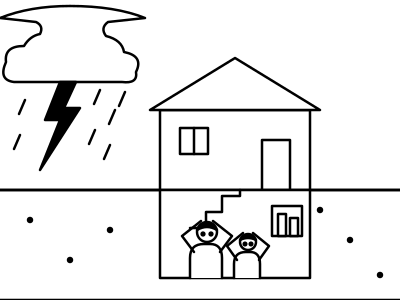
    Say: "Severe weather is weather strong enough to be dangerous. A danger like that is called a hazard." Say: "Charge builds up inside tall, dark storm clouds, like on the balloon but far greater." Say: "Lightning is a giant spark of electricity. It jumps inside a cloud or between a cloud and the ground." Say: "Lightning heats the air around it very fast. The air spreads out with a boom. That boom is thunder." Say: "Light travels much faster than sound. So the flash reaches you first." Teach the count. Say: "Count the seconds from flash to boom. Every 5 seconds is about 1 mile." Ask: "The gap is 20 seconds. How far?" (About 4 miles, because 20 ÷ 5 = 4.) Say: "When thunder roars, go indoors." Say: "If you can hear thunder, lightning is close enough to strike. Wait 30 minutes after the last thunder." Safe places are a sturdy building or a hard-topped car with the windows up. Now a design. Say: "A lightning rod is a metal rod on a roof. A wire joins it to the ground. It gives lightning a safe path into the ground and protects the building." Ask: "Is a tent a safe place? Why not?" (No. It is not a sturdy building.) If stuck, say: "Count by 5s on your fingers. Each finger is one mile."

    15–20 min · Investigation / Hands-On

    Storm Science and Safety Practice. Safety: pop the bag away from faces, ears and pets. 1) Blow up the paper bag, hold the neck shut and pop it. Say: "Air rushing outward fast makes a bang. Thunder is the same idea, far bigger." 2) Play Flash and Clap. You flash the flashlight, wait, then clap. Your child counts the seconds on the clock from flash to clap. 3) Try gaps of 5, 25 and 40 seconds. Your child records in a table with two columns: Seconds, Miles. 4) Expect 1, 5 and 8 miles. 5) Walk to the place your family would shelter in a storm. 6) Your child names three places to avoid outdoors: open fields, water, and under a lone tall tree.

    10 min · Science Notebook Entry

    Your child makes a Thunderstorm Safety Card on the index card. It says: "When thunder roars, go indoors." It lists three places to avoid and the 30-minute wait. In the notebook they draw a tall thundercloud with lightning in crayon and finish this frame. "We see lightning before we hear thunder because ___." Sample: "We see lightning before we hear thunder because light travels much faster than sound."

    5 min · Wrap-Up & Exit Ticket

    Ask the three exit questions aloud. Praise calm, exact safety steps.

    Watch for: Believing that standing under a tree keeps you safe from lightning.

    Try: Say: "Lightning often strikes tall things." Ask: "Which is safer, the tree or the house?" Walk to the house door together.

    Exit ticket (3 questions)
    1. The gap from flash to boom is 30 seconds. How many miles is that?
    2. You are swimming when you hear thunder, but no rain is falling. What should you do, and why?
    3. Make a claim: which is the safer place in a thunderstorm, a hard-topped car or an open picnic shelter? Give one reason.
    Show answers
    1. About 6 miles (30 ÷ 5 = 6).
    2. Get out of the water and go indoors. Thunder means lightning is close enough to strike.
    3. The car, with its windows up. An open shelter has no walls, so it cannot keep lightning out.

    Support: Skip the table. Your child counts one 5-second gap and says "about 1 mile".

    Extend: Your child makes up three flash-to-boom gaps that are multiples of 5. A family member works out each distance.

    Homework: Show your family the Thunderstorm Safety Card. Agree on the indoor place you will go in a storm. Look for: your child says the rule and the 30-minute wait from memory.
    Day 2 · Tuesday

    Social Studies

    I can name rights protected by the Bill of Rights and give an example of each.

    D2.Civ.3.3-5D2.Civ.8.3-5

    Builds on: Needs Day 1, where a right is a freedom the law protects, and the Constitution from Week 20. One-minute check: ask, "Name one right from yesterday's chart." (Sample: speak your mind.)

    New words:
    • amendment – a change or addition to the Constitution
    • Bill of Rights – the first ten amendments to the Constitution, which protect people's rights
    • press – the people and companies that report the news
    • assemble – to gather together in a group
    • trial – a meeting in court that decides whether someone broke a law

    Materials: Notebook, Pencil, 5 index cards, Markers

    5 min · Warm-Up

    Spaced review from Week 20. Ask: "Which written plan sets up our national government?" (The Constitution.) Then ask: "What may people here do that the law protects?"

    10–15 min · Mini-Lesson

    Say: "An amendment is a change or addition to the Constitution. The first ten amendments are called the Bill of Rights. They were added in 1791 to protect people's rights." Say: "The First Amendment protects five freedoms." Count on five fingers. "Religion: you may practice any religion or none. Speech: you may say what you think. Press: reporters may share news without government control. Assembly: people may gather peacefully. Petition: people may ask the government to fix a problem." Say: "Another amendment protects the right to a fair trial. A trial is a meeting in court that decides whether someone broke a law." Say: "Rights have limits. Freedom of speech does not cover threats or lies that harm a person." Ask: "Which freedom lets people choose their own beliefs?" (Religion.) "Does freedom of speech cover a threat?" (No.) If stuck, say: "Count on your fingers: religion, speech, press, assembly, petition."

    15–20 min · Activity / Source Work

    Read the source. 1) Say: "Here is the First Amendment in plain words." Read this card slowly. "Congress may not make a law that sets up an official religion. It may not stop people from practicing their own religion. It may not cut back what people may say or what the press may print. It may not take away the people's right to gather peaceably. It may not take away their right to petition the government to fix a complaint." 2) Ask for evidence: "Which word says gatherings must be peaceful?" (Peaceably.) "Who is told not to make such laws?" (Congress.) Say: "Today these limits apply to state and local governments too." 3) Your child makes five picture cards with markers, one for each freedom. Offer examples. Religion: a family at a mosque, church or temple. Speech: a girl tells a crowd what she thinks of a new rule. Press: a news site reports a mayor's mistake. Assembly: neighbors hold a peaceful march for a park. Petition: families sign a request for a bike rack. 4) Read four short stories. Your child holds up the matching card. "A boy wears a shirt that says Save the Bees." (Speech.) "People meet in a square for a quiet candle walk." (Assembly.) "A magazine prints a story that criticizes a new law." (Press.) "A family attends no place of worship." (Religion, which includes none.) Keep the cards for Day 5.

    10 min · Notebook Entry

    In the notebook, your child writes the heading "The Five First Amendment Freedoms" and lists each with an example. Then finish: "Rights have limits. One example is ___." Sample: "Speech: I can say what I think about a rule. One example is that I may not threaten anyone."

    5 min · Exit Ticket

    Read the three questions aloud. Praise examples your child made up.

    Watch for: Thinking freedom of speech means anyone can say anything anywhere, with no limits.

    Try: Sort three statements into okay and not okay. "I dislike that book." "That rule is unfair." "I will hurt you." Explain why the last is not protected.

    Exit ticket (3 questions)
    1. A family prays at home in their own way, and no law may stop them. Which freedom is this?
    2. Lena says, "Freedom of speech means I can say anything, even a threat." Is she right? Explain.
    3. What is an amendment?
    Show answers
    1. Freedom of religion.
    2. No. Rights have limits. Threats are not protected.
    3. A change or addition to the Constitution.

    Support: Start with speech, religion and assembly. Add press and petition once those are solid.

    Extend: Your child writes a short petition asking the family for one fair change, then collects signatures.

    Homework: Your child asks a family member which freedom matters most to them and why, then writes one sentence. Look for a named freedom and a reason.

    Mathematics

    I can find equivalent fractions with fraction strips and area models.

    3.NF.A.3.A3.NF.A.3.B

    Builds on: Needs Week 19 Day 1 (equal parts) and Week 21 Day 1 (the fraction wall). One-minute check: ask "On the wall, which eighths match 1 whole?" (8/8)

    New words:
    • area model – a shape cut into equal parts, with some parts shaded to show a fraction

    Materials: Grid paper, Ruler, Crayons, Fraction wall from Day 1, Notebook, Pencil

    5 min · Warm-Up

    Spaced review from Week 20 Day 2. Ask: "On a number line in eighths, how many jumps is it from 0 to 5/8?" (5) Then practice ×7 facts with no clock. Ask 7 × 4, 7 × 5 and 7 × 10 (28, 35, 70).

    10–15 min · Mini-Lesson

    Say: "An area model shows a fraction as shaded parts of a shape." On grid paper, outline a square 4 squares long and 4 squares tall. Draw a line down the middle. Shade the left part. Ask: "What fraction is shaded?" (1/2) Now draw a line across the middle, from edge to edge. Ask: "How many equal parts now?" (4) "How many are shaded?" (2) Say: "The shaded amount did not change. The whole just has more, smaller parts. So 1/2 = 2/4." Check on the wall: both end at 12 cm. Now your child does more. Your child outlines a rectangle 6 squares long and 4 squares tall. Your child draws a line down after every 2 squares and shades the first column. Ask: "What fraction is shaded?" (1/3) Your child draws one line across the middle. Ask: "What fraction is shaded now?" (2/6. So 1/3 = 2/6.)

    10–15 min · Guided Practice

    Your child draws each model on grid paper with the ruler. 1) Outline a rectangle 4 squares long and 2 squares tall. Draw a line down after every square. Shade 1 column. Then draw a line across the middle. (1/4 = 2/8) 2) Outline a rectangle 6 squares long and 2 squares tall. Draw a line across the middle and shade the top row. Then draw a line down after every 2 squares. (1/2 = 3/6) 3) You shade 1 of 4 columns and cut only that column in half. Ask: "Are all the parts equal?" (No. Every part must be cut.) If stuck, say: "Count all the equal parts first. That is the denominator. Now count the shaded parts."

    15–20 min · Independent Practice

    Your child draws a model and writes each missing number. 1) Shade 1/2 of a rectangle. Cut it into fourths. 1/2 = ?/4 (2) 2) Shade 1/4 of a rectangle. Cut every part in half. 1/4 = ?/8 (2) 3) Shade 2/2 of a square. Cut every part in half. 2/2 = ?/4 (4) 4) Shade 3 of 6 equal parts. 3/6 = ?/2 (1) 5) Shade 1/2 of a square. Cut it into 8 parts. 1/2 = ?/8 (4) 6) You draw two same-size squares. One has 1 of 2 parts shaded. The other has 2 of 4. Ask: "Is the same amount shaded?" (Yes. 1/2 = 2/4.) 7) A pan of brownies has 4 equal pieces. Dad takes 1. Mom cuts every piece in half. Name the share Dad took in eighths. (2/8) 8) Beans grow in 1/2 of a garden bed. The bed is split into 8 equal plots. How many plots have beans? (4; 1/2 = 4/8)

    5 min · Exit Ticket

    Read each question aloud; your child draws on grid paper and answers.

    Watch for: Cutting only the shaded part into smaller pieces.

    Try: Your child draws each new line with the ruler, all the way from edge to edge.

    Fact fluency: ×7 facts
    Exit ticket (3 questions)
    1. Shade 3/3 of a rectangle. Cut every part in half. What fraction is shaded now?
    2. A rectangle has 8 equal parts. 2 are shaded. Name that amount in fourths.
    3. Why does the fraction get a new name but stay the same size?
    Show answers
    1. 6/6
    2. 1/4
    3. Answers vary. Look for: the same amount is shaded; the whole has more, smaller parts.

    Support: Outline the shapes ahead of time. Your child adds only the new cutting lines.

    Extend: Your child outlines three rectangles, each 6 squares long and 4 squares tall, and shades the left 12 squares of each. Your child cuts them into fourths, sixths and eighths. (2, 3 and 4 parts are shaded.)

    Homework: Your child draws two area models on grid paper and writes each equation. Sample: 1/2 = 2/4 and 1/4 = 2/8.

    English Language Arts

    I can use different linking words inside my paragraphs to connect reasons and evidence.

    W.3.1.CL.3.6L.3.1.HL.3.1.I

    Builds on: Needs the linking words from Week 8 and the three sentence kinds from Week 7. One-minute check: ask, "Name three linking words." (Any three, such as because, also and for example.)

    New words:
    • coordinating conjunction – a joining word such as and, but, or or so that links two sentences
    • subordinating conjunction – a joining word such as because, when or if that starts a part that cannot stand alone

    Materials: Essay draft, Writer's notebook, One colored pencil, Pencil

    5 min · Warm-Up

    Word study: build words. Your child writes salt + y, dust + y and rock + y. (salty, dusty, rocky) Then write carry, try and busy. Your child crosses out each y, writes i and adds the ending: carried, tried, busier. Ask: "Why does play keep its y in played?" (A vowel comes before the y.) Spaced review from Week 14. Ask: "Where do quotation marks go in dialogue?" (Around the speaker's exact words.)

    10–15 min · Mini-Lesson

    Say: "Linking words connect ideas inside a paragraph." Write the list: because, since, so, also, such as, for example, for instance, in addition. Read this choppy paragraph, "Morning Walks." Families should take morning walks. Walks wake you up. I feel ready for math after a walk. We leave at seven. We are home before breakfast. Think aloud: "The second sentence gives the reason for the first. I will join them with because." Write: "Families should take morning walks because walks wake you up." Now name three kinds of sentences. A simple sentence is one complete thought. "Walks wake you up." In a compound sentence, a comma plus and, but, or or so joins two sentences. "We leave at seven, so we are home before breakfast." A complex sentence adds a part that cannot stand by itself. "Walks wake you up because your whole body gets moving." Say: "And, but, or and so are coordinating conjunctions. Because, since, when, if and although are subordinating conjunctions." Show the comma when that part comes first: "When I walk before school, I feel ready for math."

    10–15 min · Guided Practice

    Your child joins each pair with a different linking word. Then they name the kind of sentence. 1) "The trail is long. The view is worth it." (The trail is long, but the view is worth it. Compound.) 2) "We wear boots. The path is muddy." (We wear boots because the path is muddy. Complex. Since also works.) 3) "Dad forgot the map. We asked a ranger for help." (Dad forgot the map, so we asked a ranger for help. Compound.) 4) "Many birds visit our yard. Robins and wrens visit." (Many birds visit our yard, such as robins and wrens. Simple.) If stuck, say: "Which part is the reason? The reason comes after because. The result comes after so."

    15–20 min · Independent Practice

    Your child works in the essay draft. 1) Circle every linking word with the colored pencil. 2) Count them. Each body paragraph needs at least two different linking words. 3) Where one word repeats, swap it or join two short sentences. Rewrite those sentences in the notebook. 4) Make sure the essay has one compound sentence and one complex sentence. Write C or X beside them. Model: "Cats are tidy. They clean their fur." becomes "Cats are tidy because they clean their fur." Look for: a comma before and, but, or or so between two sentences, and no comma before because.

    5 min · Exit Ticket

    Your child writes the answer to question 1 and says the other two aloud.

    Watch for: Using so and because backward, such as "I went sledding so I like winter."

    Try: Ask: "Which part is the reason?" The reason follows because. The result follows so.

    Exit ticket (3 questions)
    1. Join these with a linking word: "Maya wears a helmet. She wants to stay safe."
    2. Simple, compound or complex? "Frogs can swim, but they cannot fly."
    3. Simple, compound or complex? "If it snows, we will build a fort."
    Show answers
    1. Sample: Maya wears a helmet because she wants to stay safe. ("Since" also works.)
    2. Compound. Two sentences are joined by a comma and "but."
    3. Complex. The part that starts with "if" cannot stand alone.

    Support: Write four linking words on a card: because, so, also, for example. Your child chooses only from the card.

    Extend: Your child writes one complex sentence about their topic that begins with "Although." Sample: "Although dogs are friendly, they need a lot of care."

    Homework: Read for 15 to 20 minutes. Then write three sentences about your day, each with a different linking word. Look for: one compound sentence with a comma before the joining word.

    Science

    I can explain what a tornado is, tell a watch from a warning, and find the safest place in a building.

    3-ESS3-1

    Builds on: Needs Day 1: the rule to go indoors. Also needs Week 17: a model is a simpler version of something real. One-minute check: ask what your family does when thunder roars (go indoors).

    New words:
    • tornado – a spinning column of air that reaches from a storm cloud to the ground
    • tornado watch – an alert that tornadoes could form, so be ready
    • tornado warning – an alert that a tornado has been seen nearby, so take cover now
    • storm shelter – a small, very strong room, often underground, built to keep people safe in a storm

    Materials: Clear plastic bottle with a tight cap, Water and one drop of dish soap, Paper for a floor plan, A pillow or cushion, Science notebook and pencil

    5 min · Day 102 — Tornadoes and Safe Places — Wonder Warm-Up

    Spaced review from Week 17. Ask: "Every model has limits. What is a limit?" (Something a model cannot show or do the way the real thing does.) Then the wonder. Ask: "Have you ever heard a weather alert? What do you think it was for?"

    10–15 min · Mini-Lesson

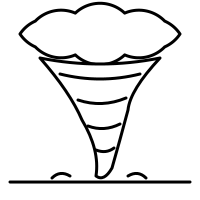
    Say: "A tornado is a spinning column of air. It reaches from a thunderstorm cloud down to the ground." Say: "In the United States, tornadoes are most common in the central states in spring." Teach two alert words. Say: "A tornado watch means tornadoes could form. Stay alert and know your plan." Say: "A tornado warning means one has been seen or shown on radar nearby. Go to your safe place now." Describe the safe place. It is on the lowest floor of a sturdy building. It is a small inside room with no windows, such as a basement, closet, bathroom or hall. There you crouch low and cover your head. Say: "Wind can break glass and throw things. Walls between you and the outside protect you." Now a design. Say: "A storm shelter is a small, very strong room, often underground." Ask: "The radio says tornadoes are possible until 8 p.m. Watch or warning?" (Watch.) Ask: "A siren sounds because a tornado was spotted near town. Watch or warning?" (Warning.) If stuck, say: "Could happen, or happening now?"

    15–20 min · Investigation / Hands-On

    Tornado Model and Safe-Place Hunt. Safety: screw the cap on tightly and swirl over a sink or towel. 1) Fill the bottle three quarters full of water. Add the drop of dish soap and cap it. 2) Your child holds the bottle upside down and swirls it fast in small circles, then stops. 3) Look for a spinning funnel in the water. It may take a few tries. 4) Ask: "How is this like a tornado? What is a limit of the model?" (It spins in a funnel. A real tornado is spinning air and is far bigger.) 5) Walk through your home. Your child checks each room in a table with three columns: Room, Lowest floor, No windows. 6) Your child sketches a floor plan and stars the room with the most ticks. 7) Practice once. Say "tornado warning". Your child walks to the safe place, crouches and covers their head with the pillow. Expect a starred inside room on the lowest floor you can reach.

    10 min · Science Notebook Entry

    Your child writes the two meanings in the notebook. "Watch = be ready. Warning = take cover now." They glue or copy the floor plan with its star and finish this frame. "Our safe place is ___ because ___." Sample: "Our safe place is the hall closet because it is on the lowest floor and has no windows."

    5 min · Wrap-Up & Exit Ticket

    Ask the three exit questions aloud. Praise going to the safe place without looking outside.

    Watch for: Mixing up watch and warning, or wanting to go outside to look at the storm.

    Try: Call out two pretend alerts in a row. Your child shows the right action for each: get ready, or go to the safe place.

    Exit ticket (3 questions)
    1. An alert says a tornado was seen 5 miles away. Is that a watch or a warning? How do you know?
    2. Which is safer in a tornado: an upstairs bedroom with two windows or a downstairs hall closet? Give two reasons.
    3. Name one way the bottle model is like a tornado and one limit of the model.
    Show answers
    1. A warning. A tornado has been seen, so it is happening and not just possible.
    2. The hall closet. It is on the lowest floor, and it has no windows.
    3. Like: it spins in a funnel shape. Limit: it is water in a bottle, not spinning air, and it is tiny.

    Support: Teach "Watch: get ready. Warning: get safe" with a hand motion for each. Call out the two words in mixed order.

    Extend: Your child asks a family member what they would do in a tornado warning at work. They compare it with the home plan.

    Homework: Show your family the starred floor plan. Practice walking to the safe place together once. Look for: everyone crouches low with head covered.

    Day 3 · Wednesday

    Social Studies

    I can name responsibilities of citizens and explain why they matter.

    D2.Civ.2.3-5D2.Civ.8.3-5

    Builds on: Needs Day 1, the meaning of responsibility, and taxes from Week 19. One-minute check: ask, "What is a responsibility?" (Something a person should do for the community.)

    New words:
    • jury – a group of citizens who listen to a trial and decide together what the facts show
    • informed – knowing the facts about something before you decide

    Materials: Notebook, Pencil, Large sheet of paper, 2 markers in different colors

    5 min · Warm-Up

    Spaced review from Week 20. Ask: "What do courts do?" (They hear both sides and decide by the law and the facts.) Then ask: "If everyone has rights, what must everyone do so those rights work for all?"

    10–15 min · Mini-Lesson

    Say: "Rights come with responsibilities." Say: "Everyone who lives here must follow the laws and pay taxes." Say: "Adult citizens have more. They vote in elections. They stay informed, which means learning the facts before deciding. They serve on a jury when called." Say: "A jury is a group of citizens who listen to a trial. Together they decide what the facts show." Say: "Children have responsibilities too. They follow rules, respect the rights of others, tell the truth and help their community." Say: "Taxes pay for schools and roads. Juries need ordinary people so trials are fair. If nobody followed laws, nobody would feel safe." Say: "A democracy works only when people take part." Say: "Our family votes on dinner, but only I bother to vote. Who decides for everyone?" (You do.) Ask: "Who must follow the laws: only citizens, or everyone here?" (Everyone.) "What does a jury do?" (It listens to a trial and decides what the facts show.) "Why do taxes count as a responsibility?" (They pay for services everyone shares.) If stuck, say: "Ask yourself: what would go wrong if nobody did this?"

    15–20 min · Activity / Source Work

    Source, chart and game. 1) Read this made-up notice aloud. "Jury Notice. To: Dana Rivers. You are called to serve as a juror at the Pine County Courthouse on May 4. Jurors listen carefully to both sides and decide together. You must be a U.S. citizen and 18 or older. Your boss may not fire you for serving. Thank you for helping to keep trials fair." 2) Ask for evidence: "Who may serve on a jury? Find the words." (A U.S. citizen who is 18 or older.) "Why does the notice say thank you?" (Serving helps keep trials fair.) 3) On the large paper, make two columns, each in its own color: Adults' responsibilities and Kids' responsibilities. Your child writes four or more in each. 4) Play "What if no one?" Your child answers each in one sentence. "What if no one paid taxes?" (No money for schools or roads.) "What if no one served on juries?" (Trials could not be fair.) "What if no one followed traffic laws?" (There would be crashes.) "What if no one listened to other opinions?" (People would argue and choose unfairly.) Look for a real result in each.

    10 min · Notebook Entry

    In the notebook, your child copies the two-column chart. Then finish: "I think the most important responsibility is ___ because ___." Sample: "I think following laws is the most important because it keeps people safe."

    5 min · Exit Ticket

    Read the three questions aloud. Praise answers that tell why a responsibility matters.

    Watch for: Mixing up rights and responsibilities, or placing voting on only one side.

    Try: Ask: "Does the law protect this for you, or do you do it for others?" Then show that voting belongs on both sides.

    Exit ticket (3 questions)
    1. What does it mean to stay informed, and why should voters do it?
    2. A woman gets a jury notice and wants to skip it. Give her one good reason to go.
    3. What might happen in a town if most people stopped voting?
    Show answers
    1. It means learning the facts before deciding. Informed voters make wiser choices.
    2. Answers vary. Look for: trials need ordinary people so they are fair.
    3. A few people would decide for everyone, and leaders might not serve the whole town.

    Support: Give a word bank: laws, taxes, jury, vote, rules, truth, respect, help. Use the frame "Adults ___. Kids ___."

    Extend: Your child writes three sentences on why the Bill of Rights promises juries made of ordinary people.

    Homework: Your child asks a family member which responsibility they did most recently, such as voting, jury service or paying a tax. How did it help? Look for one responsibility and one result.

    Mathematics

    I can use models to decide whether two fractions are equivalent.

    3.NF.A.3.A3.NF.A.3.B

    Builds on: Needs Week 20 Day 4 (stacked number lines) and Week 21 Days 1 and 2 (strips and area models). One-minute check: ask "On the wall, which eighths match 1/4?" (2/8)

    New words:
    • not equal (≠) – a sign that says two amounts are different

    Materials: Fraction wall from Week 21 Day 1 (six marked strips, each 24 cm long), Centimeter ruler, Paper, turned sideways, Crayons, Notebook, Pencil

    5 min · Warm-Up

    Spaced review from Week 19 Day 4. Ask: "Is 5/4 less than 1 or greater than 1?" (Greater. 4/4 makes 1 whole.) Then practice ÷7 facts with no clock. Ask 14 ÷ 7, 35 ÷ 7 and 56 ÷ 7 (2, 5, 8). Ask: "Which fact helps with 56 ÷ 7?" (7 × 8 = 56)

    10–15 min · Mini-Lesson

    Say: "Some fractions look alike but are not equal. Two tests tell us whether fractions are equivalent." Test 1 is the wall. Write 2/4 and 3/6. Your child puts a finger on the end of each. Ask: "Do they end at the same place?" (Yes. Both end at 12 cm.) Say: "So 2/4 = 3/6. They are equivalent." Test 2 is the number line. Draw two lines 24 cm long, one under the other. Line up the 0s. Mark the top line in thirds, a tick every 8 cm. Mark the bottom line in fourths, a tick every 6 cm. Your child circles 2/3 and 3/4 with a crayon. Ask: "Are they at the same point?" (No. 2/3 is at 16 cm and 3/4 is at 18 cm.) Write 2/3 ≠ 3/4. Say: "This sign means not equal." Now your child does more. Write 1/3 and 3/8. Your child picks a test and decides. (Not equal. 1/3 ends at 8 cm and 3/8 ends at 9 cm. 1/3 ≠ 3/8)

    10–15 min · Guided Practice

    Your child names the test, shows it and writes = or ≠. 1) 1/2 and 4/8 (=; both end at 12 cm) 2) 3/8 and 1/2 (≠; 9 cm and 12 cm) 3) 6/6 and 8/8 (=; both are 1 whole) 4) 3/4 and 5/6 (≠; 18 cm and 20 cm) After each one, ask: "How do you know?" If stuck, say: "Find the end of each fraction. Stand the ruler straight down. Is it one place or two?"

    15–20 min · Independent Practice

    Your child writes = or ≠ and sketches the test used. 1) 1/4 ___ 2/8 (=; both end at 6 cm) 2) 1/4 ___ 2/6 (≠; 6 cm and 8 cm) 3) 2/2 ___ 4/4 (=; both are 1 whole) 4) 2/3 ___ 5/8 (≠; 16 cm and 15 cm) 5) 3/6 ___ 1/2 (=; both end at 12 cm) 6) Draw a 0 to 2 number line 24 cm long, with 1 at 12 cm. Mark halves every 6 cm above the line. Mark fourths every 3 cm below it. Are 3/2 and 6/4 equivalent? (Yes. Both are at 18 cm.) 7) Eli reads 2/4 of his book. Zoe reads 1/2 of the same book. Did they read the same amount? (Yes. 2/4 = 1/2.) 8) Pat fills 5/8 of a jar. Lee fills 3/4 of a same-size jar. Is it the same amount? (No. 5/8 ends at 15 cm and 3/4 ends at 18 cm.)

    5 min · Exit Ticket

    Leave the wall and the ruler out. Read each question aloud; your child answers on paper.

    Watch for: Deciding that 3/6 and 3/8 are equal because the numerators match.

    Try: Your child finds both ends on the wall. 3/6 ends at 12 cm and 3/8 ends at 9 cm, because eighths are smaller parts.

    Fact fluency: ÷7 facts
    Exit ticket (3 questions)
    1. Write = or ≠: 2/4 ___ 2/3
    2. Write = or ≠: 4/4 ___ 6/6
    3. Show 1/2 and 2/4 on stacked number lines 24 cm long. What do you notice?
    Show answers
    1. ≠
    2. =
    3. They sit at the same point, 12 cm from 0, so they are equivalent.

    Support: Use only the wall test. Your child colors the two fractions on the wall, then checks the ends with the ruler.

    Extend: Your child finds two fractions that are not equal but very close. Sample: 7/8 ends at 21 cm and 5/6 ends at 20 cm. Ask: "How far apart are the ends?" (1 cm)

    Homework: Your child writes = or ≠ for three pairs and draws strips to prove each one. The pairs are 1/2 and 3/6, 1/3 and 1/4, 2/2 and 8/8. (=, ≠, =)

    English Language Arts

    I can write a conclusion that restates my opinion, sums up my reasons and ends with a call to action.

    W.3.1.DW.3.4L.3.2.B

    Builds on: Needs the conclusion sentence from Week 8 and the transition chosen on Day 1. One-minute check: your child reads the opinion sentence from their introduction and the transition in the bottom box of the organizer.

    New words:
    • call to action – an ending that tells the reader to do something

    Materials: Essay draft and organizer, Writer's notebook, Highlighter or colored pencil, An envelope, or a sheet of paper folded like one, Pencil

    5 min · Warm-Up

    Word study: dictation. Say this sentence twice: "We tried to feel happier on the rainy, windy day." Your child writes it. Check it together. Ask: "Which two words changed y to i?" (tried, happier) Spaced review from Week 12. Ask: "What should the ending of a story do?" (Solve the problem and fit the story.)

    10–15 min · Mini-Lesson

    Say: "A conclusion is your last chance to make the reader remember your opinion. It has three jobs. One, say your opinion again in new words. Two, sum up your reasons in one sentence. Three, finish with a call to action or a thought to remember." Say: "A call to action tells the reader to do something." Read the model conclusion, "A Pet for a Small Home." For these reasons, a cat is the right pet for apartment life. Cats stay indoors, keep themselves clean and make very little noise. Visit a shelter and meet a cat this weekend! Think aloud: "The introduction said, I think cats are the best pet for an apartment. Sentence 1 here gives the same idea in new words. Sentence 2 sums up three reasons. Sentence 3 tells the reader what to do."

    10–15 min · Guided Practice

    1) Ask: "Say this opinion again in new words: I think every kid should learn to swim." (Sample: Learning to swim matters for all children.) 2) Show three kinds of last sentence for a journal essay. Call to action: "Grab a notebook tonight and write three lines!" Question: "Would you like to remember today forever?" Picture: "Imagine reading your own words ten years from now." 3) Together, write one of each kind for your child's essay. Your child picks the best one. 4) Ask: "Does a new reason belong in a conclusion?" (No. It only sums up the reasons already given.) If stuck, say: "What do you want your reader to do tomorrow? Start with Try, Ask or Visit."

    15–20 min · Independent Practice

    1) Your child writes the conclusion, three or four sentences long. Frame, if needed: "For these reasons, ___. ___, ___ and ___ all show that ___. ___!" 2) They highlight the opinion and compare it with the introduction. The words must be new. 3) They write today's date above the conclusion and address the envelope to a real reader. Teach two commas. One goes between the day and the year: April 12, 2027. One goes after the city name, before the state. Write this sample in three lines: Ms. Rivera, then 45 Oak Street, then Santa Fe, New Mexico 87501. The finished essay can go in the envelope after Day 5. Checklist: the opinion is in new words, and the reasons are summed up. The ending is strong, and both commas are in place.

    5 min · Exit Ticket

    Your child answers in the notebook and reads their own call to action aloud at the end.

    Watch for: Copying the opinion sentence word for word from the introduction, or adding a new reason at the end.

    Try: Say: "No new reasons at the end." Your child underlines the reasons in the body and checks the conclusion against them.

    Exit ticket (3 questions)
    1. What kind of ending is this? "Plant one seed this spring!"
    2. Say this opinion again in new words: "I think families should eat dinner together."
    3. Write your own city and state the way they go on an envelope.
    Show answers
    1. A call to action. It tells the reader to do something.
    2. Answers vary. Sample: Sharing dinner is good for every family.
    3. Answers vary. Look for: a capital on each name and a comma right after the city.

    Support: Your child says the three reasons aloud. You write them as one sentence, and your child copies it into the conclusion.

    Extend: Your child writes two endings, a call to action and a question. They test both on a family member.

    Homework: Read for 15 to 20 minutes. Then read your conclusion to a family member. Ask if the call to action makes them want to act. Finish the envelope if needed. Look for: a comma right after the city name.

    Science

    I can describe how hurricanes form, what dangers they bring and how people prepare.

    3-ESS3-1

    Builds on: Needs Day 2: storms can spin, and alerts give people time to act. One-minute check: your child finds the Atlantic Ocean and the equator on the map.

    New words:
    • hurricane – a huge spinning storm that forms over warm ocean water
    • eye – the calm center of a hurricane
    • storm surge – ocean water that a storm pushes onto the shore
    • evacuate – to leave a place to get away from danger

    Materials: World map or globe, Large bowl of water and a spoon, A few tiny bits of paper, Science notebook and pencil

    5 min · Day 103 — Hurricanes — Wonder Warm-Up

    Spaced review from Week 20. Ask: "A hurricane hits a coast today. Is that weather or climate?" (Weather. It happens at one place and time.) Then the wonder. Ask: "Where do you think the biggest storms on Earth start: over land or over the ocean?"

    10–15 min · Mini-Lesson

    Say: "A hurricane is a huge, spinning storm that forms over warm ocean water." Say: "Warm water feeds the storm. Over land or cold water, it loses that supply and weakens." Sketch a top view: a spiral of cloud with a small clear circle in the middle. Say: "The calm center is called the eye. The strongest winds circle right around it." Say: "When the eye passes over, the wind stops for a while. Then the other side of the storm arrives." Strong wind can break roofs and windows. Heavy rain can cause floods. Storm surge is ocean water pushed onto the shore. Say: "Weather scientists track hurricanes for days. So people have time to prepare or to evacuate." Now three designs. Storm shutters are strong covers that close over windows. Metal straps tie a roof to the walls. Houses on tall posts let surge water pass underneath. Ask: "Which danger do tall posts help with?" (Storm surge and flooding.) Ask: "Why does a hurricane weaken over land?" (It is cut off from the warm ocean water.) If stuck, say: "What feeds the storm? Is there any of that on land?"

    15–20 min · Investigation / Hands-On

    Hurricane Model and Map. Safety: wipe up spills so nobody slips. 1) Drop the paper bits onto the bowl of water. Stir in a circle about ten times, then lift the spoon out. 2) Your child watches the bits. Ask: "What path do the bits trace? What do you see in the very middle?" 3) They record in a table with two columns: Place in bowl, What I saw. Expect the water to keep spinning, with a small dip or calmer spot at the center. Real results vary. Look for the pattern. 4) Name a limit. A real hurricane is air and cloud, not water in a bowl. 5) On the map, find the warm Atlantic Ocean, the Caribbean Sea and the Gulf of Mexico. Many hurricanes begin far out in the Atlantic near Africa. 6) Your child traces a pretend path with a finger from near Africa toward the Caribbean. They show where it would weaken. (Over land.)

    10 min · Science Notebook Entry

    Your child makes a Hurricane Facts page in the notebook with these frames. "Hurricanes form over ___. The calm center is the ___. Three dangers are ___, ___ and ___. People prepare by ___." Sample: "Hurricanes form over warm ocean water. The calm center is the eye. Three dangers are strong wind, flooding rain and storm surge. People prepare by gathering supplies and leaving if told to." They draw a top view with the eye labeled.

    5 min · Wrap-Up & Exit Ticket

    Ask the three exit questions aloud. Praise claims that come with a reason.

    Watch for: Thinking the calm eye means the storm is over and it is safe to go outside.

    Try: Move a finger across the sketch: wind, eye, wind again. Say: "People stay in until officials say it is safe."

    Exit ticket (3 questions)
    1. What is storm surge, and which design from today helps with it?
    2. In the middle of a hurricane, the wind stops and the sky clears. Is it safe to go outside? Explain.
    3. A town chooses storm shutters for its school. Make a claim about this design and give one reason.
    Show answers
    1. Ocean water that the storm pushes onto the shore. Houses on tall posts let the water pass underneath.
    2. No. That is the eye. The other side of the storm will bring strong winds again.
    3. Answers vary. Look for: it is a good design, because covers keep wind-blown things from breaking the glass.

    Support: Give a word bank for the facts page: warm ocean, eye, wind, rain, storm surge, supplies.

    Extend: Your child compares hurricanes and tornadoes in a chart with three rows: size, where they form, and warning time.

    Homework: Ask your family whether hurricanes can reach your area. Write one way a family could prepare. Look for: a real step, such as storing drinking water.

    Day 4 · Thursday

    Social Studies

    I can plan ways to be a good citizen now and listen to different points of view.

    D2.Civ.7.3-5D2.Civ.10.3-5D4.7.3-5

    Builds on: Needs Day 3, kids' responsibilities, and the listening routine from Week 16 Day 4. One-minute check: ask, "What should you do before you answer someone's idea?" (Repeat it back.)

    New words:
    • compromise – a plan where each side gives up a little so both sides get something
    • pledge – a serious promise to do something

    Materials: Notebook, Pencil, 1 index card, Markers, A small jar or envelope

    5 min · Warm-Up

    Spaced review from Week 7. Ask: "Which word means working together: cooperation or conflict?" (Cooperation.) Then ask the big question: "You cannot vote yet. What can you do for your community right now?"

    10–15 min · Mini-Lesson

    Say: "Good citizenship is how a person acts as a member of a group. Anyone can show it, at any age." Say: "Good citizens follow fair rules. They respect people with different views, beliefs and backgrounds. They help others and learn about their community. They speak up kindly when something is unfair." Say: "One key skill is listening to another point of view." Model it. Say: "I think our break should be longer, because kids need to move. Mr. Patel thinks it should stay the same, so there is time for reading. I care about exercise. He cares about reading. Both reasons make sense." Say: "People's views come from what they have lived through and what they care about." Say: "A compromise is a plan where each side gives up a little." Ask: "What does Mr. Patel care about?" (Reading time.) "Does listening mean you must agree?" (No.) "What compromise could work for the break?" (Sample: a slightly longer break on some days.) If stuck, say: "Start with 'They think ___ because ___.'"

    15–20 min · Activity / Source Work

    Two views, then a plan. 1) Read this problem aloud. "Riverside Park has one soccer field. The soccer team wants it every afternoon to get ready for games. The younger children want room to play tag. They say the fast ball scares them." 2) Your child tells the team's view with the frame "They think ___ because ___." 3) Your child tells the younger children's view the same way. 4) Ask: "What does each group care about?" (The team cares about practice. The younger children care about space and safety.) 5) Your child suggests two plans and predicts what each would cause. Sample: take turns on different days, so each group gets the whole field but less often. Sample: split the field, so both play daily but the team has less room. 6) Your child picks the fairer plan and says why. Plans vary. Look for both views told fairly before any plan. 7) Your child names five things to do this week as a good citizen at home and nearby. Offer ideas: pick up litter, carry groceries, welcome a new neighbor, return library books on time. 8) Your child writes one action and a day on the index card with markers. This is a pledge. Put it in the jar.

    10 min · Notebook Entry

    In the notebook, your child writes the title "My Citizenship Plan" and lists the five actions. Circle the one on the pledge card and write the day. Sample: "On Saturday I will pick up litter on our block."

    5 min · Exit Ticket

    Read the three questions aloud. Praise your child for telling the other side's reason first.

    Watch for: Describing only the side they agree with and calling the other side "wrong."

    Try: Your child says the other side's reason first: "They think ___ because ___." Only then may your child give an opinion.

    Exit ticket (3 questions)
    1. Two friends both want the last turn on the swing before dinner. Tell each friend's point of view and one fair plan.
    2. Why is it important to listen to a point of view that is different from yours?
    3. What did you pledge to do this week, and on which day?
    Show answers
    1. Answers vary. Look for both views and a plan, such as two short turns.
    2. Answers vary. Look for: you may learn something, it is fair, or it helps find a plan that works for more people.
    3. Answers vary. Look for a specific action that your child can really do, with a day.

    Support: Offer a menu of eight actions. Your child picks five and draws the pledged one.

    Extend: Your child plans a small project, such as a park cleanup or a book drive. List the steps, the helpers and the result you expect.

    Homework: Your child does the pledged action and tells a family member how it helped. Look for the action done and one result named.

    Mathematics

    I can write whole numbers as fractions.

    3.NF.A.3.C

    Builds on: Needs Week 19 Day 4 (fractions equal to 1 and greater than 1) and Week 20 Day 3 (number lines past 1). One-minute check: ask "How many thirds make 1 whole?" (3)

    Materials: 4 paper rectangles of the same size (cut one sheet of paper into 4 equal pieces), Centimeter ruler, Paper, turned sideways, Crayons, Notebook, Pencil

    5 min · Warm-Up

    Spaced review from Week 20 Day 3. Count by halves together: 1/2, 2/2, 3/2, 4/2, 5/2, 6/2. Your child taps the table at each whole number (2/2, 4/2, 6/2). Then practice ×9 facts with no clock. Ask 9 × 3, 9 × 5 and 9 × 8 (27, 45, 72). Ask: "How does 10 × 8 help with 9 × 8?" (One group of 8 fewer. 80 − 8 = 72.)

    10–15 min · Mini-Lesson

    Say: "Whole numbers can be written as fractions. Today we find out how." Lay down the 4 paper rectangles. Say: "Each rectangle is 1 whole. It is not cut, so it has 1 part." Write 4/1. Say: "The denominator 1 says each whole is 1 part. The numerator 4 counts the parts." Ask: "How many wholes are there?" (4) Say: "So 4/1 = 4." Next, fold 2 of the rectangles in half, then in half again. Open them. Your child counts every part aloud: 1/4, 2/4, 3/4, and on to 8/4. Ask: "How many fourths are in 2 wholes?" (8) Say: "So 8/4 = 2." Ask: "How many fourths are in 1 whole?" (4. So 4/4 = 1.) Now your child does more. Your child folds the other 2 rectangles in half, counts the halves and writes the fraction. (4 halves. So 4/2 = 2.)

    10–15 min · Guided Practice

    Use the ruler to draw a 0 to 2 number line 24 cm long, with 1 at 12 cm. Say: "Every whole on this line is 12 cm long." Your child marks halves every 6 cm and labels them above the line: 1/2, 2/2, 3/2, 4/2. 1) Which fraction sits at 1? (2/2) 2) Which fraction sits at 2? (4/2. So 4/2 = 2.) 3) Mark fourths every 3 cm below the line. Which fourths sit at 2? (8/4) 4) Write 2 as a fraction in three ways. (2/1, 4/2, 8/4) Keep this line for Day 5. If stuck, say: "How many wholes? How many parts are in each whole? Count every part."

    15–20 min · Independent Practice

    Your child writes each answer and draws a model for problems 4 and 6. 1) Write 6 as a fraction with a denominator of 1. (6/1) 2) 2/1 = ? (2) 3) Write 1 as a fraction in sixths. (6/6) 4) 9/3 = ? Draw wholes cut into thirds. (3) 5) Which is a whole number, 4/2 or 5/2? (4/2; it is 2) 6) You draw 2 rectangles, each cut into 3 equal parts, with every part shaded. Your child writes the fraction and the whole number. (6/3 = 2) 7) 4 pizzas are each cut into thirds. How many thirds are there? Write a fraction. (12 thirds; 12/3 = 4) 8) A loaf is cut into 8 equal slices. A family eats all 8 slices. What fraction did they eat? What whole number is that? (8/8 = 1)

    5 min · Exit Ticket

    Put the paper rectangles away. Read each question aloud; your child answers on paper and may draw.

    Watch for: Mixing up 4/1 (four wholes) with 1/4 (one part of a whole cut into 4).

    Try: Your child draws both side by side. 4/1 is 4 whole rectangles. 1/4 is one rectangle with 1 of 4 parts shaded.

    Fact fluency: ×9 facts
    Exit ticket (3 questions)
    1. Write 7 as a fraction with a denominator of 1.
    2. Write 6 as a fraction in halves.
    3. Is 16/8 equal to 2? Draw or count to show it.
    Show answers
    1. 7/1
    2. 12/2
    3. Yes. Two wholes cut into eighths have 16 eighths.

    Support: Use real paper rectangles for every problem. Your child folds them, colors each part and counts every part aloud.

    Extend: Your child writes 5 as a fraction in halves, in thirds and in fourths (10/2, 15/3, 20/4) and explains the count.

    Homework: Your child writes 1 as a fraction in four ways and 2 as a fraction in two ways. Then your child draws one of them. Sample: 2/2, 3/3, 4/4, 8/8; 2/1 and 4/2.

    English Language Arts

    I can revise and edit my whole essay with a checklist and a partner.

    W.3.5SL.3.1SL.3.1.BSL.3.3L.3.2L.3.1.DL.3.1.EL.3.1.FL.3.2.EL.3.2.G

    Builds on: Needs revising and editing from Week 13 and the full draft: introduction, three body paragraphs and conclusion. One-minute check: ask, "Which comes first, revising or editing?" (Revising. Fix the ideas first.)

    Materials: Essay draft, Writer's notebook, Two colored pens, A dictionary, Pencil

    5 min · Warm-Up

    Word study: use the words. Ask: "Which word fits? Pretzels taste ___." (salty) "The old attic shelf was gray and ___." (dusty) "The steep trail was ___ and full of stones." (rocky) "Of all the jokes, Ben's was the ___." (funniest) Spaced review from Week 9. Ask: "What is the plural of story? What is the plural of child?" (stories, children)

    10–15 min · Mini-Lesson

    Write two short checklists in the notebook. Title the first one Revise, to make it better. List: clear opinion, one reason in each body paragraph, evidence for each reason, transitions and linking words, strong conclusion. Title the second one Edit, to make it right. List: end marks, capitals, subjects and verbs that agree, verbs that stay in one tense. Add: tricky past-tense verbs, pronouns that match their nouns, spelling. Say: "Went, not goed. Taught, not teached. Check y to i words. Look up any word you doubt in the dictionary." Say: "Revise first in one color. Edit second in the other color." Copy this student paragraph, "Dog Walk," errors and all. Another reason is that a dog keep you moving. last Saturday my dog and I spyed a stick in the pond. He swimmed after it, and I laugh so hard. It was the muddyest walk ever (Leave off the last period.) Think aloud: "First I revise. No sentence ties back to the opinion. I add: That is why a dog is a great exercise buddy. Now I edit. One dog keeps, not keep."

    10–15 min · Guided Practice

    Your child finds the other edits in "Dog Walk" with the second color. 1) "Which word needs a capital?" (last becomes Last.) 2) "Which two words break the y to i rule?" (spyed becomes spied. muddyest becomes muddiest.) 3) "Which verbs are wrong?" (swimmed becomes swam. laugh becomes laughed, to stay in the past.) 4) "What is missing at the very end?" (a period) Next, hold a short writing conference. Your child reads Body 1 of their essay aloud. Give one glow, something that works. Ask one question, such as "How do you know?" Follow the rules: listen without interrupting, look at the speaker and ask questions that help. If stuck, say: "Read it aloud slowly and touch each word. Does it sound right?"

    15–20 min · Independent Practice

    Your child works on the whole essay. 1) Use the revise checklist in the first color. Initial each item when it is done. 2) Use the edit checklist in the second color. 3) Look up at least one word in the dictionary and fix it if needed. 4) Tell you about one change that made the essay better. Look for: at least two revisions that add, cut, move or change words or ideas. Look for edits to capitals, end marks, verbs and spelling. A good essay now has five paragraphs and no unfinished checklist items.

    5 min · Exit Ticket

    Your child writes the answer to question 2 and answers the others aloud, showing the draft.

    Watch for: Fixing only spelling and skipping the revise checklist, as if the ideas were finished.

    Try: Hand over only the first pen. Your child initials every revise item before getting the second pen.

    Exit ticket (3 questions)
    1. Is adding a new piece of evidence revising or editing?
    2. Fix this sentence: "yesterday the twins dryed the wet slide"
    3. Show one revision you made in your essay. What did it improve?
    Show answers
    1. Revising. It changes the ideas, not the spelling or punctuation.
    2. Yesterday the twins dried the wet slide.
    3. Answers vary. Look for: a change to ideas or words, such as added evidence, not a spelling fix.

    Support: Your child revises and edits only the introduction and Body 1 today. Save the other paragraphs for tomorrow morning.

    Extend: Your child holds a second conference with another family member and writes down the question that person asks.

    Homework: Copy your final essay neatly, ready to read aloud tomorrow. This takes about 20 minutes and replaces reading tonight. Look for: five paragraphs, each one indented, with every edit included.

    Science

    I can describe floods, blizzards and wildfires and name a safety step for each.

    3-ESS3-1

    Builds on: Needs Day 1: a hazard is something that can harm people or their things. Also needs quarter-inch measuring from Week 19. One-minute check: your child names the three hazards so far (thunderstorm, tornado, hurricane).

    New words:
    • flood – water covering land that is usually dry
    • blizzard – a storm with strong wind and blowing snow that makes it hard to see
    • wildfire – an unplanned fire burning in grass, brush or forest
    • levee – a long, high wall of earth built along a river to hold floodwater back

    Materials: Shallow tray or baking pan, About 4 cups of sand or soil, Measuring cup and about 6 cups of water, 3 bottle caps or small blocks (two houses and one spare), Strip of aluminum foil, about 12 inches long, Ruler with inches, Paper for a kit list, Science notebook and pencil

    5 min · Day 104 — Floods, Blizzards and Wildfires — Wonder Warm-Up

    Spaced review from Week 7. Ask: "In engineering, what are criteria?" (The things a design must do to be a success.) Then the wonder. Ask: "Rain is usually helpful. When could rain become a hazard?" (When so much falls that water covers land, roads or homes.)

    10–15 min · Mini-Lesson

    Say: "A flood is water covering land that is usually dry." Say: "The rule is: turn around, don't drown. Never walk, swim or ride through floodwater." Say: "Just 6 inches of moving water can knock a person down." Show 6 inches on the ruler against your child's leg. Say: "A blizzard is a storm with strong wind and blowing snow. It is hard to see and very cold. Stay indoors and keep warm." Say: "A wildfire is an unplanned fire in grass, brush or forest. Hot, dry, windy weather makes one more likely. Follow officials and leave early if told to." Now two designs. A levee is a long, high wall of earth along a river. Cleared space around a house gives a wildfire less to burn. Ask: "Which design keeps a river inside its banks?" (A levee.) Ask: "Why is shallow moving water still dangerous?" (It pushes hard enough to knock you down.) If stuck, say: "Think of the ruler on your leg."

    15–20 min · Investigation / Hands-On

    Flood Model. Safety: work outdoors or on towels, and wash hands afterward. 1) Soak the sand first, so both tests start equally wet. Pile it at one end of the tray as a hill. Leave the other end bare as the valley. 2) Set one cap house on the hill and one in the valley. 3) Pour 2 cups of water slowly onto the hilltop. 4) Your child measures the water depth at each house to the nearest quarter inch. Too shallow to read? Pour 1 more cup in both tests. 5) They record in a table with three columns: Test, Depth at hill house, Depth at valley house. 6) Tip the tray gently to drain it. 7) Now test a design. Fold the foil into a low wall across the tray, between the hill and the valley house. Pack damp sand along it to seal it. 8) Change only the wall. Keep the same houses, spots and amount of water. Pour and measure again. Expect water to collect in the valley while the hill house stays dry. The wall usually keeps the valley water shallower, though some may leak. Say: "Real results vary. Look for the pattern."

    10 min · Science Notebook Entry

    In the notebook, your child makes a chart with three columns: Hazard, What happens, Safety step. They fill in flood, blizzard and wildfire. They finish this claim. "A levee is a ___ design because ___." Sample: "A levee is a good design because our wall kept the water at the house shallower." Then they start an emergency kit list on paper with six items. Sample: water, flashlight, batteries, first-aid kit, snacks, warm clothes.

    5 min · Wrap-Up & Exit Ticket

    Ask the three exit questions aloud. Praise answers that use a tray measurement.

    Watch for: Thinking shallow floodwater is safe to splash or walk through.

    Try: Pour water quickly down the hill at a scrap of paper. Watch the water push it along.

    Exit ticket (3 questions)
    1. After heavy rain, does water collect first on hilltops or in low places? Why?
    2. The weather report says the week will be hot, dry and windy. Which hazard is more likely: a flood, a blizzard or a wildfire?
    3. In your tray test, how did the foil wall change the water depth at the valley house? Use your numbers.
    Show answers
    1. In low places, because water flows downhill.
    2. A wildfire.
    3. Answers vary. Sample: "It was half an inch deep without the wall and a quarter inch with it."

    Support: Focus on the one hazard most likely in your area. Your child learns its safety step and draws it.

    Extend: Your child tests a second design: the valley house raised on the spare cap.

    Homework: With a family member, check your home for the items on your kit list. Tick the ones you have. Look for: at least four ticks.

    Day 5 · Friday

    Social Studies

    I can show what I know about rights and responsibilities on the Week 21 check.

    D2.Civ.2.3-5D2.Civ.3.3-5D2.Civ.7.3-5D2.Civ.4.3-5

    Builds on: Needs Days 1 to 4 of this week. One-minute check: ask, "Which of the five freedoms can you name without looking?" (Any of religion, speech, press, assembly and petition.)

    Materials: Stored Week 21 Social Studies Check and its answer key, T-chart from Day 1, Five freedom cards from Day 2, Pledge card and jar from Day 4, A sheet of paper for a family pledge, Notebook, Pencil

    5 min · Warm-Up

    Spaced review from Week 20. Ask: "How many justices sit on the Supreme Court?" (Nine.) Then your child takes the pledge card from the jar and reports. Ask: "Did you do it? What happened?" (Answers vary. Look for the action and one result.)

    10–15 min · Mini-Lesson

    Say: "Today you show what you know about rights and responsibilities. First we warm up." Turn the T-chart face down. Play Right or Responsibility. You say a phrase, and your child says which it is and why. "Gather peacefully." (Right.) "Stay informed." (Responsibility.) "Be treated fairly in court." (Right.) "Tell the truth." (Responsibility.) "Help a neighbor." (Responsibility.) Then ask about voting. (Both.) Next, lay out the five freedom cards. Read three stories, and your child holds up a card for each. "A choir sings at a place of worship." (Religion.) "A girl gives a speech about saving a pond." (Speech.) "A hundred people walk quietly together for peace." (Assembly.) Ask: "Which two cards have we not used?" (Press and petition.) "Make up your own example for each one." (Answers vary.) If stuck, say: "Does the law protect it for you, or do you do it for others?"

    15–20 min · Activity / Source Work

    Give the stored Week 21 Social Studies Check now. It has 7 items and takes about 15 minutes. 1) Put the T-chart, the cards and the notebook away. 2) Do not time the check. You may read any item aloud. 3) Score it with the answer key and choose a route. 6 or more right: your child is ready for Week 22. With an adult, find a news story and tell which First Amendment freedom it shows. 4 or 5 right: redo the Day 2 page. Then your child makes up a new example for each of the five freedoms. 3 or fewer right: reteach Day 1 with the T-chart. Then act out each freedom with the picture cards from Day 2. 4) Go over each missed item together. Your child fixes it in a different color.

    10 min · Notebook Entry

    Write a family pledge together on the sheet of paper. It has three lines. Sample: "We will listen to each other. We will follow fair rules. We will help our community." For each line ask: "What responsibility does this give each person? What freedom or fairness does it protect?" (Sample: listening means waiting your turn. It protects everyone's chance to speak.) Say: "Groups make rules together. Rules give each person a job and protect each person's freedom." Then your child writes in the notebook: "One responsibility I did this week was ___."

    5 min · Exit Ticket

    After the check, read the three questions aloud. Praise answers that link a right with a responsibility.

    Watch for: Listing wishes, such as "the right to stay up late," as rights in the Constitution.

    Try: Ask: "Is that protected by the Bill of Rights, or is it a family rule?" Check it against the five freedom cards.

    Exit ticket (3 questions)
    1. Why do groups, such as families and towns, make rules together?
    2. Give your own example of a right and a responsibility that goes with it.
    3. Which First Amendment freedom did you use this week? Tell how.
    Show answers
    1. Answers vary. Look for: rules give people responsibilities and protect their freedoms, fairness or safety.
    2. Sample: I have the right to speak. I have the responsibility to let others speak.
    3. Answers vary. Look for a real example, such as sharing an opinion, which is speech.

    Support: Read each check item aloud. Your child may answer aloud while you write.

    Extend: Your child writes a short paragraph on why rights and responsibilities go together, with one example.

    Homework: Your child reads the family pledge aloud at dinner. Each person adds one line. Look for lines that are fair to everyone.

    Mathematics

    I can show what I know about equivalent fractions and whole numbers as fractions.

    3.NF.A.3.A3.NF.A.3.B3.NF.A.3.C

    Builds on: Needs everything from Days 1 to 4 of Week 21. One-minute check: ask "What does equivalent mean?" (The same amount, or the same point on a number line.)

    Materials: Stored Week 21 check and its answer key, Fraction wall from Week 21 Day 1 (six marked strips, each 24 cm long), 0 to 2 number line from Day 4, 12 index cards. Before the lesson, write one fraction on each: 1/2, 2/4, 1/4, 2/8, 2/2, 6/6, 2/1, 4/2, 4/1, 8/2, 3/2, 6/4., Grid paper, Centimeter ruler, Notebook, Pencil

    5 min · Warm-Up

    Spaced review from Week 19 Day 4. Ask: "Is 7/6 less than 1, equal to 1 or greater than 1?" (Greater. 6/6 makes 1 whole.) Then practice ×7 and ×9 facts with no clock. Ask 7 × 8, 9 × 3 and 9 × 9 (56, 27, 81). Ask: "How does 10 × 9 help with 9 × 9?" (One group of 9 fewer. 90 − 9 = 81.)

    10–15 min · Mini-Lesson

    Play Equivalence Match for 10 minutes. Lay the 12 cards face down in rows. They make 6 pairs. Say: "Flip two cards. If they name the same number, prove it and keep them." Model one turn. Flip 1/2 and 2/4. Say: "On the wall, both end at 12 cm. So 1/2 = 2/4. I keep them." Flip 1/4 and 2/2. Say: "1/4 ends at 6 cm. 2/2 is the whole strip. They are not equal, so I turn them back." Now your child takes turns with you. Your child proves every match with the ruler on the wall, or on the Day 4 line. Use these proofs. 1/4 and 2/8 both end at 6 cm. 2/2 and 6/6 are both 1 whole. 2/1 and 4/2 both sit at 2 on the Day 4 line. 4/1 and 8/2 are both 4 wholes. 3/2 and 6/4 both sit at 18 cm on the Day 4 line. Ask each turn: "How do you know?"

    10–15 min · Guided Practice

    Do four check-style problems together. Your child may use the wall and grid paper. 1) 1/2 = ?/8 (4; both end at 12 cm) 2) Write = or ≠: 3/8 ___ 1/4 (≠; 9 cm and 6 cm) 3) Draw an area model that shows 1/4 = 2/8. (A rectangle with 4 equal columns and 1 shaded. A line across makes 8 parts with 2 shaded.) 4) 10/2 = ? (5; 10 halves make 5 wholes) If stuck, say: "Which tool proves it: the wall, a drawing or the number line?"

    15–20 min · Independent Practice

    Give the stored Week 21 check now. It has 8 items. Allow about 15 minutes, with no clock running. Put the wall away. Your child may draw. Score it with the answer key. Then choose a route by the result. 6 or more right: move on to Week 22. 4 or 5 right: find the kind of item missed. Items 1 and 2, missing numbers: redo Day 1 Independent Practice, problems 1 to 5, with the wall. Items 3 and 4, = or ≠: redo Day 3 Guided Practice. Item 5, the area model: redo Day 2 Guided Practice. Items 6, 7 and 8, whole numbers as fractions: redo Day 4 Guided Practice. 3 or fewer right: reteach the Day 1 and Day 2 Mini-Lessons before starting Week 22.

    5 min · Exit Ticket

    After the check, your child answers these three questions; then go over any missed check items together.

    Watch for: Matching cards because the digits look alike, such as 2/4 and 4/2.

    Try: Your child proves every match before keeping it. 2/4 is less than 1 whole, and 4/2 is 2 wholes.

    Fact fluency: ×7 and ×9 facts
    Exit ticket (3 questions)
    1. Write 1 as a fraction in eighths.
    2. Is 3/8 equal to 1/2? How do you know?
    3. Which proof do you like best: the wall, an area model or a number line? Why?
    Show answers
    1. 8/8
    2. No. 1/2 is the same as 4/8, and 3/8 is one piece less.
    3. Answers vary. Look for: a named model and a reason.

    Support: Let your child use the wall during the check. Read each item aloud and give the check in two sittings if needed.

    Extend: Your child adds 4 new cards with fractions greater than 1. Your child proves each pair on a 0 to 2 number line. Sample: 4/3 and 8/6; 5/3 and 10/6.

    Homework: Play Equivalence Match with a family member for 10 minutes. Your child proves each match on the wall. Sample: 1/4 = 2/8, because both end at 6 cm.

    English Language Arts

    I can show what I know about linking words and conclusions on the weekly check.

    W.3.1.CW.3.1.DW.3.5SL.3.2

    Builds on: Needs Days 1 to 4: transitions, linking words, the conclusion and the edited final essay. One-minute check: your child points to one transition and one linking word in the final essay.

    Materials: Stored Week 21 weekly check (8 items) and its answer key, Final essay, Writer's notebook, Pencil, Your child's own book

    5 min · Warm-Up

    Word study: spelling check, not timed. Say each word, then use it in a sentence: rainy, salty, cried, carried, happier, funniest. Challenge word: prettiest. Your child writes all seven in the notebook. Correct them together. Ask: "Which words changed y to i?" (cried, carried, happier, funniest, prettiest) Spaced review from Week 19. Ask: "Which ending compares three or more things, -er or -est?" (-est)

    10–15 min · Mini-Lesson

    Play Polish the Paragraph. Read aloud "A Feeder for the Birds." Our family should hang a bird feeder. Birds are fun to watch. A feeder helps birds in winter. Seeds are hard to find under snow. A feeder teaches us bird names. Think aloud: "The reasons sound like a list. I will add a transition: First, birds are fun to watch." Then your child polishes the rest aloud. 1) "Add a transition to the next reason." (Sample: In addition, a feeder helps birds in winter.) 2) "Join that reason to the snow sentence with a linking word." (A feeder helps birds in winter because seeds are hard to find under snow.) 3) "Add a transition to the last reason." (Most importantly, a feeder teaches us bird names.) 4) "Say an ending with a call to action." (Sample: For these reasons, a feeder belongs in our yard. Fill one with seeds this weekend!)

    10–15 min · Guided Practice

    Your child reads the final essay aloud to a family audience of one or more listeners. 1) Each listener retells one reason they heard. (Look for a reason from the essay, in the listener's own words.) 2) Your child checks each retelling and says, "Yes, that is what I wrote," or "Not quite." 3) Ask a listener: "Which evidence do you remember?" (Any fact, example or story from the essay.) 4) For a reason retold wrong, talk about how to make it clearer. Your child may pencil in one small fix. If stuck, say: "Read the topic sentence of that paragraph again, slowly."

    15–20 min · Independent Practice

    Give the stored Week 21 weekly check now. It has 8 items. Your child works alone for about 15 minutes. Score it with the answer key. Choose a route by the result. 6 or more right: move on to Week 22. For a stretch, your child mails the essay with a short letter. Check the commas in the address and the date. 4 or 5 right: redo the Day 2 practice page. Then your child joins five new pairs of sentences with different linking words. 3 or fewer right: reteach Day 2 and Day 3. Build sentences from word cards and put a conjunction card between them. For the rest of the block, your child reads their own book.

    5 min · Exit Ticket

    After the check, your child answers the three questions aloud. Then go over any missed check items together.

    Watch for: Thinking "for example" is not a linking word because it is two words.

    Try: Say: "Linking words can be phrases too." List "for example" and "in addition" beside the single words.

    Exit ticket (3 questions)
    1. In the bird feeder paragraph, which reason would you save for last? Tell why.
    2. Which reason in your essay did your listeners remember best?
    3. What opinion might you write about next? Say it as one sentence.
    Show answers
    1. Answers vary. Look for: one of the three reasons and why it is the strongest.
    2. Answers vary. Look for: a reason a listener retold correctly.
    3. Answers vary. Look for: an opinion someone could disagree with, not just a topic.

    Support: Your child reads the essay to one listener only. Read each check item aloud if reading slows them down.

    Extend: Your child writes the opinion for a second essay and plans its three reasons as short notes.

    Homework: Read for 15 to 20 minutes. Find one sentence with a linking word and copy it. Circle the linking word. Look for: words such as because, so, also or for example.

    Science

    I can name the severe weather most likely where I live and explain the safety plan for it.

    3-ESS3-1

    Builds on: Needs Days 1 to 4: the hazards, their safety steps and the designs. One-minute check: your child names five hazards from this week (sample: thunderstorm, tornado, hurricane, flood, blizzard).

    Materials: Week 21 Science Check (8 items) and its answer key, Thunderstorm Safety Card, floor plan and kit list from this week, Large paper or poster board, Markers, Science notebook and pencil

    5 min · Day 105 — Week 21 Review and Family Safety Plan — Wonder Warm-Up

    Spaced review from Week 5. Ask: "What is evidence?" (Something you observe or measure that helps show whether an idea is right.) Then play Design Match. Say a design and your child names its hazard. Storm shelter: tornado. Roof straps: hurricane wind. Cleared space around a house: wildfire. Now the wonder. Ask: "People cannot stop a storm. So how do they reduce the damage?"

    10–15 min · Mini-Lesson

    Say: "Engineers design solutions that reduce harm from weather hazards. We judge a design with a claim, evidence and reasoning." List the week's designs: lightning rod, storm shelter, storm shutters, roof straps, houses on posts, levee. Model a claim. "A storm shelter is a good design for a tornado town. It is underground and very strong, so wind and flying things cannot reach people." Now compare two designs for one problem. Say: "A house by a river floods every few years. Design A stacks sandbags at the doors. Design B raises the house on tall posts." Ask: "What is a benefit of each?" (A is cheap and quick. B keeps the whole house above the water.) Ask: "What is a cost of each?" (A can leak and must be rebuilt each time. B costs a lot and needs stairs.) Ask: "Which would you choose, and why?" (Answers vary. Look for a claim with a reason.) Say: "No design is perfect. A good claim also names a limit." If stuck, say: "Finish this: I think ___ is better because ___."

    15–20 min · Investigation / Hands-On

    Family Safety Plan Poster. 1) Your child picks the severe weather most likely where you live. 2) They plan it in the notebook as a table with four rows. The rows are Hazard, Warning signs, Where to go, What to bring. 3) They copy it onto the large paper with markers, using the safety card, floor plan and kit list. 4) They add one design that reduces damage from this hazard and a claim about it. 5) They present the poster to you in about one minute. Expect a real safe place in your home, at least two kit items and a claim with a reason.

    10 min · Science Notebook Entry

    Your child finishes these frames. "The most useful safety rule I learned is ___ because ___. One design that reduces damage is ___." Sample: "The most useful safety rule I learned is to go indoors when thunder roars because lightning is close. One design that reduces damage is a lightning rod."

    5 min · Wrap-Up & Exit Ticket

    Ask the three exit questions aloud and praise calm, clear plans. Then give the Week 21 Science Check: 8 items, about 10 minutes, worked alone. Give it later today if time is short. Score it with the answer key. 6 or more right: interview a family member about a storm they remember. 4 or 5 right: redo the Day 2 watch-and-warning page and practice the walk to your safe place. 3 or fewer right: reteach Day 1 with Flash and Clap and Day 4 with the flood tray.

    Watch for: Feeling worried after a week of storm lessons.

    Try: Say: "Weather reports give warning, and our family has a plan. Most storms pass without harm."

    Exit ticket (3 questions)
    1. Which severe weather is most likely where you live, and where will your family go?
    2. Pick one design from this week. Make a claim about it and give one reason or piece of evidence.
    3. Every design has a downside. What is one downside of the design you picked?
    Show answers
    1. Answers vary. Look for: a hazard that fits your region and a real safe place.
    2. Answers vary. Sample: "Cleared space around a house is a good design because a wildfire has less to burn there."
    3. Answers vary. Sample: "The brush must be cut back every year, and wind can still carry sparks across."

    Support: Rule four boxes on the poster and label them. Your child fills each box with words or drawings.

    Extend: Your child leads a calm family practice for the chosen hazard. Afterward they name one thing to improve in the plan.

    Homework: Lead your family through the poster and show everyone the safe place. Look for: your child explains where to go and what to bring.

    Friday Checks & Answer Keys

    Mathematics · Week 21 Mathematics Check

    3.NF.A.3.A3.NF.A.3.B3.NF.A.3.C

    Goals

    • I can find equivalent fractions with strips and area models.
    • I can decide if two fractions are equivalent.
    • I can write whole numbers as fractions.

    Answer each question. Show your thinking in the box when there is one.

    1. 1/3 = ?/6
    2. 3/4 = ?/8
    3. Write = or ≠: 2/6 ___ 2/8
      ○ =○ ≠
    4. Write = or ≠: 4/8 ___ 3/6
      ○ =○ ≠
    5. Draw an area model to show 2/3 = 4/6.
    6. 3 = ?/1
    7. 12/4 = ____
    8. Abebe has 2 pies cut into sixths. How many sixths are there in all?
    Show answer key
    1. 2/6
    2. 6/8
    3. ≠
    4. =
    5. a whole in 3 equal parts with 2 shaded, then each part cut in half: 4 of 6 shaded
    6. 3/1
    7. 3
    8. 12 sixths, 12/6 = 2

    What to do next

    Most right
    If 6 or more are right: make an Equivalence Match game with 12 new cards and play it with someone at home.
    Some right
    If 4–5 are right: redo the Day 3 page, then check each pair again by stacking your fraction strips.
    Few right
    If 3 or fewer are right: reteach Day 1 and Day 2, one each day. Line up the strips of the fraction wall and find the parts that end at the same place as 1/2.

    English Language Arts · Week 21 English Language Arts Check

    W.3.1.CL.3.6L.3.1.HL.3.1.IW.3.1.DW.3.4L.3.2.BW.3.5

    Goals

    • I can use transitions and linking words to connect ideas.
    • I can tell what a strong conclusion does.
    • I can edit verbs and spell words with -y and the y-to-i rule.

    Answer each question. Show your thinking in the box when there is one.

    1. Which word best joins the ideas? 'Owls hunt at night ____ they can see well in the dark.'
      ○ because○ but○ or
    2. Join with a comma and so: 'It rained all day. We played inside.'
    3. Simple, compound or complex? 'When the bell rang, we lined up.'
      ○ simple○ compound○ complex
    4. Name the three jobs of a conclusion.
    5. Add the comma: Dayton Ohio 45402
    6. Fix the verb: 'Yesterday Leo catched the ball.'
    7. Change y to i and add -ed: carry → ____
    8. Add -y: rock → ____
    Show answer key
    1. because
    2. It rained all day, so we played inside.
    3. complex
    4. Restate the opinion, sum up the reasons, end with a call to action or memorable thought.
    5. Dayton, Ohio 45402
    6. Yesterday Leo caught the ball.
    7. carried
    8. rocky

    What to do next

    Most right
    If 6 or more are right: Write a letter to a real reader with your call to action, using commas in the address and date.
    Some right
    If 4–5 are right: Redo the Day 2 page, then join five new pairs of sentences with different linking words.
    Few right
    If 3 or fewer are right: Reteach Day 2 and Day 3 by building sentences from word cards and adding a conjunction card between them.

    Science · Week 21 Science Check

    3-ESS3-1

    Goals

    • I can explain what causes storms and the sounds they make.
    • I can name a safety step for each kind of severe weather.

    Answer each question. Show your thinking in the box when there is one.

    1. What causes thunder?
    2. You count 15 seconds between a flash and its thunder. About how far away was the lightning?
    3. A tornado WARNING is announced. What should you do?
    4. What does a tornado WATCH mean?
      ○ Tornadoes could form, so stay alert and be ready.○ A tornado is here, so take cover now.
    5. What gives a hurricane its energy?
      ○ cold air○ warm ocean water○ dry land
    6. Water is flowing across the road ahead. What should a family do?
    7. What makes a blizzard dangerous?
    8. Where should you go if you hear thunder while playing outside?
    Show answer key
    1. Lightning heats the air so fast that it expands with a loud boom.
    2. about 3 miles (15 ÷ 5 = 3)
    3. Go to the lowest inside room with no windows and cover your head.
    4. Tornadoes could form, so stay alert and be ready.
    5. warm ocean water
    6. Turn around and find another way.
    7. Strong wind and blowing snow make it hard to see, so people can get lost or stuck in the cold.
    8. Indoors to a building or a hard-top car.

    What to do next

    Most right
    If 6 or more are right: interview a family member about a storm they remember and list the safety steps that helped.
    Some right
    If 4–5 are right: redo the Day 2 watch-and-warning page, then practice walking to your safe place when someone says 'warning.'
    Few right
    If 3 or fewer are right: reteach Day 1 and Day 4 by doing the flash-and-clap counting game again and rebuilding the flood tray model.

    Social Studies · Week 21 Social Studies Check

    D2.Civ.2.3-5D2.Civ.8.3-5D2.Civ.3.3-5D2.Civ.7.3-5D2.Civ.10.3-5D4.7.3-5D2.Civ.4.3-5

    Goals

    • I can explain what it means to be a member of a country.
    • I can tell the difference between rights and responsibilities and give examples.

    Answer each question. Show your thinking in the box when there is one.

    1. What is a citizen?
    2. What is naturalization?
    3. A reporter writes a story about the town budget. Which freedom is she using?
    4. Neighbors ask the town in writing to fix a broken sidewalk. Which right are they using?
    5. What is the Bill of Rights?
    6. Name two responsibilities of adult citizens.
    7. Name one way a kid can be a good citizen now.
    Show answer key
    1. A member of a country who has rights and responsibilities.
    2. The way an adult who was not born a citizen becomes a U.S. citizen.
    3. Freedom of the press.
    4. The right to petition.
    5. The first ten amendments to the Constitution.
    6. Answers vary. Look for two of: follow laws, pay taxes, serve on a jury, vote, stay informed.
    7. Answers vary. Look for: follow rules, respect others, help a neighbor, pick up litter.

    What to do next

    Most right
    If 6 or more are right: find a news story with an adult and tell which First Amendment freedom it shows.
    Some right
    If 4–5 are right: redo the Day 2 page, then make up a new example for each of the five freedoms.
    Few right
    If 3 or fewer are right: reteach Day 1 with the T-chart and act out each freedom with picture cards.

    Week 21

    Home Connection

    Big ideas

    • Equivalent fractions name the same amount in different ways.
    • Transitions link ideas, and conclusions wrap them up.
    • A safety plan helps keep us safe in storms.
    • Citizens have rights and responsibilities in their community.

    Mathematics

    Try it (10 min): Fold two same-size paper strips, one into halves and one into fourths. Line them up to show 1/2 = 2/4, then fold a third strip into eighths to find another match. Write 1 whole as 2/2 and 4/4.

    Talk about it: How can 2/4 and 4/8 be equal when the numbers are different?

    English Language Arts

    Try it (10 min): Read your child's opinion writing together and add transitions like first, also, another reason and in conclusion. Write a conclusion that restates the opinion and ends with a call to action.

    Talk about it: Which transition word do you like best, and why?

    Science

    Try it (10 min): Make a family severe weather plan: choose a safe room away from windows, gather a flashlight and water, and practice what to do in a thunderstorm or the storm most common where you live.

    Talk about it: What is the difference between a storm watch and a storm warning?

    Social Studies

    Try it (10 min): Make a T-chart of rights, like speaking up, sharing ideas and gathering peacefully, and responsibilities, like following laws and helping others. Add one way your child can be a good citizen this week.

    Talk about it: Why do rights come with responsibilities?

    This week’s words

    equivalent · transition · conclusion · warning · right · responsibility

    Celebrate

    Celebrate three things: an equivalent fraction you found, a conclusion you wrote, and a safety plan you made.

    This week's read-aloud

    Tornado by Betsy Byars

    Your child studies severe weather and safety plans this week, and this short chapter book begins with a family taking shelter from a tornado.

    See the five daily prompts →

    Math catch-up · 3.NF.A.3

    Same Size, New Name

    Equivalent fractions are the same amount with a different name. Laying fraction strips side by side lets your child see that the lengths match.

    Builds on: 3.NF.A.1, 3.NF.A.2

    Materials: fraction strips for halves, thirds, fourths, sixths and eighths (paper you fold and cut) · crayons

    1. Make strips for 1 whole, halves, fourths and eighths. Line up 1/2 under the whole.
    2. Find fourths that match 1/2 exactly: 2/4. Then eighths: 4/8. Write 1/2 = 2/4 = 4/8.
    3. Line up 2/3 and find sixths that match: 4/6. Write 2/3 = 4/6.
    4. Each day, your child picks a strip piece and finds every other strip that matches it exactly, writing each pair with =.

    Try again

    1. How many eighths are equal to 1/2?
    2. How many sixths are equal to 1/3?
    3. Write 3 wholes as a fraction with 1 on the bottom.

    Reading About Our World · Week 21 · Science

    Staying Safe in Wild Weather

    Severe weather & safety · This week's Science lessons

    During a thunderstorm with lightning and rain outside, a family takes cover in the basement of their house, on the lowest floor with no windows, covering their heads.

    Read it aloud first while your child follows along. Then read it together, and let your child read the parts they can. Talk about the words in the word box.

    When Weather Turns Dangerous

    Most days, weather is just part of life. But some weather can harm people and property. Scientists cannot stop storms, but they can warn people, and people can plan ahead to stay safe. Weather that can cause harm is called a hazard.

    Thunderstorms

    Thunderstorms grow from tall, dark clouds. Lightning is a giant spark of electricity in a cloud or between a cloud and the ground. It heats the air so fast that the air bursts outward with a boom, which is thunder. The National Weather Service has a simple rule: When thunder roars, go indoors. Stay inside until 30 minutes after the last thunder.

    Tornadoes

    A tornado is a spinning column of air that reaches from a thunderstorm cloud down to the ground. A tornado watch means tornadoes are possible, so be ready. A tornado warning means a tornado has been seen or shown on weather radar, so take cover now. Go to a basement or a small room without windows on the lowest floor, and cover your head.

    Hurricanes

    A hurricane is a huge, spinning storm that forms over warm ocean water. It brings strong winds, heavy rain and high water along the coast. In the Atlantic Ocean, hurricane season runs from June 1 to November 30. Because forecasters can track a hurricane for days, families have time to gather supplies or leave if leaders tell them to.

    Floods

    A flood happens when water covers land that is usually dry. The safety rule is Turn around, don't drown. Never walk, swim or drive through floodwater. Just 6 inches of moving water can knock a person down.

    Make a Plan

    People also design ways to lower the danger. Builders make strong safe rooms. Towns build walls and channels to hold back floodwater. Weather radar and alert systems warn people quickly. Talk with your family about the kinds of storms that happen where you live, and where you would go to stay safe.

    Word box

    • hazard: something that can cause harm
    • A tornado: a spinning funnel of air reaching from a storm cloud down to the ground.tornado: a spinning column of air that reaches from a storm cloud to the ground
    • A hurricane seen from above: a huge spinning storm with curved cloud bands around a calm eye, over ocean waves.hurricane: a huge, spinning storm that forms over warm ocean water
    • warning: an alert that danger is happening now or is about to happen
    • radar: a tool that uses radio waves to find storms

    Questions

    1. What causes thunder?
    2. Where do hurricanes form?
    3. Your family hears a tornado watch on the radio. Should you go to your safe place right away, or get ready? Explain.
    4. The passage gives a safety rule for floods. Why do you think the rule rhymes?

    Week 21 spelling words →