3
    Third GradePowered by ThirdGrade.com

    Standards this week

    Social Studies

    • D2.Civ.2 Explain how a democracy relies on people's responsible participation.Day 1, 2, 4, 5
    • D2.Civ.11.3-5 Day 1, 5
    • D2.Civ.1 Distinguish responsibilities of local, state, and national governments.Day 2
    • D2.Civ.10.3-5 Identify the beliefs, experiences, perspectives, and values that underlie people's own and others' points of view about civic issues.Day 3
    • D2.Civ.9.3-5 Day 3, 5
    • D3.2.3-5 Day 3
    • D2.Civ.12.3-5 Day 4

    Mathematics

    • 3.NF.A.3.D Compare two fractions with the same numerator or denominator and record with >, =, or <.Day 1, 2, 3, 4, 5
    • 3.NF.A.3.B Recognize and generate simple equivalent fractions and explain why they are equivalent.Day 3
    • 3.NF.A.2.B Day 4

    English Language Arts

    • RL.3.1 Ask and answer questions referring explicitly to the text as the basis for answers.Day 1, 2, 3, 5
    • SL.3.1 Engage effectively in a range of collaborative discussions, building on others' ideas.Day 1, 5
    • L.3.6 Acquire and use grade-appropriate conversational, general academic, and domain-specific words and phrases.Day 1, 4
    • RI.3.1 Ask and answer questions to demonstrate understanding of a text.Day 2
    • RI.3.3 Describe relationships between events, ideas, or steps using sequence and cause/effect.Day 2
    • L.3.5.C Day 2
    • RL.3.3 Describe characters and explain how their actions contribute to the sequence of events.Day 3
    • RL.3.7 Explain how illustrations contribute to what is conveyed by the words in a story.Day 3
    • L.3.5.B Day 3
    • L.3.4.A Use sentence-level context as a clue to the meaning of a word or phrase.Day 4, 5
    • L.3.4.D Day 4
    • RF.3.4.C Day 4
    • RI.3.4 Determine the meaning of general academic and domain-specific words.Day 4

    Science

    • 3-ESS2-2 Obtain and combine information to describe climates in different regions of the world.Day 1, 2, 3, 4, 5
    • 3-LS4-3 Construct an argument with evidence that in a particular habitat some organisms can survive well, some survive less well, and some cannot survive at all.Day 2, 3, 4, 5

    See what your state adds or places differently

    Suggested daily schedule
    8:30–8:45 AM15 minMorning Circle / Read-Aloud / Calendar
    8:45–10:00 AM75 minEnglish Language Arts
    10:00–11:00 AM60 minMathematics
    11:00–11:15 AM15 minSnack and Movement Break
    11:15–12:00 PM30–45 minScience (every day)
    12:00–12:45 PM30–45 minSocial Studies (every day)
    12:45–1:30 PM45 minLunch and Choice Time
    1:30–2:15 PM45 minSpecials: PE / Art / Music (rotating)
    2:15–2:45 PM30 minIndependent Reading & Journaling

    Mark Week 22 complete

    0 / 4 done

    Saved in this browser

    Day 1 · Monday

    Social Studies

    I can explain what voting is and hold a fair family vote with a secret ballot.

    D2.Civ.2.3-5D2.Civ.11.3-5

    Builds on: Needs Week 19 Day 2 (leaders are elected) and Week 21 Day 3 (voting is a responsibility of adult citizens). One-minute check: ask "How do a mayor and council members get their jobs?" (Voters elect them.)

    New words:
    • ballot – the paper or screen where a voter marks a choice
    • secret ballot – a vote marked in private, so nobody else knows your choice
    • majority – more than half of the votes
    • register – to sign up on the list of voters before an election

    Materials: 8 small paper slips for ballots (one per voter, plus spares), A box or bag for a ballot box, A large book or folder to stand up as a voting screen, Pencils, Notebook

    5 min · Warm-Up

    Spaced review from Week 21. Ask: "What does a jury do?" (It listens to a trial and decides what the facts show.) Then ask the big question: "How can a group choose fairly when people want different things?"

    10–15 min · Mini-Lesson

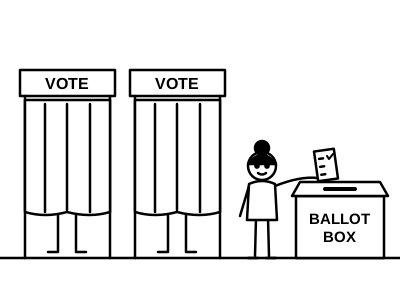
    Say: "Voting is a way for a group to make a choice. Each person gets one vote. Every vote counts the same." Hold up one paper slip. Say: "This is a ballot. A voter marks a choice on it." Stand the book up as a screen and mark a slip behind it. Say: "This is a secret ballot. Nobody sees my choice, so nobody can pressure me." Say: "To vote for national leaders, a person must be a U.S. citizen and at least 18 years old." Say: "Almost every state asks voters to register first. That means signing up on the list of voters." Say: "The choice with the most votes wins. A majority means more than half of the votes." Draw 7 stick-figure voters in the notebook. Ask: "How many votes make a majority of 7?" (4 or more.) Ask: "Where did I mark my ballot to keep it secret?" (Behind the book, in private.) Say: "After a fair vote, the winners still respect people who voted the other way." If stuck, say: "Split the 7 voters into two teams. The bigger team has 4. That is a majority."

    15–20 min · Activity / Source Work

    Family vote. 1) Pick a question with three choices, such as "Which game shall we play Saturday: a puzzle, a board game or tag?" 2) Your child makes one ballot per voter. Each ballot lists the three choices with a box beside each. 3) Keep it fair. Every voter gets one ballot, the same choices and a private place to mark it. 4) Each voter marks one box behind the book, folds the ballot and drops it in the box. 5) Your child opens the box and counts. Make a chart with three columns: Choice, Tally marks, Total. 6) Check the count. Do the totals add up to the number of voters? 7) Your child announces the winner. Ask: "Did the winner get a majority?" With three choices, the winner may have the most votes but not more than half. Real results vary. Look for a fair count. If two choices get the same number of votes, vote again between them. Ask: "How is a vote different from one person deciding?" (One person is faster. A vote gives everyone a say.)

    10 min · Notebook Entry

    Your child copies the tally chart, then finishes two frames: "Our vote was fair because ___. We kept our ballots secret by ___." Sample: "Our vote was fair because each person had one vote. We kept our ballots secret by marking them behind a book."

    5 min · Exit Ticket

    Read the three questions aloud. Your child answers in full sentences. Praise careful counting.

    Watch for: Thinking the oldest person, or the person who cares most, should get extra votes.

    Try: Say: "One person, one vote." Each voter holds up one finger while dropping in one ballot.

    Exit ticket (3 questions)
    1. Nine club members vote on a new club name. How many votes make a majority?
    2. Name two things a person must be before voting for national leaders.
    3. A club leader says, "Raise your hand so I can see who votes against my idea." What is wrong with this vote?
    Show answers
    1. 5 or more, because 5 is more than half of 9.
    2. A U.S. citizen and at least 18 years old. (Also accept: registered, in almost every state.)
    3. It is not secret. People may feel pressured to vote the way the leader wants.

    Support: Use a ballot with two choices and a picture for each. Your child sorts the ballots into two piles to count.

    Extend: Your child checks whether the winner had a majority. The most votes without a majority is called a plurality.

    Homework: Your child runs a second family vote tonight on a new question and records the tally. Look for: totals that match the number of voters.

    Mathematics

    I can compare fractions that have the same denominator.

    3.NF.A.3.D

    Builds on: Needs Week 19 Day 3 (a fraction counts unit fractions) and Week 1 Day 3 (the signs < and >). One-minute check: ask "How many 1/6 pieces make 5/6?" (5) Then write 45 ___ 54. Your child writes the sign (<).

    Materials: Fraction wall from Week 21 Day 1 (six marked strips, each 24 cm long), 3 index cards. Before the lesson, write one sign on each: <, > and =., 2 paper strips of different lengths (about 24 cm and 12 cm), Crayons, Notebook, Pencil

    5 min · Warm-Up

    Spaced review from Week 21 Day 4. Ask: "What whole number is 8/4?" (2) Then practice ÷8 facts with no clock. Ask 24 ÷ 8, 48 ÷ 8 and 80 ÷ 8 (3, 6, 10). Ask: "Which fact helps with 48 ÷ 8?" (8 × 6 = 48)

    10–15 min · Mini-Lesson

    Say: "Today we compare fractions with the same denominator. The denominator names the size of the pieces." Point to the eighths strip on the wall. Ask: "Are all the eighths the same size?" (Yes.) Write 2/8 and 5/8. Your child touches 2 eighths, then 5 eighths, counting from the left end. Ask: "Which one reaches farther?" (5/8) Say: "The pieces are the same size, so more pieces is more." Place the < card between the fractions. Read it together: "Two eighths is less than five eighths." Say: "So 2/8 < 5/8. The open side of the sign faces the greater fraction." Next, hold up the long strip and the short strip. Fold each one in half. Lay the two halves side by side. Ask: "Is half of the long strip the same as half of the short strip?" (No. Half of the long strip is longer.) Say: "We compare fractions only when the wholes are the same size. On the wall, every strip is the same whole." Now your child does more. Write 4/6 and 3/6. Your child shows both on the sixths strip, places a card and reads it. (4/6 > 3/6. Four sixths is greater than three sixths.)

    10–15 min · Guided Practice

    Your child shows each pair on the wall, places a sign card and reads the sentence aloud. 1) 1/4 and 3/4 (1/4 < 3/4) 2) 5/6 and 4/6 (5/6 > 4/6) 3) 7/8 and 4/8 (7/8 > 4/8) 4) 2/3 and 2/3 (2/3 = 2/3) If stuck, say: "Are the pieces the same size? Then count the pieces. Which fraction has more?"

    15–20 min · Independent Practice

    Your child writes <, > or = for each one in the notebook. 1) 1/3 ___ 2/3 (<) 2) 5/8 ___ 1/8 (>) 3) 2/4 ___ 3/4 (<) 4) 6/8 ___ 6/8 (=) 5) 5/6 ___ 3/6 (>) 6) You draw two same-size bars, each cut into 4 equal parts. Shade 1 part of one bar and 2 parts of the other. Your child writes the comparison. (1/4 < 2/4) 7) Ana walks 1/6 of a mile. Ben walks 5/6 of a mile. Who walks farther? (Ben. 5/6 > 1/6) 8) Two same-size pans of cornbread are each cut into 8 equal pieces. The Lee family eats 5 pieces. The Cruz family eats 7 pieces. Write both fractions. Who eats more? (5/8 and 7/8; the Cruz family. 7/8 > 5/8) Your child reads two answers aloud as full sentences, such as "one third is less than two thirds."

    5 min · Exit Ticket

    Put the wall away. Read each question aloud; your child writes each comparison with a sign.

    Watch for: Writing the sign the wrong way around, so the open side faces the smaller fraction.

    Try: Your child reads the sentence aloud to check it. Say: "The open side always faces the greater fraction."

    Fact fluency: ÷8 facts
    Exit ticket (3 questions)
    1. Compare 3/8 and 7/8. Write <, > or =.
    2. Compare 4/6 and 2/6. Write <, > or =.
    3. Why can you look at only the numerators here?
    Show answers
    1. 3/8 < 7/8
    2. 4/6 > 2/6
    3. Answers vary. Look for: the denominators are the same, so the pieces are the same size.

    Support: Your child colors each fraction on a quick strip sketch before choosing a sign card.

    Extend: Your child orders 6/8, 1/8, 4/8, 7/8 and 2/8 from greatest to least. (7/8, 6/8, 4/8, 2/8, 1/8) Ask: "How did you decide?"

    Homework: Your child writes 4 comparisons in fourths or sixths and draws strips for one of them. Sample: 1/6 < 4/6 and 3/4 > 2/4.

    English Language Arts

    I can make an inference by using a text clue and what I already know.

    RL.3.1SL.3.1L.3.6

    Builds on: Needs Week 2: inferring a character trait from an action. One-minute check: say "A friend shares her last cracker. What trait does that show?" (Generous or kind.)

    New words:
    • inference – a smart idea you figure out from a clue plus what you already know
    • text clue – words in the text that help you figure something out
    • compound word – two small words joined to make one word

    Materials: Reader's notebook, Pencil, A wet umbrella or a muddy shoe

    5 min · Warm-Up

    Word study, Week 22: compound words. Write sunshine, rainbow, snowman, bedroom, notebook, bookshelf. Say: "A compound word is two small words joined into one. Spell each small word, then join them with no space." Your child reads each word and draws a line between its two small words (sun|shine, rain|bow, snow|man, bed|room, note|book, book|shelf). Spaced review from Week 21. Ask: "Which linking words can start a new reason paragraph? Name two." (Any two: First, Another reason, Most importantly.)

    10–15 min · Mini-Lesson

    Before the lesson, set the wet umbrella or muddy shoe by the door. Point to it. Ask: "What happened outside? How do you know?" (It rained. The umbrella is wet, and umbrellas get wet in rain.) Say: "You just made an inference. An author does not tell you everything. You infer the rest." Write: Text clue + What I know = Inference. Read this story aloud. "After the Game": Tessa dropped her bag by the door and did not say hello. Her cleats left a trail of grass across the floor. She peeled off her shin guards and stared at the wall. "There's always next Saturday," Dad said softly. He set a bowl of popcorn beside her. Tessa picked up one piece, sighed, and leaned her head on his shoulder. Think aloud: "The text says cleats and shin guards. I know soccer players wear those. So I infer Tessa plays soccer. The author never used the word soccer." Write those three parts under the formula.

    10–15 min · Guided Practice

    Reread "After the Game." Your child says all three parts of the formula each time. 1) Ask: "How did the game go?" (Her team lost. Clues: no hello, staring at the wall, "next Saturday." People get quiet after a loss.) 2) Ask: "Why does Dad bring popcorn?" (He wants to cheer her up. People bring treats to comfort someone.) 3) Ask: "How does Tessa feel at the very end?" (A little better. She leans on Dad.) 4) Talk it over. Ask: "Could she just be tired? Which words rule that out?" (Dad's words about next Saturday point to a loss.) If stuck, say: "Put your finger on a clue. What do you know about that from real life?"

    15–20 min · Independent Practice

    Your child reads these three short scenes from this page. 1) "The streetlights blinked on. Mom called from the porch, and the kids groaned and picked up their bikes." 2) "Eli opened his lunch box and frowned. He looked at his sister's sandwich. 'Want to trade?' he asked." 3) "Grandpa patted every pocket. Then he looked under the newspaper and felt the top of his head." For each scene, your child writes three lines in the notebook: Clue, What I know, Inference. Good answers: 1) It is getting dark, so playtime is over, and the kids wish it were not. 2) Eli does not like his lunch. 3) Grandpa has lost something, probably his glasses. Look for a clue copied from the scene. Look for an inference the scene never states.

    5 min · Exit Ticket

    Read each question aloud. Your child writes the answers alone, then checks them with you.

    Watch for: A guess with no clue behind it, such as "Tessa is going to the park."

    Try: Ask, "Which words told you that?" If your child cannot point to words, it is not an inference yet.

    Exit ticket (3 questions)
    1. Read: "Lin shook her piggy bank and counted the coins twice. Then she put the toy back on the shelf." What can you infer?
    2. Which words about Lin were your clue?
    3. Which fact from real life did you add to the clue?
    Show answers
    1. Lin does not have enough money to buy the toy.
    2. She counted the coins twice and put the toy back.
    3. Answers vary. Look for: you need enough money to buy something, so you put it back if you are short.

    Support: Act out each scene with your child first. Ask, "What did you see me do?" before any writing.

    Extend: Your child writes a two-sentence scene that hides a feeling. You infer the feeling and name the clue.

    Homework: Read for 15 minutes. Then notice one clue about how a family member's day went. Write the clue and your inference. Look for a real clue, such as "Dad kicked off his shoes and sighed."

    Science

    I can name five climate types and color them on a world map.

    3-ESS2-2

    Builds on: Needs Week 20 Day 4: the five climate types and the equator on a world map. One-minute check: your child finds the equator on the globe or atlas and traces it with a finger.

    New words:
    • climate region – a large area of Earth where the usual weather is much the same
    • map key – the box on a map that tells what each color stands for

    Materials: World map outline on paper (printed, or traced from an atlas), World atlas or globe, Crayons in 5 colors: red, yellow, green, blue, brown, Flashlight, 1 sheet of white paper and a pencil, Science notebook

    5 min · Day 106 — The Five Major Climates — Wonder Warm-Up

    Spaced review from Week 21. Ask: "Why do we see lightning before we hear its thunder?" (Light travels much faster than sound.) Then the wonder. Point to the equator and to the North Pole on the globe or atlas. Ask: "The same sun shines on both places. Why is one hot and one frozen?" Say: "A flashlight will help us find out."

    10–15 min · Mini-Lesson

    Say: "A climate region is a large area where the usual weather is much the same." Now the flashlight model. 1) Lay the white paper flat on a table. 2) Hold the flashlight about 6 inches above the paper, pointing straight down. Your child traces the bright patch in pencil. 3) Keep the same distance, but tilt the flashlight so the light hits at a low slant. Your child traces the new patch. Ask: "Which patch is bigger?" (The slanted one.) "Which patch looks brighter?" (The straight-down one.) Say: "The same light is spread over more paper, so each spot gets less." Say: "Near the equator, sunlight comes almost straight down much of the year. Near the poles it comes at a low slant. Spread-out light warms the ground less." If stuck, say: "Which patch squeezes the light into less space?" Name the five types and their colors: tropical red, arid yellow, temperate green, polar blue, mountain brown.

    15–20 min · Investigation / Hands-On

    Color a Climate Map. Find each place in the atlas first. 1) Your child draws the equator across the outline map. 2) Red: a band along the equator through northern South America, the middle of Africa and Southeast Asia. 3) Yellow: the Sahara in northern Africa and the middle of Australia. 4) Blue: Antarctica, Greenland and the far northern edges of North America and Asia. 5) Brown: the Rocky Mountains, the Andes and the Himalayas. 6) Green: the eastern United States, most of Europe and eastern China. 7) Add a map key: five colored boxes with the climate names. 8) Ask for evidence: "What pattern do you see from the equator to the poles?" (Hot regions lie in the middle. Cold ones lie at the top and bottom.) Ask: "Does the brown follow that pattern?" (No. Mountains are cold because they are high.) Real climate maps show more regions, so small differences are fine.

    10 min · Science Notebook Entry

    In the notebook, your child makes a chart with three columns: Climate, What it is like, Example place. Look for five rows like these. Tropical: hot all year, often rainy; Manaus, Brazil. Arid: very dry; Cairo, Egypt. Temperate: four seasons; Paris, France. Polar: cold all year; Antarctica. Mountain: colder high up; the Andes in Peru. Then your child adds your own town and its climate type.

    5 min · Wrap-Up & Exit Ticket

    Read the three exit questions aloud; your child may point to the map. Praise answers that use the map or the flashlight as evidence.

    Watch for: Coloring a whole country or continent one color, as if it had a single climate.

    Try: Point to the United States on the map. Find green in the east, brown in the Rockies and blue in northern Alaska.

    Exit ticket (3 questions)
    1. On your map, which color lies along the equator? Which climate type does it stand for?
    2. Sunlight hits the ground at a low slant near the poles. How does that change how warm the ground gets?
    3. Name two different climate types found inside the United States.
    Show answers
    1. Red. It stands for tropical.
    2. The light is spread out, so the ground warms less and stays cold.
    3. Answers vary. Look for any two: temperate, arid, mountain, polar (northern Alaska) or tropical (Hawaii).

    Support: Color only the red band and the blue areas first. Then add one color at a time.

    Extend: Your child finds one country with three climate types on the map and tells where each is. Sample: the United States.

    Homework: Your child names the climate type where three relatives or friends live. Look for a reason for each, such as "Grandma's town is arid because it is very dry."
    Day 2 · Tuesday

    Social Studies

    I can name offices people vote for at the local, state and national levels.

    D2.Civ.1.3-5D2.Civ.2.3-5

    Builds on: Needs Week 19 Day 1 (the three levels of government). One-minute check: ask "Name the three levels of government, from closest to you to largest." (Local, state, federal.)

    New words:
    • office – a government job that a person is elected or chosen to do
    • ballot measure – a question on the ballot that voters decide themselves by marking yes or no

    Materials: Notebook, 9 index cards or paper slips, 4 sheets of paper for three sorting mats and a sample ballot, Marker, Pencil

    5 min · Warm-Up

    Spaced review from Week 19. Ask: "Which level of government takes care of town parks and local streets?" (Local government.) Then ask the big question: "Is the President the only leader people vote for?"

    10–15 min · Mini-Lesson

    Say: "An office is a government job. Voters choose people for offices at all three levels." With the marker, your child labels three paper sorting mats: Local, State, National. Say: "National means federal." Say: "Local offices include mayor, town council member and school board member. Many counties elect a sheriff." Say: "State offices include the governor and state legislators, who make state laws." Say: "National offices are President, U.S. senator and U.S. representative." Say: "Here is a tricky one. Voters in our state choose our two U.S. senators. Yet senators work in Congress for the whole country. So senator is a national office." Say: "Some ballots also ask a question, such as 'Should the town borrow money for a new fire truck?' Voters mark yes or no. That is a ballot measure." Say: "Local leaders decide about schools, roads and parks. Yet fewer people usually vote in local elections than for President." Ask: "Is a school board member local, state or national?" (Local.) Ask: "On a ballot measure, who decides?" (The voters.) If stuck, say: "Ask who this person works for: our town, our whole state or the whole country?"

    15–20 min · Activity / Source Work

    Office sort and sample ballot. 1) Your child writes one office on each of nine cards. Write mayor, governor, President and sheriff. Write U.S. senator, school board member and state legislator. Write town council member and U.S. representative. 2) Shuffle the cards. Your child sorts them onto the mats and says who each person works for. Expect four local, two state and three national cards. The sheriff is local. 3) Copy this made-up sample ballot onto the fourth sheet. "Willow Creek ballot. President of the United States. United States Senator. Governor. State Representative. Mayor of Willow Creek. School Board Member. Measure A: Shall Willow Creek build a walking trail along the river? Yes or No." 4) Your child writes L, S or N beside each contest. (President and Senator: N. Governor and State Representative: S. Mayor and School Board Member: L.) Say: "Read the first word. 'State' tells you the level." 5) Ask: "Which line is not an office? What is your evidence?" (Measure A. It asks a yes or no question, not for a person.) Real ballots vary. Look for the three levels.

    10 min · Notebook Entry

    In the notebook, your child draws three stacked boxes labeled Local, State and National. List the offices in each. Add one thing each level decides. Sample: "Local: mayor, parks. State: governor, state highways. National: President, the armed forces."

    5 min · Exit Ticket

    Read the three questions aloud. Your child answers without the mats. Praise answers that name the level.

    Watch for: Placing the governor or U.S. senators in the Local group because they are "ours."

    Try: Draw the nested circles from Week 19. Ask: "Does this person work for our town, our whole state or the whole country?"

    Exit ticket (3 questions)
    1. Sort these three offices by level: sheriff, governor, U.S. representative.
    2. A ballot asks, "Should the county add a small tax to repair bridges? Yes or No." What is this kind of ballot question called, and who decides it?
    3. Why should people vote in local elections, not only for President?
    Show answers
    1. Sheriff: local. Governor: state. U.S. representative: national.
    2. A ballot measure. The voters decide it themselves.
    3. Local leaders decide things close to daily life, such as schools, roads and parks.

    Support: Sort only six cards, two per level. First draw a house on the Local mat and a flag on the National mat.

    Extend: Your child asks an adult when the next local election is and which offices will be on that ballot.

    Homework: Your child asks a family member which office affects your family most, and why. Look for: a reason linked to a real decision.

    Mathematics

    I can compare fractions that have the same numerator.

    3.NF.A.3.D

    Builds on: Needs Week 19 Day 2 (more equal parts make smaller parts) and Week 22 Day 1 (comparing with signs). One-minute check: ask "Which piece is smaller, 1/4 or 1/2?" (1/4)

    Materials: Fraction wall from Week 21 Day 1 (six marked strips, each 24 cm long), Sign cards <, > and = from Day 1, Centimeter ruler, 2 paper strips of the same size (for folding), Notebook, Pencil

    5 min · Warm-Up

    Spaced review from Week 21 Day 2. Ask: "A square has 4 equal parts and 2 are shaded. What is another name for 2/4?" (1/2) Then practice ×8 facts with no clock. Ask 8 × 2, 8 × 5 and 8 × 9 (16, 40, 72). Ask: "How does 8 × 10 help with 8 × 9?" (One group of 8 fewer. 80 − 8 = 72.)

    10–15 min · Mini-Lesson

    Say: "Yesterday the denominators matched. Today the numerators match. We have the same number of pieces, but the pieces are different sizes." Ask: "Would you want a sandwich cut into 3 equal parts or 8 equal parts?" (3. The parts are bigger.) On the wall, your child measures one third and one eighth with the ruler. (8 cm and 3 cm) Say: "More parts in the whole means smaller parts. So 1/3 > 1/8." Place the > card and read it together: "One third is greater than one eighth." Write 3/4 and 3/8. Say: "Both are 3 pieces." Ask: "Which pieces are bigger, fourths or eighths?" (fourths) Your child finds the end of each fraction on the wall. (18 cm and 9 cm) Say: "So 3/4 > 3/8." Now your child does more. Write 2/3 and 2/6. Your child names the bigger pieces, checks on the wall and places a sign card. (Thirds are bigger. 2/3 ends at 16 cm and 2/6 ends at 8 cm. 2/3 > 2/6)

    10–15 min · Guided Practice

    Before each one, ask: "Which pieces are bigger?" Your child places a sign card and explains. 1) 1/6 and 1/2 (1/6 < 1/2) 2) 2/4 and 2/8 (2/4 > 2/8; 12 cm and 6 cm) 3) 3/8 and 3/6 (3/8 < 3/6; 9 cm and 12 cm) 4) Order 1/2, 1/8 and 1/3 from least to greatest. (1/8, 1/3, 1/2) If stuck, say: "Which whole is cut into more parts? Those parts are smaller. You have the same number of each."

    15–20 min · Independent Practice

    Your child writes <, > or = and checks problems 1 to 3 on the wall. 1) 1/4 ___ 1/3 (<) 2) 1/6 ___ 1/8 (>) 3) 2/6 ___ 2/4 (<) 4) 4/8 ___ 4/4 (<) 5) 3/2 ___ 3/4 (>) 6) You draw two same-size rectangles. Cut one into 2 equal parts and one into 3 equal parts. Shade 1 part of each. Your child writes the comparison. (1/2 > 1/3) 7) Two same-size pizzas are cut into 3 and 4 equal slices. Jo eats 2 slices of the first. Sam eats 2 slices of the second. Who eats more? (Jo. 2/3 > 2/4) 8) Three same-size jars hold beans. They are 1/6, 1/2 and 1/8 full. Which jar holds the most? (the jar that is 1/2 full) Ask about two answers: "How do you know without the wall?"

    5 min · Exit Ticket

    Put the wall away. Read each question aloud; your child answers on paper.

    Watch for: Choosing the fraction with the bigger denominator as the greater fraction.

    Try: Fold the two same-size strips, one into 2 parts and one into 8 parts. Your child holds one part of each side by side.

    Fact fluency: ×8 facts
    Exit ticket (3 questions)
    1. Which is greater, 1/8 or 1/2?
    2. Compare 5/6 and 5/8. Write <, > or =.
    3. Two fractions have the same numerator. How do you know which is greater?
    Show answers
    1. 1/2
    2. 5/6 > 5/8
    3. Answers vary. Look for: the one with the smaller denominator, because its pieces are bigger.

    Support: Use only unit fractions. Ask the sandwich question before each one: "Would you want 1 of 2 parts or 1 of 6 parts?"

    Extend: Your child explains without the wall why 5/4 is greater than 5/6. (Fourths are bigger pieces, and 5/4 is more than 1 whole.)

    Homework: Your child folds two same-size paper strips, one into halves and one into fourths. Your child shades one part of each and writes the comparison. (1/2 > 1/4)

    English Language Arts

    I can use a three-column chart to show the text clues and background knowledge behind my inferences.

    RL.3.1RI.3.1RI.3.3L.3.5.C

    Builds on: Needs yesterday's formula: text clue + what I know = inference. One-minute check: say "The dog's paws are muddy, and the flower bed is dug up. What can you infer?" (The dog dug in the flower bed.)

    Materials: Reader's notebook, Ruler, Pencil

    5 min · Warm-Up

    Word study: build compound words. Write one list: side, door, tooth, play, back, bath. Write a second list: brush, yard, walk, ground, tub, bell. Your child joins pairs to build six spelling words (sidewalk, doorbell, toothbrush, playground, backyard, bathtub). Say: "No space and no new letters." Spaced review from Week 13. Ask: "Which is right: The girls is reading, or The girls are reading?" (The girls are reading.)

    10–15 min · Mini-Lesson

    Your child uses the ruler to draw three columns: Text Clue | What I Know | Inference. Say: "Good readers can show where an inference comes from." Read this aloud. "Winter Visitors": Every November, Mrs. Tran fills her bird feeder with seeds. By December, snow covers the ground, and the bushes have no berries left. Now the feeder is empty by noon each day. In January, Mrs. Tran hangs a second feeder beside the first. Then April comes. The snow melts, and insects buzz in the grass. The feeder stays full for days at a time. Model row 1 and write it. Clue: snow covers the ground, and no berries are left. Know: birds eat seeds and berries from plants. Inference: birds cannot find food, so they crowd the feeder. Say: "The author never said the birds were hungry. I figured it out." Point out the cause and effect: "Snow hides their food, so more birds visit."

    10–15 min · Guided Practice

    1) Fill in row 2 together with the April clue. Ask: "Why does the feeder stay full?" (Clue: the snow melts and insects buzz. Know: birds eat insects and new plants. Inference: birds find food in other places.) 2) Your child lists the time words that show the order in the notebook (November, December, January, April). 3) Ask: "What caused the change from December to April?" (Spring brought the birds' food back.) 4) Write five words in a line, each more sure than the last: wonder, guess, suspect, believe, know. Ask: "Which word fits our April inference?" (Suspect or believe. The clues are strong, but the author did not say it.) If stuck, say: "Read the April sentences again. What do birds eat besides seeds?"

    15–20 min · Independent Practice

    Your child reads this story alone and adds three rows to the chart. "Grandpa Joe's Garden": Grandpa Joe knelt by his tomato plants and frowned. Half the leaves had holes, and a few tomatoes had bite marks. He rubbed his chin and looked toward the woods. Then he went to the shed and came back with a roll of wire fence. That night, he set a flashlight by the window. Two mornings later, every tomato was whole. Grandpa whistled as he watered. 1) Fill in a row for the holes and bite marks. 2) Fill in a row for the wire fence. 3) Fill in a row for the flashlight. 4) Under the chart, write each inference as a sentence. Start each with "I suspect," "I believe" or "I know." Good answers: an animal is eating the plants. Grandpa plans to fence the garden. He plans to watch for the animal at night. Sample: "I suspect a rabbit is eating the tomatoes."

    5 min · Exit Ticket

    Your child answers in the notebook and may reread the two texts.

    Watch for: Copying a clue into the Inference column, so the row only repeats the text.

    Try: Ask, "Did the author say this exact thing?" If yes, move it to the Clue column.

    Exit ticket (3 questions)
    1. In "Winter Visitors," why does Mrs. Tran hang a second feeder in January?
    2. At the end of "Grandpa Joe's Garden," every tomato is whole and Grandpa whistles. What can you infer?
    3. Which word shows you are more sure: guess or believe? Use it in a sentence about Grandpa Joe.
    Show answers
    1. So many hungry birds come that one feeder is not enough. Clue: the first feeder is empty by noon.
    2. The fence kept the animal out, and Grandpa is happy.
    3. Believe. Sample: I believe the fence kept the animal out.

    Support: Before reading, talk for one minute about gardens and hungry animals. This fills the What I Know column aloud.

    Extend: Your child names two animals that might eat tomatoes. Then your child lists one clue that would help decide, such as tiny tracks.

    Homework: Read for 15 minutes in your own book. Fill in one row of the three-column chart. Look for an inference the page does not state.

    Science

    I can describe tropical climates and the living things that thrive there.

    3-ESS2-23-LS4-3

    Builds on: Needs Day 1: tropical climates lie along the equator. Also needs Week 11: a rainforest is warm and very wet. One-minute check: your child points to the red band on the Day 1 map and names its climate (tropical).

    New words:
    • savanna – warm grassland with scattered trees, a rainy season and a long dry season
    • wet season – the months when most of a place's rain falls
    • dry season – the months when little or no rain falls

    Materials: Climate map from Day 1, World atlas or globe, 12 small paper slips, Science notebook, pencil and crayons, Library book with rainforest and savanna pictures (optional)

    5 min · Day 107 — Tropical Climates — Wonder Warm-Up

    Spaced review from Day 1. Ask: "Why is it warm near the equator much of the year?" (Sunlight comes almost straight down, so it is not spread out.) Then the wonder. If you have the library book, show a rainforest and a savanna. Ask: "Both places are warm all year. So why does one grow giant trees and the other mostly grass?"

    10–15 min · Mini-Lesson

    Say: "Tropical climates are warm in every month. What changes from place to place is the rain." Draw this table in the notebook and read it together. Rain in inches. Rainforest town: January 10, April 12, July 6, October 7. Savanna town: January 0, April 1, July 8, October 2. These are sample numbers. Ask: "Which town gets plenty of rain in all four months?" (The rainforest town.) "Which months are dry in the savanna town?" (January, April and October.) Say: "A rainforest has rain in every season. A savanna has a wet season and a long dry season." Ask: "Trees need water all year to grow tall and crowded. Where can they do that?" (In the rainforest.) If stuck, say: "Put your finger on the zero. What could a tree drink that month?" Say: "On a savanna, grasses and scattered trees last through the dry months. The Amazon in South America is the largest rainforest. The Serengeti in Africa is a famous savanna. Herds of wildebeest walk far there, following the rain and fresh grass."

    15–20 min · Investigation / Hands-On

    Rainforest or Savanna Sort. 1) Your child finds the Amazon and the Serengeti in the atlas and marks both on the Day 1 map. 2) Write one name on each slip. Rainforest: toucan, jaguar, poison dart frog, howler monkey, kapok tree, orchid. Savanna: gazelle, lion, giraffe, elephant, acacia tree, tall grass. 3) Mix the slips. Your child sorts them into two columns. 4) Your child picks one slip and tells how that living thing fits its home. Sample: "A giraffe's long neck reaches leaves high in acacia trees." 5) Mix-up test. Move the poison dart frog to the savanna. Ask: "Would it survive well, less well or not at all? What is your evidence?" (Not at all, or less well. A frog's thin skin must stay damp, and the dry season lasts for months.) Accept another answer if the evidence fits.

    10 min · Science Notebook Entry

    Title the page "Tropical Climates." Give the frames: "A tropical climate is ___ all year. A rainforest has ___. A savanna has ___." Sample: "A tropical climate is warm all year. A rainforest has rain in every season. A savanna has a wet season and a long dry season." Then your child draws both places with crayons and labels one plant and one animal in each.

    5 min · Wrap-Up & Exit Ticket

    Read the three exit questions aloud. Praise any answer that gives a reason about rain.

    Watch for: Thinking every tropical place is a thick, wet jungle.

    Try: Point to the savanna town's dry months in the table. Ask: "What would this land look like after months with almost no rain?" (Dry and brown, with few trees.)

    Exit ticket (3 questions)
    1. A place is warm all year. Rain falls for five months, and almost none falls for seven. Is it a rainforest or a savanna? How do you know?
    2. Why can tall trees grow close together in a rainforest?
    3. A wildebeest eats grass. Would it survive well in a thick, shady rainforest? Give one reason.
    Show answers
    1. A savanna. It has a wet season and a long dry season.
    2. Rain falls in every season, so the trees have water all year.
    3. No, not well. Little grass grows on the dark forest floor, so it would find little food.

    Support: Sort only six slips first: toucan, jaguar, kapok tree, giraffe, lion and tall grass. Add the others once those are placed.

    Extend: Your child draws a bar graph of the rain table, with two bars for each month. Ask which month shows the biggest difference (April, 11 inches).

    Homework: Your child looks in the kitchen for three foods that grow in tropical climates. Look for foods such as bananas, pineapple, cocoa, coconut or mango.

    Day 3 · Wednesday

    Social Studies

    I can explain how candidates campaign and how voters compare them fairly.

    D2.Civ.10.3-5D2.Civ.9.3-5D3.2.3-5

    Builds on: Needs Week 8 Day 2 (an opinion cannot be proved). One-minute check: ask "Fact or opinion: 'Tag is the best game'?" (An opinion. It cannot be checked.)

    New words:
    • candidate – a person who runs for an office
    • campaign – the work a candidate does to win votes
    • debate – a meeting where candidates take turns answering the same questions
    • political party – a group of people who share ideas about what government should do

    Materials: Notebook, Pencil, 2 index cards for the candidate cards, 1 sheet of paper and markers for a small poster, Timer or clock

    5 min · Warm-Up

    Spaced review from Week 21. Ask: "Which First Amendment freedom lets people say what they think about a leader?" (Freedom of speech.) Then ask the big question: "If you wanted people to vote for you, what would you do?"

    10–15 min · Mini-Lesson

    Say: "A candidate is a person who runs for an office. A campaign is the work a candidate does to win votes." Say: "Candidates share plans, meet voters and make ads. In a debate, candidates take turns answering the same questions." Say: "Many candidates belong to a political party, a group of people who share ideas about government. Some run without a party." Write two campaign lines in the notebook. Line A: "Vote Lee! Lee loves our town!" Line B: "Lee will keep the library open on Sundays." Ask: "Which line can a voter check later?" (Line B.) Say: "A fact or a plan can be checked. An opinion is a feeling. Trust a source more when its facts can be checked." Ask: "Where could a voter check a candidate's plan?" (In more than one source, such as a debate and a news story.) Say: "People's lives shape what they want. A grandparent may care most about benches. A parent of small children may care about swings." Say: "People who back different candidates can still be good neighbors and friends." If stuck, say: "Ask: Could I check this? If yes, it is a fact or a plan."

    15–20 min · Activity / Source Work

    Candidate cards for a pretend office, Park Planner. 1) Copy each card onto an index card, or read both aloud. Card 1: "Rosa Kim. Plan: add a splash pad to Oak Park. Reason: summers here are hot. Cost: high. A splash pad needs pipes and water all summer." Card 2: "Darnell Brooks. Plan: fix the broken swings and add four benches. Reason: people of more ages can use them all year. Cost: lower. Swings and benches need little care." 2) Your child draws a chart with five columns: Candidate, Plan, One strength, One cost or worry, A question I would ask. Fill it in with evidence from the cards. 3) Your child picks one candidate and makes a small poster with a slogan and one fact from the card. 4) Hold a short debate. You play the other candidate. Both answer: "Why is your plan best for the park?" Each speaker gets 30 seconds on the timer. Choices vary. Look for reasons taken from the cards.

    10 min · Notebook Entry

    Your child finishes two frames under the chart: "I would vote for ___ because ___. One good thing about the other plan is ___." Sample: "I would vote for Darnell Brooks because fixing swings costs less. One good thing about the other plan is that it cools children off."

    5 min · Exit Ticket

    Read the three questions aloud. Praise reasons that come from a plan, not from a poster.

    Watch for: Choosing a candidate for a catchy slogan or poster colors, not for the plan.

    Try: Turn the poster face down. Ask: "Which plan solves the park's problem better? Why?"

    Exit ticket (3 questions)
    1. A candidate visits a farmers market, hands out flyers and answers voters' questions. What is this work called?
    2. A flyer says, "Everyone knows Pat is the best choice." Is that a fact or an opinion? How can you tell?
    3. Why might two good neighbors want different candidates to win?
    Show answers
    1. A campaign, or campaigning.
    2. An opinion. It is a feeling that cannot be checked.
    3. They have different needs and experiences, so different plans matter most to them.

    Support: Read the cards aloud twice. Give a frame: "One good thing about ___'s plan is ___."

    Extend: Your child writes two questions a reporter could ask each candidate about cost or who is helped.

    Homework: With a family member, your child looks at one ad on a box, a flyer or a sign. Sort its words into facts and opinions. Look for: at least one statement that can be checked.

    Mathematics

    I can tell whether a fraction is less than, equal to or more than 1/2, and how close it is to 1.

    3.NF.A.3.D3.NF.A.3.B

    Builds on: Needs Week 21 Day 1 (fractions equal to 1/2 on the wall) and Week 22 Day 1 (same denominator). One-minute check: ask "Which is greater, 5/8 or 7/8?" (7/8)

    New words:
    • benchmark – a number we know well and use to judge other numbers

    Materials: Fraction wall from Week 21 Day 1 (six marked strips, each 24 cm long), Centimeter ruler, Crayons, Notebook, Pencil

    5 min · Warm-Up

    Spaced review from Week 20 Day 2. Ask: "On a number line, is 2/3 closer to 0 or closer to 1?" (Closer to 1.) Then practice ×6 facts with no clock. Ask 6 × 3, 6 × 5 and 6 × 8 (18, 30, 48). Ask: "How does 6 × 5 help with 6 × 6?" (Add one more 6. 30 + 6 = 36.)

    10–15 min · Mini-Lesson

    Say: "1/2 is a benchmark. We know it well, so we use it to judge other fractions. Is a fraction less than half, exactly half or more than half?" Stand the ruler straight down the wall at 12 cm. Ask: "Which fourths end at this line?" (2/4) "Which sixths?" (3/6) "Which eighths?" (4/8) Say: "Each one is another name for 1/2." Write 3/8 and 1/2. Say: "The denominators are different. I give 1/2 a new name in eighths." Ask: "Which eighths equal 1/2?" (4/8) Say: "Now the denominators match. 3/8 < 4/8. So 3/8 is less than 1/2." Write 5/6. Ask: "Which sixths equal 1/2?" (3/6) Say: "5/6 > 3/6. So 5/6 is more than 1/2." Point to 7/8 on the wall. Ask: "How many more eighths make the whole?" (1) Say: "7/8 is one 1/8 piece away from 8/8. It is close to 1." Now your child does more. Write 3/4. Your child gives 1/2 a new name in fourths and decides. (1/2 = 2/4. 3/4 > 2/4, so 3/4 is more than 1/2.)

    10–15 min · Guided Practice

    Your child says less than 1/2 or more than 1/2, then proves it with the ruler on the wall. 1) 1/4 (less; 1/4 < 2/4) 2) 5/8 (more; 5/8 > 4/8) 3) 4/6 (more; 4/6 > 3/6) 4) Which is closer to 1, 7/8 or 5/8? (7/8; it is one piece away from 8/8) If stuck, say: "Find the strip with that denominator. Where is the 12 cm line? Is your fraction before it, on it or past it?"

    15–20 min · Independent Practice

    Your child writes less than 1/2, equal to 1/2 or more than 1/2. 1) 1/8 (less) 2) 2/4 (equal) 3) 7/8 (more) 4) 3/6 (equal) 5) 2/8 (less) 6) You draw a rectangle cut into 8 equal parts and shade 4 parts. Ask: "Less, equal or more?" (Equal. 4/8 = 1/2.) 7) Lena eats 1/3 of her sandwich. Does she eat more or less than half of it? (Less. Thirds are smaller than halves, so 1/3 < 1/2.) 8) Two same-size jars hold beans. One is 5/6 full and one is 3/6 full. Which jar is closer to full? (The 5/6 jar. It is one 1/6 piece away from 6/6.) Your child checks problems 1 to 5 with the ruler on the wall. Ask: "Which ones sit exactly on the 12 cm line?" (problems 2 and 4)

    5 min · Exit Ticket

    Put the wall away. Read each question aloud; your child answers on paper and may sketch a strip.

    Watch for: Thinking 3/6 must be more than 1/2 because its numbers are bigger.

    Try: Your child finds the end of 3/6 on the wall. It ends at 12 cm, exactly where 1/2 ends.

    Fact fluency: ×6 facts
    Exit ticket (3 questions)
    1. Is 1/6 more or less than 1/2?
    2. Is 6/8 more or less than 1/2?
    3. Which is closer to 1: 2/3 or 1/3?
    Show answers
    1. Less. 1/2 is the same as 3/6.
    2. More. 1/2 is the same as 4/8.
    3. 2/3. It is one 1/3 piece away from 3/3.

    Support: Draw a bold crayon line down the whole wall at 12 cm. Your child checks each fraction against that line and says before, on or past.

    Extend: Your child finds the first fraction past 1/2 on four strips. (2/3 and 4/6 at 16 cm, 3/4 at 18 cm, 5/8 at 15 cm)

    Homework: Your child sketches strips for 1/4, 4/6 and 3/8 and writes less than 1/2 or more than 1/2 under each. (less, more, less)

    English Language Arts

    I can infer how a character feels from their actions, words and the pictures.

    RL.3.3RL.3.1RL.3.7L.3.5.B

    Builds on: Needs the inference formula from Day 1 and Week 2 work on character traits. One-minute check: say "Dee hummed and skipped down the hall. How does she feel?" (Happy or cheerful.)

    Materials: Reader's notebook, Crayons or colored pencils, Plain paper, Pencil, A picture book or comic from your child's shelf

    5 min · Warm-Up

    Word study: dictation. Say this sentence twice while your child writes it: "I left my notebook on the bookshelf in my bedroom." Check it together. Your child touches each compound word and names its two small words. Fix any gap, such as "book shelf." Spaced review from Week 19. Ask: "Three trees stand in a row. Is one the taller or the tallest?" (The tallest. Use -est for three or more.)

    10–15 min · Mini-Lesson

    Cross your arms and frown. Then jump and clap. Ask: "What feeling did each one show?" (Angry; excited.) Say: "Authors rarely write 'Kofi was sad.' They show it with what a character does and says. Pictures add more clues." Read this aloud. "Kofi's Kite": Kofi gripped the string with both hands as the red kite climbed higher and higher. "Look at it go!" he shouted. Then a gust of wind snapped the string. Kofi's mouth fell open. He watched the kite drift over the rooftops until it was a tiny dot. He sat down on the grass and pulled his knees to his chest. His sister Ama dropped down beside him. Without a word, she pressed her own kite string into his hand. Kofi wiped his eyes and slowly stood up. Draw two columns: What Kofi Does or Says | Feeling I Infer. Model row 1: "He gripped the string and shouted, 'Look at it go!' People shout like that when they are thrilled. I infer Kofi is excited and proud." Write it in the chart.

    10–15 min · Guided Practice

    1) Read: "Kofi's mouth fell open." Ask: "What feeling is that?" (Shocked or surprised.) 2) Read: "He watched the kite drift until it was a tiny dot." Ask: "What feeling?" (Sad, or wishing it would come back.) 3) Ask: "Does Kofi feel the same all through the story?" (No. Excited, then shocked, then sad.) Draw arrows between the feelings. 4) Open the picture book to any picture. Ask: "What does this picture tell about a feeling that the words do not?" (Answers vary. Look for a face, a body shape or a color named as the clue.) If stuck, say: "Do that action with your own body. How do you feel?"

    15–20 min · Independent Practice

    1) Add a row for "pulled his knees to his chest." (Sad, disappointed or wanting to be alone.) 2) On plain paper, draw the moment the string snaps. Use the crayons to show the feeling in Kofi's face, his body and the sky. 3) Under the drawing, finish this sentence: "My picture shows ___, which the words do not say." Sample: "My picture shows a huge gray sky, so Kofi looks small and alone." 4) Real-life link. Write one sentence each for two feeling words: disappointed and proud. Sample: "I felt disappointed when rain canceled my party." Look for a drawing that matches the text. Look for a real event for each word.

    5 min · Exit Ticket

    Ask the questions aloud. Your child answers in the notebook with the story in view.

    Watch for: Naming one feeling for the whole story and missing that Kofi's feelings change.

    Try: Ask, "How does Kofi feel at the start? In the middle? At the end?" Draw an arrow between the feelings.

    Exit ticket (3 questions)
    1. What does Ama do at the end, and what does that show about her?
    2. How does Kofi feel at the very end? Name the action that is your clue.
    3. Picture the last moment as an illustration. Name one detail an artist could add to show the mood.
    Show answers
    1. She gives Kofi her own kite string. It shows she is kind and cares about him.
    2. A little better, hopeful or thankful. He wipes his eyes and stands up.
    3. Answers vary. Look for: faces, a small smile, Ama's hand, or brighter colors as the mood lifts.

    Support: Write a feelings word bank on a strip of plain paper: excited, proud, shocked, sad, hopeful, thankful.

    Extend: Your child rewrites the last two sentences so Kofi stays upset. Only his actions may change.

    Homework: Read for 15 minutes. Find one picture in a picture book or comic that shows a feeling the words do not say. Tell a family member the clue. Look for a clue in the picture, not the words.

    Science

    I can describe a temperate climate's four seasons and how living things change through the year.

    3-ESS2-23-LS4-3

    Builds on: Needs Day 1: temperate regions are green on the map, between the tropical band and the polar areas. One-minute check: your child names the four seasons in order, starting with spring (spring, summer, fall, winter).

    New words:
    • deciduous – a kind of tree that drops all its leaves in fall and grows new ones in spring

    Materials: 1 sheet of plain paper, Crayons, Science notebook and pencil, A window or doorway with a view of a tree or yard

    5 min · Day 108 — Temperate Climates — Wonder Warm-Up

    Spaced review from Day 2. Ask: "How is a savanna different from a rainforest?" (A savanna has a long dry season. A rainforest has rain in every season.) Then look out the window together. Ask: "What season is it now? What clues can you see?" Wonder: "Why do some places have four seasons?"

    10–15 min · Mini-Lesson

    Say: "A temperate climate has four seasons: spring, summer, fall and winter. Summers are warm and winters are cool or cold." Draw this table in the notebook for a sample temperate town. Winter: usual high 40°F, about 9 hours of daylight. Spring: 62°F, about 13 hours. Summer: 86°F, about 15 hours. Fall: 64°F, about 11 hours. Ask: "Which season has the most daylight?" (Summer.) "Which season is warmest?" (Summer.) "What pattern do you see?" (More daylight goes with warmer weather.) Say: "In summer the sun also climbs higher, so its light is less slanted. Longer days and more direct light warm our part of Earth." If stuck, say: "Think of the flashlight. Which light warmed a spot more, straight or slanted?" Now living things. Say: "Many trees here are deciduous. Maples and oaks drop their leaves in fall and grow new ones in spring. Dropping leaves saves water while the ground is frozen." Ask: "What might animals do before winter?" (Sample: store food, grow thick fur or fly south.) Say: "Many geese fly south. Squirrels store nuts."

    15–20 min · Investigation / Hands-On

    Four Seasons Tree. 1) Fold the plain paper into four boxes. Label them spring, summer, fall and winter. 2) With crayons, your child draws the same deciduous tree in every box. Spring has buds and small leaves. Summer has full green leaves. Fall has colored leaves falling. Winter has bare branches. 3) Read six clues one at a time. They are blossoms, frogs calling, swimming outdoors, ripe apples, geese flying south and snowflakes. Your child draws or writes each in the season that fits best. 4) Check with this table. Spring: blossoms, frogs calling. Summer: swimming. Fall: ripe apples, geese flying south. Winter: snowflakes. 5) Ask for evidence: "Pick one change. What causes it?" (Sample: "Geese fly south because food is hard to find under snow.") 6) Your child circles today's season and adds one clue seen from the window. Seasons arrive at different times in different places. Accept a match that fits where you live.

    10 min · Science Notebook Entry

    Title the page "Temperate Climates." Give the frames: "A temperate climate has ___. In fall, deciduous trees ___. In summer the days are ___ and the weather is ___." Sample: "A temperate climate has four seasons. In fall, deciduous trees drop their leaves. In summer the days are long and the weather is warm." Keep the folded tree page inside the notebook.

    5 min · Wrap-Up & Exit Ticket

    Read the three exit questions aloud; your child answers on paper. Praise answers that connect daylight, temperature and living things.

    Watch for: Believing summer is hot because Earth moves closer to the sun.

    Try: Say that Earth is nearest the sun in early January, during northern winter. Then point to the table: summer has more daylight.

    Exit ticket (3 questions)
    1. Put these in order, starting with winter: full green leaves, bare branches, colored leaves falling, new buds.
    2. In a temperate place, which season has the shortest days? What is the weather usually like then?
    3. A chipmunk gathers seeds in fall and stores them underground. How does that help it survive winter?
    Show answers
    1. Bare branches, new buds, full green leaves, colored leaves falling.
    2. Winter. It is usually cool or cold.
    3. Food is hard to find in winter, so it eats its stored seeds.

    Support: Take the clues one box at a time. Point to a season and ask, "Does this clue fit here?" Your child answers yes or no.

    Extend: Your child picks one tree outdoors and sketches it today. They sketch it again each month and compare the drawings.

    Homework: Your child lists three signs of the current season seen outdoors. Look for things they really observed, such as bare branches, buds or birds.

    Day 4 · Thursday

    Social Studies

    I can explain why each vote matters using a close-election example.

    D2.Civ.2.3-5D2.Civ.12.3-5

    Builds on: Needs Day 1 (a majority is more than half) and adding numbers within 25. One-minute check: ask "Ten people vote. Is 5 votes a majority?" (No. A majority of 10 is 6 or more.)

    New words:
    • tie – when two choices get exactly the same number of votes
    • Election Day – the day set by law for voting

    Materials: Notebook, Pencil, 25 counters, buttons or dried beans: 11 of one color, 10 of a second and 4 of a third (or paper squares marked Y, N and ?), 1 sheet of paper for a voting mat

    5 min · Warm-Up

    Spaced review from Week 20. Ask: "Which branch of government does Congress belong to?" (The legislative branch.) Then ask the big question: "Can one vote really make a difference?"

    10–15 min · Mini-Lesson

    Say: "Some elections are very close. A few town elections have even ended in a tie." Say: "In some places, the law then breaks the tie by drawing a name or flipping a coin." Say: "In many local elections, fewer than half of the people who may vote take part. Those who vote choose for everyone." Say: "National elections come in even-numbered years. Election Day is the Tuesday after the first Monday in November." Say: "The rules about who may vote have changed, because people worked to change them." Draw a timeline in the notebook. Say each date as you write it. Say: "Long ago, mostly white men who owned land could vote." "1870: an amendment said race could not be used to stop a citizen from voting. Still, unfair rules kept many Black citizens from voting until a 1965 law." "1920: an amendment protected women's right to vote." "1924: a law said all Native people born in the United States are U.S. citizens. Some states still blocked Native voters for many years." "1971: the voting age became 18." Ask: "How did those rules change?" (People spoke up, marched, wrote and voted until laws and amendments changed.) Ask: "If only a few people vote, who decides?" (Only the people who voted.) If stuck, say: "Think of our family vote. What if only two of us had voted?"

    15–20 min · Activity / Source Work

    Counter model. A youth club has 25 members. They vote on one question: "Should the club also meet on Saturdays?" 1) Your child draws three boxes on the mat: Yes, No, Did not vote. 2) Lay 11 counters on Yes, 10 on No and 4 on Did not vote. Check that 11, 10 and 4 make 25. 3) Draw a chart with four columns: Round, Yes, No, Winner. Round 1 is 11 to 10. Yes wins by 1. 4) Change one thing each round: where the 4 extra counters go. Keep the first 21 votes the same. Round 2: move all 4 to No. Now it is 11 to 14. No wins. Round 3: reset, then move just 1 to No. It is 11 to 11, a tie. 5) Ask: "What is your evidence that the 4 members mattered?" (The winner changed when they voted.) 6) Talk about why people miss a vote: busy, forgot, did not know the date, no ride. Brainstorm three ways to help, such as a reminder note or a ride. Real elections vary. Look for the pattern: a close vote can flip.

    10 min · Notebook Entry

    Your child draws Round 1 and Round 2 as two bar pictures. Then finish the frame: "Every vote matters because ___." Sample: "Every vote matters because four people who stayed home could have changed the winner." Then list the three ways to help people vote.

    5 min · Exit Ticket

    Read the three questions aloud. Your child may use counters for the first one. Praise answers that explain with numbers.

    Watch for: Deciding that voting does not matter because one vote rarely decides an election.

    Try: Point to the 4 counters. Say: "Each of these 4 thought one vote did not matter. Together they changed the result."

    Exit ticket (3 questions)
    1. A hiking club votes: 9 for the lake trail and 8 for the hill trail. Three members stayed home. Could those 3 have changed the result? Explain.
    2. In 1920 the rule about women voting changed across the country. What changed it?
    3. Name one way a child can help more adults remember to vote.
    Show answers
    1. Yes. If all 3 had voted for the hill trail, it would have 11 votes, more than 9.
    2. An amendment to the Constitution, after many people worked for years to change the rule.
    3. Answers vary. Look for: make a reminder sign, share the date, or ask family members about their plan to vote.

    Support: Use only 10 counters: 5 Yes, 4 No and 1 Did not vote. Move the 1 counter to No to make a tie.

    Extend: Your child invents a new round for a club of 20, where members who stayed home change the winner.

    Homework: Your child shows a family member Rounds 1 and 2 with counters and asks why voting matters to them. Look for: your child explains how 4 missing votes changed the winner.

    Mathematics

    I can compare two fractions with the same numerator or the same denominator on a number line.

    3.NF.A.3.D3.NF.A.2.B

    Builds on: Needs Week 20 Days 2 and 3 (placing fractions on number lines, also past 1) and Week 22 Days 1 and 2. One-minute check: ask "On a 24 cm line in fourths, where is 1/4?" (at 6 cm)

    Materials: Centimeter ruler, 3 sheets of paper, turned sideways, 2 crayons of different colors, Notebook, Pencil

    5 min · Warm-Up

    Spaced review from Week 21 Day 3. Ask: "Are 2/2 and 4/4 equivalent? How do you know?" (Yes. Both are 1 whole.) Then practice ×7 facts with no clock. Ask 7 × 3, 7 × 6 and 7 × 9 (21, 42, 63). Ask: "How does 7 × 10 help with 7 × 9?" (One group of 7 fewer. 70 − 7 = 63.)

    10–15 min · Mini-Lesson

    Say: "On a number line, the fraction farther to the right is greater. It is farther from 0." Draw a line 24 cm long. Write 0 at the left end and 1 at the right end. Mark sixths with a tick every 4 cm. Your child puts a crayon dot on 3/6 and another color on 5/6. Ask: "Where are the dots?" (at 12 cm and 20 cm) "Which is farther right?" (5/6) Say: "So 5/6 > 3/6." Now the numerators match. Draw two more 24 cm lines, one under the other. Line up the 0s. Mark thirds every 8 cm on the top line. Mark fourths every 6 cm on the bottom line. Your child dots 2/3 and 2/4. (16 cm and 12 cm) Say: "2/3 is farther right. So 2/3 > 2/4." Now your child does more. Your child draws stacked lines in sixths and eighths, with ticks every 4 cm and every 3 cm. Your child dots 5/6 and 5/8 and compares. (20 cm and 15 cm. 5/6 > 5/8)

    10–15 min · Guided Practice

    Your child dots both fractions in different colors and writes the comparison. 1) 1/4 and 3/4 on one fourths line (6 cm and 18 cm; 1/4 < 3/4) 2) 2/6 and 2/3 on stacked lines (8 cm and 16 cm; 2/6 < 2/3) 3) Draw a 0 to 2 line 24 cm long, with 1 at 12 cm. Mark fourths every 3 cm. Compare 7/4 and 5/4. (21 cm and 15 cm; 7/4 > 5/4) If stuck, say: "Do both lines start at the same 0? Count the jumps from 0. Which dot is farther right?"

    15–20 min · Independent Practice

    Your child draws lines 24 cm long, dots each fraction and writes <, > or =. 1) 1/3 ___ 2/3 (<; 8 cm and 16 cm) 2) 7/8 ___ 4/8 (>; 21 cm and 12 cm) 3) 1/2 ___ 1/8 (>; 12 cm and 3 cm) 4) 3/8 ___ 3/6 (<; 9 cm and 12 cm) 5) Use a 0 to 2 line with 1 at 12 cm. 3/2 ___ 3/4 (>; 18 cm and 9 cm) 6) Put 2/8, 7/8, 4/8 and 1/8 on one line. Order them from least to greatest. (1/8, 2/8, 4/8, 7/8) 7) A snail crawls 2/8 of a path. A beetle crawls 2/4 of the same path. Which one goes farther? (The beetle. 2/4 > 2/8) 8) A red ribbon is 5/4 feet long. A blue ribbon is 3/4 of a foot long. Which ribbon is longer? (Red. 5/4 > 3/4)

    5 min · Exit Ticket

    Your child keeps the ruler and one sheet of paper. Read each question aloud; your child draws and answers.

    Watch for: Drawing the two number lines with different lengths, so the comparison is not fair.

    Try: Your child lines up both 0s and both 1s with the ruler before marking any ticks.

    Fact fluency: ×7 facts
    Exit ticket (3 questions)
    1. Compare 2/4 and 3/4 on a number line. Write <, > or =.
    2. Compare 1/3 and 1/2 on stacked number lines. Write <, > or =.
    3. On a number line, how can you tell which fraction is greater?
    Show answers
    1. 2/4 < 3/4
    2. 1/3 < 1/2
    3. Answers vary. Look for: the greater fraction is farther to the right, farther from 0.

    Support: Draw the stacked lines and ticks ahead of time. Your child only labels the ticks and dots the two fractions.

    Extend: Your child places 1/2, 3/2 and 3/4 on a 0 to 2 line and writes two comparisons. (1/2 < 3/2 and 3/4 < 3/2)

    Homework: Your child draws a 0 to 2 line in fourths, with 1 at 12 cm, and marks 3/4, 5/4 and 7/4. Your child writes two comparisons. Sample: 3/4 < 5/4 and 7/4 > 5/4.

    English Language Arts

    I can use context clues to figure out the meaning of new words in stories and informational texts.

    L.3.4.AL.3.4.DRF.3.4.CRI.3.4L.3.6

    Builds on: Needs the inference formula from Day 1 and context clues from Week 7. Today the clues point to a word's meaning. One-minute check: say "The gleeful kids laughed and danced. What might gleeful mean?" (Very happy.)

    New words:
    • synonym – a word that means the same, or almost the same, as another word
    • antonym – a word that means the opposite of another word

    Materials: Reader's notebook, Children's dictionary, Pencil, Your child's own book

    5 min · Warm-Up

    Word study: meaning. Ask three riddles. Your child says and spells each answer. "Which word is a path beside a street?" (sidewalk) "Which word is light from the sun?" (sunshine) "Which word rings when a visitor comes?" (doorbell) Say: "The two small words help explain the big word." Spaced review from Week 15. Ask: "What does the prefix mis- mean in misread?" (Wrongly. To misread is to read something wrong.)

    10–15 min · Mini-Lesson

    Say: "Today you infer what a new word means. The clues are the words around it. You met these context clues in Week 7." Write four kinds, one per line. Definition: the sentence tells the meaning. Example: the sentence gives examples. Synonym: a word that means the same is nearby. Antonym: an opposite is nearby. Write: "A fawn, a baby deer, stood beside its mother." Think aloud: "I don't know fawn. Right after it I see 'a baby deer.' That is a definition clue. Now I check. I swap in my guess: A baby deer stood beside its mother. It makes sense." Write the swap check in the notebook: put your guess in place of the word and reread.

    10–15 min · Guided Practice

    Read this aloud together. "The Busy Beaver": Beavers are rodents, a group of animals with large front teeth that never stop growing. Mice and squirrels are rodents too. A beaver gnaws, or chews, on a tree trunk until the tree falls. Then it drags the branches to a stream and builds a dam. The dam holds back water and makes a pond. The pond is a refuge, a safe place where the beaver can hide from wolves. Unlike its sluggish walk on land, a beaver's swimming is quick. Beavers also eat aquatic plants, such as water lilies and cattails. 1) Your child points to rodents. Ask: "What are rodents? Which clue helps?" (Animals with large front teeth that keep growing. A definition, plus the examples mice and squirrels.) 2) Point to gnaws. Ask the same. (Chews. Synonym clue: "or chews.") 3) Point to refuge. (A safe place. Definition clue.) 4) Your child does the swap check on refuge. ("The pond is a safe place." It makes sense.) If stuck, say: "Cover the word with your finger. What would make sense there?"

    15–20 min · Independent Practice

    1) Your child finds sluggish and aquatic in "The Busy Beaver." For each, write the clue, the kind of clue and a guess. (Sluggish: slow; antonym clue "quick." Aquatic: living in water; example clue "water lilies and cattails.") 2) Your child picks three new words from their own book, or uses these. "The old bench was sturdy, so it did not wobble when we all sat down." "The drowsy puppy curled up and closed its eyes." "The whale was enormous, longer than a school bus." Write a guess for each, then look it up in the dictionary. Was the guess close? (Sturdy: strong and steady. Drowsy: sleepy. Enormous: very large.) 3) Reread and fix. Your child reads aloud: "The doe drank from the steam." Ask: "Does that make sense? Fix it." (Stream.) 4) Look up rodent in the dictionary. Say: "A science book would also explain rodent in its glossary at the back."

    5 min · Exit Ticket

    Read each question aloud. Your child writes the answers with "The Busy Beaver" in view.

    Watch for: Guessing from the look of the word, such as linking "refuge" to "refrigerator."

    Try: Cover the word. Ask, "What would make sense here?" Then uncover it and do the swap check.

    Exit ticket (3 questions)
    1. In "The Busy Beaver," what is a dam? Which words helped you?
    2. Read: "Mia was elated, or very happy, when her team won." What does elated mean? What kind of clue is it?
    3. How do you check your guess about a new word?
    Show answers
    1. A wall of branches that holds back water. Clues: "builds," "holds back water," "makes a pond."
    2. Very happy. It is a synonym clue: "or very happy."
    3. Put the guess in place of the word and reread. If the sentence makes sense, the guess is close.

    Support: Read the sentence aloud with a "beep" in place of the hard word. Ask what word would fit.

    Extend: Your child writes a new sentence for refuge or aquatic with a context clue of their own. Name the kind of clue.

    Homework: Read for 15 minutes. Find one new word in a book or on a food package. Write the sentence, your guess and the dictionary meaning. Look for a guess that fits the sentence.

    Science

    I can compare polar and desert climates and explain how plants and animals survive in each.

    3-ESS2-23-LS4-3

    Builds on: Needs Day 1: polar regions are blue on the map and arid regions are yellow. Also needs Week 11: a desert gets very little rain. One-minute check: your child points to one blue area and one yellow area and names each climate (polar, arid).

    New words:
    • Arctic – the cold region around the North Pole, mostly frozen ocean with land around it
    • Antarctica – the frozen continent around the South Pole

    Materials: Climate map from Day 1, Globe or world atlas, 1 ice cube (taken from the freezer just before the towel test) and 1 spoonful of water, each on its own plate, 2 small pieces of paper towel, Ruler and pencil, Science notebook

    5 min · Day 109 — Polar and Desert Climates — Wonder Warm-Up

    Spaced review from Day 3. Ask: "Which season has the most daylight in a temperate place?" (Summer.) Then the wonder. Ask: "Which would be harder: living where it is frozen all year, or where it almost never rains? Why?" Accept any answer with a reason.

    10–15 min · Mini-Lesson

    Say: "Polar climates are cold all year. Arid climates are very dry." On the globe, find the Arctic at the top. Say: "The Arctic is mostly frozen ocean with land around it. Polar bears, Arctic foxes and seals live there." Find Antarctica at the bottom. Say: "Antarctica is a frozen continent. Penguins live along its coasts. Polar bears and penguins live at opposite ends of Earth." Now deserts. Say: "A desert gets less than about 10 inches of rain or snow in a year. The Sahara in Africa is a hot desert. The Gobi in Asia is a cold desert with freezing winters." Ask: "What do all deserts share?" (They are very dry.) If stuck, say: "One desert is hot and one is cold. So heat is not the rule. What is?" Then the towel test. Your child presses a dry paper towel piece on the ice cube for 5 seconds. They press the other piece on the spoonful of water. Ask: "Which towel soaked up more?" (Usually the one on liquid water.) Say: "Polar lands hold lots of water, but it is frozen. Living things need liquid water. Antarctica gets so little snow that it counts as a desert too."

    15–20 min · Investigation / Hands-On

    Polar and Desert Chart. 1) Your child finds the Arctic, Antarctica, the Sahara and the Gobi on the Day 1 map. 2) With the ruler, draw a chart in the notebook. It has two columns, Polar and Desert, and four rows: temperature, water, plants, animals. 3) Fill it in together. Temperature: cold all year; hot or cold. Water: frozen as ice and snow; very little rain. Plants: mosses and low Arctic poppies; cactus and aloe. Animals: polar bear, Arctic fox, penguin; camel, fennec fox, desert tortoise. 4) Ask: "What is one way the two climates are alike?" (Both have little liquid water, and few plants grow.) 5) Argue it out. Ask: "Would a polar bear survive well, less well or not at all in the Sahara? Use evidence." (Not at all. Its thick fur and fat hold heat in, and there are no seals to hunt.) Look for evidence about the animal's needs and the place.

    10 min · Science Notebook Entry

    Under the chart, your child writes two sentences from these frames. "Polar and desert climates are alike because ___. They are different because ___." Sample: "They are alike because both have little liquid water. They are different because polar lands are always cold and some deserts are hot."

    5 min · Wrap-Up & Exit Ticket

    Read the three exit questions aloud. Praise answers that use evidence from the chart or the globe.

    Watch for: Thinking a desert must be hot and sandy.

    Try: Put a finger on the Gobi and then on Antarctica. Say: "Both are deserts because they are dry, not because they are hot."

    Exit ticket (3 questions)
    1. An explorer sees wild penguins on an icy coast. Is she near the North Pole or the South Pole? How do you know?
    2. Ice and snow lie all around an Arctic plant. Why is water still hard for it to get?
    3. Would a camel from the Sahara survive well, less well or not at all in Antarctica? Give one reason.
    Show answers
    1. The South Pole. Penguins live in the far south, not in the Arctic.
    2. The water is frozen. Plants need liquid water.
    3. Not at all. It is far too cold, and almost no plants grow there for it to eat.

    Support: Fill in the Polar column together first. Then your child tells you the Desert column while you write.

    Extend: Your child adds a third column for a cold desert like the Gobi. Look for: freezing winters, yet still very dry with few plants.

    Homework: Your child tells a family member two facts about a polar or desert climate from today's chart. Look for one fact about water.

    Day 5 · Friday

    Social Studies

    I can show what I know about voting on the Week 22 check and run a mock election.

    D2.Civ.2.3-5D2.Civ.11.3-5D2.Civ.9.3-5

    Builds on: Needs the ballot box from Day 1 and the candidate cards from Day 3. One-minute check: ask "What makes a ballot secret?" (It is marked in private, and no name goes on it.)

    Materials: Stored Week 22 Social Studies Check (7 items) and its answer key, Ballot box from Day 1 and blank ballot slips, one per voter, Candidate cards from Day 3, A large book or folder for a voting screen, Notebook, Pencil

    5 min · Warm-Up

    Spaced review from Week 19. Ask: "At a council meeting, what happens between the proposal and the vote?" (Discussion. Residents may speak for or against.) Then a quick round on this week. Ask: "Is a governor a local, state or national office?" (State.) Say: "Today you run a whole election."

    10–15 min · Mini-Lesson

    Say: "A fair election has four parts." Your child writes them in the notebook as you say them. "One: every voter gets one ballot. Two: voters mark ballots in private. Three: every ballot is counted once. Four: everyone accepts the count." Say: "Real elections use a list of voters. Each voter is checked off, so nobody votes twice." Ask two new questions. "A voter drops in two ballots. Which part is broken?" (Part one: one ballot each.) "A counter skips a ballot she dislikes. Which part is broken?" (Part three: every ballot is counted.) Say: "The side that loses can try again at the next election by sharing its ideas. That is how leaders change peacefully." Say: "After the wrap-up comes a short check on this week. Read each question twice." If stuck, say: "Think of our family vote on Day 1. What did we do to keep it fair?"

    15–20 min · Activity / Source Work

    Mock election for Park Planner. Your child is the election worker. 1) Your child writes a voter list in the notebook with every voter's name. 2) Lay out the two candidate cards. Your child gives a short, fair summary of each plan. 3) Each voter signs beside their name on the list and gets one ballot slip. 4) Each voter writes one candidate's name behind the book, folds the slip and drops it in the box. 5) Your child counts with tally marks in a chart with three columns: Candidate, Tally, Total. 6) Check the count. Does the total match the number of names signed on the list? 7) Your child announces the result. The winner thanks the voters. The other side says a kind congratulation. If there is a tie, write both names on slips and draw one from the box, as some towns do. Results vary. Look for a correct count and a secret vote.

    10 min · Notebook Entry

    Keep this to 5 minutes today so the check fits. Your child writes: "The winner was ___ with ___ votes out of ___. Losing an election is okay because ___." Sample: "The winner was Rosa Kim with 3 votes out of 5. Losing is okay because the other side can try again."

    5 min · Exit Ticket

    Ask the three exit questions aloud. Then give the stored Week 22 check: 7 items, about 15 minutes. If your child is tired, give it later today. 6 or more right: move on, and find the date of the next local election with an adult. 4 or 5 right: redo the Day 2 page and sort the office cards by level again. 3 or fewer right: reteach Day 1 with a new family vote, and count the tallies together. Praise a careful count.

    Watch for: Believing the side that lost an election does not have to follow the result.

    Try: Say: "The other side can try again at the next election." Practice a kind sentence together: "Congratulations. I hope your plan helps the park."

    Exit ticket (3 questions)
    1. How did you check that every ballot in the mock election was counted once?
    2. What should the side that lost do after a fair election?
    3. Why did each voter sign the list before getting a ballot?
    Show answers
    1. The total number of votes matched the number of names signed on the voter list.
    2. Accept the result, congratulate the winner, and try again next time by sharing ideas.
    3. So each person votes only once. It works like registering to vote.

    Support: Read the check aloud and write down your child's spoken answers. Count the ballots together, one at a time.

    Extend: Run a second round with a third candidate whose plan your child invents. Does anyone get a majority?

    Homework: Your child explains to a family member how the mock election stayed fair. Look for: one ballot each, a secret vote and a checked count.

    Mathematics

    I can show what I know about comparing fractions.

    3.NF.A.3.D

    Builds on: Needs everything from Days 1 to 4 of Week 22. One-minute check: ask "Which is greater, 3/6 or 5/6? Why?" (5/6. The pieces are the same size and there are more of them.)

    Materials: Stored Week 22 check and its answer key, Fraction wall from Week 21 Day 1 (six marked strips, each 24 cm long), 10 index cards. Before the lesson, write one fraction on each. Pile A: 1/4, 2/4, 3/4, 4/4, 5/4, 6/4. Pile B: 3/3, 3/4, 3/6, 3/8., Sign cards <, > and = from Day 1, 2 drinking glasses of different sizes, Notebook, Pencil

    5 min · Warm-Up

    Spaced review from Week 20 Day 3. Ask: "On a 0 to 2 number line in halves, which fraction sits at 2?" (4/2) Then practice ×7 and ×8 facts with no clock. Ask 7 × 7, 8 × 4 and 8 × 8 (49, 32, 64). Ask: "How does 8 × 4 help with 8 × 8?" (Double it. 32 + 32 = 64.)

    10–15 min · Mini-Lesson

    Play Fraction Compare for 10 minutes. Keep the two piles apart, face down. Say: "Pile A fractions share a denominator. Pile B fractions share a numerator." Model one turn. Flip two cards from Pile A: 5/4 and 2/4. Say: "Same denominator, so the pieces are the same size. 5 pieces is more than 2 pieces. So 5/4 > 2/4." Place the > card between them. Flip two cards from Pile B: 3/8 and 3/4. Say: "Same numerator. Fourths are bigger pieces than eighths. So 3/8 < 3/4." Now your child takes every turn. Your child flips two cards from one pile, places a sign card and says the whole sentence. Ask each turn: "Which number is the same, the numerator or the denominator?" A correct sentence with a reason wins both cards. Check doubts on the wall. 5/4 and 6/4 are more than 1 whole. Switch piles after each turn. When a pile runs out, mix its cards and use them again.

    10–15 min · Guided Practice

    Do four check-style problems together. 1) 1/6 ___ 5/6 (<; same-size pieces, and fewer of them) 2) Order 1/3, 1/8 and 1/4 from least to greatest. (1/8, 1/4, 1/3) 3) Is 3/8 more or less than 1/2? (Less. 1/2 = 4/8, and 3/8 < 4/8.) 4) Set out the two glasses. Dan drinks 1/2 of the small glass of milk. Eva drinks 1/2 of the large glass. Do they drink the same amount? (No. The wholes are different sizes.) If stuck, say: "Which number is the same? Are the pieces the same size, or is the count the same?"

    15–20 min · Independent Practice

    Give the stored Week 22 check now. It has 7 items. Allow about 15 minutes, with no clock running. Put the wall away. Your child may draw. Score it with the answer key. Then choose a route by the result. 6 or more right: move on to Week 23. 4 or 5 right: find the kind of item missed. Item 1, same denominator: redo Day 1 Guided Practice. Items 2, 3 and 5, same numerator and ordering: redo Day 2 Guided Practice. Items 4 and 6, equal to 1/2 or compared with 1/2: redo the Day 3 Mini-Lesson and Guided Practice. Item 7, wholes of different sizes: redo the strip folding in the Day 1 Mini-Lesson. 3 or fewer right: reteach the Day 1 and Day 2 Mini-Lessons with the wall before Week 23.

    5 min · Exit Ticket

    After the check, your child answers these three questions; then go over any missed check items together.

    Watch for: Using the wrong reason, such as counting pieces when the pieces are different sizes.

    Try: Before each comparison, ask: "Which number is the same, the numerator or the denominator?"

    Fact fluency: ×7 and ×8 facts
    Exit ticket (3 questions)
    1. Compare 2/8 and 2/4. Write <, > or =.
    2. Compare 7/8 and 5/8. Write <, > or =.
    3. Why must the wholes be the same size when we compare fractions?
    Show answers
    1. 2/8 < 2/4
    2. 7/8 > 5/8
    3. Answers vary. Look for: half of a big thing is more than half of a small thing.

    Support: Let your child use the wall during the check. Read each item aloud and give the check in two sittings if needed.

    Extend: Your child writes a same-numerator comparison with fractions greater than 1 and explains it. Sample: 5/4 > 5/6, because fourths are bigger pieces.

    Homework: Play Fraction Compare with a family member for 10 minutes. Your child says each sentence and its reason. Sample: 1/4 < 3/4, because the pieces are the same size.

    English Language Arts

    I can make inferences and use context clues on the weekly check.

    RL.3.1L.3.4.ASL.3.1

    Builds on: Needs Days 1 to 4: the inference formula, feelings from actions, and context clues. One-minute check: say "Jay blew on his soup and waited. What can you infer?" (The soup is too hot to eat.)

    Materials: Stored Week 22 weekly check (8 items) and its answer key, Reader's notebook with this week's charts, Pencil, Your child's own book

    5 min · Warm-Up

    Word study: spelling check, not timed. Say each word while your child writes it: rainbow, snowman, playground, backyard, toothbrush, bookshelf. Challenge word: grandmother. Correct them together. For any miss, your child writes the two small words, then the whole word. Spaced review from Week 21. Ask: "What is a call to action?" (An ending that asks the reader to do something.)

    10–15 min · Mini-Lesson

    Say: "Let's warm up both skills on one old fable." Read this traditional fable from Aesop aloud. "The Crow and the Pitcher": A crow had flown all morning under a hot sun. She was parched, so thirsty that her throat felt like sand. At last she spotted a pitcher, a tall jug, beside a garden wall. A little water sat at the bottom, but her beak could not reach it. The crow looked at the pitcher. Then she looked at the pebbles on the path. One by one, she dropped pebbles into the pitcher. Slowly the water rose. At last, the crow drank. Think aloud with the formula: "Clue: she drops pebbles one by one until the water rises. I know that takes a plan and a long time. I infer the crow is clever and patient." Then model a word: "Parched. The clue says 'so thirsty.' That is a definition clue. Swap check: She was very thirsty. It fits." Your child points to both clues in the fable.

    10–15 min · Guided Practice

    Hold a short talk; each speaker gives an idea and a reason. 1) Ask: "At the end, is the crow proud or just relieved?" Each of you picks one and names a clue. (Either works with a clue. Proud: her plan worked. Relieved: she was so thirsty.) 2) Ask: "We may not agree. Can both ideas be good inferences?" (Yes, as long as each idea has a clue.) 3) Ask: "Is 'the crow is angry' a good inference?" (No. No clue backs it.) 4) Your child states the rule. (Inferences can differ, but each one needs a clue.) If stuck, say: "Point to the words that made you think so."

    15–20 min · Independent Practice

    Give the stored Week 22 weekly check now. It has 8 items. Your child works alone for about 15 minutes. Score it with the answer key. Choose a route by the result. 6 or more right: move on to Week 23. For a stretch, your child writes three inferences from a picture book, with a clue for each. 4 or 5 right: redo the Day 1 practice page. Then your child makes inferences from three mystery objects in a bag. 3 or fewer right: reteach Day 1 with real clues, such as a wet umbrella. Say the formula aloud for each clue. Reteach Day 4 as well if the word-meaning items were missed. For the rest of the block, your child reads their own book.

    5 min · Exit Ticket

    After the check, your child answers these three questions about the fable. Then go over any missed check items together.

    Watch for: Choosing a word meaning that fits the word's sound but not the sentence.

    Try: Do the swap check again. Read the sentence with the guess in place. Ask, "Does it make sense?"

    Exit ticket (3 questions)
    1. Why did the crow look at the pebbles before she did anything? What can you infer?
    2. What is a pitcher in this fable? Which words told you?
    3. Which was easiest for you this week: inferring events, feelings or word meanings? Why?
    Show answers
    1. She was thinking of a plan to raise the water.
    2. A tall jug. The words "a tall jug" come right after it, so it is a definition clue.
    3. Answers vary. Look for: one kind named, with an example from the week.

    Support: Read each check item aloud if needed. Your child may keep the three-column chart open for the inference items.

    Extend: Your child retells the fable as the crow, using I, and adds what she was thinking.

    Homework: Read for 15 minutes. Write one inference about a character and the clue that helped. Look for the word "because" joining the two.

    Science

    I can identify climate regions and match living things to the climate where they live.

    3-ESS2-23-LS4-3

    Builds on: Needs Days 1 to 4: the five climate types and the living things that fit them. One-minute check: your child finds the Sahara and Antarctica on the climate map. They tell one way the two are alike (both are very dry).

    Materials: Week 22 Science Check (7 items) and its answer key, Climate map and notebook charts from Days 1 to 4, 10 index cards, Science notebook and pencil

    5 min · Day 110 — Week 22 Review and Weekly Check — Wonder Warm-Up

    Spaced review from Week 20. Ask: "Dad says, 'Bring a coat, it is chilly tonight.' Is he talking about weather or climate?" (Weather. Tonight is one short time.) Then play one round of Climate Charades. Your child acts out life in one climate, and you guess it. Big question: "Can you match any living thing to its climate and say why?"

    10–15 min · Mini-Lesson

    Keep this part to 10 minutes so the check fits. Say: "Scientists combine clues to name a climate. Listen for temperature and water clues." Read each traveler's note. Your child names the climate type. Note 1: "I packed shorts and a raincoat. Monkeys call from giant trees, and it pours most afternoons." (Tropical.) Note 2: "I wear a heavy parka in July. The sea is frozen and no trees grow." (Polar.) Note 3: "My water bottle is my best friend. The ground is bare and cracked, and rain is rare." (Arid.) Note 4: "The air got colder as we climbed. Snow lies at the top, but flowers bloom far below." (Mountain.) Ask: "Which climate type is missing?" (Temperate.) Your child makes up a temperate note. (Sample: "Leaves turn red in fall, and it snows in winter.") If stuck, say: "Ask two things. How warm is it? How wet is it?" Settle any mix-up with the climate map and charts.

    15–20 min · Investigation / Hands-On

    Living Things Match. Keep it to 15 minutes. 1) Write the five climate types on five cards. 2) Write one living thing on each of five more cards: toucan, camel, maple tree, snowy owl, mountain goat. 3) Mix the cards. Your child pairs each living thing with a climate and gives one reason. 4) Check with this table. Toucan: tropical; it eats fruit from rainforest trees. Camel: arid; it can go many days without drinking. Maple tree: temperate; it drops its leaves before the cold winter. Snowy owl: polar; thick feathers cover even its toes. Mountain goat: mountain; its hooves grip steep rock. 5) Swap test. Put the maple tree with tropical. Ask: "Would it survive well, less well or not at all? Why?" (Less well or not at all. Sample reason: a maple needs a cold season for its winter rest.) Accept other true reasons.

    10 min · Science Notebook Entry

    In the notebook, give the frames: "The climate I would most like to visit is ___ because ___. I would pack ___." Look for packing choices that fit the climate, such as a parka and boots for a polar trip.

    5 min · Wrap-Up & Exit Ticket

    Ask the three exit questions aloud and praise reasons. Then give the Week 22 Science Check: 7 items, about 10 minutes, worked alone. Score it with the answer key. 6 or more right: make a mini fact book about one climate region. 4 or 5 right: redo the Day 4 polar and desert chart, then replay the match with new animals. 3 or fewer right: reteach Day 1 by coloring the climate map together, naming each region and color.

    Watch for: Matching by guess, or giving "it lives there" as the reason.

    Try: Ask: "What does it need? What is that place like?" A good reason connects those two answers.

    Exit ticket (3 questions)
    1. Which two climate types are cold? What makes each one cold?
    2. A maple tree's leaves turn red and fall. Which climate type is it growing in, and which season is it?
    3. Choose one living thing from today's cards. Give one reason it fits its climate.
    Show answers
    1. Polar and mountain. Polar places get slanted, spread-out sunlight. Mountains are high up, where the air is colder.
    2. Temperate. It is fall.
    3. Answers vary. Look for: a true reason, such as "A snowy owl has thick feathers for the cold."

    Support: Read the check aloud and write down your child's spoken answers. For the match, start with three pairs.

    Extend: Your child adds two new living-thing cards of their own. They challenge you to match them and judge your reasons.

    Homework: Your child packs a pretend suitcase for one climate region and lists five items. Look for a reason for each item, such as "sun hat for the desert sun."

    Friday Checks & Answer Keys

    Mathematics · Week 22 Mathematics Check

    3.NF.A.3.D3.NF.A.3.B3.NF.A.2.B

    Goals

    • I can compare fractions with the same denominator.
    • I can compare fractions with the same numerator.
    • I can use 1/2 and number lines to compare fractions.

    Answer each question. Show your thinking in the box when there is one.

    1. 3/8 ___ 6/8
      ○ <○ >○ =
    2. 1/3 ___ 1/6
      ○ <○ >○ =
    3. 4/6 ___ 4/8
      ○ <○ >○ =
    4. 2/4 ___ 4/8
      ○ <○ >○ =
    5. Order from least to greatest: 1/6, 1/2, 1/4
    6. Is 2/6 more or less than 1/2?
      ○ more○ less
    7. Pedro reads 5/8 of a long book. Lucy reads 5/8 of a short book. Did they read the same number of pages? Why?
    Show answer key
    1. <
    2. >
    3. >
    4. =
    5. 1/6, 1/4, 1/2
    6. less
    7. No. The wholes are different sizes, so 5/8 of the long book is more pages.

    What to do next

    Most right
    If 6 or more are right: play Fraction Compare with cards from 1/8 to 8/8 and say each comparison sentence aloud.
    Some right
    If 4–5 are right: redo the Day 2 page, then check each pair with two folded paper strips of the same size.
    Few right
    If 3 or fewer are right: reteach Day 1 and Day 2 with the fraction wall. Count same-size pieces, or ask which pieces are bigger, before placing the sign card.

    English Language Arts · Week 22 English Language Arts Check

    RL.3.1SL.3.1L.3.6RI.3.1RI.3.3L.3.5.CRL.3.3RL.3.7

    Goals

    • I can make an inference with text clues and my own background.
    • I can tell how a character feels from what they do.
    • I can use context clues and split compound words.

    Answer each question. Show your thinking in the box when there is one.

    1. Read: 'Noah put on his raincoat and grabbed an umbrella before he opened the door.' What can you infer?
    2. What two things do you put together to make an inference?
    3. Read: 'Maya slammed her book shut and stomped up the stairs.' How does Maya feel?
    4. Which word is the MOST sure?
      ○ wonder○ suspect○ know
    5. 'The tiny mouse was timid, not bold at all.' What does timid mean?
    6. 'A desert is arid, which means it is very dry.' What kind of clue is this?
      ○ definition○ example○ antonym
    7. Split into two words: backyard
    8. Join: bath + tub = ____
    Show answer key
    1. It is raining (or about to rain) outside.
    2. A text clue and what I already know.
    3. Angry or upset.
    4. know
    5. Shy or easily scared.
    6. definition
    7. back + yard
    8. bathtub

    What to do next

    Most right
    If 6 or more are right: Read a short picture book and write three inferences with the clue for each.
    Some right
    If 4–5 are right: Redo the Day 1 page, then make inferences from three mystery objects in a bag.
    Few right
    If 3 or fewer are right: Reteach Day 1 with real clues, such as a wet umbrella, and say the formula out loud for each one.

    Science · Week 22 Science Check

    3-ESS2-23-LS4-3

    Goals

    • I can name the five kinds of climate regions and where they are.
    • I can match plants and animals to the region they live in.

    Answer each question. Show your thinking in the box when there is one.

    1. Name the five climate types.
    2. A sloth hangs in a warm forest where it rains all year. Which climate is this?
      ○ tropical○ polar○ arid
    3. Zebras move to find grass and water during a long dry season. Where are they?
      ○ a rainforest○ a savanna○ a polar region
    4. Where are polar climates found?
    5. Which plant would you find in a desert?
      ○ cactus○ moss on an iceberg○ kapok tree
    6. What do deciduous trees do in fall?
    7. Is every desert hot?
      ○ Yes○ No
    Show answer key
    1. tropical, arid, temperate, polar and mountain
    2. tropical (rainforest)
    3. a savanna
    4. near the North and South Poles
    5. cactus
    6. They drop their leaves.
    7. No. Some deserts, like the Gobi, are cold.

    What to do next

    Most right
    If 6 or more are right: choose a climate region and make a mini fact book with one plant, one animal and one weather fact.
    Some right
    If 4–5 are right: redo the Day 4 polar-and-desert page, then play the matching card game again with new animals.
    Few right
    If 3 or fewer are right: reteach Day 1 by coloring the climate map together, saying each region's name and color as you go.

    Social Studies · Week 22 Social Studies Check

    D2.Civ.2.3-5D2.Civ.11.3-5D2.Civ.1.3-5D2.Civ.10.3-5D2.Civ.9.3-5D3.2.3-5D2.Civ.12.3-5

    Goals

    • I can explain how a fair election works.
    • I can tell how candidates and voters take part in elections.

    Answer each question. Show your thinking in the box when there is one.

    1. What is voting?
    2. What is the youngest age a U.S. citizen can vote?
      ○ 12○ 16○ 18○ 21
    3. Why do voters use a secret ballot?
    4. Which office is a national office?
      ○ mayor○ governor○ U.S. senator
    5. What is a ballot measure?
    6. What is a campaign?
    7. A town vote ends 120 to 118. What does this show about each vote?
    Show answer key
    1. A way for a group to make a choice where each person gets one vote.
    2. 18
    3. So no one can pressure them about how they vote.
    4. U.S. senator
    5. A question on the ballot that voters decide directly.
    6. The work a candidate does to win votes.
    7. Every vote matters, because the race was won by only 2 votes.

    What to do next

    Most right
    If 6 or more are right: with an adult, find when the next local election is and make a reminder poster for your family.
    Some right
    If 4–5 are right: redo the Day 2 page, then sort the office cards again by level.
    Few right
    If 3 or fewer are right: reteach Day 1 by holding a new family vote with secret ballots and counting the tallies together.

    Week 22

    Home Connection

    Big ideas

    • We compare fractions by thinking about the size of parts.
    • Readers use clues and what they know to infer.
    • Different climates are home to different plants and animals.
    • Voting is a fair way for groups to decide.

    Mathematics

    Try it (10 min): Cut two same-size paper circles, one into thirds and one into sixths. Compare 1/3 and 1/6, then 2/6 and 5/6, and write each comparison with <, > or =.

    Talk about it: Why is 1/3 bigger than 1/6 even though 6 is bigger than 3?

    English Language Arts

    Try it (10 min): While reading or watching a show, pause and ask how a character feels. Your child names a clue from the words or pictures plus what they already know.

    Talk about it: What clue helped you make your inference?

    Science

    Try it (10 min): On a world map or globe, find one tropical, one desert, one polar and one temperate place. Name an animal or plant that lives well in each one.

    Talk about it: Which climate would be hardest for you to live in, and why?

    Social Studies

    Try it (10 min): Hold a family vote with secret paper ballots on something fun, like a weekend game or a dinner choice. Count the votes together and announce the result.

    Talk about it: Why do people use a secret ballot?

    This week’s words

    compare · infer · context clue · climate · ballot · vote

    Celebrate

    Name three things to celebrate: fractions you compared, an inference you made, and a vote you counted.

    This week's read-aloud

    Grace for President by Kelly DiPucchio

    This week's social studies is about voting and campaigns, and your child practices making inferences about how characters feel.

    See the five daily prompts →

    Math catch-up · 3.NF.A.3

    More Pieces, Smaller Pieces

    Children often think 1/8 is bigger than 1/4 because 8 is bigger than 4. Sharing the same whole into more pieces shows that each piece gets smaller.

    Builds on: 3.NF.A.1, 3.NF.A.2

    Materials: 2 paper circles or tortillas the same size · scissors · fraction strips

    1. Cut one circle into 4 equal pieces and the other into 8 equal pieces. Hold up 1/4 and 1/8. Ask, "Which piece would you rather eat?"
    2. Write 1/8 < 1/4. Say: "Same top number: the more pieces the whole is cut into, the smaller each piece is."
    3. Use the eighths: compare 3/8 and 5/8. Same-size pieces, so more pieces is more: 3/8 < 5/8.
    4. Each day, compare 3 pairs using strips. Your child says first, "Same top number" or "Same bottom number," and then compares.

    Try again

    1. Compare 1/8 and 1/4 using <, > or =.
    2. Compare 3/6 and 5/6 using <, > or =.
    3. Compare 2/6 and 2/4 using <, > or =.

    Reading About Our World · Week 22 · Social Studies

    Every Vote Counts

    Voting · This week's Social Studies lessons

    At a polling place, two voters mark their ballots in private booths while another voter drops a folded ballot into the ballot box.

    Read it aloud first while your child follows along. Then read it together, and let your child read the parts they can. Talk about the words in the word box.

    Making a Choice Together

    Voting is a way for a group to make a choice. Each person gets one vote, and every vote counts the same. Your family might vote on which game to play. Your class might vote on a name for the class pet. In the United States, citizens also vote to choose their leaders. Voting is one of the most important ways citizens take part in government.

    Who Can Vote?

    To vote in national elections, a person must be a United States citizen and be at least 18 years old on Election Day. In almost every state, people must also register, or sign up, before they vote. The voting age became 18 for the whole country in 1971.

    A Secret Ballot

    A ballot is the paper or screen where a voter marks a choice. In the United States, ballots are secret. No one can see how you vote unless you choose to tell them. A secret ballot helps people vote for the choice they really want, without worrying about what others think. Voters fill out ballots in private booths.

    Many Elections

    People vote for leaders at every level of government. In towns and cities, they may choose a mayor, city council members and school board members. In states, they choose a governor and state lawmakers. For the nation, they choose members of Congress and the President. Sometimes people vote on questions too, such as whether to build a new library.

    Learning About Candidates

    A candidate is a person who runs for office. Candidates share their ideas in speeches, debates and on signs. Smart voters learn about each candidate. They ask, What does this person plan to do? Do I agree? Then they make their own choice.

    Close Calls

    Some elections are very close. A town race might be decided by just a handful of votes, and once in a while there is an exact tie. That is why every single vote matters.

    Word box

    • vote: to make a choice in a group decision or an election
    • A paper ballot with three choices, one marked with a check, and a pencil.ballot: the paper or screen where a voter marks a choice
    • candidate: a person who runs for an office
    • register: to sign up officially
    • election: a time when people vote to choose leaders or decide questions

    Questions

    1. How old must a citizen be to vote in national elections?
    2. Name two leaders people vote for in towns and cities.
    3. Why might a person feel better voting with a secret ballot?
    4. What is the main idea of the section Close Calls?

    Week 22 spelling words →