Day 1 · Monday
Mathematics
I can explain that perimeter is the distance all the way around a shape.
Builds on: Needs ruler measuring from Week 24 Day 3 and the meaning of area from Week 28 Day 1. One-minute check: your child shows 1 inch on the ruler, then adds 9 + 1 + 9 + 1 (20).
- perimeter – the distance all the way around the outside of a flat shape
Materials: Ruler (inches), String or yarn (about 50 inches), A book and a box lid, 4 sticky notes, Plain paper, Round jar lid (for the extension), Pencil
5 min · Warm-Up
Spaced review from Week 29. Ask: "A rug is 6 feet long and 3 feet wide. What is its area?" (18 square feet) Then practice ×4 facts with no clock. Ask 4 × 3, 4 × 6, 4 × 7 and 4 × 9 (12, 24, 28, 36).
10–15 min · Mini-Lesson
Say: "Perimeter is the distance all the way around a flat shape." With the ruler, draw a rectangle 4 inches long and 2 inches tall. Your child walks a finger around the edge, back to the start. Say: "Your finger traveled the perimeter. To find it, we add every side." Label each side. Put a sticky note on each side as you add it. Write 4 + 2 + 4 + 2 = 12. Say: "So the perimeter is 12 inches." Lay string around the edge and pinch where it meets its start. Straighten it along the ruler. Ask: "How long is the string?" (About 12 inches.) Say: "Perimeter is a length. We use inches, not square inches." Ask: "How is perimeter different from area?" (Area covers the inside. Perimeter goes around the edge.) Now your child does more. Draw a rectangle 6 inches long and 2 inches tall. Your child labels four sides and adds. (6 + 2 + 6 + 2 = 16 inches)
10–15 min · Guided Practice
1) Your child lays string around the book cover, then measures the string along the ruler. Next your child measures each side to the nearest inch and adds. (Answers vary; the two results should be close.) 2) A placemat is 18 inches long and 12 inches wide. Your child sketches it, labels four sides and adds. (18 + 12 + 18 + 12 = 60 inches) 3) A square napkin has 10-inch sides. (10 + 10 + 10 + 10 = 40 inches). If stuck, say: "Put your finger on one corner. Walk around. Say each side length as you pass it."
15–20 min · Independent Practice
Your child sketches each shape, writes a length on every side, then adds. 1) A rectangle 5 inches long and 4 inches wide (18 inches). 2) A rectangle 9 cm long and 2 cm wide (22 cm). 3) A square with 4-cm sides (16 cm). 4) A rectangle 12 feet long and 3 feet wide (30 feet). 5) Your child draws a rectangle 3 inches long and 1 inch tall with the ruler (8 inches). 6) Your child measures the box lid to the nearest inch and adds four sides. (Answers vary.) 7) Lena walks once around a sandbox 8 feet long and 5 feet wide. How far does she walk? (26 feet) 8) Tape goes around the edge of a square board with 6-inch sides. How much tape is needed? (24 inches)
5 min · Exit Ticket
Read each question aloud; your child may sketch.
Watch for: Adding only two sides, such as 4 + 2 = 6 for the first rectangle.
Try: Put a sticky note on each side as it is added. Four notes mean every side is counted.
Exit ticket (3 questions)
- An ant walks all the way around the edge of a cracker. Did it walk the perimeter or the area?
- A photo is 7 inches long and 3 inches wide. What is its perimeter?
- A square has 8-foot sides. What is its perimeter?
Show answers
- The perimeter
- 20 inches (7 + 3 + 7 + 3)
- 32 feet (8 + 8 + 8 + 8)
Support: Draw a rectangle 2 inches long and 1 inch tall. Your child traces the edge, says each length aloud and adds (6 inches).
Extend: Your child wraps string around a round lid and measures the string. Ask: "Why can we not add side lengths here?" (A circle has no straight sides.)
Homework: Your child measures two rectangles at home to the nearest inch and adds the sides. Sample: a book 10 inches long and 8 inches wide has a perimeter of 36 inches.
English Language Arts
I can plan the parts of my research report in an outline.
Builds on: Needs the subtopic pages with big-idea sentences from Week 29 Day 4 and the paragraph shape from Week 7. One-minute check: ask, "What are the three parts of a paragraph?" (A topic sentence, details and a closing sentence.)
Materials: Writer's notebook, Subtopic pages with big-idea sentences, Colored pencils, Ruler, Pencil
5 min · Warm-Up
Word study, Unit 5 review. Write station, vision, picture, can't, she's, dog's. Say: "The endings -tion and -sion say shun or zhun. The ending -ture says cher. An apostrophe marks dropped letters or an owner." Your child sorts the words under Endings and Apostrophes. Ask: "Which apostrophe word shows an owner?" (dog's) Spaced review from Week 29. Ask: "What is a big-idea sentence?" (One sentence that sums up the notes on a subtopic.)
10–15 min · Mini-Lesson
Say: "A report is a stack of paragraphs with a plan. The plan is called an outline." Say: "A third-grade research report has six parts." Write them. 1) Title and your name. 2) Introduction: a hook, the topic and what the report will explain. 3) Body paragraphs, one for each subtopic. 4) Conclusion: what you learned. 5) A picture, diagram or chart with a label. 6) Sources page. Think aloud and write this model outline. "Outline: How Honeybees Make Honey. Title: How Honeybees Make Honey. Introduction: hook about how little honey one bee makes. Body 1: where bees get nectar. Body 2: what happens in the hive. Body 3: why a hive needs many bees. Conclusion: what surprised me. Picture: a labeled diagram of a bee carrying nectar. Sources: S1, S2, S3." Say: "Facts that belong together go in the same body paragraph. Each big-idea sentence becomes the topic sentence of one body paragraph." Ask: "Why does Body 1 come before Body 2?" (Bees must get nectar before they can change it in the hive.)
10–15 min · Guided Practice
1) Ask: "Which bee notes page feeds Body 2?" (What happens in the hive.) 2) Ask: "Where would the note 'fan wings to dry nectar' go?" (Body 2) 3) Ask: "Where would 'bees have six legs' go?" (Nowhere. It does not help answer the research question.) Say: "Save it in a fun facts box for your talk." 4) Your child lays out their own subtopic pages. Ask: "Which page becomes Body 1, Body 2 and Body 3? Why that order?" (Listen for an order that makes sense, such as time order.) If stuck, say: "Which part must a reader understand first? Start there."
15–20 min · Independent Practice
Your child outlines their own report on one notebook page. 1) Use the ruler to draw a box for each of the six parts, and label each box. 2) Write 2 to 4 words in each box. 3) Under each body box, copy the big-idea sentence and list three notes to use. 4) In the picture box, name what the picture will show. 5) Color the three body boxes in three colors. A body box for otters might read "Fur: thick, traps air, groomed daily." Look for: all six parts; a body box for every subtopic. Also look for notes that match their box and an order your child can explain.
5 min · Exit Ticket
Ask the three questions. Your child points to the outline while answering.
Watch for: Packing every fact into the outline, even facts that do not answer the research question.
Try: Ask, "Does this note help answer your question?" Move off-topic facts to the fun facts box.
Exit ticket (3 questions)
- Which part of the report comes right after the body paragraphs?
- Point to your Body 2 box. Which big-idea sentence will start that paragraph?
- You have a note that does not help answer your research question. What do you do with it?
Show answers
- The conclusion.
- Answers vary. Look for: the big-idea sentence from the matching subtopic page.
- Leave it out of the outline. Save it in a fun facts box for the talk.
Support: Draw and label the six boxes yourself. Your child fills them in and tells you each big-idea sentence aloud first.
Extend: Your child writes a heading for each body paragraph that would make a reader curious.
Homework: Explain your outline to a family member and name each part in order. Then read your own book for 15 minutes. Look for all six parts named without peeking.
Science
I can observe and measure variation among living things of the same kind.
Builds on: Needs Week 28 Day 3, variation, and measuring to the nearest centimeter. One-minute check: ask "What is variation?" (Small differences among living things of the same kind.)
- species – one kind of living thing, such as robins; members of a species can have offspring together
- individual – one single living thing in a group
Materials: 5 leaves, one from each of 5 plants of the same kind, such as clover, dandelions or hedge bushes (or 5 leaves from one tree), Ruler marked in centimeters, Science notebook and pencil, Hand lens or magnifying glass
5 min · Day 146 — Same Kind, Different Individuals — Wonder Warm-Up
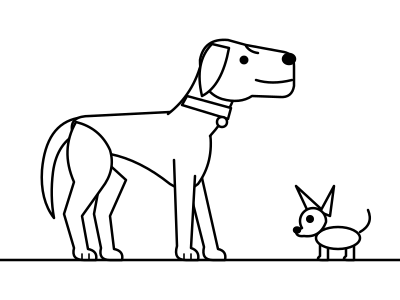
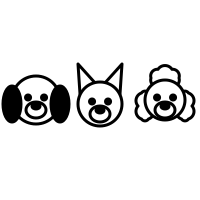
Spaced review from Week 29. Ask: "A house finch's red color has two parts. What are they?" (Feathers that can turn red are inherited. The red comes from its food.) Now the wonder. Ask: "All dogs are dogs. Are all dogs the same?" Your child names 3 differences they have noticed.
10–15 min · Mini-Lesson
Say: "One kind of living thing is called a species. All robins are one species. Each single robin is an individual." Say: "Individuals of one species share many traits, but each one is a little different. Those differences are variation." Give examples: no two people look exactly alike, and no two clover plants are exactly the same size. Say: "Scientists measure variation with numbers." Write three leaf lengths: 9, 12 and 10 centimeters. Say: "The longest is 12. The shortest is 9. The difference is 12 minus 9, which is 3 centimeters." Now your child tries with 7, 10 and 8 centimeters. Ask: "Which is longest? Which is shortest? What is the difference?" (10, 7, and 3 centimeters.) "Are all robins exactly alike?" (No. Individuals vary.) "Do a robin and a blue jay belong to one species?" (No. They are two different kinds.) If stuck, say: "Find the biggest number and the smallest number. Subtract the small one from the big one."
15–20 min · Investigation / Hands-On
Leaf Variation Investigation. Safety: an adult checks that the plants are safe to touch; wash hands afterward. 1) Collect 5 leaves, one from each of 5 plants of the same kind. If you use one tree, say: "These leaves come from one individual, but they still vary." 2) Number the leaves 1 to 5. 3) Your child measures each leaf from the base of the blade to the tip. They record each length to the nearest centimeter. 4) With the hand lens, they compare color, edges and vein patterns. 5) They find the longest and shortest leaf and subtract. Record in a table with four columns: Leaf, Length in centimeters, Color, Edge or veins. Nothing is changed in this study. Keep the same kind of plant, the same ruler and the same way of measuring. Expect lengths that differ by 1 centimeter or more. If every length matches, compare the widths instead. Say: "Real results vary. Look for the pattern."
10 min · Science Notebook Entry
In the notebook, your child traces or sketches the 5 leaves in a row and writes each length beneath. They list 3 ways the leaves vary. Then they finish the frame: "Living things of the same kind are alike, but ___." Sample: "Living things of the same kind are alike, but each individual is a little different in size, color and shape."
5 min · Wrap-Up & Exit Ticket
Read the three exit questions aloud; your child may use paper for question 2. Praise careful subtraction and the word individual.
Watch for: Thinking variation only means big differences, such as color, and missing small differences in size or shape.
Try: Line the leaves up side by side with their bases on the ruler's edge. Small differences in length become easy to see.
Exit ticket (3 questions)
- What is a species? Give one example.
- Four pumpkins are 18 cm, 22 cm, 15 cm and 20 cm across. How much wider is the widest than the narrowest?
- Name two ways your leaves were alike and two ways they varied.
Show answers
- One kind of living thing, such as robins, dogs or dandelions.
- 7 cm (22 − 15 = 7)
- Answers vary. Look for: alike in kind, basic shape or color; different in length, width, shade, edges or spots.
Support: Your child measures only 3 leaves. They compare them using the words longer and shorter before subtracting.
Extend: Your child measures 10 leaves and makes a tally chart of the lengths. They tell which length is most common.
Homework: Collect 5 acorns, clover leaves or pieces of one kind of fruit. Write 2 ways they vary. Look for: size, shape, color or markings.