3
    Third GradePowered by ThirdGrade.com

    Standards this week

    Social Studies

    • D2.Eco.4.3-5 Explain why individuals and businesses specialize and trade.Day 1, 5
    • D2.Geo.2 Use maps, satellite images, and other models to explain relationships between places.Day 1, 5
    • D2.Geo.6 Describe how environmental and cultural characteristics influence population distribution.Day 1
    • D2.Eco.1 Compare the benefits and costs of individual choices.Day 2, 3, 5
    • D2.Eco.9.3-5 Day 2
    • D2.Eco.10.3-5 Day 2
    • D2.Eco.7.3-5 Day 3
    • D2.Eco.3.3-5 Identify examples of the variety of resources (human, natural, capital) used to produce goods and services.Day 3
    • D2.Eco.14.3-5 Day 4
    • D2.Geo.7.3-5 Explain how cultural and environmental characteristics affect the distribution and movement of people, goods, and ideas.Day 4
    • D2.Geo.1 Construct maps and other graphic representations of familiar and unfamiliar places.Day 4
    • D2.Civ.6 Describe how communities work to accomplish common tasks and fulfill responsibilities.Day 5

    Mathematics

    • 3.MD.C.7.B Multiply side lengths to find areas of rectangles in real-world and mathematical problems.Day 1, 2, 3, 4, 5
    • 3.MD.C.7.D Find areas of rectilinear figures by decomposing them into non-overlapping rectangles and adding the areas.Day 1, 3, 5
    • 3.MD.D.8 Solve real-world problems involving perimeters of polygons.Day 1, 2, 3, 4, 5
    • 3.OA.A.4 Determine the unknown whole number in a multiplication or division equation.Day 2
    • 3.OA.D.8 Solve two-step word problems using the four operations.Day 3
    • 3.OA.C.7 Fluently multiply and divide within 100; know products of two one-digit numbers.Day 5

    English Language Arts

    • W.3.8 Recall and gather information from sources; take brief notes and sort evidence into categories.Day 1, 4, 5
    • RI.3.4 Determine the meaning of general academic and domain-specific words.Day 1
    • RI.3.2 Determine the main idea of a text and recount key details.Day 1
    • L.3.4.A Use sentence-level context as a clue to the meaning of a word or phrase.Day 1
    • L.3.4.B Day 1
    • L.3.4.D Day 1
    • RF.3.3.C Day 1
    • W.3.2.B Develop the topic with facts, definitions, and details.Day 2
    • W.3.2.C Use linking words and phrases to connect ideas within categories of information.Day 2, 5
    • L.3.1.A Day 2
    • L.3.1.F Ensure subject-verb and pronoun-antecedent agreement.Day 2, 5
    • L.3.1.G Day 2
    • RL.3.7 Explain how illustrations contribute to what is conveyed by the words in a story.Day 3, 5
    • RL.3.2 Recount stories and determine the central message, lesson, or moral.Day 3
    • SL.3.1 Engage effectively in a range of collaborative discussions, building on others' ideas.Day 3, 4
    • SL.3.1.B Day 3
    • SL.3.1.D Day 3
    • L.3.1.C Day 3
    • SL.3.3 Ask and answer questions about information from a speaker, offering appropriate elaboration and detail.Day 4
    • SL.3.1.C Day 4
    • SL.3.2 Determine the main ideas and supporting details of a text read aloud or information presented in diverse media.Day 4
    • L.3.5.B Day 4
    • L.3.5.A Distinguish the literal and nonliteral meanings of words and phrases in context.Day 5

    Science

    • 3-LS3-1 Analyze data to provide evidence that traits are inherited from parents.Day 1, 3, 5
    • 3-LS3-2 Use evidence to support that traits can be influenced by the environment.Day 1, 2, 5
    • 3-LS4-2 Use evidence to construct an explanation for how variations in traits provide advantages.Day 2, 3, 4, 5
    • 3-LS4-3 Construct an argument with evidence that in a particular habitat some organisms can survive well, some survive less well, and some cannot survive at all.Day 4

    See what your state adds or places differently

    Suggested daily schedule
    8:30–8:45 AM15 minMorning Circle / Read-Aloud / Calendar
    8:45–10:00 AM75 minEnglish Language Arts
    10:00–11:00 AM60 minMathematics
    11:00–11:15 AM15 minSnack and Movement Break
    11:15–12:00 PM30–45 minScience (every day)
    12:00–12:45 PM30–45 minSocial Studies (every day)
    12:45–1:30 PM45 minLunch and Choice Time
    1:30–2:15 PM45 minSpecials: PE / Art / Music (rotating)
    2:15–2:45 PM30 minIndependent Reading & Journaling

    Mark Week 32 complete

    0 / 4 done

    Saved in this browser

    Day 1 · Monday

    Social Studies

    I can trace goods through a chain of people and read the key on a resource or population map.

    D2.Eco.4.3-5D2.Geo.2.3-5D2.Geo.6.3-5

    Builds on: Needs Week 28 Day 1 (chains of workers) and Week 29 Days 1 and 2 (resource and population maps). One-minute check: "What does a map key tell you?" (What each symbol or color means.)

    Materials: 16 index cards (for three chains), 2 sheets of plain paper (for two practice maps), Notebook, Pencil

    5 min · Warm-Up

    Spaced review from Week 29. Ask: "Which kind of map shows the usual weather of a place?" (A climate map.) Say: "This catch-up week starts with chains of workers and map keys." Ask the big question: "How many workers helped bring you a glass of milk?" Write your child's guess.

    10–15 min · Mini-Lesson

    Say: "Interdependence means people depend on each other for goods and services." Write six cards: cow, dairy farmer, milk truck driver, bottling plant worker, grocery worker, family. Your child puts them in order and counts the workers. Compare with the guess. Say: "Each one depends on the one before. Each worker specializes in one job." Ask: "What happens to the family's milk if the truck driver stays home?" (The milk does not reach the plant or the store.) Now the key. In the notebook, draw only a key. A fish means fishing. A wheat stalk means farms. A tree means forests. Say: "Read the key before the map." Ask: "What does the tree stand for?" (Forests.) Ask: "A map has dark and light shading. Where do you find out what dark means?" (In the key.) If stuck, say: "Point to the symbol in the key. Read the words beside it."

    15–20 min · Activity / Source Work

    Catch-up practice. 1) Write two more sets of five cards and shuffle each set. T-shirt: cotton farmer, cloth mill worker, sewing factory worker, truck driver, store worker. Peanut butter: peanut farmer, sheller who removes the shells, factory worker, truck driver, store worker. 2) Your child orders both chains and tells what each worker adds. Meanwhile, you draw two maps. 3) Draw the same rectangle on both sheets of paper. It is Clover State, a made-up place. Add a lake at the top, an ocean along the bottom and mountains on the right. Title Map 1 "Resources." Copy the key from the mini-lesson. Put fish by the lake and the ocean, wheat in the middle and trees in the mountains. Title Map 2 "Population." Its key says dark means many people and light means few. Shade dark by the lake and at one spot on the coast. Shade the rest light. 4) Your child reads each title and key aloud, then answers. "Where are the forests?" (In the mountains.) "Where do the most people live?" (By the lake and on the coast.) "Use both maps. Why might many people live there?" (Water, fishing jobs and ships are close.) "Why might few people live in the mountains?" (Steep land is hard to build and farm on.) Look for answers that use the key's words.

    10 min · Notebook Entry

    Your child writes a "Fixed It!" note. "I used to think ___. Now I know ___." Sample: "I used to think dark on a population map meant hot. Now I know it means many people."

    5 min · Exit Ticket

    Read the questions aloud. Your child answers in writing with both maps in view. Praise each answer that names the key.

    Watch for: Mixing up map types, such as reading dark population shading as heat or as resources.

    Try: Before each answer, your child reads the map title aloud and says what kind of map it is.

    Exit ticket (3 questions)
    1. A jar of honey reaches you through a store worker, a beekeeper and a truck driver. Who comes first? Who comes last before you?
    2. On the Resources map, which symbol sits in the middle of Clover State? What does it tell you about work there?
    3. Your friend says the dark part of the Population map is where it is hottest. What should your friend read to fix the mistake?
    Show answers
    1. The beekeeper comes first. The store worker comes last before you.
    2. Wheat. It shows farms, so farming is important work there.
    3. The title and the key. The title says the map is about people. The key says dark means many people.

    Support: Use four cards for each chain and leave out the truck driver. Point to each key symbol together first.

    Extend: Your child makes an eight-card chain for a library book, from a tree to the reader. Include the author and the printer.

    Homework: Your child orders the milk cards for a family member and explains interdependence. Look for the words "depends on."

    Mathematics

    I can tell area and perimeter apart and find both for shapes made of rectangles.

    3.MD.C.7.b3.MD.C.7.d3.MD.D.8

    Builds on: Needs Week 31 Day 1 (area and perimeter of a rectangle) and Week 29 Day 4 (adding parts of a shape). One-minute check: ask the area and the perimeter of a 2 by 7 rectangle (14 square units; 18 units).

    Materials: 30 square tiles (or 1-inch paper squares), Yarn or string, about 40 inches long, Grid paper, Crayons in two colors, Notebook, Pencil

    5 min · Warm-Up

    Spaced review from Week 30 Day 3. A triangle has sides of 6, 9 and 10 cm. Your child finds the perimeter (25 cm). Then practice ×6 facts with no clock. Ask 6 × 3, 6 × 6 and 6 × 8 (18, 36, 48). This is a catch-up day. Look back at the Week 29 to 31 checks and the Unit 5 test. Note any kind of problem your child missed.

    10–15 min · Mini-Lesson

    Say: "Today we use the floor and fence picture. The floor is area. The fence is perimeter." Build 3 rows of 7 tiles. Ask: "How many tiles cover the floor?" (21) Write 3 × 7 = 21. Say: "The area is 21 square units." Lay yarn around the outside edge. Say: "The yarn is the fence. Add the four sides." Write 7 + 3 + 7 + 3 = 20. Say: "So the area is 21 square units and the perimeter is 20 units." Next, draw an L on grid paper. Draw a rectangle 6 squares long and 2 squares tall. On top of its left end, draw a rectangle 2 squares long and 3 squares tall. Shade each part a different color. Write 6 × 2 = 12 and 2 × 3 = 6, then 12 + 6 = 18. Say: "So the area of the L is 18 square units." Now your child does more. Your child builds 4 rows of 5 tiles and finds both measures. (20 square units; 18 units)

    10–15 min · Guided Practice

    Work on grid paper. Your child shades each inside and traces each outside edge in the other color. 1) Find the perimeter of the L from the Mini-Lesson. Start at the bottom left corner and walk around. (6 + 2 + 4 + 3 + 2 + 5 = 22 units) 2) Find both measures of a 2 by 9 rectangle (18 square units; 22 units). 3) Draw a rectangle 5 squares long and 2 squares tall. Put a 2 by 2 square on top of its left end. Find the area and the perimeter. (Area: 10 + 4 = 14 square units. Perimeter: 5 + 2 + 3 + 2 + 2 + 4 = 18 units.) If stuck, say: "Are we covering the floor or walking the fence? Cover means multiply. Walk means add every outside side."

    15–20 min · Independent Practice

    Your child sketches each shape, shades the area and traces the perimeter. 1) A 6 by 8 rectangle (48 square units; 28 units). 2) A 2 by 8 rectangle (16 square units; 20 units). 3) A square with 8-unit sides (64 square units; 32 units). 4) A 7 by 10 rectangle (70 square units; 34 units). 5) You draw a rectangle 8 squares long and 2 squares tall. Add a 3 by 3 square on top of its left end. Your child finds the area. (16 + 9 = 25 square units) 6) Your child finds the perimeter of that L. (8 + 2 + 5 + 3 + 3 + 5 = 26 units) 7) Tiles cover a floor 4 feet by 8 feet. Each tile is 1 square foot. How many tiles are needed? (32 tiles) 8) Edging goes around a rug 4 feet by 7 feet. How many feet of edging are needed? (22 feet)

    5 min · Exit Ticket

    Read each question aloud; your child answers on grid paper with no tiles and writes the unit each time.

    Watch for: Counting the inside edges of an L, where the two parts touch, as part of the perimeter.

    Try: Lay yarn along the outside only. Any edge the yarn does not touch is not part of the perimeter.

    Fact fluency: ×6 facts
    Exit ticket (3 questions)
    1. Find the area and the perimeter of a 5 by 8 rectangle.
    2. Which measure do tiles show, and which measure does yarn around the edge show?
    3. Draw a rectangle 4 squares long and 2 squares tall. Put a 2 by 2 square on top of its left end. Find its area.
    Show answers
    1. 40 square units; 26 units
    2. Tiles show area. Yarn shows perimeter.
    3. 12 square units (8 + 4 = 12)

    Support: Build every shape with tiles and yarn before sketching. Start with a 2 by 4 rectangle (8 square units; 12 units).

    Extend: Your child makes a shape from 12 tiles with a perimeter of more than 20 units. Sample: 1 row of 12 tiles has a perimeter of 26 units.

    Homework: Your child draws a 2 by 10 rectangle on grid paper and finds both measures (20 square units; 24 units). Then your child finds one rectangle at home and runs a finger around its perimeter.

    English Language Arts

    I can understand the important words in a passage and paraphrase it in my own words (catch-up day).

    W.3.8RI.3.4RI.3.2L.3.4.AL.3.4.BL.3.4.DRF.3.3.C

    Builds on: Needs the four paraphrase steps from Week 29 and using clues in a sentence to learn a word. One-minute check: ask "What does it mean to paraphrase?" (To say an idea in your own words and keep the meaning.)

    Materials: Reader's notebook, Highlighter, Three index cards, Beginning dictionary, Pencil

    5 min · Warm-Up

    Word study (about 3 minutes). Say: "This week we review tricky words and add three: taught, does and friend." Write taught, does, friend, tough, caught and people. Your child reads each word. Ask: "Which two words rhyme?" (taught, caught) "In which word does gh say /f/?" (tough) Your child underlines the tricky part in does, friend and people. Spaced review from Week 13. Ask: "What does the prefix re- mean in reread?" (Again.)

    10–15 min · Mini-Lesson

    Say: "Today is a catch-up day for the hardest research skill." Read aloud "Staying Warm in Cold Water": Sea otters live in the chilly ocean along the northern Pacific coast. Unlike seals and whales, they have no blubber, the thick layer of fat that keeps those animals warm. Instead, otters have the densest fur of any animal. The hairs are packed so tightly that water cannot reach the skin. Otters spend hours grooming. They rub their fur and blow air into it. The trapped air acts like a blanket and holds in body heat. Food is fuel, too. A sea otter eats about a quarter of its body weight every day. That food gives its body the energy to make heat. Ask: "What is the main idea?" (Sea otters have special ways to stay warm.) Write the four steps. 1) Find tricky words and use clues. 2) Cover the passage. 3) Say it in your own words. 4) Check the meaning. Think aloud for step 1: "Blubber. The words right after it say the thick layer of fat. So blubber is thick fat." Then: "Densest. The next sentence says packed so tightly. Densest means most tightly packed." Your child highlights both words and their clues. Add two word checks. Write unlike. Say: "Un- means not, so unlike means not like." Split blub|ber and den|sest between the two middle consonants and read each part.

    10–15 min · Guided Practice

    1) Ask: "Find grooming. Which words give a clue?" (They rub their fur and blow air into it.) Look up groom in the dictionary. Your child picks the meaning that fits otters. (To clean and care for fur.) 2) Paraphrase one sentence together: "Instead, otters have the densest fur of any animal." (No animal has thicker fur than a sea otter.) 3) Your child tries: "The trapped air acts like a blanket and holds in body heat." (Sample: Air caught in the fur keeps the otter's warmth inside.) 4) Ask: "Did the meaning stay the same? Did most words change?" (Yes to both.) If stuck, say: "Cover the sentence. Tell me what it means as if I were five years old."

    15–20 min · Independent Practice

    1) Your child writes three note cards. Each card has one tricky word from the passage, its meaning and the clue. Good choices are chilly, coast, densest and trapped. 2) On the back of each card, your child paraphrases one sentence from the passage. 3) In the notebook, your child writes a three-sentence summary in their own words. Sample: "Sea otters stay warm without a layer of fat. Their thick fur holds air that keeps heat in. They also eat a lot so their bodies can make heat." Look for: the main idea, two key details, and no more than three copied words in a row.

    5 min · Exit Ticket

    Ask the three questions. Your child may look at the passage for questions 1 and 3, but covers it for question 2.

    Watch for: Calling it a paraphrase when only one or two words have changed.

    Try: Your child counts copied words. If more than three in a row match, cover the passage and say it again.

    Exit ticket (3 questions)
    1. What does fuel mean in the passage? What clue helped?
    2. Paraphrase: 'The hairs are packed so tightly that water cannot reach the skin.'
    3. Name two details that support the main idea.
    Show answers
    1. Something that gives energy. The clue is that food gives the body the energy to make heat.
    2. Answers vary. Sample: The fur is so thick that an otter's skin stays dry.
    3. Any two: very thick fur keeps water out; trapped air holds in heat; eating a lot gives energy to make heat.

    Support: Work with only the first four sentences of the passage. Your child paraphrases each one aloud before writing anything.

    Extend: Your child writes two new sentences with densest and grooming. Each sentence must give a clue to the word's meaning.

    Homework: Explain to a family member, in your own words, how sea otters stay warm without blubber. Then read your own book for 15 minutes.

    Science

    I can correctly sort traits and behaviors as inherited or learned and explain my reasons.

    3-LS3-13-LS3-2

    Builds on: Needs Week 29 Days 1 to 3: inherited traits and learned behaviors. One-minute check: ask, "Inherited or learned: a duck's webbed feet? Tying shoes?" (Inherited. Learned.)

    Materials: Sorting cards from Week 29 (if you still have them), 10 blank index cards and a marker, 2 sheets of paper labeled Inherited and Learned, Bean cups and Bean Log from Week 31, Ruler marked in centimeters, Science notebook and pencil

    5 min · Flex Day 1 — Catch-Up: Inherited or Learned — Wonder Warm-Up

    Bean check: measure the tallest sprout in each cup in centimeters and record both. Spaced review from Week 28. Ask: "What do we call the young of a living thing?" (Offspring.) Play Born With or Practiced. Say three items: a porcupine's quills, whistling a tune, a rooster's comb. (Born with, practiced, born with.) Then the wonder. Ask: "A spider spins a web with no lessons. How does it know how?"

    10–15 min · Mini-Lesson

    Say: "Use one key question. Was it passed from parents to offspring? Or did it take practice, teaching or watching others?" Write the key question on paper and keep it in view. Say: "A spider spinning a web is a behavior. No one teaches the spider, so the behavior is inherited. We call that an instinct." Say: "A dog that sits on command was taught, so that behavior is learned." Say: "Behaviors can be inherited too. Many insects and spiders never meet their parents." Ask: "A newborn foal stands and walks within hours. Inherited or learned?" (Inherited. No one taught it.) Ask: "A child ties shoelaces. Inherited or learned?" (Learned. It took teaching and practice.) Ask: "A young songbird sings better after hearing adult birds. What does that tell you?" (Some behaviors are partly inherited and partly learned.) If stuck, say: "Who taught it? Did it need practice?"

    15–20 min · Investigation / Hands-On

    Reteach Card Sort. 1) Write these 10 new cards. A robin's red breast. A newly hatched chick pecking at the ground. A child swimming laps. A newborn baby crying. Saying "please." A rabbit's long ears. A bear cub fishing the way its mother does. Riding a bicycle. The color of a tulip's petals. A songbird's song. 2) Mix them with the Week 29 cards. If those are lost, use the new cards alone. 3) Your child places each card on a sheet and says "born with" or "had to learn." 4) For any card you disagree on, read the key question together. 5) Keep a tally with two columns: Sorted right | Needed the key question. Answers: the robin, chick, baby, rabbit and tulip cards are inherited. Swimming, "please," the bear cub and the bicycle are learned. The songbird's song is partly both, so it may sit between the sheets. Look for at least 8 of the 10 new cards sorted with a sound reason.

    10 min · Science Notebook Entry

    Your child chooses the 3 hardest cards and writes a reason for each. Frame: "___ was tricky because ___. It is ___ because ___." Sample: "The chick pecking was tricky because it is an action. It is inherited because no one taught the chick." Then they copy today's bean data into the notebook.

    5 min · Wrap-Up & Exit Ticket

    Ask the three exit questions aloud; your child answers aloud or in writing. Praise every answer that comes with a reason.

    Watch for: Sorting every animal action as learned because it is something the animal does.

    Try: Ask: "Who taught it? Did it ever meet its parents?" Use the spider as the example.

    Exit ticket (3 questions)
    1. Inherited or learned: a kangaroo's pouch?
    2. Inherited or learned: a sea lion balancing a ball on its nose?
    3. A baby bird opens its beak wide for food on its first day. Why is this behavior inherited?
    Show answers
    1. Inherited.
    2. Learned. A trainer taught it.
    3. No one taught it, and it had no time to practice. It hatched able to do it.

    Support: Sort 6 clear cards first. Then add 2 tricky cards and use the key question together.

    Extend: Your child writes 3 tricky cards of their own and an answer key that explains each one.

    Homework: Play Born With or Practiced with a family member, using 5 new examples. Look for: a reason with each answer.
    Day 2 · Tuesday

    Social Studies

    I can solve money problems with budgets, savings and bank balances.

    D2.Eco.1.3-5D2.Eco.9.3-5D2.Eco.10.3-5

    Builds on: Needs Week 30 Days 2 to 4 (deposits, withdrawals, interest and budgets). One-minute check: "Maya has $12 and spends $5. How much is left?" ($7.)

    Materials: 20 play $1 bills (or paper slips marked $1), 2 sheets of plain paper (a budget page and a register page), Ruler, Notebook, Pencil

    5 min · Warm-Up

    Spaced review from Week 30. Ask: "What do we call the small extra amount a bank pays savers?" (Interest.) Then ask the big question: "Where is money safer and able to grow: in a drawer or in a bank? Why?" (In a bank. It is kept safe, and the bank may add interest.)

    10–15 min · Mini-Lesson

    Say: "Today we practice budgets and bank registers with play money." Budget first. Count out $15. Say: "My income is $15. Needs come first: a lunch box for $6. Then I save $5. That leaves wants: a puzzle for $4." Count the bills into three piles. Say: "Check: 6 + 5 + 4 = 15. The plan fits my income." Now the bank. Say: "A bank or credit union keeps savings safe. It lends some of that money to people who need loans. Borrowers pay the bank extra, so the bank can pay savers interest." Say: "The interest rate tells how much the bank pays. With a higher rate, savings grow faster." With the ruler, draw a register with three columns: What happened | Amount | Balance. Say each step while moving bills. "Start with $10. Deposit $6. A deposit adds: 10 + 6 = 16." "Withdraw $4. A withdrawal subtracts: 16 − 4 = 12." "The bank adds $1 of interest: 12 + 1 = 13." Ask: "Which move made the balance smaller?" (The withdrawal.) Ask: "Who added the interest, and why?" (The bank. It pays savers for keeping money there.) Ask: "The balance is $8. You deposit $5. What is the new balance?" ($13.) If stuck, say: "Putting in? Add. Taking out? Subtract. Move the bills to match."

    15–20 min · Activity / Source Work

    Money practice stations. Station 1, budget. 1) Label one sheet of paper "Budget" and the other "Register." Write this price list on the budget page: notebook $3, pencil set $4, snack $2, game $7. 2) Your child has $15. The notebook and pencil set are needs. Your child must save at least $3. Your child writes a plan and checks it by adding. (Sample: needs $7, save $3, snack $2, and $3 more to save.) Ask: "Can you buy the game this week?" (No. Only $5 is left after needs and saving.) Station 2, register. 3) On the register page, your child records five rows: start $5, deposit $10, withdraw $3, deposit $4, interest $1. (Balances: 5, 15, 12, 16, 17.) Station 3, compare. 4) A book costs $7 at the library sale and $11 new. Ask: "Which costs less, and by how much?" (The sale book, by $4: 11 − 7 = 4.) 5) Check each station with the bills before moving on. Ask for evidence: "Point to the row where the balance went down." (The withdrawal row.) Budget plans vary. Look for a total of $15 or less.

    10 min · Notebook Entry

    Your child writes two money problems with answers. One is about a budget, and one is about a bank balance. Sample: "I had $9 in the bank. I deposited $6. What is my balance? $15."

    5 min · Exit Ticket

    Your child solves all three on paper. The play money may stay nearby. Praise saying "add" or "subtract" before writing.

    Watch for: Subtracting a deposit or adding a withdrawal.

    Try: Your child says the action aloud before writing: "Putting in, add. Taking out, subtract." Move the bills to match.

    Exit ticket (3 questions)
    1. Kim deposits $7 into her account. Does her balance go up or down? What happens when she withdraws $7?
    2. A register shows a balance of $14. The next two rows say: withdraw $5, interest $1. What is the final balance?
    3. Lena's budget for $12 lists needs $5, save $4 and wants $4. Does it fit? How do you know?
    Show answers
    1. A deposit makes it go up. A withdrawal makes it go down.
    2. $10 (14 − 5 = 9, and 9 + 1 = 10).
    3. No. 5 + 4 + 4 = 13, which is $1 more than $12.

    Support: Use amounts under $10. Your child acts out every step with the bills before writing.

    Extend: Your child writes a six-row register that ends at exactly $25, then checks it with a family member.

    Homework: A family member solves your child's two problems, then writes two new ones. Your child solves them. Look for add or subtract steps written out.

    Mathematics

    I can find an unknown side length from the area or the perimeter.

    3.MD.C.7.b3.MD.D.83.OA.A.4

    Builds on: Needs Week 29 Day 2 (unknown side from the area) and Week 30 Day 4 (unknown side from the perimeter). One-minute check: ask "5 times what number is 35?" (7)

    Materials: Grid paper, String tied in a loop 24 inches around, Ruler, 12 square tiles (or 1-inch paper squares), Notebook, Pencil

    5 min · Warm-Up

    Spaced review from Week 15 Day 2. Write 7 × n = 63. Your child finds the unknown (n = 9). Write n × 8 = 40 (n = 5). Then practice ÷6 and ÷9 facts with no clock. Ask 42 ÷ 6, 54 ÷ 6, 45 ÷ 9 and 72 ÷ 9 (7, 9, 5, 8). Say: "Today a letter stands for an unknown side."

    10–15 min · Mini-Lesson

    Say: "A side is unknown. First ask: was I given the inside or the distance around?" Start with area. Say: "A rectangle has an area of 48 square units. One side is 6 units." Sketch it and label the unknown side s. Write 6 × s = 48. Ask: "6 times what number is 48?" (8) Say: "So s = 8. The other side is 8 units." Check on grid paper: 6 rows of 8 squares make 48. Now perimeter. Say: "A rectangle has a perimeter of 24 inches. Its length is 7 inches." Write 7 + 7 = 14 for the two long sides. Write 24 − 14 = 10 for what is left. Share it between the two short sides: 10 ÷ 2 = 5. Say: "So the width is 5 inches." Check with the string loop. Bend it into a rectangle 7 inches long and measure a short side with the ruler. Now your child does more. Area 40 and one side 5. (5 × s = 40; s = 8) Perimeter 18 and length 6. (6 + 6 = 12; 18 − 12 = 6; 6 ÷ 2 = 3)

    10–15 min · Guided Practice

    Your child names the kind first, area or perimeter, then solves and checks. 1) Area 28 square units, one side 4. (4 × s = 28; s = 7) 2) Perimeter 26, length 8. (8 + 8 = 16; 26 − 16 = 10; 10 ÷ 2 = 5) 3) A square has a perimeter of 32. How long is each side? (32 ÷ 4 = 8) 4) A garden has 36 feet of fence around it. It is 10 feet long. How wide is it? (10 + 10 = 20; 36 − 20 = 16; 16 ÷ 2 = 8. The garden is 8 feet wide.) If stuck, say: "Is the number the inside or the distance around? Inside means a missing factor. Around means subtract, then share."

    15–20 min · Independent Practice

    Your child sketches each rectangle, labels the unknown side with a letter, and checks each answer. 1) Area 24, one side 3. (3 × s = 24; s = 8) 2) Area 42, one side 7. (7 × s = 42; s = 6) 3) Area 81, one side 9. (9 × s = 81; s = 9, so it is a square) 4) Perimeter 14, length 4. (4 + 4 = 8; 14 − 8 = 6; 6 ÷ 2 = 3) 5) Perimeter 34, length 10. (10 + 10 = 20; 34 − 20 = 14; 14 ÷ 2 = 7) 6) You draw a rectangle, label one side 7 and write "area 70" inside. Your child finds the other side. (7 × s = 70; s = 10) 7) A poster covers 60 square inches. It is 6 inches wide. How tall is it? (6 × s = 60; s = 10 inches) 8) A dog pen uses 28 feet of fence. It is 8 feet long. How wide is it? (8 + 8 = 16; 28 − 16 = 12; 12 ÷ 2 = 6 feet)

    5 min · Exit Ticket

    Read each question aloud; your child sketches each rectangle, solves it on paper and checks the answer.

    Watch for: Using the area method on a perimeter problem, such as dividing the perimeter by the known side.

    Try: Before any work, your child says "inside" or "around" and points to it on the sketch.

    Fact fluency: ÷6 and ÷9 facts
    Exit ticket (3 questions)
    1. A rectangle has an area of 21 square units. One side is 3 units. How long is the other side?
    2. A rectangle has a perimeter of 22 units and a length of 6 units. What is the width?
    3. A square has a perimeter of 16 units. How long is each side?
    Show answers
    1. 7 units
    2. 5 units (6 + 6 = 12; 22 − 12 = 10; 10 ÷ 2 = 5)
    3. 4 units

    Support: Build area problems with tiles. For area 12 and one side 3, your child makes rows of 3 until 12 tiles are used (4 rows). Use the string loop for perimeter problems.

    Extend: Your child finds a rectangle with an area of 20 square units and a perimeter of 18 units. (4 by 5) Your child explains the search.

    Homework: Your child solves two problems and checks each. 1) Area 32, one side 8. (8 × s = 32; s = 4) 2) Perimeter 18, length 5. (5 + 5 = 10; 18 − 10 = 8; 8 ÷ 2 = 4)

    English Language Arts

    I can write a strong body paragraph with linking words and correct subject-verb agreement (catch-up day).

    W.3.2.BW.3.2.CL.3.1.AL.3.1.FL.3.1.G

    Builds on: Needs the body paragraph plan from Week 30 and the -er and -est endings from Week 19. One-minute check: ask "What three parts does a body paragraph need?" (A topic sentence, facts and a closing sentence.)

    Materials: Writer's notebook, Otter note cards from Day 1, Published report, Colored pencil, Pencil

    5 min · Warm-Up

    Word study (about 3 minutes). Write thought, brought, taught, friend and does. Your child copies each word and circles the tricky part: ough, ough, augh, ie and oe. Ask: "Which letters spell /aw/ in taught?" (augh) Cover the words. Your child writes all five from memory and checks them. Spaced review from Week 28. Ask: "Which two words make the contraction we've?" (we have)

    10–15 min · Mini-Lesson

    Say: "A strong body paragraph has a topic sentence, three or four facts and a closing sentence. Linking words connect the facts." Read aloud this model, "Built for Cold Water": Sea otters are built to hold in heat. For example, their fur is the densest of any animal, with up to a million hairs in one square inch. In addition, they fluff their fur with air, which works like a blanket. As a result, cold water never touches their skin. Otters are ready for the chilly sea. Your child points to the topic sentence and the closing sentence. Then your child finds three linking words. (For example, In addition, As a result.) Next, check agreement. Your child underlines a subject once and its verb twice in colored pencil. Say: "One subject takes a verb with -s: water touches. More than one takes no -s: they fluff." Then teach comparing words. Write dense, denser, densest. Say: "Use -er to compare two things. Use -est to compare three or more. Long words and -ly words use more and most." Write: "The pup swims more slowly than its mother."

    10–15 min · Guided Practice

    1) Write a paragraph together called "How Otters Get Energy." Use the food facts from the Day 1 passage and note cards. Your child says the topic sentence. Take turns adding a fact with a linking word. Sample: Sea otters need a lot of food to stay warm. For example, an otter eats about a quarter of its body weight each day. It dives for crabs, clams and sea urchins. As a result, an otter spends much of its day hunting. Food is an otter's fuel. 2) Your child underlines each subject once and each verb twice. Ask: "Do they agree?" (Yes: an otter eats, it dives, an otter spends, food is.) 3) Ask for the right form. "An otter's fur is ___ than a dog's." (thicker) "The otter has the ___ fur of all." (thickest) Use carefully: "The pup dives ___ than its mother." (more carefully) 4) Write: "The hungry otter eats quickly, and it rests." Your child names each word's job. (Otter is a noun that names the animal. The word "it" is a pronoun that stands for otter. Eats and rests are verbs that show action. Hungry is an adjective that describes the otter. Quickly is an adverb that tells how.) If stuck, say: "Ask who or what does the action. Is it one or more than one? Now say the verb with it."

    15–20 min · Independent Practice

    Your child picks the weakest body paragraph in the published report and rewrites it in the notebook. Write five to seven sentences. Use this checklist. 1) A clear topic sentence. 2) At least three linking words that fit the meaning. 3) A closing sentence. 4) Every subject and verb agree. Your child underlines them to check. Then read the old and new paragraphs side by side. Your child names what improved.

    5 min · Exit Ticket

    Ask the three questions. Your child keeps the new paragraph in view.

    Watch for: Adding a linking word that does not fit, such as "as a result" before a fact that is not a result.

    Try: Ask: "Does this fact happen because of the one before?" If not, your child chooses also or in addition.

    Exit ticket (3 questions)
    1. Read your new topic sentence. Which fact under it fits best, and why?
    2. Fix this sentence: 'Its thick fur keep the cold out.'
    3. Which is right: 'the most thick fur' or 'the thickest fur'? Why?
    Show answers
    1. Answers vary. Look for: a fact on the same subtopic as the topic sentence.
    2. Its thick fur keeps the cold out.
    3. The thickest fur. Short words add -est to compare three or more.

    Support: Give a paragraph frame with the linking words already in place: "___. For example, ___. In addition, ___. As a result, ___." Your child fills in the facts.

    Extend: Your child rewrites the model paragraph for a younger reader. Keep the same facts and use simpler words.

    Homework: Read your rewritten paragraph to a family member. Ask them to clap once for each linking word they hear. Then read your own book for 15 minutes.

    Science

    I can explain the difference between variation that is inherited and changes caused by the environment, and how variation can help survival.

    3-LS3-23-LS4-2

    Builds on: Needs Week 30 Day 4 on advantage and Week 31 on the environment. One-minute check: ask, "What is an advantage?" (A better chance than others to survive, find a mate or have offspring.)

    Materials: Bean cups and Bean Log from Week 31, Ruler marked in centimeters, 2 sheets of newspaper or other printed pages with small type, 5 sheets of plain white paper, Scissors, pencil and a penny to trace, Science notebook

    5 min · Flex Day 2 — Catch-Up: Environment and Variation — Wonder Warm-Up

    Bean check: measure the tallest sprout in each cup with the ruler. Your child subtracts to find the difference and records it. Ask: "Is this difference from inheritance or the environment?" (The environment. Both cups hold the same kind of bean.) Spaced review from Week 14. Ask: "What is camouflage?" (Colors or shapes that help a living thing blend in.) Then the wonder. Ask: "Why would a moth's color matter to a hungry bird?"

    10–15 min · Mini-Lesson

    Say: "Some differences are inherited, like the different fur colors of guinea pig pups in one litter. Some are caused by the environment, like pale sprouts in the dark." Name three differences. Your child says "inherited" or "environment" for each. Two sister cows, one black and one brown. (Inherited.) Two bean plants, one green in light and one pale under a box. (Environment.) Two dogs from one litter, one thin and one heavy from table scraps. (Environment.) Say: "When individuals differ, some have traits that help in their environment. They are more likely to survive and have offspring." Say: "Light moths and dark moths rest on dark tree bark. Birds spot the light ones more easily." Say: "No moth chooses or changes its color. It hatched that way." Ask: "Which moths are more likely to live long enough to lay eggs?" (The dark ones.) Ask: "What if the bark were pale?" (Then the light moths would have the advantage.) If stuck, say: "Pretend you are the bird. Which moth do you see first?"

    15–20 min · Investigation / Hands-On

    Camouflage Hunt. Safety: pick up every paper piece afterward so no pet swallows one. 1) Trace the penny and cut 10 circles from newspaper and 10 from white paper. These are moths with two color variations. 2) Open the second newspaper sheet on the floor. Your child looks away while you scatter all 20 moths on it. 3) Your child is the bird. Count slowly to 10. They pick up moths one at a time with one hand, taking the first moth they see. 4) Count the catch by color and record it. 5) Lay 4 white sheets edge to edge. Repeat the hunt on this white background. Change only the background. Keep the number of moths, the count to 10 and the picker the same. Table: Background | Newspaper moths caught | White moths caught. Expect fewer catches of the moths that match the background. Real results vary. Look for the pattern. Ask: "Which moths survived better on each background? What is your evidence?" (The color with the smaller catch.)

    10 min · Science Notebook Entry

    Your child copies the table into the notebook. Then they finish two frames. "On newspaper, the ___ moths had an advantage because ___." "The moths did not change color. The ___ decided which ones were caught." Sample: "On newspaper, the newspaper moths had an advantage because they were hard to see. The background decided which ones were caught."

    5 min · Wrap-Up & Exit Ticket

    Ask the three exit questions aloud; your child answers aloud or in writing. Praise answers that use the hunt numbers as evidence.

    Watch for: Saying a moth changed its color in order to hide.

    Try: Hold up one paper moth. Ask: "Did this one change?" Say: "It hatched with its color. The background did the choosing."

    Exit ticket (3 questions)
    1. Tan lizards and dark lizards live on pale desert sand. Which color will hawks catch more often? Explain.
    2. An apple on the sunny side of a tree is redder than one in the shade. Two hens from one nest are brown and white. Which difference comes from the environment?
    3. In the hunt, did any paper moth change its color to hide? What decided which moths were caught?
    Show answers
    1. The dark lizards. They stand out against pale sand, so the tan lizards have the advantage.
    2. The apple color. Sunlight is part of the environment. The hens' feather colors are inherited.
    3. No. Each moth kept its color. The background decided which moths were easy to see.

    Support: Run one round on each background and count the catch together.

    Extend: Run the newspaper round 3 times. Your child adds the catches and tells whether the pattern holds.

    Homework: Teach the camouflage hunt to a family member and play one round. Look for: your child explains which moths had the advantage and why.

    Day 3 · Wednesday

    Social Studies

    I can plan a pretend lemonade stand and figure out its costs, income and profit.

    D2.Eco.7.3-5D2.Eco.3.3-5D2.Eco.1.3-5

    Builds on: Needs Week 25 Day 1 (natural, human and capital resources) and Week 26 Day 2 (profit). One-minute check: "Is a baker's mixing bowl a natural, human or capital resource?" (Capital.)

    New words:
    • loss – what a business has when its costs are more than the money it takes in

    Materials: 25 play $1 bills (or paper slips marked $1), 1 large sheet of paper, Markers, 2 index cards (what-if cards), Notebook, Pencil

    5 min · Warm-Up

    Spaced review from Week 25. Ask: "Name the three kinds of resources producers use." (Natural, human and capital resources.) Then ask the big question: "What would you need to run a lemonade stand?" Sort your child's list. Natural: water and lemons. Human: the seller and the sign maker. Capital: the pitcher, the table and the cooler.

    10–15 min · Mini-Lesson

    Say: "A business pays costs to make its product. Money from selling is its income. Profit is the money left after paying the costs." Model with bills. Say: "Lemons cost $4, sugar $3 and cups $2. 4 + 3 + 2 = 9. Costs are $9." Say: "The stand sells 20 cups at $1 each. Income is $20." Count out 20 bills. Move 9 into a costs pile. Say: "20 − 9 = 11. Profit is $11." Say: "Now a rainy day. The stand sells only 7 cups. Income is $7, but costs were $9. 9 − 7 = 2. The stand has a loss of $2." Say: "Profit is a signal. A good profit tells the seller to open again or make more. A loss tells the seller to change something." Ask: "Costs are $6 and income is $10. What is the profit?" ($4.) Ask: "After a loss, what might a seller change?" (The price, the supplies, the day or the place.) Ask: "Is all the money in the cash box profit?" (No. Costs must be paid first.) If stuck, say: "Put the cost money in its own pile first. Count what is left."

    15–20 min · Activity / Source Work

    Lemonade stand challenge. The stand is pretend. 1) Your child names the stand and writes the name on the large sheet of paper with markers. Write the price list below it: lemons $5, sugar $2, cups $3. Your child adds the costs. ($10.) 2) Your child picks a price, $1 or $2 a cup, and predicts how many cups will sell. 3) Draw a chart with four columns: Day | Cups sold | Income | Profit or loss. Costs stay $10 every day. 4) Write the two what-if cards. "It rains. You sell 5 cups." "A hot day. You sell 25 cups." Row 1 is the prediction. Rows 2 and 3 are the cards. 5) Your child works out each row. Check the $1 rows with the bills. At $1 a cup, rain brings a $5 loss and the hot day brings a $15 profit. At $2 a cup, rain brings $0 and the hot day brings a $40 profit. Say: "A higher price may mean fewer buyers." 6) Ask for evidence from the chart: "Which day earned the most? What would you change after the rainy day?" (Sample: sell only on sunny days.) Prediction rows differ. Look for income minus costs in every row.

    10 min · Notebook Entry

    In the notebook, your child splits the profit. "My profit is $___. I will put $___ in Save, $___ in Spend and $___ in Give." The three amounts must add up to the profit. Sample: "With a profit of $15, I will put $6 in Save, $7 in Spend and $2 in Give."

    5 min · Exit Ticket

    Your child solves the questions on paper. Praise putting the costs aside before naming the profit.

    Watch for: Calling all the money taken in "profit" and forgetting to subtract the costs.

    Try: Your child puts the cost bills in a separate pile first. Only the pile that is left is profit.

    Exit ticket (3 questions)
    1. A bracelet stand spends $7 on string and beads. It takes in $16 from sales. What is the profit?
    2. The next week the stand spends $7 again but takes in only $5. Is that a profit or a loss? How much?
    3. A seller earned a big profit on Saturday. What might the seller do next Saturday, and why?
    Show answers
    1. $9 (16 − 7 = 9).
    2. A loss of $2 (7 − 5 = 2).
    3. Answers vary. Look for: open again or make more, because the profit shows people want the product.

    Support: Use one price, $1 a cup. Your child lays out one bill for each cup sold, up to 20.

    Extend: Your child tests $2 a cup with only 12 cups sold. (Income $24, profit $14.) Ask why a big profit might bring a second stand to the street. (Other sellers see a chance to earn too.)

    Homework: With an adult, your child prices the real ingredients for one batch of lemonade or another snack. Add up the cost. Look for each price written and a correct total.

    Mathematics

    I can design a floor plan for a dream bedroom and find areas and perimeters.

    3.MD.C.7.b3.MD.C.7.d3.MD.D.83.OA.D.8

    Builds on: Needs Week 31 Day 4 (choosing area or perimeter) and Week 29 Day 4 (adding the areas of parts). One-minute check: ask "Is carpet an area job or a perimeter job? What about baseboard trim?" (area; perimeter)

    New words:
    • floor plan – a drawing of a room as seen from above

    Materials: 2 sheets of grid paper (1 square stands for 1 foot), Ruler, Colored pencils, Scissors, Glue stick or tape, Notebook, Pencil

    5 min · Warm-Up

    Spaced review from Week 29 Day 4. A shape is made of a 5 by 2 rectangle and a 3 by 3 square. Your child finds its area (10 + 9 = 19 square units). Then practice ×9 facts with no clock. Ask 9 × 3, 9 × 6 and 9 × 8 (27, 54, 72). Say: "Today you are a designer. Every measurement must be right."

    10–15 min · Mini-Lesson

    Say: "A floor plan shows a room from above. Each square is 1 foot." With a ruler, your child outlines a room 10 squares long and 8 squares tall. Ask: "How much floor is there?" Write 10 × 8 = 80. Say: "The floor area is 80 square feet." Ask: "How much baseboard trim goes around the walls?" Write 10 + 8 + 10 + 8 = 36. Say: "So the room needs 36 feet of trim." Give the rule: each piece of furniture is a rectangle drawn to size, and no pieces may overlap. On the second sheet, draw a bed 3 squares by 7 squares. Write 3 × 7 = 21. Say: "So the bed covers 21 square feet." Color it, cut it out and lay it in the room. Now your child does more. Your child draws, cuts out and places a desk 2 by 4 and a rug 4 by 5. (2 × 4 = 8 square feet; 4 × 5 = 20 square feet)

    10–15 min · Guided Practice

    Keep the three pieces loose so they can move. 1) Find the floor the three pieces cover. (21 + 8 + 20 = 49 square feet) 2) Find the open floor. Write 80 − 49 = f. (f = 31 square feet) 3) Check the rule. Does any piece overlap another or cross a wall? (No. Move pieces until none do.) 4) The rug gets fringe all the way around. How many feet of fringe is that? (4 + 5 + 4 + 5 = 18 feet) If stuck, say: "Is it covering or going around? Covering is area. Going around is perimeter."

    15–20 min · Independent Practice

    Your child finishes the design and labels each piece with its area. 1) Add a chair 2 by 2. What area does it cover? (2 × 2 = 4 square feet) 2) Add a bookshelf 1 by 5. (1 × 5 = 5 square feet) 3) Find the new covered floor. (49 + 4 + 5 = 58 square feet) 4) Find the new open floor. (80 − 58 = 22 square feet) 5) Find the perimeter of the bed. (3 + 7 + 3 + 7 = 20 feet) 6) Draw a closet 4 squares by 2 squares outside one wall, touching the room. Find the area of the room and closet together. (80 + 8 = 88 square feet) 7) The door is 3 feet wide and needs no trim. How much trim does the room need now? (36 − 3 = 33 feet) 8) Carpet squares come 10 in a box. Each one covers 1 square foot. How many boxes cover the 80 square feet? (80 ÷ 10 = 8 boxes) Last, glue the pieces down. Your child writes a design report with four numbers. (area 80, trim 36, covered 58, open 22)

    5 min · Exit Ticket

    Read each question aloud; your child may sketch on grid paper but starts a new room, not today's plan.

    Watch for: Placing furniture that overlaps or hangs past a wall, which makes the open-floor total wrong.

    Try: Your child moves each cut-out piece on the plan before gluing. Every piece must sit fully inside the room.

    Fact fluency: ×9 facts
    Exit ticket (3 questions)
    1. A room is 6 feet by 10 feet. What is its floor area?
    2. How many feet of trim go around that room?
    3. A 3 by 5 bed and a 2 by 4 desk are in that room. How much floor is open?
    Show answers
    1. 60 square feet
    2. 32 feet
    3. 37 square feet (15 + 8 = 23; 60 − 23 = 37)

    Support: Use a smaller room, 5 squares by 8 squares, and one bed 2 by 4. Your child finds the open floor (40 − 8 = 32 square feet).

    Extend: Your child changes the three-piece design so the open floor is exactly 30 square feet. Sample: swap the desk for a 3 by 3 table. (21 + 9 + 20 = 50; 80 − 50 = 30)

    Homework: Your child measures one real piece of furniture to the nearest foot and adds it to the plan. Sample: a dresser 2 feet by 4 feet covers 8 square feet. Then the open floor is 22 − 8 = 14 square feet.

    English Language Arts

    I can explain how pictures add to a story by making an illustrated fable (enrich day).

    RL.3.7RL.3.2SL.3.1SL.3.1.BSL.3.1.DL.3.1.C

    Builds on: Needs fables and their morals from Week 4 Day 2. Your child first heard this fable in Week 3 Day 4. One-minute check: ask "What do we call the lesson a fable teaches?" (The moral.)

    New words:
    • Artist's Note – a sentence that tells what your picture adds to the words

    Materials: One large sheet of paper folded into four panels, Crayons or colored pencils, Reader's notebook, Pencil

    5 min · Warm-Up

    Word study (about 3 minutes). Dictate this sentence: "Does your friend laugh a lot?" Your child writes it in the notebook. Check it together, one word at a time. Your child fixes any word and underlines the tricky parts in does, friend and laugh. Spaced review from Week 9. Ask: "What is the plural of mouse?" (Mice.)

    10–15 min · Mini-Lesson

    Say: "Today is an enrich day. You will turn a fable into a four-panel picture book." Read aloud this retelling of a traditional fable, "The Lion and the Mouse": A lion lay asleep in the tall grass. A little mouse ran across his nose and woke him. The lion slapped down a huge paw and caught her by the tail. "Please let me go," squeaked the mouse. "One day I may help you." The lion laughed so hard that his mane shook. How could a mouse help a lion? Still, he lifted his paw, and the mouse dashed away. Weeks later, the lion walked into a hunter's net. The more he pulled, the tighter the ropes held him. He roared until the trees trembled. The mouse heard him and came running. She chewed through one rope, then another, until the net fell open. "You laughed at me once," she said, "but no friend is too small to help." Say: "Pictures can show more than the words say. They can show a feeling, the mood or a detail of the setting." Think aloud: "The words say the lion caught her by the tail. I will draw a huge paw and a tiny, shaking mouse. My picture adds her fear." Next, say: "A moral often names an idea you cannot see or touch, such as kindness or courage. Those words are abstract nouns, from Week 5." Ask: "Which abstract noun fits what the mouse showed?" (Courage, kindness or friendship.)

    10–15 min · Guided Practice

    Talk about the fable. Take turns and listen without interrupting. Use the stem "I think ___ because in the story ___." 1) Ask: "Why did the lion laugh?" (He thought a tiny mouse could never help a lion.) 2) Ask: "How does the lion feel in the net? Which words tell you?" (Scared and helpless. He pulled, and he roared until the trees trembled.) 3) Ask: "What colors and lines would show that feeling?" (Dark colors and tangled lines.) 4) Plan the four panels in the notebook: caught, set loose, trapped, rescued. Beside each, your child writes one feeling or mood word and one drawing choice. Your child then finishes: "At first I thought ___, but now I think ___ because ___." If stuck, say: "Close your eyes and picture it. Is it bright or dark? Who looks big, and who looks small?"

    15–20 min · Independent Practice

    Your child makes the picture book. 1) Draw the four panels. 2) Under each, write one sentence of the story in your own words. 3) Beside each, write an Artist's Note with this frame: "My picture shows ___ by ___." Sample: "My picture shows the mouse is brave by making her tiny beside the huge net." 4) Write the moral in your own words and use one abstract noun. Sample: "Kindness comes back to you." Look for: each note names a feeling, mood or detail, and does more than retell the event.

    5 min · Exit Ticket

    Ask the three questions. Your child points to the panels while answering.

    Watch for: Writing an Artist's Note that only retells the event, such as "The lion is in the net."

    Try: Ask: "How does the lion feel in your picture? What did you draw to show that?" Your child writes that answer.

    Exit ticket (3 questions)
    1. Which panel shows the strongest feeling? What did you draw to show it?
    2. Read your moral aloud. Which word is the abstract noun?
    3. Look at your net panel. Which drawing choice adds something the story never states?
    Show answers
    1. Answers vary. Look for: one feeling named and the drawing choice, such as color, size or a face.
    2. Answers vary. Look for: a word for an idea, such as kindness, friendship or courage.
    3. Answers vary. Look for: a detail the picture adds, such as dark colors, tangled ropes or a frightened face.

    Support: Draw panel 1 together and write its Artist's Note as a model. Your child does panels 2 to 4 with the frame.

    Extend: Your child adds a fifth panel showing the next day. The Artist's Note tells its mood and how the picture shows it.

    Homework: Show your illustrated fable to a family member. Explain what one picture adds to the words. Then read your own book for 15 minutes.

    Science

    I can measure and graph the variation in a group of seeds of the same kind.

    3-LS3-13-LS4-2

    Builds on: Needs Week 28 Day 3, where beans from one bag varied, and Week 30 Day 1. One-minute check: ask, "One leaf is 9 centimeters long and another is 6. What is the difference?" (3 centimeters.)

    New words:
    • line plot – a number line with one X above it for each thing you measured

    Materials: 20 dry lima beans or other large dry beans from one bag, Ruler marked in centimeters and millimeters, 1 sheet of plain paper for the line plot, Bean cups and Bean Log from Week 31, Science notebook and pencil

    5 min · Flex Day 3 — Deepen: Seed Variation Study — Wonder Warm-Up

    Bean check: record both cups in the Bean Log. Spaced review from Week 30. Ask: "What is a species?" (A group of living things of the same kind.) Then the wonder. Ask: "Will 20 beans from one bag all be the same length?" Your child writes a prediction.

    10–15 min · Mini-Lesson

    Say: "Scientists measure many individuals to see how much one kind varies. A line plot shows how many individuals have each size." Show the ruler. Say: "Between 1 and 2 there is a longer middle mark. That mark is 1 1/2 centimeters." Your child finds the mark for 2 1/2. Model one bean. Lay it longways with one end on the 0 mark. Say: "The other end is nearest this mark, so I read that number." Say the length aloud. Draw a number line on the plain paper. Mark it 1, 1 1/2, 2, 2 1/2 and 3. Put an X above your bean's length. Ask: "Where does every measurement start?" (At the 0 mark, not at the ruler's edge.) Ask: "A bean ends between 2 and 2 1/2, but closer to 2 1/2. What do I write?" (2 1/2 centimeters.) Ask: "What does a tall stack of Xs mean?" (Many beans have that length.) If stuck, say: "Put your finger on 0. Slide the bean to touch it. Which mark is nearest the other end?"

    15–20 min · Investigation / Hands-On

    Seed Variation Challenge. Safety: dry beans are not for eating raw. Keep them away from toddlers. 1) Your child measures each of the 20 beans to the nearest half centimeter. They write each length in a list. 2) They extend the number line so it runs from the shortest length to the longest. 3) They draw one X for each bean above its length. 4) They count the Xs. There must be 20. 5) They find the shortest and longest lengths. They count the half-centimeter jumps between them. Two jumps make 1 centimeter. 6) Ask: "Which length has the most beans?" Nothing is changed on purpose today. Keep the ruler and the way of measuring the same. Expect most beans to stack at one or two lengths, with a few shorter or longer. Real results vary. Look for the pattern. If every X lands on one mark, hold two beans side by side to see small differences. Say: "Some differences are inherited. Some come from each bean's environment as it grew. Length alone cannot tell us which."

    10 min · Science Notebook Entry

    Your child copies the line plot into the notebook. Then they finish three frames. "Most beans were ___ centimeters long." "The shortest was ___ centimeters and the longest was ___ centimeters." "This shows ___." Sample: "Most beans were 2 centimeters long. The shortest was 1 1/2 centimeters and the longest was 2 1/2 centimeters. This shows that beans of one kind vary."

    5 min · Wrap-Up & Exit Ticket

    Ask the three exit questions aloud; your child may sketch the acorn plot to answer. Praise careful reading of the Xs.

    Watch for: Measuring from the end of the ruler and not from the 0 mark.

    Try: Your child touches the 0 line before placing each bean. Check the first 3 measurements together.

    Exit ticket (3 questions)
    1. A line plot shows 12 acorns. It has 7 Xs above 2 cm, 3 Xs above 1 cm and 2 Xs above 3 cm. Which length is most common?
    2. On that acorn plot, are all the acorns the same length? What science word names the differences?
    3. Why must each bean start at the 0 mark on the ruler?
    Show answers
    1. 2 cm.
    2. No. The differences are called variation.
    3. Otherwise the length reads too long or too short, and the measurements cannot be compared fairly.

    Support: Measure 10 beans. You draw the number line and your child adds the Xs.

    Extend: Your child measures the width of the same 20 beans and makes a second line plot. They tell which varies more.

    Homework: Measure 10 leaves from one plant, or 10 seeds of one kind, in centimeters. List the shortest, the longest and the difference. Look for: every measurement starts at 0.

    Day 4 · Thursday

    Social Studies

    I can make a world map that shows where the foods in a breakfast come from.

    D2.Eco.14.3-5D2.Geo.7.3-5D2.Geo.1.3-5

    Builds on: Needs Week 14 Day 4 (tracing breakfast with labels) and Week 28 Day 4 (world trade). One-minute check: your child finds the Atlantic Ocean, the Pacific Ocean and your state on the world map. (All three are found.)

    Materials: World map or globe (to copy from), 1 large sheet of plain paper (for the breakfast map), 3 to 5 breakfast foods with labels, such as a banana, oatmeal, orange juice and cocoa, Colored pencils (at least 2 colors), Notebook, Pencil

    5 min · Warm-Up

    Spaced review from Week 26. Ask: "What is an import?" (A good that one country buys from another country.) Then set out the breakfast foods. Ask the big question: "How many countries helped make this breakfast?" Write your child's guess.

    10–15 min · Mini-Lesson

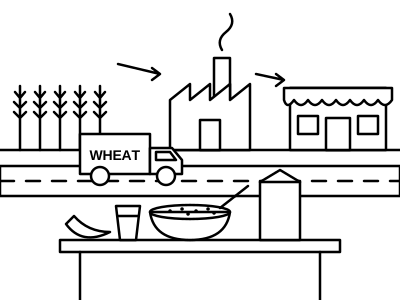
    Say: "Today you are a mapmaker. Your map will tell the story of one breakfast. A good map has a title, a key and a compass rose." Model one food. Find Guatemala on the world map. Say: "Many bananas sold in the U.S. grow in Guatemala, Ecuador or Costa Rica. Bananas need warm weather all year." Say: "A ship carries them to a U.S. port, and a truck brings them here." Copy this Food Facts chart into the notebook. Bananas: Guatemala, Ecuador, Costa Rica. Oats: Canada and the northern Midwest. Oranges for juice: Florida, Brazil, Mexico. Cocoa: Côte d'Ivoire and Ghana in West Africa. Coffee: Brazil and Colombia. Say: "Each country grows or makes some things well, so countries trade. We depend on their farmers, and they depend on our buyers." Ask: "Why are bananas not grown in most of the U.S.?" (Most of it is too cold in winter.) Ask: "Which ocean would a ship from West Africa cross to reach us?" (The Atlantic.) Ask: "What three parts does your map need?" (A title, a key and a compass rose.) If stuck, say: "Find the country on the world map first."

    15–20 min · Activity / Source Work

    Breakfast map challenge. 1) Your child sketches the world on the large sheet of paper, copying the world map. Rough shapes for the seven continents are fine. Label the Atlantic and Pacific Oceans. 2) Your child reads each food label for "Product of" or "Grown in." If a label does not say, use the Food Facts chart and write "likely." 3) Mark a dot and the food's name at each place. Plot at least four foods. Mark your home with a star. 4) Draw a route from each dot to the star. Use one color for ships over oceans and a second color for trucks or trains over land. Add an arrowhead at the home end. 5) Add a title, a compass rose and a key. The key shows both colors, the dot and the star. 6) Count the countries on the map. Compare the count with the guess. Ask for evidence: "Which food crossed water? How does your map show it?" (Sample: the bananas. The ship color runs from Guatemala to a U.S. port.) Look for routes that start at a growing place and end at home.

    10 min · Notebook Entry

    Your child writes two sentences. "I was surprised that ___." "My breakfast shows interdependence because ___." Sample: "I was surprised that oats may come from Canada. My breakfast shows interdependence because farmers in three countries grew it."

    5 min · Exit Ticket

    Your child answers with the finished map in view. Praise a clear key and arrows that point home.

    Watch for: Drawing the route from home to the country, as if we sent the food there.

    Try: Ask: "Where does the trip start? Where does the food end up?" Your child draws the arrowhead at the home end.

    Exit ticket (3 questions)
    1. Point to one route on your map. Where does it start? Which kinds of travel does your key show for it?
    2. Bananas need warm weather all year. How does that explain where a banana route starts?
    3. Suppose ships stopped crossing the oceans for a month. How would your breakfast change? What does that show?
    Show answers
    1. Answers vary. Look for: a growing place as the start, and the ship or truck color read from the key.
    2. It starts in a country that is warm all year, such as Guatemala, Ecuador or Costa Rica.
    3. Answers vary. Look for: foods from other countries would run out, so we depend on farmers and shippers far away.

    Support: Sketch the continents yourself. Your child plots three foods and draws the routes.

    Extend: Your child adds a third color for a food your own state grows and sends elsewhere.

    Homework: Your child shows the breakfast map to a family member and tells one food's story. Look for the key being used.

    Mathematics

    I can solve the Garden Fence Challenge and explain which rectangle is the best design.

    3.MD.D.83.MD.C.7.b

    Builds on: Needs Week 31 Day 3 (same perimeter, different areas) and Week 31 Day 2 (same area, different perimeters). One-minute check: ask the perimeters of a 2 by 4 and a 1 by 5 rectangle (12 units; 12 units).

    Materials: String tied in a loop 24 inches around (each inch stands for 1 foot of fence), Ruler, Grid paper, 20 square tiles (or 1-inch paper squares), Notebook, Pencil

    5 min · Warm-Up

    Spaced review from Week 30 Day 4. A rectangle has a perimeter of 16 units and a length of 5 units. Your child finds the width (5 + 5 = 10; 16 − 10 = 6; 6 ÷ 2 = 3 units). Then practice ×4 and ×7 facts with no clock. Ask 4 × 6, 4 × 8, 7 × 5 and 7 × 8 (24, 32, 35, 56).

    10–15 min · Mini-Lesson

    Read the challenge aloud: "Ms. Okafor has 24 feet of fence for a rectangle garden. Which shape gives the most room to plant?" Bend the string loop into a long, thin rectangle 1 inch wide. Your child measures the long side with the ruler (11 inches). Check the fence: 1 + 11 + 1 + 11 = 24. Say: "One length plus one width is half the fence. Half of 24 is 12." Write 1 + 11 = 12. Start a table with three columns: width, length, area. Write 1 × 11 = 11. Say: "So the 1 by 11 garden has an area of 11 square feet." Outline it on grid paper. Next row: width 2. Ask: "What length makes 12?" (10) Write 2 × 10 = 20. Say: "The fence is the same, but the area grew." Now your child does more. Your child bends the string to width 3, then fills in the row. (3 by 9; 3 × 9 = 27 square feet)

    10–15 min · Guided Practice

    Your child finishes the table and outlines each garden on grid paper. 1) Width 4. (4 by 8; 4 × 8 = 32 square feet) 2) Width 5. (5 by 7; 5 × 7 = 35 square feet) 3) Width 6. (6 by 6; 6 × 6 = 36 square feet) 4) Ask: "Which garden is best for planting? Why?" (The 6 by 6 square. It has the most area, 36 square feet.) Ask: "What about width 7?" (It is the 5 by 7 garden turned.) If stuck, say: "The width and length must make 12. What goes with this width?"

    15–20 min · Independent Practice

    Now flip the problem. Mr. Diaz has 20 square patio tiles, each 1 foot on a side. He wants the shortest border. Your child builds each patio with tiles. 1) A 1 by 20 patio. Find its perimeter. (1 + 20 + 1 + 20 = 42 feet) 2) A 2 by 10 patio. (2 + 10 + 2 + 10 = 24 feet) 3) A 4 by 5 patio. (4 + 5 + 4 + 5 = 18 feet) 4) Which patio needs the shortest border? (4 by 5, the one closest to a square) 5) A new garden has 18 feet of fence. List every rectangle and its area. (1 by 8, area 8; 2 by 7, area 14; 3 by 6, area 18; 4 by 5, area 20) 6) Which of those is best for planting? (4 by 5, area 20 square feet) 7) One bag of soil covers 6 square feet. How many bags cover the 36 square foot garden? (36 ÷ 6 = 6 bags) 8) A gate 3 feet wide replaces part of the 24 feet of fence. How much fence is needed now? (24 − 3 = 21 feet) Last, your child writes one sentence of advice to each gardener.

    5 min · Exit Ticket

    Read each question aloud; your child may sketch or make a small table but uses no string or tiles.

    Watch for: Forgetting that one length plus one width is only half of the fence.

    Try: Your child bends the string into a rectangle and measures one long side and one short side. Together they make 12, half of 24.

    Fact fluency: ×4 and ×7 facts
    Exit ticket (3 questions)
    1. A garden has 28 feet of fence. What must one length plus one width make?
    2. With 28 feet of fence, which rectangle gives the most garden area?
    3. With 12 square tiles, which rectangle needs the shortest border?
    Show answers
    1. 14 feet (half of 28)
    2. 7 by 7 (area 49 square feet)
    3. 3 by 4 (perimeter 14 units)

    Support: Give your child the table with the widths and lengths filled in. Your child only multiplies to find each area.

    Extend: Your child tries 38 feet of fence and explains why no square with whole-number sides works. (The two sides must make 19. The best is 9 by 10, area 90 square feet.)

    Homework: Your child explains the Garden Fence Challenge to a family member and shows the table. Then your child solves it for 10 feet of fence. (1 by 4, area 4; 2 by 3, area 6; the best is 2 by 3)

    English Language Arts

    I can interview a family expert, ask good follow-up questions and recount what I learned (enrich day).

    SL.3.3SL.3.1SL.3.1.CSL.3.2W.3.8L.3.5.B

    Builds on: Needs open questions from Week 28 and follow-up questions from Week 17. One-minute check: ask "Which gets a longer answer: Do you like cooking? or How did you learn to cook?" (How did you learn to cook?)

    New words:
    • interview – a talk in which one person asks questions to learn from another

    Materials: Writer's notebook, Pencil, A family member or neighbor with a skill to share, One large index card

    5 min · Warm-Up

    Word study (about 3 minutes). Use four words in meaning. Ask: "Which word fits? My grandma ___ me to knit." (taught) "Which word fits? I ___ the ball with one hand." (caught) "Which word means hard, not easy?" (tough) "Which word means one more time?" (again) Your child says a new sentence with each word. Spaced review from Week 3. Ask: "Where do the quotation marks go? Mom said, Dinner is ready." (Around Dinner is ready.)

    10–15 min · Mini-Lesson

    Say: "Today is the Family Expert Interview. An interview is a talk where you ask questions to learn from someone. A good interviewer listens closely and asks follow-up questions that dig deeper." Write three follow-up stems: "Can you tell me more about ___?" "Why did you ___?" "What happened next?" Read aloud this model, "Talking with Uncle Dev": Q: How did you learn to play the drums? A: My neighbor gave me lessons when I was nine. I practiced on a pillow first. Q: Why a pillow? A: Drums are loud! A pillow let me learn the beats quietly. Q: What was the hardest part? A: Keeping a steady beat with both hands. "Slow is smooth," my teacher said. Think aloud: "The first question was planned. Why a pillow? was a follow-up. It used a word he had just said." Ask: "Which other question could be a follow-up?" (What was the hardest part?) Point to the last line. Say: "The teacher's exact words have quotation marks."

    10–15 min · Guided Practice

    Hold a two-minute practice interview. You are the expert on a skill you really have, such as making pancakes. 1) Your child writes three How, Why or What questions about your skill. 2) Your child asks two of them and takes notes in short phrases. 3) Your child asks one follow-up that uses something you just said. (Sample: "You said the pan must be hot. Why?") 4) Your child recounts two things you said, in order. If stuck, say: "Say back one thing I told you. Now ask why or how about it."

    15–20 min · Independent Practice

    Your child interviews a family member or neighbor for about 10 minutes. If no one else is home, you are the expert. 1) Ask at least five questions, with two follow-ups, and take notes. 2) On the index card, write an Expert Card. Recount the three most important things you learned, in order. 3) Add one quote in quotation marks. 4) Add one describing word that fits the expert in real life, such as patient, skillful or helpful. Tell what the expert did that shows it. Sample: "Uncle Dev is patient. He practiced on a pillow first." Check the card with the expert for mistakes.

    5 min · Exit Ticket

    Ask the three questions. Your child may look at the notes and the Expert Card.

    Watch for: Reading the list of questions one after another without listening to the answers.

    Try: Pause after each answer. Your child repeats one word the expert said before asking the next question.

    Exit ticket (3 questions)
    1. Which of your questions today was a follow-up? What answer did it follow?
    2. Recount one important thing your expert told you.
    3. Which describing word did you choose for your expert? What did the expert do that proves it?
    Show answers
    1. Answers vary. Look for: a question that used something the expert had just said.
    2. Answers vary. Look for: a correct detail from the interview, said in a complete sentence.
    3. Answers vary. Look for: a word such as patient or skillful and a real action that shows it.

    Support: Write the five interview questions together first. Your child reads them from the notebook and you help with one follow-up.

    Extend: Your child turns the Expert Card into a paragraph with a hook, three facts and a closing sentence.

    Homework: Read your Expert Card to another family member. Answer one question they ask about it in a complete sentence.

    Science

    I can design a bird with traits that help it survive in a chosen habitat and explain my choices.

    3-LS4-23-LS4-3

    Builds on: Needs the Week 30 Day 4 beak model and Week 11 on habitats. One-minute check: ask, "What is a habitat?" (The place where a living thing gets its food, water, shelter and space.)

    New words:
    • field guide – a book that helps people name living things and tells where they live

    Materials: Tweezers, a clothespin, a spoon and 2 chopsticks or unsharpened pencils (model beaks), 3 small dishes: 30 grains of dry rice, 20 dried beans, 20 small cereal pieces, Cup to drop the food into (model stomach), Drawing paper and colored pencils, Bean cups and Bean Log from Week 31, Science notebook and pencil

    5 min · Flex Day 4 — Enrich: Design-a-Bird Project — Wonder Warm-Up

    Bean check: record both cups in the Bean Log. Spaced review from Week 30. Ask: "In the beak model, which beak picked up beans best? Why did that matter?" (Answers vary. Listen for: that beak had an advantage for that food.) Then the wonder. Ask: "What would the best bird for a snowy forest look like?"

    10–15 min · Mini-Lesson

    Say: "Today you are a scientist and an artist. You will design a bird for one habitat. Its traits must help it survive there." Read three habitat cards aloud. Snowy forest: big seeds inside cones, long cold winters, white ground. Marsh: insects in soft mud, shallow water, tall brown reeds. Meadow: tiny seeds on the ground, green and tan grass, hawks overhead. Say: "Real birds do not choose their traits. They inherit them. In each habitat, birds with helpful traits survive and raise more young." Ask: "Would thick, fluffy feathers help in the snowy forest? In a hot marsh?" (Yes in snow, because they hold warmth. In heat the bird could get too warm.) Ask: "Why might brown streaked feathers help among reeds?" (Camouflage.) Ask: "Can one bird be the best in every habitat?" (No. A trait that helps in one place can hurt in another.) If stuck, say: "Name the food first. Then ask which body part gets that food."

    15–20 min · Investigation / Hands-On

    Design-a-Bird. 1) Your child picks a habitat and its food: beans for big seeds, cereal for insects, rice for tiny seeds. 2) Beak test. Count slowly to 20 while your child moves food into the cup with one beak. They use one hand and take one piece at a time. Count the pieces moved. 3) Repeat with each of the 4 beaks on the same food. Change only the beak. Keep the food, the count to 20, the hand and the dish the same. Table: Beak | Pieces moved. 4) Your child picks the beak shape with the highest number. 5) They choose 2 more traits for that habitat. Ideas: feather color, thick feathers, long wading legs or strong gripping feet. 6) They draw and label the bird. 7) Ask: "Would your bird survive well, less well or not at all in another habitat?" Tweezers often do well with rice and cereal. The clothespin often grips beans. Real results vary. Use your own data.

    10 min · Science Notebook Entry

    Your child writes a field guide entry in the notebook: the bird's name, habitat, food, beak results and 3 labeled traits. Each trait needs a reason. Frame: "My bird's ___ helps it ___ in the ___." Sample: "My bird's thin, pointed beak helps it pull insects from mud in the marsh."

    5 min · Wrap-Up & Exit Ticket

    Ask the three exit questions aloud; your child points to the table and the drawing while answering. Praise reasons that link a trait to the habitat.

    Watch for: Giving one bird every helpful trait, such as thick feathers in a hot marsh.

    Try: For each trait ask: "Would this help here, or make life harder?" Your child erases traits that do not fit.

    Exit ticket (3 questions)
    1. Which beak worked best for your bird's food? What is your evidence?
    2. A bird with thick white feathers lives well in a snowy forest. How well might it survive in a hot, green marsh? Why?
    3. Do birds choose their beak shapes? Where do the shapes come from?
    Show answers
    1. Answers vary. Look for: the beak with the highest number in the table.
    2. Less well, or not at all. It could get too warm, and white feathers would stand out to predators.
    3. No. Beak shapes are inherited from parents. Birds with helpful beaks survive and raise more young.

    Support: Choose the habitat together and test only 2 beaks. Your child labels one trait with a reason.

    Extend: Your child designs a second bird for another habitat. They explain what would happen if the two birds traded places.

    Homework: Present your bird to a family member. Explain one trait and how it helps the bird survive. Look for: a clear link between the trait and the habitat.

    Day 5 · Friday

    Social Studies

    I can review Weeks 28 to 31, reflect on my learning and notice needs in my community.

    D2.Eco.4.3-5D2.Geo.2.3-5D2.Eco.1.3-5D2.Civ.6.3-5

    Builds on: Needs this week's chains, registers, lemonade stand and breakfast project. One-minute check: "Name one thing you made this week and one thing it taught you." (Answers vary. Look for a real project and a fact.)

    Materials: 6 index cards (mixed review), Clipboard or a hard book to write on, 1 sheet of paper (noticing list), Stored Week 32 check (the Friday Check) and its answer key, Notebook, Pencil

    5 min · Warm-Up

    Spaced review from Week 26. Ask: "Many people want a toy, and stores have only a few. What usually happens to the price?" (It goes up.) Then ask the big question: "What is one thing near our home that works well? What is one thing that could be better?"

    10–15 min · Mini-Lesson

    Say: "First, a mixed review of Weeks 28 to 31." Write these six questions on cards. Your child draws a card and answers aloud. "Why can no family make everything it uses?" (No one has every skill and resource. People specialize and trade.) "Where on a map do you learn what the shading means?" (In the key.) "Name one food the U.S. buys from another country." (Bananas, cocoa or coffee.) "The balance is $9. Deposit $4, then withdraw $6." ($7.) "Is teaching a neighbor to knit a gift of talent or things?" (Talent.) "Income is $15 and costs are $9. Profit or loss?" (A $6 profit.) Now say: "Next week you start a Civic Action Project. Today we look for needs with our own eyes." Say: "I saw a cracked step at the library door, so it goes on my list." Ask: "Is 'the whole world has too much trash' something we saw today?" (No. It is too big, and we did not see it.) If stuck, say: "Open your notebook to that week and find the page."

    15–20 min · Activity / Source Work

    Noticing Walk. Stay beside an adult and on sidewalks or paths. 1) Fold the sheet of paper into two columns: Works well | Could be better. Put it on the clipboard. 2) Walk together for about 15 minutes around your block or a park. 3) Your child lists five things that work well and three that could be better. Samples: a clean playground, litter near a bench. 4) Beside each "could be better" item, your child writes where it is. 5) Back home, ask for evidence: "Where exactly did you see it? Who uses that place?" 6) Your child stars the one need that matters most to them. Look for things your child really saw, not guesses. Keep the list for Monday. If you cannot go out, look from a window or porch.

    10 min · Notebook Entry

    Your child finishes the flex week reflection. "This week I caught up on ___." "The project I enjoyed most was ___ because ___." "A need I noticed in my community is ___." Sample: "A need I noticed is litter by the bench." Keep this to 5 minutes if you give the check right after.

    5 min · Exit Ticket

    Ask the three exit questions aloud. Then give the stored Week 32 check. It has 7 items and takes about 15 minutes. Score it with the answer key. 6 or more right: move on to Week 33. 4 or 5 right: redo Day 2, then run Station 2 with a new starting balance. 3 or fewer right: reteach Day 3 by acting out the stand with play money. Praise careful noticing. If time is short, give the check later today.

    Watch for: Listing big problems heard about elsewhere instead of things seen on the walk.

    Try: Ask: "Where exactly did you see it?" Add only items your child can point to or describe from the walk.

    Exit ticket (3 questions)
    1. What did you get better at this week? Give an example.
    2. Read one item from your "Could be better" column. Where did you see it?
    3. Why does the list include only things you saw yourself?
    Show answers
    1. Answers vary. Look for: a named skill and an example, such as adding a deposit.
    2. Answers vary. Look for: a real thing and an exact place.
    3. Things we saw are facts we can check. Guesses and far-away problems are not evidence from our walk.

    Support: Use three of the six cards. Walk one block and list three things that work well and one that could be better.

    Extend: On the walk, your child tallies one need for 10 minutes, such as pieces of litter. Save the count as evidence for next week.

    Homework: Your child shares the noticing list with the family. Look for a mark beside each need they have also seen.

    Mathematics

    I can review area, perimeter and missing sides and reflect on what I have learned.

    3.MD.C.7.b3.MD.C.7.d3.MD.D.83.OA.C.7

    Builds on: Needs Days 1 to 4 of this week, which revisited Weeks 28 to 31. One-minute check: ask "Which do we measure in square units, area or perimeter?" (area)

    Materials: Stored Week 32 check and its answer key, 4 index cards. Before the lesson, write one station on each. Area: a 7 by 7 square. Perimeter: a 2 by 6 rectangle. L-shape area: a 6 by 3 rectangle with a 2 by 4 rectangle on top of its left end. Unknown side: perimeter 20, length 8., Grid paper, 20 square tiles and yarn (for reteaching), Notebook, Pencil

    5 min · Warm-Up

    Spaced review from Week 31 Day 4. Ask: "Is a fence an area job or a perimeter job? What about carpet?" (perimeter; area) Then practice ×6, ×7 and ×8 facts with no clock. Ask 6 × 9, 7 × 7 and 8 × 8 (54, 49, 64).

    10–15 min · Mini-Lesson

    Play Four Stations for 10 minutes. Lay the 4 cards face down. Say: "Each card is one kind of problem from this week. Flip a card, name its kind, and solve it." Model one turn with the unknown side card. Say: "The 20 is the distance around. The two long sides use 8 + 8 = 16." Write 20 − 16 = 4, then 4 ÷ 2 = 2. Say: "So the width is 2 units." Check it: 8 + 2 + 8 + 2 = 20. Now your child takes the other three turns on grid paper. Area card, like Day 1: the 7 by 7 square. (7 × 7 = 49 square units) Perimeter card, like Day 1: the 2 by 6 rectangle. (2 + 6 + 2 + 6 = 16 units) L-shape card, like Day 1. (6 × 3 = 18 and 2 × 4 = 8. Then 18 + 8 = 26 square units.) Ask after each turn: "Did you cover the floor or walk the fence?" Put a star on any card that needed help.

    10–15 min · Guided Practice

    Your child works on paper while you watch. Help only when asked. 1) A yard is 6 feet by 8 feet. A sandbox covers 12 square feet of it. How much yard is open? (6 × 8 = 48; 48 − 12 = 36 square feet) 2) A pen uses 16 feet of fence. Which rectangle holds the most area? (4 by 4, area 16 square feet) 3) A rectangle has an area of 40 square units. One side is 8. (8 × s = 40; s = 5) 4) Reflect. Your child names one skill that got stronger this week and shows one problem that proves it. (Answers vary.) If stuck, say: "Which day is this like? What did we build or draw that day?"

    15–20 min · Independent Practice

    Give the stored Week 32 check now. It has 7 items on area, perimeter and unknown sides. Allow about 20 minutes, with no clock running. Your child may sketch on grid paper. Score it with the answer key. Then choose a route by the result. 6 or 7 right: move on to Week 33. 4 or 5 right: find the kind of item missed. For items 1 and 2, area and perimeter of a rectangle, redo the Day 1 Mini-Lesson. For item 3, the L-shape, redo Day 1 Guided Practice. For items 4 and 5, unknown sides, redo Day 2 Guided Practice. For item 6, open floor, redo Day 3 Guided Practice. For item 7, the fence, redo the Day 4 Mini-Lesson. 3 or fewer right: reteach Day 1 with tiles and yarn, then Day 2, before Week 33.

    5 min · Exit Ticket

    After the check, your child answers these three questions; then go over any missed check items together.

    Watch for: Writing a bare number with no unit, or writing square units for a perimeter.

    Try: Your child says "floor" or "fence" before writing each unit. Only floor answers get the word square.

    Fact fluency: ×6, ×7 and ×8 facts
    Exit ticket (3 questions)
    1. What is the perimeter of a 3 by 7 rectangle?
    2. Which skill got stronger this week: area, perimeter or unknown sides?
    3. Which project did you like best, the Dream Bedroom or the Garden Fence? Tell one number from it.
    Show answers
    1. 20 units
    2. Answers vary. Look for: a named skill and one example.
    3. Answers vary. Look for: a correct number, such as 80 square feet of floor or 36 square feet of garden.

    Support: Read each check item aloud. Let your child build with tiles and yarn first. Give the check in two sittings if your child tires.

    Extend: Your child writes a fifth station card with a two-step area problem and an answer key. Sample: a 5 by 7 board holds a 2 by 2 note. How much board is open? (35 − 4 = 31 square feet)

    Homework: Your child redoes two missed check items with a family member and explains each fix. If none were missed, your child finds both measures of a 5 by 10 rectangle (50 square units; 30 units).

    English Language Arts

    I can review the skills from this quarter and reflect on which ones I have mastered.

    W.3.8W.3.2.CL.3.1.FL.3.5.ARL.3.7

    Builds on: Needs this quarter's skills: paraphrasing, joining sentences, agreement, nonliteral language and story pictures. One-minute check: ask "What does a paraphrase keep, and what does it change?" (It keeps the meaning and changes the words.)

    Materials: Week 32 English Language Arts Check, Writer's notebook, Illustrated fable, Expert Card, Pencil

    5 min · Warm-Up

    Word study (about 3 minutes). Give a quick spelling check with no clock. Say each word and a short sentence: tough, taught, friend, does, again, enough. Challenge word: although. Your child writes in the notebook. Correct it together. Your child rewrites any missed word and underlines its tricky part. Spaced review from Week 27. Ask: "Which word fits? The otters groom ___ fur: there, their or they're?" (their)

    10–15 min · Mini-Lesson

    Say: "Today we review with five quick stations, then you take the weekly check." Read aloud "A Raft of Otters": Sea otters often rest together in a group called a raft. A raft may hold just a few otters or more than a hundred. Males and females usually rest in separate rafts. Before a nap, an otter may wrap itself in long strands of kelp. The kelp is anchored to the sea floor, so it holds the otter in place while the waves roll by. Model Station 1, paraphrase. Think aloud: "The first sentence says otters often rest together in a group called a raft. I cover it. In my own words: A raft is a group of sea otters resting side by side. The meaning is the same, and most words changed." Then name the other stations: joining sentences, agreement, nonliteral words and story pictures.

    10–15 min · Guided Practice

    Do the stations together, about two minutes each. 1) Station 2. Ask: "Join these with so: An otter wraps itself in kelp. It does not drift away." (An otter wraps itself in kelp, so it does not drift away.) 2) Station 3. Ask: "Fix the verbs: The otters rests in a raft. A raft hold many otters." (rest, holds) 3) Station 4. Say: "Kelp is the otter's seat belt." Ask: "Is kelp really a seat belt? What does it mean?" (No. Kelp holds the otter safely in place.) 4) Station 5. Your child points to one panel of the illustrated fable and tells what the picture adds. (Look for: a feeling, a mood or a detail.) Then your child reads one follow-up question from the Expert Card notes. If stuck, say: "Which skill is this station about? Tell me its rule, then try again."

    15–20 min · Independent Practice

    1) Give the stored Week 32 English Language Arts Check. It has 8 items and takes about 15 minutes. Your child works alone. Check it with the answer key, and your child corrects each missed item. 2) Follow this route. 6 or more right: your child is ready for next week. 4 or 5 right: redo the Day 2 practice page, then compare three family shoes with -er and -est words. 3 or fewer right: reteach Day 1 with a short animal article and two tricky words. 3) Your child writes a reflection of three or four sentences. If time is short, your child says it aloud. Use the frames: "The activity that helped me most was ___ because ___. I feel sure about ___. I still need practice with ___."

    5 min · Exit Ticket

    Ask the three questions to close the flex week. Your child may look at the passage and the reflection.

    Watch for: Explaining a nonliteral sentence as if it were real, such as saying otters wear seat belts.

    Try: Ask: "What does a seat belt do for you? So what is the writer saying about kelp?"

    Exit ticket (3 questions)
    1. Paraphrase: 'Before a nap, an otter may wrap itself in long strands of kelp.'
    2. Which skill do you feel most sure of now? What shows it?
    3. Which skill needs more practice, and what will you do about it?
    Show answers
    1. Answers vary. Sample: An otter sometimes winds seaweed around its body before it sleeps.
    2. Answers vary. Look for: one skill named with proof, such as a station or check item done correctly.
    3. Answers vary. Look for: one skill named and a real plan, such as redoing a practice page.

    Support: Read each check item aloud. Do every station together, and let your child answer first before you confirm.

    Extend: Your child designs a sixth station on any skill from this quarter, with one sample item and its answer.

    Homework: Teach one station skill to a family member with your own example. Then read your own book for 15 minutes.

    Science

    I can review traits, inheritance, environment and variation and reflect on my learning.

    3-LS3-13-LS3-23-LS4-2

    Builds on: Needs Weeks 28 to 31 and the finished Bean Log. One-minute check: ask, "What was the one thing we changed in the bean test?" (Light.)

    Materials: Week 32 Science Check (7 items) and its answer key, Bean cups and Bean Log from Week 31, Ruler marked in centimeters, Science notebook and pencil

    5 min · Flex Day 5 — Mixed Review and Reflection — Wonder Warm-Up

    Final bean measurement: measure the tallest sprout in each cup in centimeters and record both. Your child names 3 differences between the cups. Spaced review from Week 13. Ask: "In a science argument, what does reasoning do?" (It tells how the evidence supports the claim.) Then the big question. Ask: "What did two weeks of bean data show?"

    10–15 min · Mini-Lesson

    Mixed review. Ask six questions aloud. 1) "What is a trait?" (A feature of a living thing.) 2) "Name an inherited trait of a rabbit." (Sample: long ears.) 3) "Name a learned behavior of a horse." (Sample: carrying a rider.) 4) "What is variation?" (Differences among living things of one kind.) 5) "Give an example of variation that helps survival." (Sample: sand-colored lizards hide well on sand.) 6) "Name two parts of the environment that change how a plant grows." (Any 2: light, water, soil, wind, warmth.) Reteach any miss from the notebook. Then model an argument with the moth hunt. Say: "A claim answers the question. Evidence is data. Reasoning tells why the evidence fits." Say: "Claim: newspaper moths had an advantage on newspaper. Evidence: I caught 2 newspaper moths and 7 white moths. Reasoning: moths that match the background are harder to see." Ask: "Which sentence had numbers?" (The evidence.) If stuck, say: "Which sentence could you check by counting?" Keep this part to 12 minutes.

    15–20 min · Investigation / Hands-On

    Bean Experiment Wrap-Up. 1) Read the Bean Log together. Your child circles the final heights and colors. 2) They draw the two final sprouts side by side and label each height. 3) They write three sentences from frames. "Claim: Bean plants grown in the dark ___." "Evidence: The dark sprouts were ___ centimeters tall and ___. The light sprouts were ___ centimeters tall and ___." "Reasoning: Both cups had the same ___, ___ and ___. Only ___ was different, so ___." 4) Check that the claim and evidence match the log. Dark sprouts are often taller, thinner and pale yellow. Sprouts in light are often shorter, sturdier and green. Real results vary. Write what your own data shows. If one cup has no sprouts, that is the evidence. Talk about possible causes, such as too much water. 5) Now move the Dark cup into the light and watch it for 3 days. Keep this part to 15 minutes.

    10 min · Science Notebook Entry

    Reflection page. Your child finishes three frames. "Three things I learned about traits are ___." "My favorite investigation was ___ because ___." "One question I still have is ___." Sample: "My favorite investigation was the camouflage hunt because I was the bird."

    5 min · Wrap-Up & Exit Ticket

    Ask the three exit questions aloud and praise answers that use data. Then give the Week 32 Science Check, which has 7 items. Allow about 10 minutes, later today if time is short. Your child works alone. Score it with the key. With 6 or more right, design a mammal with 3 traits that help it survive in a desert. With 4 or 5 right, redo the Day 2 camouflage hunt on a new background, such as a patterned towel. With 3 or fewer right, reteach Day 1. Act out 6 cards and decide "born with" or "had to learn."

    Watch for: Saying the dark plants grew better because they are taller.

    Try: Compare color, stem thickness and how well each sprout stands. Ask: "Which plant looks healthier?"

    Exit ticket (3 questions)
    1. What did your bean data show? Give one number as evidence.
    2. Why can we say that light caused the difference between the two cups?
    3. What is one question you still have about traits?
    Show answers
    1. Answers vary. Look for: a height from the Bean Log plus a color or stem difference.
    2. Light was the only thing changed. The beans, soil, water and cups were the same.
    3. Answers vary. Look for: a question that could be tested or looked up.

    Support: Ask only 3 of the review questions. Your child may look in the notebook. Write the claim together.

    Extend: Your child writes a short lab report on the bean test: question, materials, steps, data, claim and evidence.

    Homework: Show the bean cups and Bean Log to a family member. Explain what light does for plants. Look for: evidence read from the log.

    Friday Checks & Answer Keys

    Mathematics · Week 32 Mathematics Check

    3.MD.C.7.b3.MD.C.7.d3.MD.D.83.OA.A.43.OA.D.83.OA.C.7

    Goals

    • I can find area and perimeter for rectangles and shapes made of rectangles.
    • I can find a missing side from the area or the perimeter.
    • I can use area and perimeter to plan a design.

    Answer each question. Show your thinking in the box when there is one.

    1. What is the area of a 9 by 4 rectangle?
    2. What is the perimeter of a 9 by 4 rectangle?
    3. An L is made of a 4 by 4 square and a 3 by 2 rectangle. What is its area?
    4. A rectangle has area 56 square units and one side of 8. How long is the other side?
    5. A rectangle has perimeter 30 and length 9. What is the width?
    6. A room is 8 ft by 9 ft. A bed takes 18 square feet. How much floor is still open?
    7. With 20 feet of fence, which rectangle gives the most garden?
    Show answer key
    1. 36 square units
    2. 26 units
    3. 22 square units
    4. 7
    5. 6
    6. 54 square feet
    7. 5 by 5 (area 25 square feet)

    What to do next

    Most right
    If 6 or more are right: draw a floor plan for a dream treehouse with three pieces of furniture and find the open floor.
    Some right
    If 4–5 are right: redo the Day 2 page, then make missing-side cards for a partner to solve.
    Few right
    If 3 or fewer are right: reteach Day 1, using tiles for area and yarn around the edge for perimeter. Then reteach Day 2.

    English Language Arts · Week 32 English Language Arts Check

    W.3.8RI.3.4RI.3.2L.3.4.AL.3.4.BL.3.4.DRF.3.3.CW.3.2.B

    Goals

    • I can use clues to explain word meanings and paraphrase.
    • I can use correct verbs and comparing words.
    • I can explain pictures, follow-up questions and nonliteral words.

    Answer each question. Show your thinking in the box when there is one.

    1. 'Camels can go a long time without water because they are well adapted, or suited, to the desert.' What does adapted mean?
    2. Paraphrase: 'Camels store fat in their humps.'
    3. Fix it: The camels walks slowly.
    4. Circle the right word: A camel is ____ than a goat.
      ○ tall○ taller○ tallest
    5. What does 'My little brother was a tornado at the party' mean?
    6. Name one thing a picture in a fable can show.
    7. An expert says, 'I grow tomatoes in buckets.' Write a follow-up question.
    8. Spell the heart word that means more than one person: The ____ at the show laughed.
    Show answer key
    1. suited
    2. Answers vary. Look for: the same idea in new words, such as 'A camel keeps extra fat in its hump.'
    3. The camels walk slowly.
    4. taller
    5. He was wild and messy, running all over.
    6. A character's feelings, the mood, or an important detail.
    7. Answers vary. Look for: a question that digs deeper, such as 'Why do you use buckets?'
    8. people

    What to do next

    Most right
    If 6 or more are right: Write and illustrate your own short fable with a moral that uses an abstract noun.
    Some right
    If 4–5 are right: Redo the Day 2 page, then compare three family shoes with -er and -est words.
    Few right
    If 3 or fewer are right: Reteach Day 1: read a short animal article together, highlight two tricky words and use sticky notes to write each clue.

    Science · Week 32 Science Check

    3-LS3-13-LS3-23-LS4-23-LS4-3

    Goals

    • I can sort traits we are born with and behaviors we practice.
    • I can explain how variation can help survival.
    • I can use data as evidence.

    Answer each question. Show your thinking in the box when there is one.

    1. A sea turtle hatchling crawls toward the ocean right after it hatches.
      ○ inherited○ learned
    2. A girl learns to ride a scooter.
      ○ inherited○ learned
    3. White rabbits and brown rabbits live in a snowy place. Which are more likely to survive? Why?
    4. Seeds measured 3 cm, 1 cm, 2 cm, 2 cm and 4 cm. What is the difference between the longest and the shortest?
    5. A bird eats nectar deep inside long flowers. Which beak helps most?
      ○ a short, thick beak○ a long, thin beak○ a flat, wide beak
    6. Max says, 'Sunlight helped my bean plants grow.' Is this a claim, evidence or reasoning?
      ○ claim○ evidence○ reasoning
    7. Which sentence is evidence?
      ○ The sun sprouts were 12 cm tall and the dark sprouts were 18 cm tall but pale.○ Plants are interesting.○ I think plants like sun.
    Show answer key
    1. inherited
    2. learned
    3. White rabbits, because they blend in with the snow.
    4. 3 cm (4 − 1 = 3)
    5. a long, thin beak
    6. claim
    7. The sun sprouts were 12 cm tall and the dark sprouts were 18 cm tall but pale.

    What to do next

    Most right
    If 6 or more are right: Design a mammal with 3 traits that help it survive in a desert, and explain each one.
    Some right
    If 4–5 are right: Redo the Day 2 camouflage hunt on a new background, such as a patterned towel.
    Few right
    If 3 or fewer are right: Reteach Day 1, Catch-Up: Inherited or Learned: act out 6 cards and decide 'born with' or 'had to learn' for each.

    Social Studies · Week 32 Social Studies Check

    D2.Eco.4.3-5D2.Geo.2.3-5D2.Geo.6.3-5D2.Eco.1.3-5D2.Eco.9.3-5D2.Eco.10.3-5D2.Eco.7.3-5D2.Eco.3.3-5

    Goals

    • I can trace a production chain and read a map key.
    • I can solve budget, bank and profit problems.

    Answer each question. Show your thinking in the box when there is one.

    1. Put the chain in order: store worker, apple grower, truck driver, you.
    2. On a population map, what does the darkest color mean?
    3. A store shows a $12 game and the same game for $8 online. How much less is it online?
    4. Start with $6. Deposit $8, then withdraw $5. What is the balance?
    5. Ivan has $14. Needs cost $5 and he saves $4. How much is left for wants?
    6. A stand's costs are $8. It sells 13 cups at $1 each. What is the profit?
    7. Is a cash register a natural, human or capital resource?
      ○ Natural○ Human○ Capital
    Show answer key
    1. Apple grower, truck driver, store worker, you.
    2. The most people live there.
    3. $4 less (12 − 8 = 4)
    4. $9 (6 + 8 = 14, and 14 − 5 = 9)
    5. $5 (14 − 5 = 9, 9 − 4 = 5)
    6. $5 (13 − 8 = 5)
    7. Capital

    What to do next

    Most right
    If 6 or more are right: Plan a second pretend business (such as a bookmark shop) and find its costs, income and profit for two "what if" days.
    Some right
    If 4–5 are right: Redo the Day 2 page, then run Station 2 again with a new starting balance.
    Few right
    If 3 or fewer are right: Reteach Day 3 (profit): act out the lemonade stand with play money, paying costs first and counting what is left.

    Week 32

    Home Connection

    Big ideas

    • Floor plans and fences use area and perimeter.
    • Interviews help us learn from experts we know.
    • Variation can help some living things survive.
    • A business needs a plan for costs and profit.

    Mathematics

    Try it (10 min): Draw a dream bedroom on grid paper with a bed, desk and rug as rectangles. Find the area of each piece and the perimeter of the whole room.

    Talk about it: If you had 24 feet of fence, which garden rectangle would give the most space?

    English Language Arts

    Try it (10 min): Help your child interview a family member or friend about something they know well, like cooking, a hobby or a job. Ask three questions and one follow-up, then retell what you learned.

    Talk about it: Which follow-up question got the most interesting answer?

    Science

    Try it (10 min): Design a bird on paper with a beak, feet and colors that help it survive in one habitat, like a pond or a desert. Explain each trait you chose.

    Talk about it: Which of your bird's traits helps it the most?

    Social Studies

    Try it (10 min): Plan a pretend lemonade stand: list the costs, set a price and find the profit. If supplies cost 12 dollars and you sell 20 cups for 1 dollar each, what is the profit?

    Talk about it: How could your stand earn more profit?

    This week’s words

    floor plan · interview · follow-up · variation · cost · profit

    Celebrate

    Name three things to celebrate: a design you planned, an interview you held, and a profit you figured out.

    This week's read-aloud

    Charlotte's Web by E. B. White

    In this flex week, start this longer novel together and keep reading it in the weeks ahead. It reviews character traits, change and how animals live together on a farm. Be ready to talk about a sad moment near the end.

    See the five daily prompts →

    Math catch-up · 3.MD.C.7.d

    Cut It Into Rectangles

    Shapes made of rectangles look hard until your child cuts them into rectangles, finds each area and adds.

    Builds on: 3.MD.C.5, 3.MD.C.7.c

    Materials: grid paper · scissors · crayons in two colors · pencil

    1. Draw an L-shape on grid paper: a 6-by-2 rectangle with a 3-by-4 rectangle under its left end. Cut it out.
    2. Color the 6-by-2 part one color and the 3-by-4 part another. Find each area: 12 and 12 square units.
    3. Add the parts: 12 + 12 = 24 square units. Count the squares to check.
    4. Each day, your child draws a new L-shape or T-shape, cuts it into two rectangles in a different place, and checks that the total area stays the same.

    Try again

    1. A shape is made of a 5-by-3 rectangle and a 2-by-2 square. What is its total area?
    2. A shape is made of a 4-by-6 rectangle and a 4-by-2 rectangle. What is its total area?
    3. A rectangle has an area of 40 square feet. One side is 8 feet. How long is the other side?

    Reading About Our World · Week 32 · Social Studies

    The Journey of Your Breakfast

    Interdependence · This week's Social Studies lessons

    Wheat from a farm field travels by truck to a factory and a grocery store before ending up in a bowl of cereal on a breakfast table.

    Read it aloud first while your child follows along. Then read it together, and let your child read the parts they can. Talk about the words in the word box.

    Many Hands

    Think about your breakfast. Did you make the cereal, grow the wheat or milk the cow? Probably not! Many people in many places helped bring breakfast to your table. Depending on each other for goods and services is called interdependence.

    From Field to Bowl

    A bowl of cereal might start as wheat growing on a farm in Kansas. A farmer plants and harvests it. A truck driver carries it to a mill, where workers grind it into flour. A factory turns it into cereal and boxes it. Trains and trucks carry the boxes to stores, and a grocery worker puts them on the shelf. Each step needs different workers.

    Milk and Juice

    The milk on your cereal came from a dairy farm. It was cooled, cleaned and packed into cartons at a processing plant. Orange juice may come from oranges grown in Florida or in other countries, such as Brazil. Dairy farms are found in many states, such as Wisconsin and California.

    Around the World

    Some breakfast foods grow only in warm places near the equator. Bananas sold in the United States often come from countries in Central and South America, such as Guatemala and Ecuador. Cocoa beans for hot chocolate grow in warm places too, such as West Africa. Ships carry these foods across the ocean. The trip can take days or even weeks.

    Why We Trade

    Every place is good at making certain things because of its land, climate and resources. No single place can make everything. So people specialize, which means they focus on one kind of work, and then they trade. Farmers grow food, drivers move it, and store workers sell it. Each person depends on many others. When one link in the chain has a problem, many people feel it.

    Trace It Yourself

    Pick one food from your kitchen and read its label. Where was it grown or made? Draw a map that shows its journey to your home. You may be surprised how far it traveled.

    Word box

    • interdependence: depending on each other for goods and services
    • specialize: to focus on one kind of work
    • harvest: to gather crops when they are ready
    • processing plant: a factory where food is cleaned, prepared and packed

    Questions

    1. Where might the wheat in a bowl of cereal be grown?
    2. Name two countries where bananas sold in the United States often come from.
    3. What might happen to your breakfast if truck drivers could not work for a week?
    4. The section From Field to Bowl tells events in time order. What happens right after the wheat reaches the mill?

    Week 32 spelling words →