3
    Third GradePowered by ThirdGrade.com

    Quarter 4 · Synthesis: Area, Shapes, Research, Traits & Civic Action

    Week 33: Polygons & partitioning shapes into equal parts · Presenting research

    Standards this week

    Social Studies

    • D4.7.3-5 Explain different strategies and approaches students and others could take in working alone and together to address local, regional, and global problems.Day 1, 4, 5
    • D2.Civ.2 Explain how a democracy relies on people's responsible participation.Day 1
    • D2.Civ.14.3-5 Illustrate historical and contemporary means of changing society.Day 1
    • D4.6.3-5 Draw on disciplinary concepts to explain the challenges people have faced and opportunities they have created in addressing local, regional, and global problems.Day 2
    • D2.Civ.10.3-5 Identify the beliefs, experiences, perspectives, and values that underlie people's own and others' points of view about civic issues.Day 2
    • D4.8.3-5 Use a range of deliberative and democratic procedures to make decisions about and act on civic problems in their classrooms and schools.Day 2, 4
    • D1.1.3-5 Day 2
    • D1.2.3-5 Day 2
    • D1.5.3-5 Day 3
    • D3.1.3-5 Day 3
    • D2.Civ.1 Distinguish responsibilities of local, state, and national governments.Day 3
    • D1.3.3-5 Day 3
    • D1.4.3-5 Day 3
    • D3.2.3-5 Day 3
    • D2.Eco.12.3-5 Day 3
    • D4.1.3-5 Construct arguments using claims and evidence from multiple sources.Day 5
    • D3.4.3-5 Day 5

    Mathematics

    • 3.G.A.1 Understand that shapes in different categories may share attributes (e.g., quadrilaterals).Day 1, 2, 4, 5
    • 3.G.A.2 Partition shapes into parts with equal areas; express each part as a unit fraction.Day 3, 5
    • 3.NF.A.1 Understand a unit fraction 1/b and a fraction a/b as a parts of size 1/b.Day 3

    English Language Arts

    • SL.3.4 Report on a topic or text with appropriate facts and relevant details, speaking clearly.Day 1, 2, 3, 4, 5
    • W.3.4 Produce writing in which development and organization are appropriate to task and purpose.Day 1
    • L.3.3.B Day 1
    • RF.3.3.C Day 1
    • L.3.2.F Day 1
    • SL.3.6 Speak in complete sentences when appropriate to task and situation to provide requested detail or clarification.Day 2, 4, 5
    • SL.3.5 Create engaging audio recordings or add visual displays to emphasize or enhance certain facts or details.Day 3, 5
    • RI.3.7 Use information from illustrations and words to demonstrate understanding.Day 3
    • SL.3.3 Ask and answer questions about information from a speaker, offering appropriate elaboration and detail.Day 4, 5
    • SL.3.2 Determine the main ideas and supporting details of a text read aloud or information presented in diverse media.Day 5

    Science

    • 3-LS4-1 Analyze and interpret data from fossils to provide evidence about organisms and environments.Day 1, 2, 3, 4, 5

    See what your state adds or places differently

    Suggested daily schedule
    8:30–8:45 AM15 minMorning Circle / Read-Aloud / Calendar
    8:45–10:00 AM75 minEnglish Language Arts
    10:00–11:00 AM60 minMathematics
    11:00–11:15 AM15 minSnack and Movement Break
    11:15–12:00 PM30–45 minScience (every day)
    12:00–12:45 PM30–45 minSocial Studies (every day)
    12:45–1:30 PM45 minLunch and Choice Time
    1:30–2:15 PM45 minSpecials: PE / Art / Music (rotating)
    2:15–2:45 PM30 minIndependent Reading & Journaling

    Mark Week 33 complete

    0 / 4 done

    Saved in this browser

    Day 1 · Monday

    Social Studies

    I can explain what civic action is and name the steps of a civic action project.

    D4.7.3-5D2.Civ.2.3-5D2.Civ.14.3-5

    Builds on: Needs the noticing list from Week 32 Day 5 and Week 21 Day 3 (responsibilities of citizens). One-minute check: "Read me the need you starred on your list." (Answers vary. Look for a real need your child saw.)

    New words:
    • civic action – what people do, alone or together, to help fix a problem in their community
    • boycott – when many people agree not to buy or use something, to ask for a change

    Materials: Civic Action Project planner from the site's Civic Action Project page (or a notebook page titled Step 1), 10 index cards, Noticing list from Week 32 Day 5, Notebook, Pencil

    5 min · Warm-Up

    Spaced review from Week 21. Ask: "Citizens have rights and responsibilities. Tell me one responsibility." (Following laws, helping the community, or voting when grown up.) Then ask the big question: "What could you do to make our community a little better?"

    10–15 min · Mini-Lesson

    Say: "Civic action means doing something, alone or with others, to help solve a community problem." Read two examples aloud. Long ago: "In 1955, Montgomery, Alabama, had unfair bus laws. Black riders had to sit in the back and give up seats to white riders. Rosa Parks refused and was arrested. Thousands of Black residents then stayed off the buses for more than a year. This was a boycott. In 1956 the Supreme Court ruled that separate seating on buses was against the Constitution." Today: "Amara is a made-up third grader. Two of the four swings at her park were broken. She counted the children waiting for a swing on three afternoons. Then she wrote a polite letter to the parks department." Say: "A democracy needs people who take part. Big and small changes start with people who act." Teach the cycle. Say: "Civic action has six steps: identify a problem, research it, plan, act, reflect and share." Say: "Civic action is not about picking sides in an election. Children always do it with an adult." Ask: "What problem did the people of Montgomery act on?" (An unfair bus law.) Ask: "What did Amara do about the swings?" (She counted, then wrote a letter.) If stuck, say: "Listen again. What did the person do about the problem?"

    15–20 min · Activity / Source Work

    Civic action sort. 1) Write one action on each card. Five are civic action. "Picking up litter at the park with a parent." "Writing a polite letter asking the library for more graphic novels." "Collecting canned food for a food bank." "Making a Slow Down sign for the street with an adult." "Reading to a younger child at the library." Five are not. "Buying a toy." "Complaining but doing nothing." "Watching TV." "Playing a video game." "Taking a nap." 2) Make two headings: Civic Action | Not Civic Action. 3) Your child sorts each card and explains why. 4) Ask for evidence: "Which words on the card show it helps the community?" (Sample: "at the park" or "for a food bank.") 5) Ask: "Complaining names a problem. Why is it not civic action?" (Nothing is done to solve it.) 6) Your child predicts a result for two civic action cards. (Sample: "Drivers may slow down near the sign.") Look for reasons about helping the community.

    10 min · Notebook Entry

    Open the planner to Step 1, or title a notebook page "Step 1." Your child writes the six cycle steps in order. Then your child lists five civic action ideas from the noticing list, one sentence each. Sample: "We could pick up the litter by the bench with Dad."

    5 min · Exit Ticket

    Your child answers the three questions in writing. Praise ideas that are small, real and close to home.

    Watch for: Thinking civic action must be huge, like changing a national law.

    Try: Point to Amara's example. Ask: "Was this big or small? Did it still help?"

    Exit ticket (3 questions)
    1. Jay picks up cans at the creek with his aunt. Lee says the creek is dirty but does nothing. Who is taking civic action? Why?
    2. Which step of the cycle means looking back at what happened and what you learned?
    3. People in Montgomery stopped riding the buses for more than a year. What change did their action help bring?
    Show answers
    1. Jay. He is doing something to help solve a community problem.
    2. Reflect.
    3. The unfair bus laws were ended. The Supreme Court ruled against it in 1956.

    Support: Use six cards, three of each kind. Draw the six steps as small pictures in the notebook.

    Extend: Your child picks two ideas from the list. For each, write what the first three steps would look like.

    Homework: Your child tells a family member what civic action means and shares two ideas. Look for an idea that is close to home.

    Mathematics

    I can name flat shapes by counting their sides.

    3.G.A.1

    Builds on: Needs Grade 2 shape names (triangle, pentagon, hexagon) and Week 30 Day 3, which added the sides of polygons. One-minute check: your child draws a triangle and a rectangle and counts the sides of each (3 and 4).

    New words:
    • quadrilateral – any polygon with 4 sides
    • octagon – a polygon with 8 sides

    Materials: 12 index cards. Before the lesson, draw one shape on each with a ruler. Triangles: one thin and one wide. Quadrilaterals: a square, a long rectangle and a lopsided 4-sided shape. Pentagon: a house shape. Hexagons: a metal-nut shape and an L-shape. Octagon: a stop-sign shape. Not polygons: a circle, a half circle, and 3 lines that do not join up. Keep the cards for Day 5., Ruler, Crayons, Grid paper, Notebook, Pencil

    5 min · Warm-Up

    Spaced review from Week 32 Day 2. A rectangle has an area of 24 square units and one side of 4. Your child finds the other side (6). Then practice ×3 facts with no clock. Ask 3 × 6, 3 × 8 and 3 × 9 (18, 24, 27).

    10–15 min · Mini-Lesson

    Say: "You met the word polygon in Week 30. A polygon is a closed flat shape with only straight sides. Today we name polygons by counting their sides." Draw one of each and name it as you go. Triangle: 3 sides. Quadrilateral: 4 sides. Pentagon: 5 sides. Hexagon: 6 sides. Octagon: 8 sides. Say: "Quadrilateral is a big group. Squares and rectangles belong, and so does any other shape with 4 sides." Now work one card fully. Hold up the L-shape card. Ask: "Is it closed? Are all its sides straight?" (Yes and yes.) Say: "So it is a polygon." Put a crayon tick on each side as you count them. Ask: "How many sides?" (6) Say: "So this L is a hexagon. The number of sides gives the name, not the look." Hold up the circle. Say: "It has no straight sides, so it is not a polygon." Hold up the 3 lines. Say: "They are not closed, so they are not a polygon." Now your child does more. Your child tests the lopsided card and the half circle card. (a quadrilateral; not a polygon, because one side is curved)

    10–15 min · Guided Practice

    Use all 12 cards. Your child ticks each side with a crayon while counting. 1) Sort the cards into piles by number of sides. (2 triangles, 3 quadrilaterals, 1 pentagon, 2 hexagons, 1 octagon, 3 not polygons) 2) Ask: "Which pile holds the square and the rectangle?" (The quadrilaterals. Each has 4 sides.) 3) Ask: "The two hexagons look different. Why do they share a name?" (Both have 6 sides.) 4) Ask: "Why do the 3 lines not make a polygon?" (The shape is not closed.) If stuck, say: "Put your pencil on one corner. Count each straight side until you are back."

    15–20 min · Independent Practice

    Your child draws each polygon with a ruler and writes its name and number of sides. 1) A triangle (3 sides). 2) Two different quadrilaterals (4 sides each). 3) A pentagon (5 sides). 4) A hexagon (6 sides). 5) An octagon (8 sides). 6) You draw a T-shape on grid paper. Your child counts its sides and names it. (8 sides; an octagon) 7) Maya's garden bed is closed and has 5 straight sides. What polygon is it? (a pentagon) 8) One cell of a honeycomb has 6 straight sides. What polygon is it? (a hexagon) Check each drawing by counting the sides together.

    5 min · Exit Ticket

    Read each question aloud; your child answers on paper and may sketch.

    Watch for: Saying a 4-sided shape is not a quadrilateral because it is not a square or a rectangle.

    Try: Your child counts the sides first, then names the group. 4 sides means quadrilateral, whatever it looks like.

    Fact fluency: ×3 facts
    Exit ticket (3 questions)
    1. What makes a shape a polygon?
    2. A polygon has 6 sides. What is its name?
    3. A shape has 4 straight sides, but two of them do not meet. Is it a polygon? Why?
    Show answers
    1. It is closed and flat, and all its sides are straight.
    2. Hexagon
    3. No. It is not closed.

    Support: Use only the square, the house-shaped pentagon and the nut-shaped hexagon cards. Your child touches each side with a finger while you count aloud together.

    Extend: Your child draws three hexagons that look very different, such as one with a dent. Then your child proves each is a hexagon by counting 6 sides.

    Homework: Your child finds five flat shapes at home, sketches each, and writes its polygon name or "not a polygon". Sample: a book cover is a quadrilateral; a plate is not a polygon.

    English Language Arts

    I can plan a 3–5 minute talk about my research with a hook, key facts and a strong close.

    SL.3.4W.3.4L.3.3.BRF.3.3.CL.3.2.F

    Builds on: Needs the published research report from Week 31 and finding a main idea with key details. One-minute check: ask "What is the main idea of your report, in one sentence?" (Answers vary. Look for: the topic and the most important point about it.)

    New words:
    • filler words – extra little words such as um and well that we say but do not write

    Materials: Published report, Five index cards, Highlighter, Clock, Writer's notebook, Pencil

    5 min · Warm-Up

    Word study (about 3 minutes). Say: "This week two letters team up to spell one vowel sound. Oi and oy say /oi/. Use oi inside a word and oy at the end. Ou and ow say /ow/. Use ou inside a word and ow at the end or before a last n or l. Aw and au say /aw/. Use aw at the end or before a last n or l, and au at the start or inside." Write soil, enjoy, mouth, crown, crawl and launch. Your child reads each word and sorts it by sound in the notebook. Then your child splits the challenge words thou|sand and au|tumn and reads each part. Spaced review from Week 30. Ask: "What is a hook?" (An opening that makes people want to read or listen.)

    10–15 min · Mini-Lesson

    Say: "A talk is shorter than a report. Listeners cannot reread, so you pick your best facts and say them clearly." Write the talk plan: hook, main idea, three key facts with one detail each, close. Say: "Each part goes on a note card in key words, not full sentences." Show these model cards, "Sea Otter Talk": Card 1, hook: ice-cold water, no coat? Card 2, main idea: otters have special ways to stay warm. Card 3, fact 1: densest fur, water can't reach skin. Card 4, facts 2 and 3: grooming traps air like a blanket; eats a quarter of its weight daily. Card 5, close: next time you shiver, think of otters! Think aloud with card 1: "The card has only a few words. I say two full sentences: Could you swim in ice-cold water with no coat? Sea otters do it every day." Next, compare speaking and writing. Say: "In a talk you may say, Okay, here is the cool part. In a report you write, The most surprising fact is this. In a talk you can point and say this part. In writing you must name the part." Ask: "Change this to written style: And, well, these guys eat tons." (Sea otters eat a great deal of food.)

    10–15 min · Guided Practice

    1) Plan the hook two ways. Your child says a question hook and a surprising-fact hook aloud. Your child picks the one that makes you lean in. 2) Ask: "Does your hook lead to your main idea?" (Look for: the same topic in both.) 3) Your child reads one fact sentence from the report and shrinks it to six key words or fewer. (Sample: "bees fan wings, nectar dries.") 4) Plan the close. Your child chooses: tell what you learned, or ask the audience a question. If stuck, say: "Tell me the fact with no paper. Which three words must you remember?"

    15–20 min · Independent Practice

    1) Your child highlights the three best facts in the published report. 2) Your child makes five note cards: hook, main idea, fact 1, facts 2 and 3, close. Each card holds key words only, about six for each fact. 3) Your child talks through the cards once while you watch the clock. The goal is 3 to 5 minutes. Under 3 minutes: add one detail to each fact. Over 5 minutes: cut a fact. Look for: five cards in order, key words only, and full sentences when speaking.

    5 min · Exit Ticket

    Ask the three questions. Your child holds the note cards.

    Watch for: Copying whole report sentences onto the cards and then reading them word for word.

    Try: Limit each fact to six words. Your child looks at the card, looks up, then speaks.

    Exit ticket (3 questions)
    1. Read the key words on your fact 1 card. Now say them as a full spoken sentence.
    2. Which fact from your report did you leave out of the talk, and why?
    3. Read your hook aloud. How does it connect to your main idea?
    Show answers
    1. Answers vary. Look for: a few key words on the card and a complete sentence when speaking.
    2. Answers vary. Look for: a reason such as it is less important or the talk must be short.
    3. Answers vary. Look for: a question or surprising fact on the same topic as the main idea.

    Support: Label the five cards for your child: Hook, Main Idea, Fact 1, Facts 2 and 3, Close. Your child tells you the key words and you help write them.

    Extend: Your child plans one question to ask the audience in the middle of the talk and adds it to a card.

    Homework: Give your talk once to a family member using only the note cards. Ask which fact they remember best.

    Science

    I can explain what a fossil is and name different kinds of fossils.

    3-LS4-1

    Builds on: Needs the everyday experience of seeing footprints in mud or snow. One-minute check: ask, "You see paw prints in mud. What do they tell you?" (An animal walked here, though it is gone now.)

    New words:
    • fossil – the remains or traces of a living thing from long ago, often found in rock
    • remains – parts of a living thing's body, such as bones, teeth, shells or leaves
    • trace – a sign a living thing left behind, such as a footprint or a burrow
    • amber – golden, hardened resin, the sticky stuff that oozes from some trees

    Materials: 6 index cards and a pencil (fossil cards), Hand lens or magnifying glass, A real shell or leaf, Science notebook, Library book with fossil photos (optional)

    5 min · Day 161 — What Are Fossils? — Wonder Warm-Up

    Spaced review from Week 32. Ask: "What did the bean test show about light?" (Sample: beans in the dark grew pale and thin.) Then the wonder. Ask: "How can we know about animals that lived before there were any people?"

    10–15 min · Mini-Lesson

    Say: "A fossil is the remains or traces of a living thing from long ago. Fossils are often found in rock." Say: "Remains are parts of the body: bones, teeth, shells, leaves and wood. Traces are signs it left: footprints, burrows and nests." Say: "Some fossils are not in rock. Insects are found in amber, which is hardened tree resin. Mammoths have been found in frozen ground." Say: "Fossils are very old. Scientists usually use the word for things older than about ten thousand years. Many are millions of years old." Say: "An ammonite was a sea animal with a coiled shell. Its fossil is a shell that slowly turned to stone." Hold up the real shell or leaf. Say: "This is a part of a living thing, but it is not a fossil. It is not from long ago." Ask: "A dinosaur tooth: remains or trace?" (Remains.) Ask: "A worm's tunnel in ancient mud that became rock?" (Trace.) Ask: "Is a chicken bone from last week a fossil?" (No. It is not from long ago.) If stuck, say: "Is it a piece of the body, or a sign the body left behind?"

    15–20 min · Investigation / Hands-On

    Fossil Sort. 1) Together, draw one fossil on each card. A mammoth tooth. A tree leaf pressed flat on stone. Three-toed footprints across a rock slab. A coiled ammonite shell. A tube-shaped burrow. An insect inside amber. 2) Your child studies the real shell or leaf with the hand lens. They name 2 details a fossil might keep, such as ridges or veins. 3) They sort the cards into two piles: Remains and Traces. (Remains: tooth, leaf, shell, insect. Traces: footprints, burrow.) 4) For each card they say "plant," "animal" or "sign of an animal." 5) They compare the ammonite card with the real shell. They name one way the two are alike and one way they differ. Table: Fossil | Remains or trace | Plant, animal or sign. Say: "The leaf was part of the plant's body, so it counts as remains." If you have the library book, match each card to a photo. Keep the cards all week.

    10 min · Science Notebook Entry

    Start a notebook section titled "Fossils." Your child finishes the frame: "A fossil is ___." Then they sketch 4 of the cards. Under each sketch they write "remains" or "trace" and what made it. Sample: "A fossil is the remains or traces of a living thing from long ago, often found in rock."

    5 min · Wrap-Up & Exit Ticket

    Ask the three exit questions aloud; your child answers aloud or in writing. Praise answers that give a reason.

    Watch for: Thinking any old bone in the ground is a fossil, or that every fossil is a dinosaur.

    Try: Show the leaf and shell cards. Say: "Plants and sea animals left fossils too. A fossil is from very long ago."

    Exit ticket (3 questions)
    1. A fossil tooth and fossil tooth marks on a bone are found together. Which is remains, and which is a trace?
    2. You pick up a clam shell on the beach today. Is it a fossil? Why or why not?
    3. Name one place besides rock where fossils have been found.
    Show answers
    1. The tooth is remains. The tooth marks are a trace, because they are a sign of biting.
    2. No. The clam lived a short time ago, and a fossil is from long ago.
    3. Any 1: amber or frozen ground.

    Support: Use only the tooth card and the footprint card. Ask: "Body part, or sign it left?"

    Extend: Your child draws 2 more fossil cards, one remains and one trace, and explains each.

    Homework: Look outside for a trace of a living thing, such as tracks in mud or a chewed leaf. Draw it. Look for: your child tells what made it.
    Day 2 · Tuesday

    Social Studies

    I can choose a real community issue for my project and explain who it affects.

    D4.6.3-5D2.Civ.10.3-5D4.8.3-5D1.1.3-5D1.2.3-5

    Builds on: Needs Day 1 (the six steps) and Week 8 Day 1 (compelling questions). One-minute check: "What is a compelling question?" (A big question worth investigating that people may answer in different ways.)

    New words:
    • issue – a problem that affects many people and that people may see in different ways

    Materials: Civic Action Project planner, Step 2 (or a notebook page titled Step 2), Noticing list and Step 1 ideas from Day 1, 1 sheet of paper (issue-choosing chart), 3 small paper slips (for a family vote if two ideas tie), Notebook, Pencil

    5 min · Warm-Up

    Spaced review from Week 7. Ask: "What is a point of view?" (How one person or group sees and feels about something.) Then ask the big question: "Which problem on your noticing list bothers you the most, and why?"

    10–15 min · Mini-Lesson

    Say: "An issue is a problem that affects many people. A good project issue passes five tests." "Is it real? We saw it ourselves." "Is it local? It is in our town, school or neighborhood." "Is it kid-sized? We can do something in two weeks with an adult." "Does it help others?" "Is it safe?" Say: "Idea 1: end all pollution. It is not local and not kid-sized. It scores 3 out of 5." Say: "Idea 2: litter by the Oak Street bench. It passes all five tests." Say: "People can see one issue differently. A new dog park may please dog owners. Neighbors may worry about barking. Their views come from what they care about. A good citizen listens to both." Say: "Next, turn the issue into a compelling question, such as 'How can we keep our playground clean?' People may answer it in different ways." Ask: "Who else would care about the answer, and why?" (Sample: families who play there.) Ask: "Which tests does 'stop all littering everywhere' fail?" (Local and kid-sized.) Ask: "Why might the neighbors and the dog owners disagree?" (They care about different things: quiet, or a place for dogs to run.) If stuck, say: "Could we work on it this week, near home, with a grown-up?"

    15–20 min · Activity / Source Work

    Choose an issue. 1) On the sheet of paper, draw a chart with seven columns: Idea | Real | Local | Kid-sized | Helps others | Safe | Score. 2) Your child writes the top three ideas from Step 1 in the first column. 3) For each idea, mark one point for every test it passes. Write the score out of 5. 4) Choose the idea with the highest score. If two tie, hold a family vote. Each person gives one reason first, then votes on a paper slip. 5) Your child names two groups the issue affects. 6) Your child names one person or group who might see it differently and tells what they care about. Sample: "The park workers may say they have too few helpers." 7) Ask for evidence: "Show me on the chart why this idea won." Look for an issue that scores 5, such as playground litter or a food bank that needs supplies. If no idea scores 5, shrink one together until it does.

    10 min · Notebook Entry

    On Step 2, your child writes an issue statement. "In our ___, ___ is a problem because ___. It affects ___." Below it, write the compelling question: "How can we ___?" Sample: "In our park, litter by the bench is a problem because it blows into the playground. It affects kids and families."

    5 min · Exit Ticket

    Read the questions aloud. Your child answers aloud, then writes question 1. Praise listening to another point of view.

    Watch for: Picking a problem that is too large, such as "world hunger" or "pollution."

    Try: Shrink it together. Ask: "Where can we help with that near us? This week?" Stop when it is local and doable.

    Exit ticket (3 questions)
    1. Which issue is kid-sized: hunger around the world, or an empty shelf at the town food bank? Tell why.
    2. Name two groups of people your issue affects.
    3. Name someone who might see your issue differently. What might that person care about?
    Show answers
    1. The empty shelf. It is local, and a child can help in a short time with an adult.
    2. Answers vary. Look for: two real groups, such as children who use the park and families who walk there.
    3. Answers vary. Look for: a real person or group and something they value, such as cost, quiet or safety.

    Support: Offer three ready issues to score: park litter, a book drive, or thank-you notes for community workers. Your child picks one.

    Extend: With an adult, your child interviews one person who might see the issue differently. Write what that person cares about.

    Homework: Your child reads the issue statement to a family member and asks who else it affects. Look for one new group added to the notebook.

    Mathematics

    I can count the sides and vertices of polygons.

    3.G.A.1

    Builds on: Needs Week 33 Day 1 (naming polygons by counting sides). One-minute check: ask the names of polygons with 4 sides and with 6 sides (quadrilateral; hexagon).

    New words:
    • vertex – a corner where two sides meet; more than one are called vertices

    Materials: 24 toothpicks (or straws cut short), 24 small balls of clay or dough (or mini marshmallows), Grid paper, Ruler, Notebook, Pencil

    5 min · Warm-Up

    Spaced review from Week 30 Day 3. A pentagon has sides of 4, 6, 3, 5 and 7 cm. Your child finds the perimeter (25 cm). Then practice ×4 facts with no clock. Ask 4 × 4, 4 × 7 and 4 × 8 (16, 28, 32).

    10–15 min · Mini-Lesson

    Say: "A side is a straight edge of a polygon. A vertex is a corner where two sides meet. More than one are called vertices." Build a square with 4 toothpicks and 4 clay balls. Touch each toothpick. Ask: "How many sides?" (4) Touch each clay ball. Ask: "How many vertices?" (4) Build a pentagon the same way. Count together: 5 toothpicks and 5 clay balls. Ask: "What do you notice?" (The two numbers match.) Say: "So a pentagon has 5 sides and 5 vertices. Every polygon has the same number of sides and vertices." Now pull one toothpick out of the pentagon. Ask: "Is it still a polygon?" (No. It is not closed.) Say: "A polygon must be closed, with every side joined at a vertex." Now your child does more. Your child builds a hexagon and counts both. (6 sides; 6 vertices)

    10–15 min · Guided Practice

    Your child builds or draws each one, then counts sides and vertices. 1) Push the toothpick square sideways so it leans. Is it still a quadrilateral? (Yes. It still has 4 sides and 4 vertices.) 2) Build an octagon. (8 sides; 8 vertices) 3) Draw an L-shape on grid paper with a ruler. Put a dot on each vertex. (6 vertices and 6 sides; a hexagon) 4) Ask: "A polygon has 10 sides. How many vertices does it have?" (10) If stuck, say: "Put a dot on each corner. Touch each side once. Count the dots, then the sides."

    15–20 min · Independent Practice

    Your child makes a table with three columns: name, sides, vertices. 1) Draw a quadrilateral that is not a rectangle. (4; 4) 2) Draw a pentagon. (5; 5) 3) Draw a hexagon with sides of different lengths. (6; 6) 4) Draw an octagon. (8; 8) 5) A polygon has 7 sides. How many vertices does it have? (7) 6) You draw a plus-sign shape on grid paper. Your child dots and counts. (12 vertices; 12 sides) 7) Leo builds one polygon with 6 toothpicks, one for each side. How many clay balls does he need? (6) 8) Ana uses 9 clay balls for the corners of one polygon. How many toothpicks does she need? (9) Check that each row of the table has matching numbers.

    5 min · Exit Ticket

    Read each question aloud; your child answers on paper and may build with toothpicks for question 3.

    Watch for: Thinking a shape must look even to keep its name, so a lopsided hexagon is not called a hexagon.

    Try: Count the sides together. The number of sides, not the look, decides the name.

    Fact fluency: ×4 facts
    Exit ticket (3 questions)
    1. What is a vertex?
    2. How many sides and how many vertices does a hexagon have?
    3. You pull one toothpick out of a toothpick octagon. Is it still a polygon? Why?
    Show answers
    1. A corner where two sides meet.
    2. 6 sides and 6 vertices
    3. No. It is not closed.

    Support: Start with the 4-toothpick square. Your child puts a dot on each vertex before counting, then touches each side once.

    Extend: Ask: "Can a polygon have only 2 sides?" Your child tries with toothpicks. (No. Two straight sides cannot close a shape. The fewest is 3.)

    Homework: Your child sketches three polygons from around the house and dots each vertex. Under each, your child writes the number of sides and vertices. Sample: a door has 4 sides and 4 vertices.

    English Language Arts

    I can speak loudly, clearly and at a good pace while looking at my audience.

    SL.3.6SL.3.4

    Builds on: Needs yesterday's five note cards and reading aloud with expression from earlier fluency work. One-minute check: your child puts the five cards in order and names each part. (Hook, main idea, fact 1, facts 2 and 3, close.)

    New words:
    • eye contact – looking at your listeners while you speak

    Materials: Note cards, Mirror, Clock, A family member as audience, Writer's notebook, Pencil

    5 min · Warm-Up

    Word study (about 3 minutes). Write point, enjoy, cloud, crown and draw. Your child copies each word and circles the two letters that spell the vowel sound. Ask: "Why is it oy in enjoy?" (The sound comes at the end.) "Why is it ow in crown?" (It comes before a last n.) Your child splits en|joy into syllables. Spaced review from Week 2. Ask: "How does your voice change at a question mark?" (It goes up at the end.)

    10–15 min · Mini-Lesson

    Warm up the voice. Say this tongue twister slowly, at talking speed, then too fast: "Six sleek seals sat on slippery rocks." Ask: "Which speed was easiest to understand?" (Talking speed.) Teach four voice tips and write them down. Loud enough for the back of the room. Clear, with the ends of words finished. Steady, with a pause at each period. Expression, with a stronger voice on important words. Then teach eye contact: "Look up at the end of each sentence. Meet one listener's eyes." Read aloud this practice card, "Otter Pups," twice: A newborn sea otter pup floats like a cork. Its baby fur holds so much air that the pup cannot sink. The mother floats on her back and carries the pup on her chest. She grooms its fur and feeds it. When she dives, she may wrap the pup in kelp. By about two months, the pup starts to dive too. The first time, mumble and stare at the page. The second time, use all four tips and look up. Ask: "What changed?" (Louder, clearer, pauses, eyes up.) Say: "When a listener asks something, answer in a complete sentence."

    10–15 min · Guided Practice

    1) Your child reads "Otter Pups" aloud, loud and clear. 2) Your child marks the card. Draw a slash after each period for a pause. Underline one word to stress in each sentence. (Samples: cork, sink, chest, grooms, kelp, dive.) 3) Your child reads it again and looks up at each slash. Give a thumbs up for each tip you notice. 4) Your child says the hook card three ways: quietly, then loud and clear, then with a pause before the surprising part. Ask: "Which way would a listener like best?" (Loud and clear, with the pause.) If stuck, say: "Read one sentence. Stop. Look at me. Breathe. Now read the next one."

    15–20 min · Independent Practice

    Your child practices the full talk three times. 1) In front of the mirror, watching for eyes up. 2) For a family member seated nearby. 3) From the far side of the room, loud enough to reach. After each run, the listener names one strong tip and one tip to work on. Your child writes both in the notebook, along with the clock time. Look for: a pause at each period, eyes up after each sentence, and a time of 3 to 5 minutes.

    5 min · Exit Ticket

    Ask the three questions. For question 2, your child stands and shows you.

    Watch for: Speeding up when nervous, so the words run together.

    Try: Draw a small slash on each card where your child must pause and take a breath.

    Exit ticket (3 questions)
    1. Which word did you choose to stress on your hook card, and why?
    2. Say your main idea sentence to me. Where do your eyes go when the sentence ends?
    3. What got easier from your first practice run to your third?
    Show answers
    1. Answers vary. Look for: an important or surprising word and a reason.
    2. Up from the card to one listener.
    3. Answers vary. Look for: one clear change, such as a louder voice or fewer looks at the cards.

    Support: Change one thing at a time. Your child practices sitting down first, then standing, then standing far away.

    Extend: Your child underlines two words to stress on every card and adds a slash for one extra pause.

    Homework: Give your talk once tonight for a family member who sits across the room. Ask if they heard every word.

    Science

    I can describe the steps of how most fossils form and make a model of a fossil.

    3-LS4-1

    Builds on: Needs Day 1: fossils are remains or traces from long ago. One-minute check: ask, "Is a fossil leaf print remains or a trace?" (Remains. The leaf was part of the plant.)

    New words:
    • sediment – bits of mud, sand and tiny stones that settle in layers
    • minerals – hard natural materials that rocks are made of
    • mold fossil – a hollow print in rock shaped like a living thing

    Materials: Modeling clay or salt dough, a ball the size of an orange (salt dough: 1 cup flour, 1/2 cup salt, about 1/2 cup water), A shell, a leaf with thick veins and a small toy animal, Paper plate, Plain paper and pencil, Science notebook

    5 min · Day 162 — How Fossils Form — Wonder Warm-Up

    Spaced review from Week 10. Ask: "What does a decomposer do?" (It breaks down dead plants and animals.) Then the wonder. Ask: "Most dead things rot away. So how does a bone ever become a fossil?"

    10–15 min · Mini-Lesson

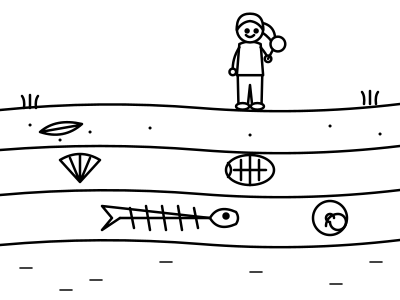
    Say: "Most living things never become fossils. Decomposers and weather break them down. A fossil needs special conditions." Draw four boxes on plain paper and sketch as you speak. Say: "One. A living thing dies and is quickly buried by sediment, which is mud or sand, often under water." Say: "Two. Soft parts rot away. Hard parts like bones, shells and teeth last longer." Say: "Three. More layers pile on top for thousands to millions of years. Their weight presses the lower layers into rock. Water carrying minerals seeps into the hard parts. The minerals slowly fill and replace them, so the bone becomes stone." Say: "Four. Much later, the land may be pushed up. Wind and water wear the rock away. The fossil is uncovered." Say: "Sometimes a shell dissolves and leaves only its shape in the rock. That hollow print is a mold fossil." Ask: "Why does quick burial help?" (It keeps animals, decomposers and weather from breaking the body apart.) Ask: "Which lasts longer after death, a snail's body or its shell?" (Its shell.) Ask: "What turns a buried bone into stone?" (Minerals from water.) If stuck, say: "Point to the box. What happens next to the buried bone?"

    15–20 min · Investigation / Hands-On

    Model Fossil. 1) Flatten the clay on the plate until it is as thick as a finger. This is the sediment. 2) Your child presses the shell firmly into the clay and lifts it straight up. The print is a model of a mold fossil. 3) In a fresh spot they press the leaf, vein side down. 4) In another spot they walk the toy animal's feet across the clay. These prints model a trace. 5) Your child compares the three prints. Table: Object | Models remains or a trace | Details I can see. Change only the object. Keep the clay thickness and the push the same. A hard, ridged shell often leaves the sharpest print. Real results vary. Look for the pattern. 6) Ask: "Which of the four steps does pressing show?" (Burial in sediment.) Ask: "What can the model not show?" (Rotting, minerals, hard rock or millions of years.) Keep the model flat on the plate for Day 3.

    10 min · Science Notebook Entry

    In the notebook, your child draws a four-box comic strip of how a fossil forms. They label the boxes: buried, soft parts rot, minerals turn it to stone, uncovered. Under the strip they finish the frame: "My model shows ___. It cannot show ___." Sample: "My model shows a shell pressed into mud. It cannot show millions of years."

    5 min · Wrap-Up & Exit Ticket

    Ask the three exit questions aloud; your child may point to the comic strip. Praise steps told in the right order.

    Watch for: Thinking fossils form in days or years, the way the clay print does.

    Try: Say: "Our model took one minute. A real fossil takes far longer than all of written history."

    Exit ticket (3 questions)
    1. Put the four steps in order: uncovered, buried, minerals turn it to stone, soft parts rot.
    2. Which is more likely to become a fossil, a jellyfish or a snail? Explain.
    3. Your clay print took one minute. Name one way a real fossil forms differently.
    Show answers
    1. Buried, soft parts rot, minerals turn it to stone, uncovered.
    2. A snail. Its hard shell can last. A jellyfish is all soft, so it usually rots away quickly.
    3. Any 1: it takes thousands to millions of years, sediment layers bury it, or minerals turn it to stone.

    Support: Act out the four steps with the toy animal and the clay before drawing. Say each step together.

    Extend: Your child explains why a lake animal is more likely to become a fossil than a desert animal. (Lake mud buries it quickly.)

    Homework: Show the model fossil to a family member and explain the four steps. Look for: the steps in order and one thing the model cannot show.

    Day 3 · Wednesday

    Social Studies

    I can research my issue using at least two sources and record where each fact came from.

    D1.5.3-5D3.1.3-5D2.Civ.1.3-5D1.3.3-5D1.4.3-5D3.2.3-5D2.Eco.12.3-5

    Builds on: Needs the issue statement and compelling question from Day 2, and Week 8 Day 1 (supporting questions). One-minute check: "Read your compelling question aloud." (Your child reads the "How can we ___?" question.)

    Materials: Civic Action Project planner, Step 3 (or a notebook page titled Step 3), Clipboard or a hard book, with 1 sheet of paper for a tally, 1 index card (interview questions), A town newsletter or a posted sign about the place (optional reading source), Notebook, Pencil

    5 min · Warm-Up

    Spaced review from Week 19. Ask: "How do towns pay for services like parks and libraries?" (With taxes that people and businesses pay.) Then ask the big question: "What do we need to find out before we can help?" List two questions, such as "How often does it happen?" and "Who is in charge?" Say: "These are supporting questions. Each one helps answer our compelling question."

    10–15 min · Mini-Lesson

    Say: "Research turns an opinion into facts. There are three kinds of sources." Say: "One: observe and count, as Amara did." "Two: interview. With an adult, ask a neighbor or librarian your written questions." "Three: read a posted sign or a town newsletter." Say: "A fact can be checked. An opinion is what someone thinks or feels. Facts make stronger evidence." Say: "People may disagree about an issue, so ask more than one person." Say: "Local problems often belong to a town department, such as parks, public works or the library. Taxes pay for most of their work." Fill in together: "The department in charge of our issue is ___. Our town's leader is called the ___." (For example, mayor, city manager or town supervisor.) Ask: "Which kind of source is a count you make yourself?" (Observing.) Ask: "Is 'This is the worst park in town' a fact or an opinion?" (An opinion. It cannot be checked.) Ask: "How will knowing who is in charge help answer our big question?" (We learn whom to ask for help.) If stuck, say: "Can we count it or check it? Then it is a fact."

    15–20 min · Activity / Source Work

    Research time. 1) Read Amara's practice notes aloud. "Tally of children waiting for a swing: Tuesday 6, Friday 11. Interview: a parent said, 'Two swings have been broken since March.' A sign on the fence says, 'Report problems to the Parks Department.' A boy said, 'This park is boring.'" 2) Ask for evidence: "Which notes are facts? Which is an opinion?" (The tally, the parent's report and the sign are facts. "Boring" is an opinion.) Ask: "Which source would you trust most, and why?" (Sample: the tally, because Amara counted it herself.) 3) Your child writes two interview questions on the card. 4) Gather facts from two kinds of sources. Tally for 10 minutes at the place with an adult, on the clipboard. Interview someone who knows the place, or read a sign or newsletter. 5) Record each fact in the notebook in a chart with two columns: Fact | Source. 6) Check: every fact has a source, and at least one fact is a number. Real results vary. If the place is far, interview a family member now and tally later today.

    10 min · Notebook Entry

    On Step 3, your child writes the two best facts with their sources. Add one thing still to find out. Sample: "The food bank sign lists 5 foods it needs (sign). Ms. Ortiz said Saturday is the busiest day (interview)."

    5 min · Exit Ticket

    Your child writes the answers. Praise every fact with its source.

    Watch for: Writing opinions as facts, such as "This is the worst park in town."

    Try: Ask: "How do we know? What did we count, or who told us?" Rewrite it as a fact with a source.

    Exit ticket (3 questions)
    1. Dan wants to know how many cars pass the school at 3:00. Which kind of source fits best? What would he do?
    2. Why do you write the source next to each fact?
    3. Which local department or group is in charge of your issue? What pays for most of its work?
    Show answers
    1. Observing and counting. He would tally the cars with an adult.
    2. So others can check it and trust it, and so you can find it again.
    3. Answers vary. Look for: a real department or group. Taxes pay for town departments. Gifts pay for most nonprofits.

    Support: Use one 5-minute tally and one short interview with a family member. You write the facts.

    Extend: Your child adds a third source. Write one sentence comparing what two sources said.

    Homework: With an adult, your child asks one more person a research question. Add the answer to the chart. Look for the person's name or job in the Source column.

    Mathematics

    I can split shapes into equal areas and name each part as a unit fraction of the whole.

    3.G.A.23.NF.A.1

    Builds on: Needs Week 24 Day 1 (partition a shape into unit fractions) and Week 28 Day 3 (area by counting squares). One-minute check: ask "A shape is split into 2 equal parts. What fraction is one part?" (1/2)

    Materials: Grid paper, Crayons, Ruler, 1 paper square (about 6 inches on each side), 8 square tiles or 1-inch paper squares (for support), Notebook, Pencil

    5 min · Warm-Up

    Spaced review from Week 24 Day 1. Your child folds the paper square corner to corner, then corner to corner again, and opens it. Ask: "Do the 4 triangles match? What fraction of the square is each one?" (Yes; 1/4) Say: "Parts that match have equal areas." Then practice ÷4 and ÷6 facts with no clock. Ask 24 ÷ 4, 32 ÷ 4, 24 ÷ 6 and 48 ÷ 6 (6, 8, 4, 8).

    10–15 min · Mini-Lesson

    Say: "To partition means to split into parts. Parts are equal when they have the same area. On grid paper we can prove it by counting squares." Draw a rectangle 6 squares long and 4 squares tall with the ruler. Ask: "What is its area?" Write 4 × 6 = 24. Say: "We want 4 equal parts. Share the 24 squares among 4 parts." Write 24 ÷ 4 = 6. Draw a line under rows 1, 2 and 3 to make 4 strips. Count 6 squares in each strip and label each strip 1/4. Say: "So each part is 1/4 of the rectangle, and each part has 6 squares." Draw the rectangle again. Draw lines under row 1 and row 2. Then split the bottom two rows with one line straight down the middle. Ask: "The parts have different shapes. Are they still fourths?" (Yes. Every part has 6 squares.) Now your child does more. Your child draws a rectangle 6 squares long and 2 squares tall and makes 3 equal parts. (12 ÷ 3 = 4 squares each; each part is 1/3)

    10–15 min · Guided Practice

    Your child draws each shape, colors each part and labels it with a fraction. 1) A rectangle 6 squares long and 4 squares tall, in 6 equal parts. (24 ÷ 6 = 4 squares each; 1/6) 2) A rectangle 8 squares long and 2 squares tall, in 8 equal parts. (16 ÷ 8 = 2 squares each; 1/8) 3) A 4 by 4 square in 2 equal parts, split by a zigzag line. (16 ÷ 2 = 8 squares each; 1/2) 4) You split a rectangle of 12 squares into parts of 2, 4, 3 and 3 squares. Ask: "Are these fourths?" (No. The parts do not have equal areas.) If stuck, say: "Find the area first. Divide by the number of parts. Each part needs that many squares."

    15–20 min · Independent Practice

    Your child draws each rectangle on grid paper and splits it. Your child writes the squares in each part and the fraction. 1) 4 long and 2 tall, in 2 equal parts. (8 ÷ 2 = 4 squares each; 1/2) 2) 3 long and 3 tall, in 3 equal parts. (9 ÷ 3 = 3 squares each; 1/3) 3) 6 long and 3 tall, in 6 equal parts. (18 ÷ 6 = 3 squares each; 1/6) 4) 4 long and 4 tall, in 8 equal parts. (16 ÷ 8 = 2 squares each; 1/8) 5) 4 long and 3 tall, in 4 equal parts that are not all the same shape. (12 ÷ 4 = 3 squares each; 1/4; sample: two columns of 3 and two L-shapes of 3) 6) You draw a square cut into 4 strips of different widths. Ask: "Is each strip 1/4?" (No. The strips do not have equal areas.) 7) A garden bed is 8 feet long and 4 feet wide. Four children share it equally. How many square feet does each child get, and what fraction? (8 × 4 = 32; 32 ÷ 4 = 8 square feet each; 1/4) 8) A quilt is 9 squares long and 2 squares tall. Three colors cover equal areas. How many squares is each color, and what fraction? (18 ÷ 3 = 6 squares each; 1/3)

    5 min · Exit Ticket

    Read each question aloud; your child draws on grid paper and counts squares to check each part.

    Watch for: Thinking parts must be the same shape to be equal, or calling any 4 parts fourths.

    Try: Count the squares in each part. Equal counts mean equal areas, whatever the shapes of the parts.

    Fact fluency: ÷4 and ÷6 facts
    Exit ticket (3 questions)
    1. A rectangle of 12 grid squares is split into 6 equal parts. How many squares are in each part, and what fraction is each part?
    2. A rectangle has 12 squares. Two parts have different shapes, but each has 6 squares. Is each part 1/2? Why?
    3. Draw a rectangle 8 squares long and 2 squares tall. Split it into 4 equal parts and label each part.
    Show answers
    1. 2 squares; each part is 1/6
    2. Yes. The two parts have equal areas.
    3. Each part has 4 squares and is labeled 1/4.

    Support: Use a rectangle 4 squares long and 2 squares tall. Your child covers it with 8 tiles, then deals the tiles into 2 equal piles (4 tiles each; 1/2).

    Extend: Your child splits a 4 by 4 square into 4 equal parts that are not rectangles. Sample: four L-shapes of 4 squares each.

    Homework: Your child draws a rectangle 5 squares long and 2 squares tall two times. Your child splits each into 2 equal parts in a different way and labels the parts. (10 ÷ 2 = 5 squares each; 1/2)

    English Language Arts

    I can make or choose a visual aid and plan exactly when to show it.

    SL.3.5SL.3.4RI.3.7

    Builds on: Needs the report visual from Week 31 and the note cards from Day 1. One-minute check: ask "What three things does a report visual need?" (A title, labels and a caption.)

    New words:
    • visual aid – something you show during a talk to help listeners understand

    Materials: Report visual, Poster board or large paper, Markers, Note cards, Writer's notebook, Pencil

    5 min · Warm-Up

    Word study (about 3 minutes). Dictate this sentence: "I draw a cloud over the town." Your child writes it in the notebook. Check it together, one word at a time. Your child circles aw in draw, ou in cloud and ow in town. Ask: "Why is it aw in draw?" (The sound comes at the end.) Spaced review from Week 29. Ask: "What does it mean to cite a source?" (To tell where your facts came from.)

    10–15 min · Mini-Lesson

    Say: "A visual aid is something you show to help listeners understand. It follows three rules. It is big enough to read from across the room. It is simple, with a title and three or four labels. You show it at the moment you talk about it." Name three choices: hold up the report visual, make a poster, or show a real object. A piece of fleece could show how dense fur feels. Read aloud this model, "Poster Plan and Card 3": Poster title: HOW OTTERS STAY WARM. Picture: one large otter floating on its back. Labels: DENSE FUR, TRAPPED AIR, LOTS OF FOOD. Card 3 with a star: densest fur, water can't reach skin. Spoken words: "Sea otters have the densest fur of any animal." Show the poster and point to DENSE FUR. "The hairs are packed so tightly that water never reaches the skin." Look back at the listeners. Think aloud: "The star on card 3 tells me when to show the poster. I hold it beside me, not in front of my face. I point to the label. Then I look back at my listeners." Act it out once with any sheet of paper.

    10–15 min · Guided Practice

    1) Ask: "Which part of your talk is hardest to picture?" (Answers vary. That part needs the visual.) 2) Your child draws a small star on the note card for that part. 3) Stand across the room while your child holds up the report visual. Ask: "Can I read every label from here?" If not, your child will make a larger poster. 4) Practice the show and point move three times: hold it to the side, point, look back. Check that your child does not talk to the poster. If stuck, say: "Which card tells about parts, steps or places? Put the star there."

    15–20 min · Independent Practice

    Your child gets the visual aid ready. 1) Make the poster or choose the object. Write a large title in thick marker. 2) Add three or four big labels. Make letters at least as tall as a thumb. 3) Test it from across the room and fix any label that is hard to read. 4) Practice the whole talk twice and show the visual at the star. Look for: big letters, few labels, the visual held to the side, and eyes back on the listener.

    5 min · Exit Ticket

    Ask the three questions. Your child holds the visual aid and the starred card.

    Watch for: Holding the visual in front of the face, or turning away to read from it.

    Try: Your child holds the visual beside the body and points with the nearer hand. Count "point, look back" together.

    Exit ticket (3 questions)
    1. Which card has your star? What will you say as you show the visual?
    2. Why did you choose only these labels for your visual aid?
    3. Stand far back and look. Which label is hardest to see? How could you fix it?
    Show answers
    1. Answers vary. Look for: the starred card named and a sentence that matches the visual.
    2. Answers vary. Look for: they are the most important parts, and too many labels are hard to read.
    3. Answers vary. Look for: a real fix, such as bigger letters, a darker marker or fewer words.

    Support: Your child enlarges the report visual by copying its main shape onto poster paper. You draw light pencil lines for the labels.

    Extend: Your child adds an audience challenge to the visual, such as a question for listeners to answer at the end.

    Homework: Give the talk with your visual aid to a family member. Ask if they could read every label from their seat.

    Science

    I can explain what fossils tell us about living things from long ago.

    3-LS4-1

    Builds on: Needs Days 1 and 2. One-minute check: your child names the four steps of fossil forming. (Buried, soft parts rot, minerals turn it to stone, uncovered.)

    New words:
    • paleontologist – a scientist who studies fossils to learn about life long ago
    • extinct – no longer living anywhere on Earth

    Materials: Model fossil from Day 2, Fossil cards from Day 1, 1 sheet of paper, pencil and scissors (footprint cutout), 4 small pieces of masking tape, Science notebook

    5 min · Day 163 — What Fossils Tell Us — Wonder Warm-Up

    Spaced review from Week 11. Ask: "What is a physical adaptation? Give one." (A body part that helps a living thing survive. Sample: a sea turtle's flippers.) Hold up the model fossil. Ask: "Suppose a scientist found this print a million years from now. What could they learn?" (Sample: the animal's size and shape.)

    10–15 min · Mini-Lesson

    Say: "Scientists who study fossils are called paleontologists. They read fossils like clues." Say: "Teeth are clues about food. Pointed teeth tear meat. Wide, flat teeth grind plants." Your child feels their own front and back teeth with their tongue. Say: "Your front teeth cut and your back teeth grind. People eat both plants and meat." Say: "Tracks are clues about movement. Footprints far apart can mean the animal moved fast. Deep prints can mean it was heavy." Say: "A trilobite was a sea animal with a hard outer covering and many legs. No trilobites live today. They are extinct." Say: "Some fossils look like living things of today. Others look very different." Hold up the leaf card and the ammonite card. Ask: "Which looks like something alive today?" (The leaf.) Ask: "A horse's back teeth are wide and flat. What do horses eat?" (Plants.) Ask: "Can a fossil bone tell us an animal's color?" (Almost never. Most fossils show shape, not color.) If stuck, say: "What do you see? What does that clue tell you?"

    15–20 min · Investigation / Hands-On

    Paleontologist for a Day. Part A. Read three dig reports. Your child fills in a table: Fossil | Clue I notice | What it tells us. Report 1: "A pointed tooth as long as a banana, with edges like a steak knife." (A large meat-eater.) Report 2: "A flat animal the size of a cookie, with a hard covering in sections, found among seashells." (It lived in the sea. The covering protected it.) Report 3: "A row of three-toed prints that get farther apart." (An animal walked here and then sped up.) Part B. Track Test. Safety: clear the floor and wear shoes that grip. 1) Trace your child's shoe on paper and cut it out. 2) Your child walks 3 steps. Tape the toe spot of two steps in a row. 3) Count how many shoe cutouts fit between the tapes. 4) Repeat while your child jogs. Change only the speed. Keep the walker, floor and measuring the same. Table: Speed | Shoe lengths between steps. Expect longer steps when jogging. Real results vary. Look for the pattern.

    10 min · Science Notebook Entry

    Your child copies both tables into the notebook. Then they finish the frame twice: "The clue ___ tells us ___." Sample: "The clue of sharp teeth tells us the animal ate meat. The clue of long steps tells us it was moving fast."

    5 min · Wrap-Up & Exit Ticket

    Ask the three exit questions aloud; your child answers aloud or in writing. Praise every answer that names the clue behind it.

    Watch for: Thinking fossils show an animal's color, or that every fossil is a dinosaur.

    Try: Show the leaf and ammonite cards. Say that most fossils show shape, not color, and that plants and sea animals left fossils too.

    Exit ticket (3 questions)
    1. A fossil jaw has wide, flat teeth with ridges. What did this animal most likely eat? How do you know?
    2. Two fossil trails have prints of the same size. In trail A the prints are close together. In trail B they are far apart. Which animal was likely moving faster?
    3. Woolly mammoths are extinct. What does that mean?
    Show answers
    1. Plants. Wide, flat teeth grind plants, like the back teeth of horses today.
    2. The animal that made trail B. Longer steps usually mean faster movement.
    3. No woolly mammoths are alive anywhere on Earth.

    Support: Do only the tooth report. Compare pointed and flat teeth using your child's own front and back teeth.

    Extend: Your child invents a fossil find and writes 3 clues. A family member tells what the clues show.

    Homework: Tell a family member what a paleontologist does. Then walk 5 steps across damp sand, soil or snow. Look for: your child reads one clue from the tracks.

    Day 4 · Thursday

    Social Studies

    I can make a step-by-step plan for one civic action and predict its results.

    D4.7.3-5D4.8.3-5

    Builds on: Needs the facts and sources from Day 3. One-minute check: "Tell me your best fact and where it came from." (Answers vary. Look for a fact and its source.)

    Materials: Civic Action Project planner, Step 4 (or a notebook page titled Step 4), Calendar, A box (to hold the project materials), Notebook, Pencil

    5 min · Warm-Up

    Spaced review from Week 22. Ask: "In a fair vote, how many votes does each person get?" (One. Every vote counts the same.) Then ask the big question: "What one action could make a difference for your issue?"

    10–15 min · Mini-Lesson

    Say: "A good plan answers six questions." Count them on your fingers. "What will we do?" "What is our goal?" "When?" "Who will help?" "What do we need?" "How will we know it worked?" Show five kinds of action. Say: "You could write a polite letter to the department in charge. You could hold a cleanup with family. You could run a collection drive. You could make a poster for a library or school. You could do a kindness project." Model a plan. Say: "Action: collect cans for the food bank. Goal: 50 cans in one week. Helpers: Mom puts up flyers, and my brother carries the box. Materials: a box from home and a $3 poster board." Say: "Now I predict. I think we will collect 30 to 50 cans. Later we compare the prediction with what really happens." Say: "A goal needs a number so we can count it. 'Help the food bank' cannot be counted. '50 cans' can." Ask: "Which of the six questions does '50 cans' answer?" (What is our goal?) Ask: "Change 'help the animal shelter' into a goal you can count." (Sample: collect 20 old towels by Friday.) Ask: "Why predict before acting?" (So we can compare it with the real result and learn.) If stuck, say: "What could we count or show when we finish?"

    15–20 min · Activity / Source Work

    Plan it. 1) Your child and the helpers talk over the action choices. Each person gives one idea and one reason. Agree on one action together. 2) On Step 4, your child writes the action and a goal with a number. 3) Write a date for each step on the calendar. 4) Name two helpers and give each a job. 5) List the materials and any costs. Put what you already have into the box. 6) Write one safety rule. Sample: "Always work with an adult, and never share our address online." 7) Your child writes a prediction: "I predict ___ because ___." 8) Check the plan with a two-column chart in the notebook: Six questions | Answered? Tick each one. Plans vary. Look for a goal you can count and a date on every step.

    10 min · Notebook Entry

    Your child writes the plan as a numbered list of four to six steps. Then draw what success would look like. Sample: "1. Make a flyer Monday. 2. Put the box by the door Tuesday. 3. Count the cans each night. 4. Take the cans to the food bank Saturday."

    5 min · Exit Ticket

    Your child answers from the written plan. Praise a goal with a number and jobs with names.

    Watch for: Setting a goal that cannot be counted, such as "make the park nicer."

    Try: Ask: "What could we count or show?" Rewrite the goal with a number and a date.

    Exit ticket (3 questions)
    1. What is your action? What number is in your goal?
    2. Name two helpers and the job each one will do.
    3. What is your prediction? How will you find out if it was right?
    Show answers
    1. Answers vary. Look for: one clear action and a goal that can be counted, such as 40 cans or two bags of litter.
    2. Answers vary. Look for: two real people with specific jobs.
    3. Answers vary. Look for: an expected result and a way to check it, such as counting items or a reply to a letter.

    Support: Offer three ready plans: a cleanup, a collection drive or a letter. Your child picks one and fills in the dates and helpers.

    Extend: Your child plans two actions that work together, such as a poster and a collection box. Put the steps in order.

    Homework: Your child gathers the rest of the materials on the list and puts them in the box. Look for each listed item checked off.

    Mathematics

    I can name quadrilaterals and draw ones that are not squares, rectangles or rhombuses.

    3.G.A.1

    Builds on: Needs Week 33 Days 1 and 2: a quadrilateral is any polygon with 4 sides and 4 vertices. One-minute check: your child draws any quadrilateral and counts its sides (4).

    New words:
    • square corner – a corner that fits the corner of an index card exactly
    • rhombus – a quadrilateral with 4 equal sides

    Materials: 6 quadrilateral cards. Before the lesson, draw each on grid paper with the ruler and cut it out. Square: 4 by 4. Rectangle: 6 long and 2 tall. Rhombus: mark the middle of each side of a rectangle 6 long and 4 tall, then join the 4 marks. Roof shape: bottom side 6 long; top side 2 long, 3 rows higher and centered; join the ends. Kite: mark a top point; mark two side points 1 row lower, one 2 squares to the left and one 2 squares to the right; mark a bottom point 6 rows below the top point; join top to sides and sides to bottom. Lopsided shape: bottom side 6 long; mark a point 1 square right and 2 rows up from its left end, and a point 1 square left and 3 rows up from its right end; join the 4 points. Keep the cards for Week 34., Scissors (to cut out the cards), Ruler, Index card (to test square corners), Grid paper, Notebook, Pencil

    5 min · Warm-Up

    Spaced review from Week 32 Day 2. A square has a perimeter of 12 units. Your child finds the length of each side (12 ÷ 4 = 3 units). Then practice ×6 facts with no clock. Ask 6 × 4, 6 × 6 and 6 × 9 (24, 36, 54).

    10–15 min · Mini-Lesson

    Say: "Every quadrilateral has 4 sides and 4 vertices. Some have special names. We test two things: corners and sides." Show the test. Say: "A square corner fits the corner of an index card exactly." Work the square card fully. Fit the index card into each corner. Ask: "How many square corners?" (4) Measure each side with the ruler. (All 4 sides are equal.) Say: "It has 4 square corners and 4 equal sides. So this shape is a square." Test the rectangle card. Say: "It has 4 square corners, but its sides are 6, 2, 6 and 2. It is a rectangle." Test the rhombus card. Say: "It has 4 equal sides, but no square corners. A quadrilateral with 4 equal sides is a rhombus." Now your child does more. Your child tests the kite, roof and lopsided cards. (None has 4 square corners or 4 equal sides. All are still quadrilaterals.)

    10–15 min · Guided Practice

    Your child tests every card with the index card and the ruler. 1) Sort the 6 cards into four groups. (1 square, 1 rectangle, 1 rhombus, 3 other quadrilaterals) 2) Turn the square card onto one corner. Ask: "Is it still a square?" (Yes. Its corners and sides did not change.) 3) Ask: "Does the square pass the rhombus test, 4 equal sides?" (Yes. A square is a special rhombus.) 4) On grid paper, your child draws a quadrilateral that is not a square, rectangle or rhombus. (Sample: bottom side 5, top side 2, slanted ends.) If stuck, say: "Check two things. Do all four corners fit the card? Are all four sides the same length?"

    15–20 min · Independent Practice

    Your child draws with a ruler on grid paper, then tests corners and sides. 1) Draw a square with sides 3 units long. Count its square corners and equal sides. (4 and 4) 2) Draw a rectangle 5 units long and 2 units tall. Is it a square too? (No. Its sides are not all equal.) 3) Mark the middle of each side of a rectangle 4 long and 2 tall. Join the 4 marks. Name the new shape. (a rhombus; 4 equal sides) 4) Draw a quadrilateral with no square corners and no equal sides. (It has no special name.) 5) Draw a quadrilateral with exactly 2 square corners. (Sample: bottom side 5, left side straight up 3, top side 2.) 6) You turn the rhombus card on its side. Your child names it. (still a rhombus) 7) A kite has two sides of 2 feet and two sides of 4 feet. Can it be a rhombus? (No. Its sides are not all equal.) 8) A frame has sides of 4, 6, 4 and 6 inches. One corner does not fit the index card. Is it a rectangle? (No. A rectangle needs 4 square corners.)

    5 min · Exit Ticket

    Read each question aloud; your child answers on grid paper and may use the ruler and the index card.

    Watch for: Believing a tilted square is no longer a square and calling it a diamond.

    Try: Turn the card slowly while your child retests one corner and one side. Turning a shape does not change its name.

    Fact fluency: ×6 facts
    Exit ticket (3 questions)
    1. How do you test for a square corner?
    2. What two things do you test to name a quadrilateral?
    3. Draw a quadrilateral with exactly 1 square corner. Is it a square, a rectangle, a rhombus or none of these?
    Show answers
    1. Fit the corner of an index card into it. It must match exactly.
    2. Whether the corners are square and whether the sides are equal.
    3. None of these. The drawing has 4 sides and only one corner that fits the card.

    Support: Give your child a checklist for each card: 4 sides? 4 square corners? 4 equal sides? Your child ticks each line, then names the shape.

    Extend: Your child draws a quadrilateral with one corner pushed in, like an arrowhead. Is it still a quadrilateral? (Yes. It is closed and has 4 straight sides.)

    Homework: Your child sketches three quadrilaterals seen at home and labels each one square, rectangle, rhombus or other quadrilateral. Sample: a window is a rectangle; a floor tile is a square.

    English Language Arts

    I can rehearse my talk and answer audience questions with details.

    SL.3.4SL.3.6SL.3.3

    Builds on: Needs the note cards, the visual aid and follow-up questions from Week 32. One-minute check: ask "What is a follow-up question?" (A question that digs deeper into what the speaker just said.)

    New words:
    • three-part answer – say the question again, answer it, and add a detail
    • rehearse – to practice a talk the way you will really give it

    Materials: Note cards, Visual aid, Clock, Writer's notebook, Pencil, A family member as audience

    5 min · Warm-Up

    Word study (about 3 minutes). Use four words in meaning. Ask: "Which word names the dirt that plants grow in?" (soil) "Which word means to like doing something?" (enjoy) "Which word means to send a boat or rocket off?" (launch) "Point has two meanings. Name both." (A sharp tip, and to show with a finger.) Your child says one sentence with each word. Spaced review from Week 31. Ask: "Is adding a missing comma revising or editing?" (Editing.)

    10–15 min · Mini-Lesson

    Say: "After a talk, listeners ask questions. A strong answer has three parts. Say the question again. Answer it. Add a detail from your research." Read aloud this "Fact Card: The Otters Come Back": Long ago, hunters killed sea otters for their thick fur. By 1911, only about 1,000 to 2,000 otters were left in the world. That year, several countries signed a treaty that stopped the hunt. Slowly, the otters came back. Today, more than 100,000 sea otters live along the coasts of the northern Pacific Ocean. Model with the card. Say: "A listener asks, Why did people hunt sea otters? I answer: Why did people hunt sea otters? They wanted the fur. Otter fur is very thick." Your child counts the three parts on fingers. Then teach the honest answer: "Good question. My sources did not say, but I can look it up." Say: "Always answer in complete sentences, never just yes or no."

    10–15 min · Guided Practice

    Use the fact card. 1) Ask: "How many otters were left by 1911?" (How many otters were left by 1911? Only about 1,000 to 2,000 were. Hunters had taken the rest.) 2) Ask: "What stopped the hunt?" (What stopped the hunt? A treaty did. Several countries signed it in 1911.) 3) Ask: "How long does a sea otter live?" (The card does not say. Your child gives the honest answer.) 4) Together, predict three questions about your child's own topic and write them in the notebook. Your child answers each with three parts. Then watch one full run of the talk. Give one glow (a strength) and one grow (a next step). If stuck, say: "Say my question back to me. Now answer it. Now add one fact."

    15–20 min · Independent Practice

    Your child rehearses with the cards, the visual aid and the clock. 1) Give the full talk twice more. Write down each time in the notebook. 2) After the last run, a family member asks two questions. 3) Your child answers each with three parts. Look for: a talk of 3 to 5 minutes and the visual shown at the star. Each answer uses a fact from the report.

    5 min · Exit Ticket

    Ask the three questions. Your child stands to answer question 1 as if facing an audience.

    Watch for: Answering a question with "yes," "no" or "I don't know" and then stopping.

    Try: After every short answer, say: "Tell me one fact that goes with that." Your child adds it in a complete sentence.

    Exit ticket (3 questions)
    1. I ask: 'What was the most surprising thing you learned?' Give a three-part answer.
    2. Which question we predicted was hardest? Answer it again with a detail.
    3. Tell one glow and one grow from your rehearsal today.
    Show answers
    1. Answers vary. Look for: the question said again, an answer, and one detail from the report.
    2. Answers vary. Look for: all three parts, or the honest answer if the sources did not say.
    3. Answers vary. Look for: one real strength and one change your child can make.

    Support: Your child keeps a question card. It lists three likely questions with one key-word answer for each.

    Extend: Your child prepares one extra fact to share only if a listener asks about it.

    Homework: Give your talk one last time for a family member. Answer one surprise question with a three-part answer.

    Science

    I can use fossils as evidence of what environments were like long ago.

    3-LS4-1

    Builds on: Needs Day 2 on sediment layers and Week 11, where each living thing needs a certain habitat. One-minute check: ask, "Could coral live in a desert? Why not?" (No. Coral needs warm, shallow sea water.)

    New words:
    • rock layer – a flat band of rock that formed from sediment, with newer layers on top of older ones

    Materials: World map or globe, 3 sheets of plain paper (model rock layers), Colored pencils, Science notebook and pencil

    5 min · Day 164 — Fossils and Past Environments — Wonder Warm-Up

    Spaced review from Week 20. Ask: "What is climate?" (The usual weather pattern of a place over many years.) Then the wonder. Ask: "Suppose you found seashells inside the rock on a mountaintop. What would you think?"

    10–15 min · Mini-Lesson

    Say: "Each kind of living thing needs a certain environment. So a fossil is a clue about the place where it lived." Say: "Fossil seashells are found in rock high on mountains. That rock formed under a sea long ago. Later the land was slowly pushed up." Say: "Fossil leaves and tree trunks are found in Antarctica. Today ice covers it. Long ago it was much warmer and had forests." Say: "Earth's surface changes very slowly, over millions of years." Now lay down the 3 sheets one at a time in a stack. Say: "Sediment settles in layers. The first layer ends up on the bottom." Your child labels the bottom sheet "oldest" and the top sheet "youngest." Say: "So fossils in lower rock layers are usually older than fossils above them." Ask: "A leaf fossil lies two layers above a coral fossil. Which living thing lived there later?" (The plant with the leaf.) Ask: "Fossil leaves of warm-weather trees are found where winters are long and snowy. What was that place like long ago?" (Warmer.) If stuck, say: "What does this living thing need? So what was the place like?"

    15–20 min · Investigation / Hands-On

    Past and Present Chart. 1) Read three cases. Your child finds each place on the map or globe. Case 1: sea animal fossils in rock high in the Himalaya mountains of Asia. Case 2: fossil forests in Antarctica. Case 3: stone logs of giant trees in the dry desert of Arizona. 2) Your child fills in a table: Place | Fossils found | Past environment | Environment today. (Himalayas: a sea; high, cold mountains. Antarctica: a warmer forest; ice. Arizona: a wet forest; dry desert.) 3) For each row they say: "My evidence is ___." 4) Layer story. With colored pencils, your child draws one fossil on each sheet. A trilobite goes on the bottom, a fern in the middle and a mammoth tooth on top. Say: "Woolly mammoths lived on cold grasslands." Your child tells the story from the bottom up. (A sea. Then damp land with ferns. Then cold grassland.) Look for a past environment that matches what each living thing needed. Say: "Scientists check many fossils before they decide."

    10 min · Science Notebook Entry

    In the notebook, your child chooses one place and draws it twice, labeled "Long Ago" and "Today." Under the drawings they finish the frame: "Long ago this place was ___. My evidence is ___." Sample: "Long ago this place was a forest. My evidence is the stone logs in the desert."

    5 min · Wrap-Up & Exit Ticket

    Ask the three exit questions aloud; your child answers aloud or in writing. Praise each answer that uses the word evidence.

    Watch for: Thinking sea animals climbed the mountain, or that people carried the shells up.

    Try: Say that the shells are inside the rock itself. The rock formed under the sea, and then the land rose very slowly.

    Exit ticket (3 questions)
    1. A farm field far from any ocean has fossil coral in its rock. What once covered that land?
    2. Fossil tree stumps are found on an Arctic island where no trees grow today. What does that suggest about the past?
    3. Why can a living thing's needs tell us what a place was like long ago?
    Show answers
    1. A warm, shallow sea.
    2. The island was once warm enough for forests.
    3. Each kind needs a certain environment. Its fossil is evidence that the place once had that environment.

    Support: Do the Antarctica case together. Your child does the Arizona case alone with the hint, "What do big trees need?"

    Extend: Your child draws a three-layer cliff with one fossil in each layer. A family member reads the story from bottom to top.

    Homework: Ask a family member, "What might our town have been like long ago?" Draw one idea and the fossil that would be evidence. Look for: the fossil fits the environment.

    Day 5 · Friday

    Social Studies

    I can explain my civic action plan with a claim and evidence and show what I know on the weekly check.

    D4.1.3-5D4.7.3-5D3.4.3-5

    Builds on: Needs the plan from Day 4, the facts from Day 3 and Week 6 Day 4 (claims). One-minute check: "What is a claim?" (An answer that you can back up with evidence.)

    Materials: Stored Week 33 check (the Friday Check) and its answer key, Civic Action Project planner (or the Step 1 to Step 4 notebook pages), Civic Action Project rubric from the site's Civic Action Project page (optional), 10 sorting cards from Day 1 (for reteaching), Materials box from Day 4, Notebook, Pencil

    5 min · Warm-Up

    Spaced review from Week 8. Ask: "What is an opinion?" (What someone thinks or feels, which cannot be proved.) Then your child names the six plan questions and says the goal in one sentence. (What, goal, when, who, what we need, how we will know.)

    10–15 min · Mini-Lesson

    Say: "When you ask people to help, you need a claim backed by evidence." Model with Amara. Say: "Claim: our park should fix its two broken swings." "Evidence 1: we counted 11 children waiting on Friday." "Evidence 2: a parent said the swings have been broken since March." Say: "Each piece of evidence is a fact from a source. A feeling is not evidence." Say: "Evidence from two different sources makes an argument stronger." Practice with a weak reason. Say: "The park should fix the swings because swings are fun." Ask: "Is that evidence?" (No. It is a feeling.) Ask: "Which of Amara's facts came from observing?" (The count of 11 children.) Ask: "What is your claim about your own issue?" (Answers vary. Look for: "Our community should ___.") Then review the week aloud. Your child names the six cycle steps, the five issue tests and the three kinds of sources. (Identify, research, plan, act, reflect, share. Real, local, kid-sized, helps others, safe. Observing, interviewing, reading.) If stuck, say: "What did you count, see or hear from a source? Start there."

    15–20 min · Activity / Source Work

    The Friday Check and a plan check. 1) Give the stored Week 33 check now. It has 7 items and takes about 15 minutes. Do not time it. You may read any item aloud. 2) Score it with the answer key and choose a route. 6 or more right: your child is ready to act next week. For a challenge, interview one more person and add the fact to the planner. 4 or 5 right: redo the Day 2 chart with a new idea and score it with the five tests. 3 or fewer right: reteach Day 1. Sort the ten cards again, and your child explains each one. 3) Go over each missed item together. 4) Plan check. Read the plan against the six questions, or use the planning rows of the project rubric. Your child fixes anything missing. Look for a goal with a number, a date on each step and a safety rule.

    10 min · Notebook Entry

    In the notebook, your child writes the claim and two pieces of evidence. "Our community should ___ because ___ and ___." Sample: "Our food drive should start now because the sign lists 5 needed foods and the shelves were half empty."

    5 min · Exit Ticket

    After the check, your child answers the three questions aloud. Praise evidence that names its source. If time ran short, finish the plan check later today.

    Watch for: Giving a feeling as the reason, such as "because I like parks."

    Try: Ask: "What did you count, see or hear from a source?" Replace the feeling with that fact.

    Exit ticket (3 questions)
    1. Say your claim and one piece of evidence. Name the source of the evidence.
    2. "We should clean the creek because I like frogs." What is missing from this argument? Fix it.
    3. Which part of your plan are you most excited to start? When does it happen?
    Show answers
    1. Answers vary. Look for: a clear claim and a fact with its source.
    2. Evidence is missing. Liking frogs is a feeling. Sample fix: "because we counted 15 cans on the bank."
    3. Answers vary. Look for: a specific step and its date.

    Support: Read the check aloud. For the claim, give the frame "Our community should ___ because ___." Your child says it before writing.

    Extend: Your child adds a third piece of evidence. Then write one sentence that answers someone who might disagree.

    Homework: Your child reads the claim and evidence to a family member. Then check that the materials box is ready. Look for two facts, each with a source.

    Mathematics

    I can name polygons, count sides and vertices, and split shapes into equal parts on the Week 33 check.

    3.G.A.13.G.A.2

    Builds on: Needs Days 1 to 4 of this week. One-minute check: ask "What is a vertex?" (a corner where two sides meet)

    Materials: Stored Week 33 check (the Week 33 quiz) and its answer key, The 12 shape cards from Day 1, Grid paper, Ruler, Toothpicks and clay balls from Day 2 (for reteaching), Notebook, Pencil

    5 min · Warm-Up

    Spaced review from Week 32 Day 1. Ask the area and the perimeter of a 5 by 10 rectangle (50 square units; 30 units). Then practice ×7 facts with no clock. Ask 7 × 3, 7 × 6 and 7 × 9 (21, 42, 63).

    10–15 min · Mini-Lesson

    Play Name It, Count It for 10 minutes. Mix the 12 shape cards and lay them face down. Say: "Flip a card. Tell if it is a polygon. If it is, give its name, sides and vertices." Model one turn with the L-shape card. Say: "It is closed with straight sides, so it is a polygon. I count 6 sides and 6 vertices. So it is a hexagon." Now your child takes five turns. Check each answer against the card. (triangle 3 and 3; quadrilateral 4 and 4; pentagon 5 and 5; hexagon 6 and 6; octagon 8 and 8) For the circle, the half circle or the 3 lines, your child says why it is not a polygon. Then split one shape together. Your child draws a rectangle 5 squares long and 2 squares tall with the ruler and makes 2 equal parts. (10 ÷ 2 = 5 squares each; each part is 1/2) Put a star beside any card that needed help.

    10–15 min · Guided Practice

    Your child works on paper while you watch. Help only when asked. 1) You draw a closed shape with 7 straight sides. Is it a polygon? How many vertices does it have? (Yes; 7) 2) A rectangle 6 squares long and 4 squares tall is split into 3 equal parts. How many squares are in each part, and what fraction? (24 ÷ 3 = 8 squares each; 1/3) 3) You split a rectangle of 12 squares into parts of 5, 4 and 3 squares. Are the parts thirds? (No. The areas are not equal.) 4) Hold up the square card turned on one corner. What is its name? (a square; it is also a quadrilateral) If stuck, say: "Which day is this like? What did we build, count or color that day?"

    15–20 min · Independent Practice

    Give the stored Week 33 check now. It has 7 items on polygons, vertices and equal parts. Allow about 15 minutes, with no clock running. Your child may sketch on grid paper but puts the shape cards away. Score it with the answer key. Then choose a route by the result. 6 or 7 right: move on to Week 34. 4 or 5 right: find the kind of item missed. For items 1, 3 and 4, naming polygons, redo the Day 1 Mini-Lesson. For item 2, vertices, redo the Day 2 Mini-Lesson with toothpicks and clay. For items 5, 6 and 7, equal parts, redo Day 3 Guided Practice. 3 or fewer right: reteach Day 2 with toothpicks and clay, then Day 3, before Week 34.

    5 min · Exit Ticket

    After the check, your child answers these three questions; then go over any missed check items together.

    Watch for: Calling a shape with a curved side a polygon.

    Try: Your child runs a finger along every side. All straight and closed means polygon.

    Fact fluency: ×7 facts
    Exit ticket (3 questions)
    1. Name a polygon with more than 5 sides. How many vertices does it have?
    2. A rectangle of 8 grid squares is split into 2 equal parts. How many squares are in each part, and what fraction is each part?
    3. Which check item was hardest? What will you practice?
    Show answers
    1. Hexagon, 6 vertices (or octagon, 8 vertices)
    2. 4 squares; each part is 1/2
    3. Answers vary. Look for: a named skill and a plan to practice it.

    Support: Read each check item aloud. Your child may keep grid paper and the shape cards on the table. Give the check in two sittings if your child tires.

    Extend: After the check, your child draws a rectangle 4 long and 2 tall. Add a 2 by 2 square on top of its left end. Your child splits this L into 3 equal parts. (12 ÷ 3 = 4 squares each; 1/3)

    Homework: Your child redoes any missed check items with a family member. If none were missed, your child finds one hexagon and one octagon in pictures or signs. Then ask 7 × 4 and 7 × 8 (28 and 56).

    English Language Arts

    I can give my research talk and be a good listener who recounts a speaker's points and asks questions.

    SL.3.4SL.3.5SL.3.6SL.3.2SL.3.3

    Builds on: Needs the rehearsed talk, the visual aid and the three-part answer from Day 4. One-minute check: ask "What are the three parts of a strong answer?" (Say the question again, answer it, add a detail.)

    Materials: Note cards, Visual aid, Audience of family members, Writer's notebook, Week 33 English Language Arts Check, Pencil

    5 min · Warm-Up

    Word study (about 3 minutes). Give a quick spelling check with no clock. Say each word and a short sentence: coin, enjoy, mouth, crown, crawl, launch. Challenge word: thousand. Your child writes in the notebook. Correct it together. Your child rewrites any missed word and circles the two letters that spell the vowel sound. Spaced review from Week 31. Ask: "Which page comes last in a published report?" (The Sources page.) Then take three slow breaths together.

    10–15 min · Mini-Lesson

    Draw the rubric in the notebook. Make four rows: voice, eye contact, facts, visual. Say: "Each row gets a score. A 3 means you did it the whole time. A 2 means some of the time. A 1 means you are still learning it." Explain each row. Voice: loud, clear and steady. Eye contact: eyes up after each sentence. Facts: a main idea and three key facts. Visual: big, simple and shown at the star. Then explain the listener job: "Later you will hear a short talk. You will recount its three main points in order. You will ask two questions, and one must be a follow-up." Your child runs the hook card once in a clear voice.

    10–15 min · Guided Practice

    Your child presents. 1) Seat the audience across the room. Your child stands with the cards and keeps the visual ready. 2) Your child gives the 3 to 5 minute talk. One family member scores the rubric while listening. 3) Each listener asks one question. Your child gives three-part answers in complete sentences. 4) Each listener names one glow. If your child freezes, say: "Look at your card. Take a breath. Start that sentence again."

    15–20 min · Independent Practice

    1) Switch roles. A family member gives a two-minute talk on something they know well. If no one has a talk ready, read this one aloud. It is called "Three Rules for a Happy Houseplant." Do you have a plant at home that looks droopy? I can help. A houseplant needs three things. First, it needs light. Set it near a window, because leaves use light to make the plant's food. Second, it needs the right amount of water. Push a finger into the soil. If the top inch feels dry, it is time to water. Too much water can rot the roots. Third, it needs room. When roots poke out of the bottom of the pot, move the plant to a bigger one. Give a plant light, water and room, and it will thank you with new green leaves. 2) Your child recounts the three main points in order. (For this talk: light, water, room.) Then your child asks two questions, one of them a follow-up. 3) Your child scores the rubric for their own talk and compares scores with the family member. 4) After a short break, give the stored Week 33 English Language Arts Check. It has 8 items and takes about 10 minutes. Check it with the answer key. 6 or more right: your child is ready for next week. 4 or 5 right: redo the Day 4 practice page and answer three family questions with three-part answers. 3 or fewer right: reteach Day 1 by building a talk plan on five index cards.

    5 min · Exit Ticket

    Ask the three questions to celebrate the end of the project. Your child may look at the rubric.

    Watch for: As the listener, recounting only the last thing heard and skipping the earlier points.

    Try: Your child holds up one finger for each main point while listening, then recounts from finger one.

    Exit ticket (3 questions)
    1. Which rubric row was your strongest? What did you do to earn that score?
    2. Recount two main points from the family member's talk, in order.
    3. Name one goal for your next talk. How will you practice it?
    Show answers
    1. Answers vary. Look for: one row named and an action that fits it.
    2. Answers vary. Look for: two correct points in the order they were said. For the houseplant talk: light, then water, then room.
    3. Answers vary. Look for: one clear goal and a way to practice, such as rehearsing in a mirror.

    Support: Your child presents to one listener first, seated. Then your child stands and presents to the whole family.

    Extend: Your child writes two goals for the next talk in the notebook, one for voice and one for facts.

    Homework: Celebrate the finished project. Tell a relative or friend one fact from your research, in a clear voice and a complete sentence.

    Science

    I can show what I know about fossils and what they tell us about the past.

    3-LS4-1

    Builds on: Needs Days 1 to 4 and this week's notebook pages. One-minute check: ask, "Remains or trace: a fossil burrow?" (A trace.)

    Materials: Week 33 Science Check (7 items) and its answer key, Fossil cards from Day 1, Model fossil from Day 2, 3 hand towels and a box or tray (model dig), Science notebook and pencil

    5 min · Day 165 — Week 33 Check: Fossils — Wonder Warm-Up

    Spaced review from Week 31. Ask: "What is the rule for a fair test?" (Change one thing and keep everything else the same.) Fossil quick ID: hold up 4 fossil cards, one at a time. Your child says what each one was and whether it is remains or a trace. Then the big question. Ask: "What can a pile of rock tell us about the past?"

    10–15 min · Mini-Lesson

    Say: "Hold your model fossil. Tell its story as if it were real." Your child tells the four steps in order, pointing to the print. (It was buried in sediment. Soft parts rotted. Minerals turned it to stone. Rock wore away and uncovered it.) Prompt with the Day 2 comic strip if a step is skipped. Ask: "What could this fossil tell a paleontologist?" (The animal's size and shape, and that it had a hard part.) Ask: "What could it not tell?" (Its color.) Ask: "Where do paleontologists usually find the oldest fossils in a cliff?" (In the lowest layers.) If stuck, say: "Find that day's notebook page. Read me your frame sentence." Keep this part to 10 minutes.

    15–20 min · Investigation / Hands-On

    Model Dig. 1) While your child looks away, build three layers in the box. Lay the ammonite card on the bottom and cover it with a towel. Add the amber card and a second towel. Add the footprint card and the third towel. 2) Your child digs from the top, one layer at a time. 3) After each layer they fill in one table row. Table: Layer | Fossil | Remains or trace | What it tells about the place. 4) Ask: "Which fossil is oldest? How do you know?" (The ammonite. The bottom layer was laid down first.) 5) Your child tells the story of the place from oldest to youngest. (A sea. Then a forest with resin trees. Then land where an animal walked.) 6) Ask: "How is this model different from a real dig?" (Real layers are rock and took millions of years.) Look for a story told from the bottom up. Keep this part to 15 minutes.

    10 min · Science Notebook Entry

    Reflection. Your child finishes three frames. "My strongest idea this week was ___." "My hardest idea was ___." "The most interesting fossil was ___ because ___." Sample: "The most interesting fossil was the insect in amber because even its tiny wings show."

    5 min · Wrap-Up & Exit Ticket

    Ask the three exit questions aloud and praise answers that give evidence. Then give the Week 33 Science Check, which has 7 items. Allow about 10 minutes, later today if time is short. Your child works alone. Score it with the key. With 6 or more right, make a fossil time card. Draw an animal from a fossil and write 3 things the fossil tells us. With 4 or 5 right, redo the Day 2 page and make a new mold fossil with a different object. With 3 or fewer right, reteach Day 2. Act out the four steps with a toy, sand in a pan and a cup of water.

    Watch for: Mixing up the order and saying a bone turns to stone before it is buried.

    Try: Use the Day 2 comic strip. Your child points to each box in order and says the step aloud.

    Exit ticket (3 questions)
    1. Give one example of remains and one example of a trace.
    2. In the model dig, you reached the youngest fossil first. Why?
    3. What was the most interesting fossil fact you learned this week?
    Show answers
    1. Remains: any of a bone, tooth, shell or leaf. Trace: any of a footprint, burrow or nest.
    2. The youngest layer was laid down last, so it is on top. Older layers lie deeper.
    3. Answers vary. Look for: an accurate fact from this week.

    Support: Read the check aloud. Your child answers aloud while you write the answers down.

    Extend: After the check, your child writes a half-page report on one fossil card. It tells what the fossil was and what it shows.

    Homework: Teach a family member one thing fossils tell us, using an example from this week. Look for: a clue and what the clue shows.

    Friday Checks & Answer Keys

    Mathematics · Week 33 Mathematics Check

    3.G.A.13.G.A.23.NF.A.1

    Goals

    • I can name polygons by their sides.
    • I can count sides and vertices.
    • I can split a shape into equal parts and name each part.

    Answer each question. Show your thinking in the box when there is one.

    1. What is a polygon with 8 sides called?
    2. How many vertices does a triangle have?
    3. Is a shape with one curved side a polygon?
      ○ yes○ no
    4. Name a polygon with 4 sides.
    5. A rectangle of 15 squares is split into 3 equal parts. How many squares are in each part?
    6. A circle is split into 6 equal parts. What fraction is each part?
    7. A rectangle is cut into 2 parts. One part is much bigger. Is each part 1/2? Why?
    Show answer key
    1. octagon
    2. 3
    3. no
    4. quadrilateral (or square, rectangle, rhombus)
    5. 5
    6. 1/6
    7. No. The parts do not have equal area.

    What to do next

    Most right
    If 6 or more are right: hunt for polygons at home and make a chart of each one's name, sides and vertices.
    Some right
    If 4–5 are right: redo the Day 3 page, then fold paper squares into equal parts three ways.
    Few right
    If 3 or fewer are right: reteach Day 2 (sides and vertices) by building shapes with toothpicks and clay and counting each part. Then reteach Day 3.

    English Language Arts · Week 33 English Language Arts Check

    SL.3.4W.3.4L.3.3.BRF.3.3.CL.3.2.FSL.3.6SL.3.5RI.3.7

    Goals

    • I can plan a talk with note cards.
    • I can present with a strong voice and a visual aid.
    • I can spell words with oi, oy, ou, ow, aw and au.

    Answer each question. Show your thinking in the box when there is one.

    1. What goes on a note card?
      ○ full sentences○ key words
    2. Put the talk parts in order: key facts, close, hook, main idea.
    3. Change to written style: 'Um, so, frogs are, like, really good jumpers.'
    4. Name two voice tips for a talk.
    5. When should you show your visual aid?
    6. Question: 'Why do frogs have sticky tongues?' Your notes say: to catch bugs fast. Write a three-part answer.
    7. Circle the right spelling.
      ○ boy○ boi
    8. Circle the right spelling.
      ○ oul○ owl
    Show answer key
    1. key words
    2. Hook, main idea, key facts, close.
    3. Frogs are very good jumpers.
    4. Any two of: loud enough, clear, steady pace, expression.
    5. When you talk about that part
    6. Why do frogs have sticky tongues? To catch bugs. The bug sticks to the tongue, so the frog can grab it fast.
    7. boy
    8. owl

    What to do next

    Most right
    If 6 or more are right: Record a one-minute 'news report' about your topic with a visual and play it for a relative.
    Some right
    If 4–5 are right: Redo the Day 4 page, then answer three family questions with the three-part answer.
    Few right
    If 3 or fewer are right: Reteach Day 1: lay five index cards on the table and build a talk plan by placing a fact on each card.

    Science · Week 33 Science Check

    3-LS4-1

    Goals

    • I can explain what fossils are and how most fossils form.
    • I can use fossils as evidence about the past.

    Answer each question. Show your thinking in the box when there is one.

    1. What is a fossil?
    2. Which one is a trace fossil?
      ○ a dinosaur's footprint○ a dinosaur's leg bone○ a fossil fern leaf
    3. A fish fossil is in a deep rock layer. A fern fossil is in a layer above it. Which is probably older?
    4. Why are shells and bones found as fossils more often than skin?
    5. What do we call a scientist who studies fossils?
    6. Fish fossils are found in rock on top of a high hill. What does this tell us?
    7. A fossil animal has long, sharp teeth. What did it probably eat?
      ○ meat○ plants
    Show answer key
    1. The remains or traces of a living thing from long ago, often found in rock.
    2. a dinosaur's footprint
    3. The fish fossil, because deeper layers usually formed first.
    4. Hard parts last; soft parts rot away.
    5. a paleontologist
    6. Long ago, water covered that place.
    7. meat

    What to do next

    Most right
    If 6 or more are right: Make a fossil time card: draw an animal from a fossil and write 3 things the fossil tells us about it.
    Some right
    If 4–5 are right: Redo the Day 2 page and make a new mold fossil with a different object.
    Few right
    If 3 or fewer are right: Reteach Day 2, How Fossils Form: act out the 4 steps with a toy, sand in a pan and a cup of water.

    Social Studies · Week 33 Social Studies Check

    D4.7.3-5D2.Civ.2.3-5D2.Civ.14.3-5D4.6.3-5D2.Civ.10.3-5D4.8.3-5D1.1.3-5D1.2.3-5

    Goals

    • I can explain civic action and its steps.
    • I can choose a good project issue and research it.
    • I can set a goal that can be counted.

    Answer each question. Show your thinking in the box when there is one.

    1. What is civic action?
    2. Which is civic action?
      ○ Making cards for people at a care home○ Watching a movie○ Buying a snack
    3. What step comes right after research in the civic action cycle?
    4. Claim: "Our park needs more trash cans." Write one piece of evidence that could support it.
    5. You ask a park worker how often the trash is picked up. What kind of source is this?
      ○ An interview○ Observing○ Reading
    6. Why should you research before you act?
    7. Which plan goal can be measured?
      ○ Collect 25 books.○ Be nice.○ Do a lot.
    Show answer key
    1. Working alone or with others to help solve a problem in your community.
    2. Making cards for people at a care home
    3. Plan
    4. Answers vary. Look for: a fact from a source, such as "We counted 23 pieces of litter on Monday" or "The park worker said the cans are full by noon."
    5. An interview
    6. To know the real facts and what is really needed.
    7. Collect 25 books.

    What to do next

    Most right
    If 6 or more are right: Interview one more person about your issue and add the new fact and source to your planner.
    Some right
    If 4–5 are right: Redo the Day 2 page with a new idea, then score your plan with the five tests.
    Few right
    If 3 or fewer are right: Reteach Day 1 (civic action): sort 10 picture cards into Civic Action and Not Civic Action and explain each one.

    Week 33

    Home Connection

    Big ideas

    • Polygons are named by counting their sides and vertices.
    • Speakers use a hook, key facts and a strong close.
    • Fossils show what life was like long ago.
    • Civic action means working to improve our community.

    Mathematics

    Try it (10 min): Go on a shape hunt at home for triangles, quadrilaterals, pentagons and hexagons, and count their sides and vertices. Then fold a paper square into 4 equal parts and name each part as 1/4.

    Talk about it: How many sides and vertices does a hexagon have?

    English Language Arts

    Try it (10 min): Your child practices a 3-minute talk about the research topic with a hook, three key facts and a closing line, speaking clearly and looking at the audience.

    Talk about it: What visual aid would help your audience understand?

    Science

    Try it (10 min): Press a shell, leaf or toy animal into playdough or clay to make an imprint fossil model. Swap models and guess what made each print.

    Talk about it: What can a fossil tell us about where a living thing lived?

    Social Studies

    Try it (10 min): Talk about a real need in your community, like a messy park or a food pantry that needs help. Pick one, list who it affects and plan one small, safe step to help.

    Talk about it: Who in your community would your project help?

    This week’s words

    polygon · vertex · hook · fossil · civic action · issue

    Celebrate

    Celebrate three things: shapes you named, a talk you practiced, and a fossil model you made.

    This week's read-aloud

    Fossils Tell of Long Ago by Aliki

    Your child learns what fossils tell us about past environments this week, and this book shows how fossils form step by step.

    See the five daily prompts →

    Math catch-up · 3.G.A.2

    Equal Parts, Different Shapes

    Equal parts must have the same area, but they don't have to look the same. Cutting and matching paper shapes helps your child see that each part is a unit fraction of the whole.

    Builds on: 3.NF.A.1

    Materials: paper squares the same size · scissors · crayons · a ruler

    1. Fold one square into 4 equal rectangles and another into 4 equal triangles (fold on both diagonals).
    2. Cut out one rectangle and one triangle. Lay them on top of each other, cutting and moving pieces to show they cover the same space. Each is 1/4 of the square.
    3. Cut a rectangle into 6 equal parts. Your child colors one part and writes, "Each part is 1/6 of the area."
    4. Each day, your child splits a new shape into 2, 3, 4, 6 or 8 equal parts and names one part as a unit fraction.

    Try again

    1. A rectangle is split into 8 equal parts. What fraction of the area is each part?
    2. A square is cut on both diagonals into 4 equal triangles. What fraction of the square is each triangle?
    3. A hexagon is split into 3 equal parts. What fraction of the area is each part?

    Reading About Our World · Week 33 · Science

    Clues in the Rocks

    Fossils & past environments · This week's Science lessons

    A scientist with a magnifying glass stands on the ground above rock layers that hold fossils of a leaf, a shell, a trilobite, a fish and a coiled sea shell.

    Read it aloud first while your child follows along. Then read it together, and let your child read the parts they can. Talk about the words in the word box.

    What Is a Fossil?

    A fossil is the remains or traces of a living thing from long ago, usually kept in rock. Some fossils are remains, such as bones, teeth, shells and leaves. Others are traces, or signs that a living thing was there, such as footprints, burrows and nests. Most fossils are thousands to millions of years old.

    How Fossils Form

    Most fossils form in layers of mud or sand. First, a living thing dies and is quickly buried. Next, its soft parts rot away, and hard parts like bones and shells are left. Then, over a very long time, more layers pile on top and slowly harden into rock. Minerals in water can seep into the bones or shells and turn them to stone.

    Reading the Layers

    Rock layers stack up like pages in a book. In most places, the bottom layers formed first, so they are the oldest. Fossils in lower layers are usually older than fossils in higher layers. This idea helps scientists put fossils in order from oldest to youngest.

    Fossil Detectives

    Scientists who study fossils are called paleontologists. Fossils tell them what lived long ago and how it lived. Sharp, pointed teeth show that an animal ate meat. Flat teeth show it ate plants. Footprints far apart can show an animal was moving fast.

    Ocean in the Desert

    Fossils also show what a place was like long ago. Today the Grand Canyon in Arizona is in a dry desert. But many of its rock layers hold fossils of sea animals, such as shellfish, corals, sea lilies and trilobites. These fossils tell us that shallow seas once covered that land.

    Changing Earth

    Other fossils tell similar stories. Fossil palm leaves found in cold places show the land was once warm. Fossil seashells found on mountains show that those rocks formed under water and were later pushed up high. Fossils help us see that Earth's environments have changed many times. Fossils are like letters from the past.

    Word box

    • A fossil fish skeleton pressed into a slab of rock.fossil: the remains or traces of a living thing from long ago, kept in rock
    • A paleontologist in a sun hat brushes dirt off a dinosaur bone in the ground.paleontologist: a scientist who studies fossils
    • layer: one level of material lying on top of another
    • A tree grows in soil beside a pond under the sun and a rain cloud, the parts of its environment.environment: everything around a living thing, such as land, water and weather

    Questions

    1. What is the difference between a remains fossil and a trace fossil?
    2. What kinds of fossils are found in the Grand Canyon's rock layers?
    3. A fossil of a fish is found in rock in the middle of a dry plain. What can you tell about that place long ago?
    4. The section How Fossils Form uses the words first, next and then. What kind of text structure is this?

    Week 33 spelling words →